Kategorie: Travel

  • Industrial Veins: A Monochromatic Journey Through Urban Infrastructure and Heritage

    Industrial Veins: A Monochromatic Journey Through Urban Infrastructure and Heritage

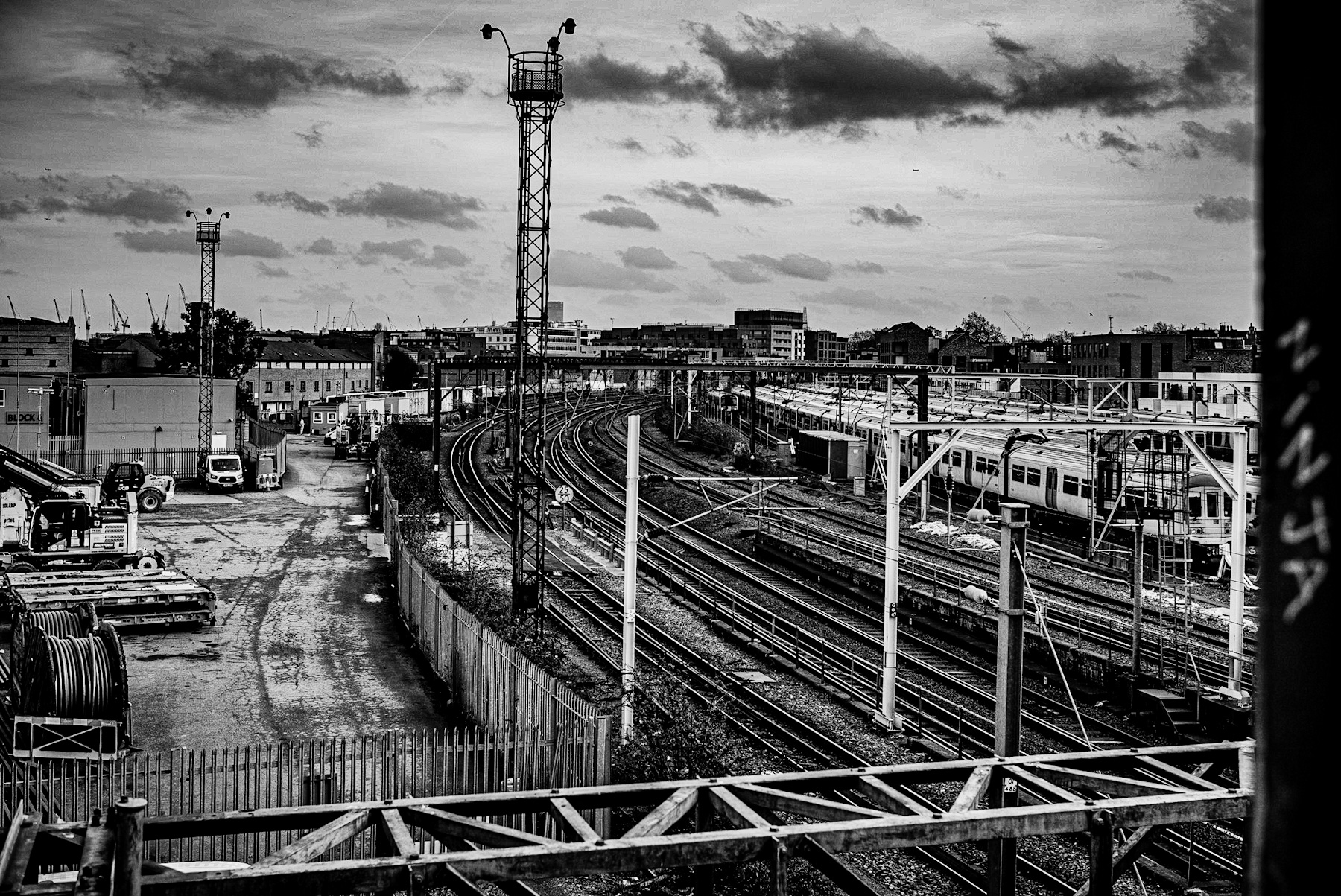
    The compelling black and white photograph presents a panoramic view of an urban landscape, masterfully capturing the intricate layers of industrial activity, transportation infrastructure, and historical resonance. The monochromatic treatment lends a timeless quality, emphasizing textures, forms, and the stark reality of this bustling environment.
    A Visual Tapestry of Urban Dynamics
    From an elevated vantage point, the immediate foreground frames the scene with a robust metal framework, hinting at the industrial context of the observation itself. The complex scene unfolds into distinct visual zones.
    To the left, an industrial yard bustles with heavy machinery: cranes, excavators, and large spools of cable, all indicative of ongoing construction or logistical operations. Utilitarian buildings, one clearly marked „BLOCK,“ stand firm, while various commercial vehicles suggest active movement of goods and personnel. In the far distance, a multitude of cranes pierces the skyline, strongly implying the proximity of a significant port or major industrial shipping facility—a cornerstone of economic activity.
    Centrally, and extending towards the right, a sprawling railway network dominates the midground. Multiple sets of tracks curve gracefully into the distance, converging and diverging, illustrating the complexity of modern rail transport. Overhead electrification gantries crisscross the sky, supporting vital power lines. Prominent signal towers, including a tall lattice structure with lights, stand as sentinels overseeing the flow of traffic. Several trains, some appearing to be parked or awaiting dispatch in sidings, underscore the constant operational rhythm of this extensive railway infrastructure. The background reveals a cityscape, a blend of older industrial buildings and more contemporary structures, all under an overcast sky with dramatic cloud formations that add to the atmospheric depth.
    Echoes of Industrial Heritage and Connectivity
    This image is more than just a snapshot; it is a visual narrative steeped in industrial heritage and the evolution of urban infrastructure. The extensive rail network immediately evokes the transformative power of the Industrial Revolution. Railways were the arteries of industrialization, facilitating the rapid transport of raw materials to factories and finished goods to markets, profoundly shaping national economies and cityscapes. The sheer scale and complexity of the tracks and overhead lines reflect centuries of development, from steam-powered locomotives to modern electric multiple units. This transportation history is a testament to continuous innovation and the enduring human need for efficient connectivity.
    The industrial yard and the distant port cranes further amplify this historical context. Ports have been vital trade hubs for millennia, evolving from manual labor-intensive operations to highly mechanized logistics centers. The heavy machinery depicted signifies the ongoing, dynamic nature of logistics and supply chain management in a globalized world. The juxtaposition of older industrial architecture with newer buildings in the background speaks to the constant process of urban regeneration and development, where foundational infrastructure often persists, adapting to contemporary demands. This scene represents a living testament to an area that has likely served as a nexus for industry and trade for generations.
    A Timeless Perspective Through Black and White
    The choice of black and white photography transcends mere aesthetic preference; it serves to distill the scene to its fundamental elements. By stripping away color, the image emphasizes the textures of metal, concrete, gravel, and the stark lines of the tracks and gantries. It highlights the interplay of light and shadow, particularly the dramatic clouds, which impart a sense of gravitas and perhaps a touch of melancholy. This monochromatic lens infuses the scene with a timeless quality, allowing viewers to contemplate the enduring nature of human endeavor, the constant flow of goods and people, and the historical layers embedded within our cityscapes. The photograph captures a moment where the past and present converge, underscoring the relentless pulse of urban life and the foundational role of its industrial and transport systems.
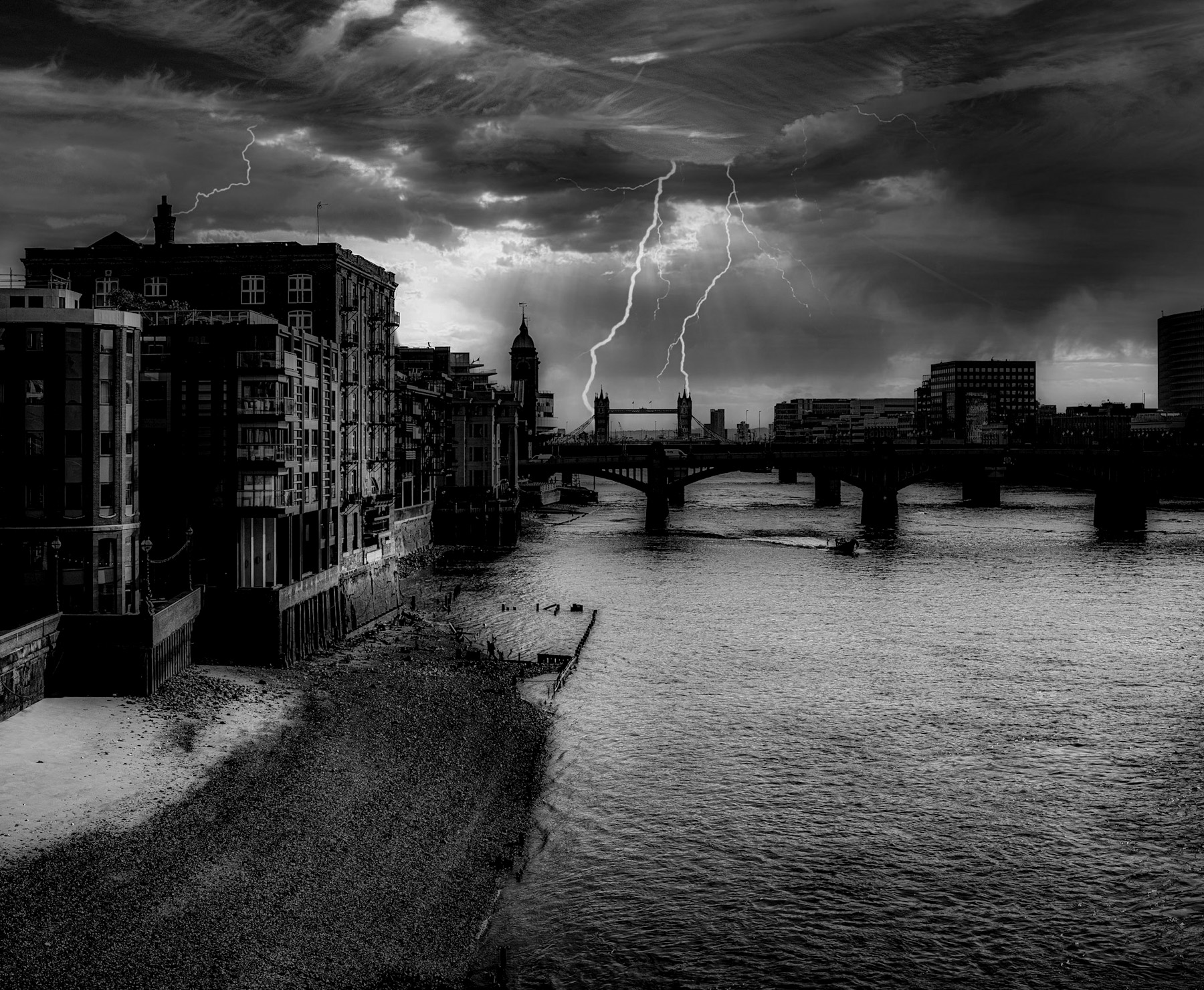
  • London’s Enduring Spirit: A Storm Over the Thames and Tower Bridge

    London’s Enduring Spirit: A Storm Over the Thames and Tower Bridge

    The monochrome photograph captures a raw, dramatic moment over the River Thames, presenting London’s iconic cityscape under a tempestuous sky. Striking lightning bolts pierce dense, swirling clouds, casting an almost apocalyptic aura over the urban landscape. This powerful imagery, rendered in stark black and white, accentuates the timeless grandeur of the scene, inviting viewers to contemplate both the immediate visual impact and the deep historical layers embedded within this venerable city.
    **A Visual Symphony of Contrast and Power**
    At the heart of the composition lies Tower Bridge, its distinctive Victorian Gothic architecture silhouetted against the turbulent heavens. The bridge’s robust towers and intricate suspension cables stand as a testament to human ingenuity, bridging the mighty Thames. The river itself, a dark, textured expanse, flows beneath multiple bridges, reflecting the somber light of the sky. On the left bank, a mix of architectural styles lines the water’s edge: older, perhaps industrial-era buildings with their sturdy facades, juxtaposed with more contemporary structures featuring large windows and balconies. The foreground reveals a pebbled riverbank, hinting at the Thames‘ tidal nature and its constant interaction with the land. The absence of colour emphasizes the dramatic interplay of light and shadow, lending the scene a profound sense of gravitas and intensity.
    **The Thames: A Historical Lifeline**
    The River Thames is more than just a waterway; it is London’s historical artery, a silent witness to millennia of human endeavour. From its origins as a vital trade route for Roman Londinium, through the Viking invasions, the medieval period, and the bustling port life of the British Empire, the Thames has shaped the city’s destiny. The river’s ebb and flow mirror the fortunes of London itself, enduring plagues, fires, and wars. This photograph, with its turbulent waters and ominous sky, subtly evokes the numerous challenges and triumphs that have defined London’s past. The Thames was the city’s highway, its protector, and its provider, a constant in an ever-changing urban tapestry.
    **Tower Bridge: An Emblem of Victorian Ambition**
    Tower Bridge, completed in 1894, is a quintessential symbol of Victorian engineering prowess and London’s industrial might. Conceived to alleviate traffic congestion while maintaining river access to the Pool of London, its innovative bascule design allowed large ships to pass. Its construction was a monumental undertaking, reflecting the era’s ambition and technological advancement. In this image, the bridge stands firm against the natural fury of the storm, a powerful metaphor for London’s resilience. It reminds us of a time when the city was the heart of a global empire, and its infrastructure was built to reflect that stature.
    **London’s Enduring Resilience**
    The dramatic lightning strikes over London can be interpreted as a powerful symbol of the city’s enduring spirit in the face of adversity. Throughout its history, London has faced numerous catastrophes: the Great Fire of 1666, the devastating cholera epidemics, and the relentless bombing during the Blitz of World War II. Each time, the city has rebuilt, adapted, and emerged stronger. The stormy sky in the photograph encapsulates this narrative of challenge and resilience, suggesting that while nature’s power is immense, London’s spirit is equally formidable. The blend of ancient and modern architecture along the riverbanks further reinforces this idea of continuous evolution and survival.
    This striking black and white capture is more than just a photograph of a storm; it is a profound reflection on London’s enduring character, its historical depth, and its unwavering ability to stand firm against the forces of nature and time. It invites contemplation on the city’s past, present, and future, all under a sky that seems to echo centuries of drama.
  • London’s Layers: A Glimpse Through Time and Reflection

    London’s Layers: A Glimpse Through Time and Reflection

    The urban landscape of London consistently offers a compelling narrative, a tapestry woven from centuries of history and relentless modernity. This particular black and white photograph encapsulates that essence, presenting a layered visual dialogue between past and present, tradition and contemporary culture.
    JUXTAPOSITION IN MONOCHROME
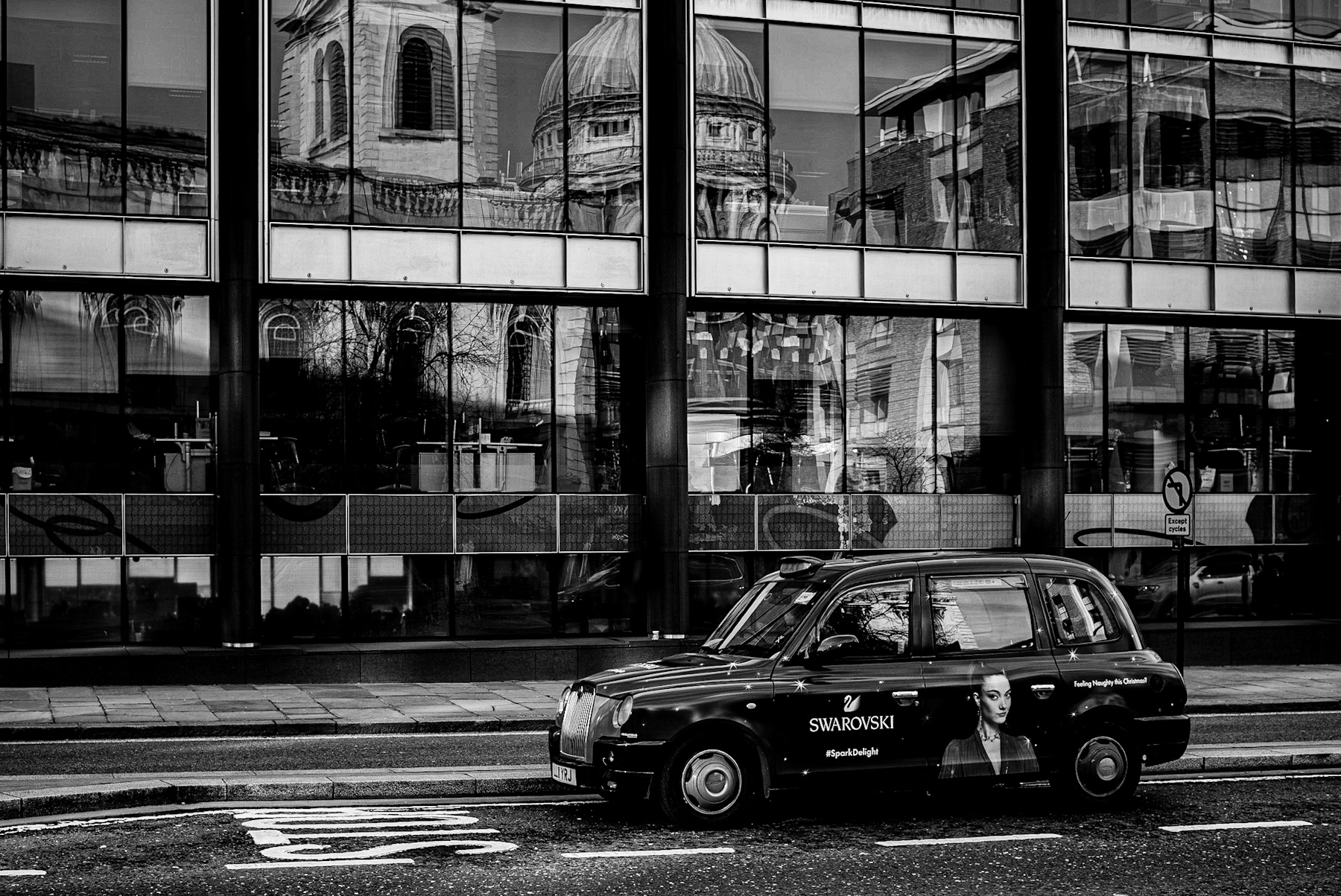
    At first glance, the image draws the eye to a classic London black cab, positioned prominently on a city street. Rendered in monochromatic tones, the scene accentuates textures and forms, stripping away the distraction of colour to reveal the intricate interplay of light and shadow. The taxi, an enduring symbol of London’s transport heritage, is adorned with modern branding: „Swarovski“ and the slogan „#SparkDelight,“ alongside a striking portrait and the intriguing phrase „Feeling Naughty this Christmas?“. This immediately establishes a contemporary commercial presence against a backdrop of architectural complexity.
    REFLECTIONS OF GRANDEUR: ST PAUL’S CATHEDRAL
    The true depth of the photograph unfolds in the reflections cast upon the expansive glass facade of a modern building that dominates the background. Within these mirrored surfaces, the distinct silhouette of St Paul’s Cathedral’s iconic dome emerges, a magnificent testament to English Baroque architecture. Designed by Sir Christopher Wren and rebuilt after the Great Fire of London in 1666, St Paul’s stands as a powerful symbol of resilience and historical continuity. Its presence in the reflection, alongside other traditional structures featuring arched windows and balustrades, creates a fascinating illusion where historical landmarks appear to float within the glass skin of a contemporary edifice. This visual merging highlights how London’s historical fabric is not merely preserved but actively interwoven into its evolving urban identity.
    THE BLACK CAB: A ROLLING ICON
    The London black cab itself carries significant historical weight. Its design, while having undergone various iterations, has maintained a recognisable form that dates back decades, if not centuries, in spirit. These vehicles have navigated London’s streets through countless historical events and everyday moments, becoming an integral part of the city’s character. In this image, the taxi acts as a mobile canvas, showcasing a global luxury brand like Swarovski, founded in Austria in 1895. This fusion of a time-honoured London conveyance with international high-end branding speaks to London’s status as a global hub where diverse influences converge. The specific festive messaging („Feeling Naughty this Christmas?“) further anchors the scene in a particular temporal context, contrasting with the timeless architectural reflections.
    LONDON’S ENDURING NARRATIVE
    Beyond the individual elements, the photograph masterfully captures London’s unique ability to embrace change while honouring its heritage. The sleek, reflective surfaces of modern architecture, which typically signify progress and innovation, here become conduits for history, projecting the grandeur of the past onto the present. The interior of the modern building, faintly visible through some of the glass panels, hints at contemporary office life, further emphasizing the coexistence of different eras within a single urban frame. This dynamic interplay of old and new, tradition and commerce, makes the image a powerful commentary on London’s enduring character and its continuous evolution as a vibrant, multi-layered metropolis. It is a visual metaphor for a city that constantly builds upon its rich past, reflecting it forward into an ever-changing future.
  • London’s Iconic Heart: History and Art at Trafalgar Square

    London’s Iconic Heart: History and Art at Trafalgar Square

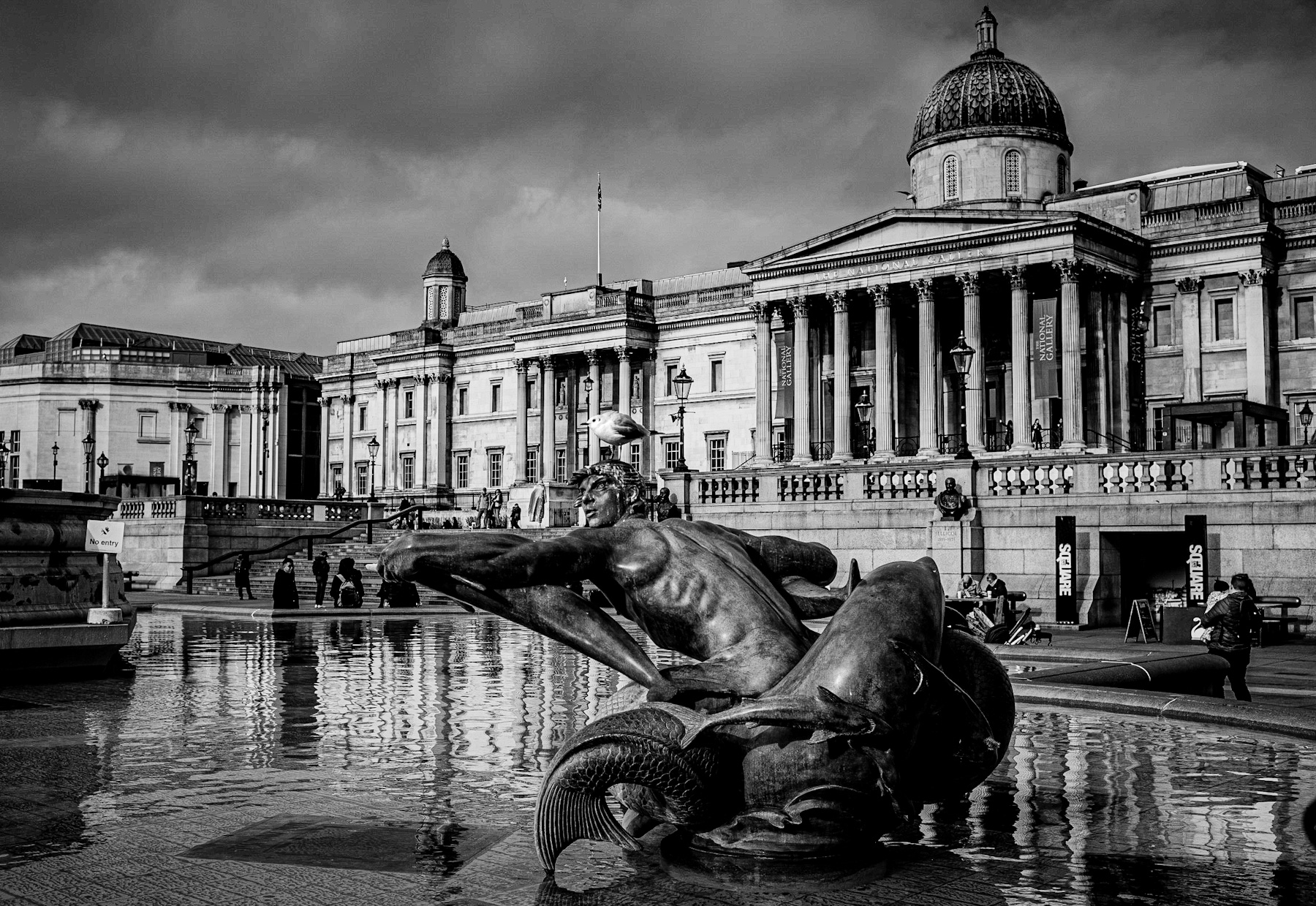
    The captured image presents a powerful monochromatic view of **Trafalgar Square**, one of **London’s** most celebrated public spaces. Dominated by the majestic facade of the **National Gallery** in the background, the scene is anchored by one of the square’s iconic **fountains**, featuring a striking bronze sculpture. The absence of colour amplifies the architectural grandeur and the dynamic interplay of light and shadow under a dramatic, cloudy sky, lending a timeless quality to this bustling urban landscape.
    **A Glimpse into the Visual Narrative**
    In the foreground, the focus rests on a magnificent **Triton statue**, a merman-like figure wrestling with a large fish or sea creature, its muscular form rendered with impressive detail. A lone seagull perches momentarily on the statue’s head in some perspectives, a small detail adding a touch of natural life to the monumental art. The fountain’s water, gently rippling, reflects the overcast sky, creating a textured surface that contrasts with the solid bronze. This aquatic element provides a serene counterpoint to the architectural formality beyond.
    Behind the fountain, the grand steps of the **National Gallery** rise, inviting visitors into its hallowed halls. The building’s neoclassical architecture is prominent, characterized by its imposing columns, intricate detailing, and the distinctive dome that crowns its structure. Banners for „National Gallery“ are visible, subtly reinforcing the building’s identity. Pedestrians dot the square and the gallery steps, their presence hinting at the continuous flow of life and activity that defines this central London landmark. The black and white palette emphasizes the textures of stone and water, highlighting the craftsmanship of both the sculpture and the architecture.
    **Echoes of British History and Cultural Heritage**
    **Trafalgar Square** itself is steeped in **British history**, commemorating the Battle of Trafalgar in 1805, a pivotal naval victory for Britain during the Napoleonic Wars. Named in 1830, the square was largely developed in the 1840s, evolving into a major civic space. The **National Gallery**, established in 1824 and opened in its current **William Wilkins**-designed building in 1838, stands as a testament to Britain’s commitment to art and culture. It houses a world-renowned collection of Western European paintings, spanning from the 13th to the 19th centuries, making it a vital institution for art enthusiasts and scholars globally.
    The fountains, while part of the original square design from the 1840s, underwent a significant redesign in the 1930s by architect **Sir Edwin Lutyens**. The current bronze sculptures, including the depicted Triton, replaced the earlier Victorian designs, introducing a more classical, robust aesthetic featuring mermaids, tritons, and dolphins. These additions enhance the square’s artistic appeal and contribute to its identity as a place where art, history, and public life converge.
    **An Enduring Public Space**
    Beyond its historical and artistic significance, **Trafalgar Square** functions as a vibrant public arena, a focal point for celebrations, protests, and everyday gatherings. Its strategic location and the grandeur of its surroundings make it an enduring symbol of London. The image, through its careful composition and monochromatic treatment, encapsulates not just a moment in time but also the timeless essence of this **iconic landmark**, inviting contemplation on the layers of history and culture embedded within its fabric. It serves as a reminder of London’s rich **cultural heritage** and its continuous evolution as a global city.
  • London’s Enduring Tapestry: A Journey Through Time on the Thames

    London’s Enduring Tapestry: A Journey Through Time on the Thames

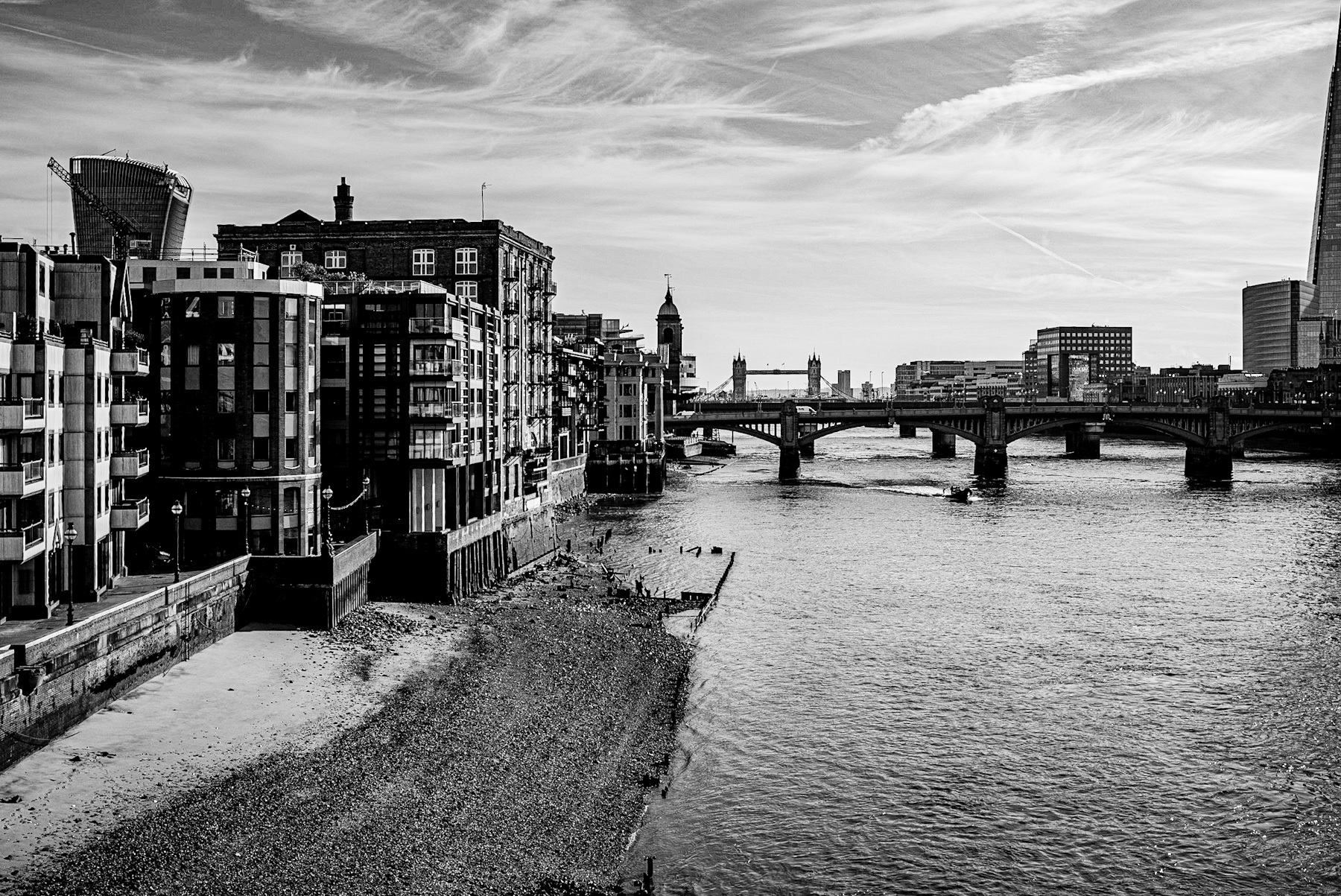
    The monochrome palette of this striking image presents a panoramic view of London, capturing the dynamic interplay between its ancient roots and its relentless march towards modernity. The River Thames, a historic artery, dominates the midground, its waters reflecting the intricate tapestry of the city’s past and present. This London photography piece offers a unique perspective on urban evolution.
    The Thames: Lifeline of London’s History
    At the heart of the composition lies the River Thames, its tidal currents visible as they gently lap against the foreshore on the left bank. This exposed gravel and sand, a testament to the river’s ebb and flow, hints at centuries of human activity. For millennia, the Thames has been London’s vital conduit, a highway for trade, a defensive barrier, and a source of sustenance.
    From Roman galleys to medieval merchant ships and Victorian steam tugs, the river has facilitated the city’s growth, shaping its economy and culture. The visible Thames foreshore today still offers glimpses into this deep history, revealing artifacts from various epochs to those who engage in the practice known as mudlarking. It’s a living testament to London’s rich historical background.
    A Symphony of Architectural Eras
    The skyline depicted is a compelling dialogue between different architectural eras. On the left, a cluster of buildings lines the riverbank, some with classic facades suggesting Victorian or Edwardian origins, others with more contemporary designs featuring balconies and large windows.
    Dominating the immediate background on the left, the distinctive curved silhouette of 20 Fenchurch Street, colloquially known as the „Walkie-Talkie“ building, stands tall. It’s a symbol of 21st-century corporate architecture. Its presence, alongside a visible crane, underscores London’s ongoing development and constant reinvention.
    Further downriver, a series of bridges gracefully span the Thames. In the midground, Southwark Bridge, with its distinctive steel arches, connects the city. Beyond it, in the distance, the iconic silhouette of Tower Bridge emerges, its neo-Gothic towers and suspension structure instantly recognizable. Completed in 1894, Tower Bridge represents the peak of Victorian engineering and a pivotal moment in London’s industrial expansion, designed to ease traffic congestion while allowing tall ships access to the Pool of London.
    To the right, piercing the sky, stands The Shard, a contemporary glass skyscraper that redefines London’s southern skyline. Its sharp, crystalline form contrasts starkly with the older structures, embodying the city’s aspirations for global prominence and modern urban design. This London cityscape perfectly illustrates the city’s ambition, showcasing both historic London and cutting-edge architecture.
    London’s Enduring Evolution
    This photograph, rendered in timeless black and white, emphasizes textures and forms, stripping away color to highlight the essence of London’s urban landscape. The dramatic cloud formations above add to the atmospheric quality, mirroring the layers of history below.
    The contrast between the ancient riverbed, the sturdy Victorian bridges, the classic buildings, and the gleaming modern skyscrapers encapsulates London’s continuous urban evolution. It is a city that respects its heritage while embracing innovation, a place where history is not merely preserved but actively lives alongside the cutting edge.
    This visual narrative speaks to London’s resilience and its enduring identity as a global metropolis. The Thames foreshore in the foreground, the historic London buildings, and the modern architecture of The Shard and Walkie-Talkie building all contribute to a rich tapestry. It invites contemplation on how past decisions continue to influence the present cityscape, and how future developments will inevitably become part of London’s rich historical background and urban evolution. This London photography piece truly captures the spirit of the city.
  • Echoes in Stone: Navigating Rouen’s Historic Shadows

    Echoes in Stone: Navigating Rouen’s Historic Shadows

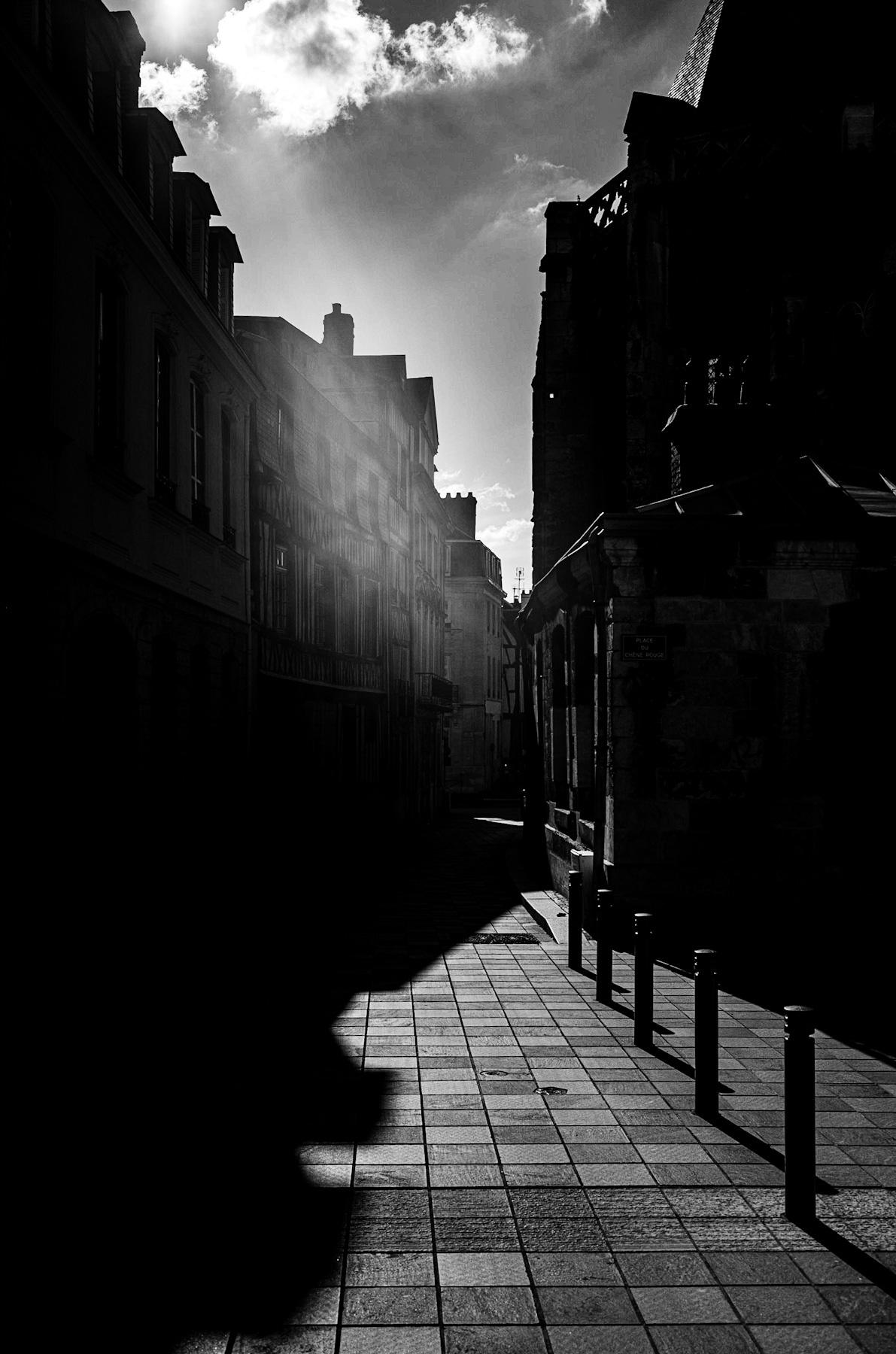
    The interplay of light and shadow transforms a seemingly ordinary urban scene into a profound visual narrative, inviting contemplation on history and architectural endurance. This compelling black and white photograph captures a narrow street, where sunlight, piercing through a partially clouded sky, dramatically illuminates the scene, carving out forms from the depths of darkness.
    A STUDY IN CONTRAST AND FORM
    The image is a masterclass in chiaroscuro, presenting sharp contrasts between intensely lit areas and deep, enveloping shadows. On the left, a row of buildings, possibly residential or commercial, features classic dormer windows, their facades partially catching the sun’s rays, revealing subtle textures and architectural details often characteristic of historic French architecture. The sunbeams themselves are almost tangible, creating a ethereal glow that highlights the upper stories.
    The foreground features a meticulously tiled pavement, its grid pattern providing a strong geometric element that guides the eye. A series of dark bollards line the right edge of this path, casting long, distinct shadows that stretch across the tiles, accentuating the sense of depth and perspective. These elements, though modern in function, integrate seamlessly into the timeless feel of the streetscape. The right side of the frame is dominated by the imposing silhouette of a larger, darker structure, possibly a church or a significant public building, its intricate Gothic details hinted at within the deep shade. A street sign, partially visible, reads „PLACE DU CHENE ROUGE,“ offering a crucial clue to the location.
    UNVEILING ROUEN’S MEDIEVAL HEART
    The inscription „PLACE DU CHENE ROUGE“ (Red Oak Square) strongly suggests this evocative scene is located in Rouen, France. Rouen, the historic capital of Normandy, is renowned for its remarkably preserved medieval quarter, a labyrinth of narrow streets, half-timbered houses, and grand Gothic structures like its famous cathedral. This photograph perfectly encapsulates the essence of Rouen’s medieval streets, where centuries of history are etched into the stone and timber.
    The architectural style, particularly the visible half-timbered elements and the density of the urban fabric, is highly characteristic of the city’s heritage. Walking these streets is akin to stepping back in time, a journey through eras marked by figures such as Joan of Arc, whose fate is inextricably linked to Rouen. The dark, imposing building on the right could well be a section of one of Rouen’s many historic churches or a former civic building, whose scale and design speak to the city’s past grandeur and spiritual significance. The very narrowness of the street reflects the urban planning of medieval times, designed for foot traffic and defense, creating a naturally dramatic play of light and shadow as the sun tracks across the sky.
    TIMELESSNESS THROUGH BLACK AND WHITE
    The choice of black and white photography for this scene is particularly effective. It strips away the distractions of color, allowing the viewer to focus entirely on the interplay of light, shadow, texture, and form. This artistic decision enhances the sense of timelessness, connecting the present moment captured by the lens with the centuries of history embedded in the architecture. The strong contrasts evoke a sense of drama and mystery, inviting one to imagine the countless stories that have unfolded on this very spot.
    Ultimately, this image is more than just a snapshot of a street; it is a portal to the past, a visual poem celebrating the enduring beauty of historic urban landscapes and the profound impact of light on perception. It serves as a powerful reminder of France’s rich architectural legacy and the timeless allure of its ancient cities.
    Keywords: Historic Rouen, French architecture, black and white photography, medieval streets, Place du Chêne Rouge, urban history, European cityscapes, light and shadow, timeless streets, travel France, half-timbered houses.
  • Pastoral Echoes: The Enduring Legacy of Cattle in a Black and White World

    Pastoral Echoes: The Enduring Legacy of Cattle in a Black and White World

    The striking black and white imagery of a herd of cattle immediately draws the viewer into a serene, yet dynamic, pastoral scene. Dominating the foreground, a cow with distinctive white and black markings turns its head, seemingly in mid-lick or an inquisitive gesture, its tongue playfully extended. Beside it, another bovine with a prominent white triangular blaze on its forehead gazes directly forward, anchoring the composition. In the background, additional cows graze peacefully, their forms silhouetted against a distant horizon where land meets a vast expanse of water under a dramatic, cloudy sky.
    This monochrome palette lends a timeless quality to the photograph, stripping away distractions and highlighting the textures of their coats, the subtle nuances of light and shadow, and the rugged beauty of the landscape. The expressive interaction between the two foreground cows captures a moment of natural behavior, reminding us of the sentient lives within these domesticated animals. The visible ear tag on one cow, bearing the number „6626,“ is a subtle nod to modern agricultural practices, even as the overall impression harks back to simpler times.
    A Glimpse into Ancient Agricultural Roots
    The presence of cattle in human civilization is profoundly ancient, tracing back to the Neolithic Revolution approximately 10,500 years ago. Their domestication marked a pivotal shift in human history, moving societies from a hunter-gatherer existence to settled agrarian communities. Early humans recognized the immense value of these animals, not just for meat, but also for milk, hides, and crucially, as working beasts for plowing fields and transportation. This foundational relationship enabled the development of complex societies and laid the groundwork for modern agriculture and sustainable farming practices.
    The Rise of Dairy and Iconic Breeds
    The black and white patterns seen on these animals strongly suggest they are Holstein-Friesian cattle, a breed renowned globally for its exceptional dairy production. Originating from the provinces of North Holland and Friesland in the Netherlands, and Schleswig-Holstein in Germany, these cows have been selectively bred over centuries to become the world’s highest-producing dairy animals. Their widespread adoption has significantly shaped the global dairy industry, making milk and dairy products accessible staples in diets worldwide. The image subtly connects to this rich agricultural history, portraying animals that are direct descendants of those critical to this agricultural evolution.
    Modern Context and Timeless Connection
    The expansive, grassy field leading to a watery horizon in the background evokes the traditional grazing lands often associated with cattle farming. Such coastal or near-coastal pastures have historically provided rich forage, contributing to the health and productivity of herds. While modern farming has introduced technological advancements like detailed animal identification through ear tags and improved animal welfare practices, the fundamental interaction between cattle and their environment, as depicted here, remains largely unchanged. It speaks to an enduring rhythm of rural life and the continuous cycle of nature, connecting contemporary livestock management with centuries of farming heritage.
    This photograph, with its compelling monochrome aesthetic and candid portrayal of bovine life, serves as more than just a snapshot. It is a visual testament to the deep-rooted historical partnership between humans and cattle, a connection that has nourished and shaped civilizations for millennia. From ancient domestication to their pivotal role in contemporary food systems, these animals continue to be silent, yet powerful, anchors in our agricultural narrative. The image invites contemplation on this enduring legacy, reminding us of the simple beauty and complex history woven into the fabric of our natural world, celebrating pastoral life through timeless black and white photography.
  • Maritime Echoes: A Monochrome Journey Through Coastal Heritage and Contemporary Life

    Maritime Echoes: A Monochrome Journey Through Coastal Heritage and Contemporary Life

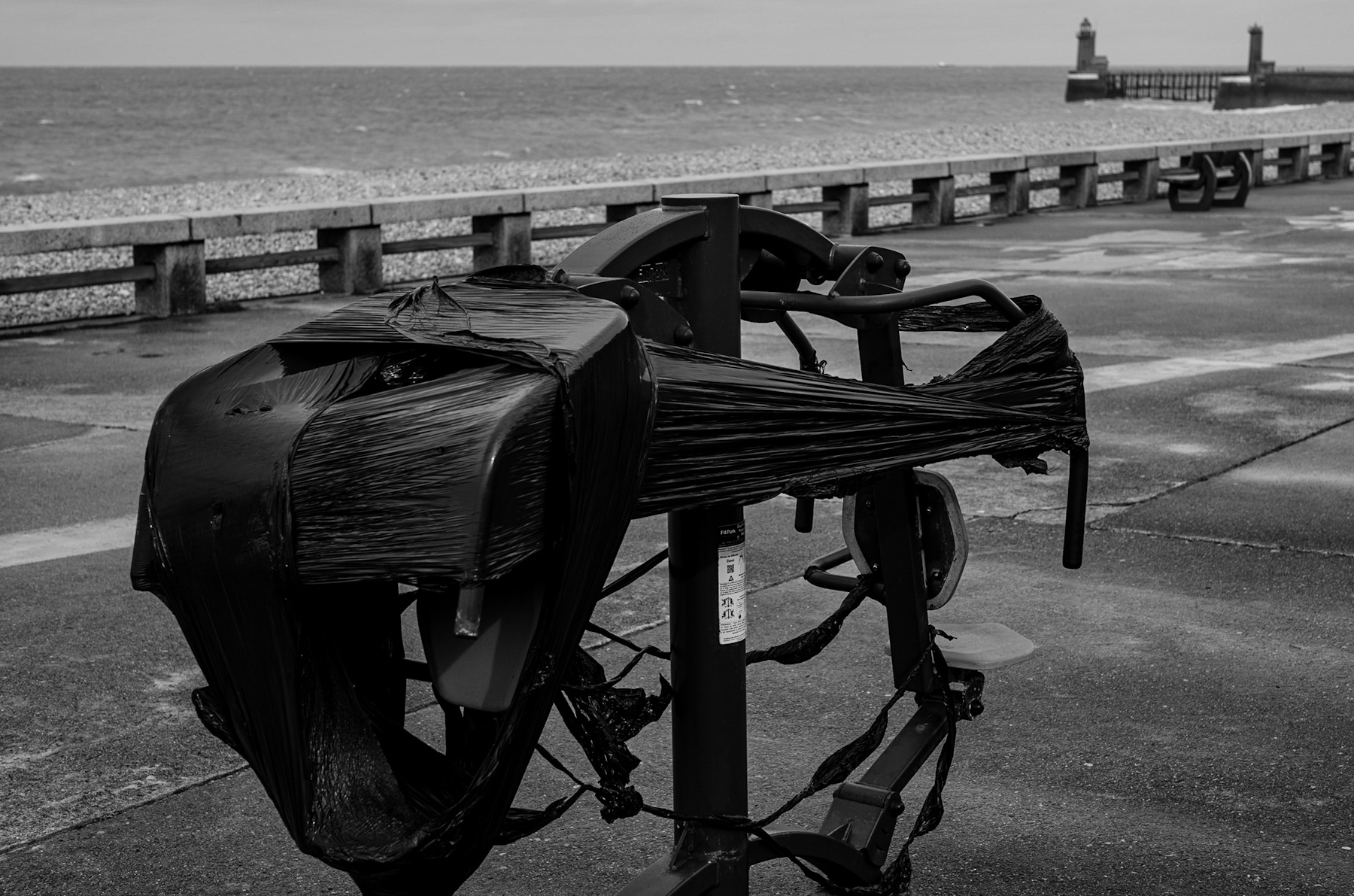
    This striking black and white image masterfully captures a slice of coastal life where human innovation meets the vast, enduring sea. Dominating the foreground is an outdoor fitness machine, temporarily veiled in black plastic, hinting at a pause in its intended function. This immediate visual contrast sets the stage for a deeper dive into the scene’s rich layers, seamlessly blending modern urban elements with the timeless historical narrative of the coastline.
    ### The Foreground: Contemporary Life in Abeyance
    The shrouded outdoor fitness equipment, likely part of a public exercise park, serves as a tangible symbol of contemporary urban planning and community well-being initiatives. Its monochrome portrayal highlights the contrasting textures: the crinkled, taut plastic providing a temporary skin over the sturdy, exposed metal frame. This act of covering suggests either seasonal protection, necessary maintenance, or a period of disuse, perhaps due to weather or regulations. This temporary cessation of function for an active-use machine introduces a quiet contemplative element, underscoring the transient nature of modern amenities against a backdrop of more permanent structures and natural forces. The black and white palette further accentuates its form, stripping away color to focus on shape and material.
    ### The Midground: A Promenade’s Enduring Presence
    Extending beyond the fitness apparatus, a robust concrete promenade, complete with visible wooden support beams, creates a distinct boundary between the paved recreational area and the pebble beach leading to the open water. Such coastal promenades are quintessential features in seaside landscapes, often deeply rooted in historical development, particularly during the Victorian era when coastal towns blossomed as tourist and leisure destinations. These public walkways were, and continue to be, vital community spaces, offering residents and visitors alike a place for leisure, exercise, and quiet reflection by the sea. The substantial construction of this barrier speaks to the constant engineering effort required to resist the sea’s erosive power, a testament to human determination to create and maintain accessible public amenities along dynamic coastlines.
    ### The Background: Sentinels of Maritime History
    In the distant background, two distinctive structures rise from the water, clearly identifiable as lighthouses or substantial pierheads, likely marking the entrance to a harbor or river mouth. These maritime sentinels are steeped in rich historical significance, having served for centuries as critical navigational aids. Their unwavering purpose has been to guide vessels safely through treacherous waters, marking channels, hazards, and port entrances, thereby facilitating trade, exploration, and naval operations. They embody an era of significant maritime engineering and profound human reliance on the sea for commerce and travel. The presence of a connecting pier or breakwater further underscores the historical importance of this location as a point of arrival, departure, and often, coastal defense. These historical landmarks stand as silent witnesses to countless journeys and the enduring human connection to the ocean.
    ### A Confluence of Eras in Monochrome
    The photograph masterfully captures a compelling confluence of different eras and purposes. The modern, temporarily dormant outdoor fitness equipment speaks to present-day lifestyle trends and urban development. The enduring promenade reflects over a century of public leisure, coastal architecture, and urban planning. The distant lighthouses stand as timeless symbols of maritime heritage, human ingenuity, and our long-standing relationship with the sea. Rendered in black and white, the image transcends specific temporal details, emphasizing form, texture, and the intricate interplay of light and shadow. This aesthetic choice allows the viewer to connect these seemingly disparate elements into a cohesive narrative of a living, evolving coastline, where history and modernity coexist.
    This visual narrative invites contemplation on the deep layers of history embedded within our public spaces. From the functional structures guiding ships for generations to the contemporary amenities promoting community well-being, coastal environments are dynamic archives of human endeavor. The covered machine, awaiting its next use, serves as a subtle reminder that even as new elements emerge, the historical foundations of our relationship with the sea continue to shape and define our surroundings.
  • Echoes of Stone: A Journey Through Europe’s Enduring Alleys

    Echoes of Stone: A Journey Through Europe’s Enduring Alleys

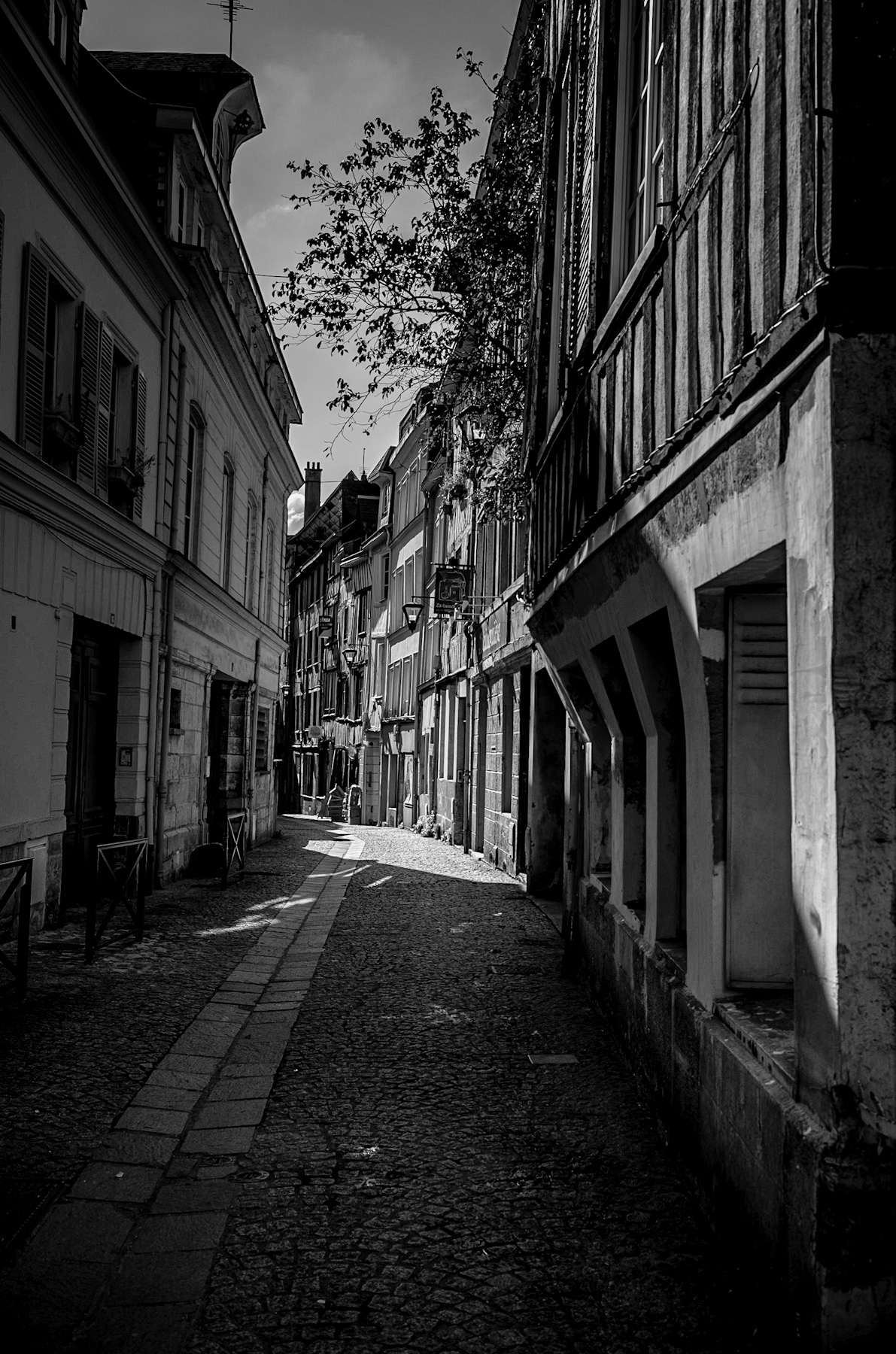
    The monochromatic lens reveals a captivating view of a narrow, historic street, a testament to centuries of urban development. This image, rendered in stark black and white, accentuates the textures and contrasts of an ancient European thoroughfare, inviting contemplation of its rich past and timeless appeal.
    Architectural Layers of History
    The street is flanked by buildings that narrate a complex architectural history. On the right, structures display distinct half-timbered (or *colombage*) construction on their upper floors, characterized by exposed wooden beams forming geometric patterns. This building style, prevalent across much of medieval and early modern Europe, particularly in regions like France, Germany, and England, speaks to an era when timber was a primary building material. The ground floor on this side appears to be constructed from stone or rendered masonry, featuring deep-set, arched window openings that suggest an original commercial or workshop function, common in densely populated urban centres. These elements collectively transport the viewer to a period predating modern construction techniques, highlighting craftsmanship and local materials.
    In contrast, the buildings on the left side, while equally historic, present a more classical or perhaps later architectural style. Their facades are smoother, likely rendered or stone-faced, with evenly spaced windows often adorned with traditional shutters. This juxtaposition of architectural styles within a single street segment illustrates the organic evolution of urban landscapes, where buildings from different epochs stand side-by-side, each adding a layer to the city’s visual narrative. The tall, steep roofs and visible chimneys further underscore their age and traditional European design.
    The Cobblestone Path and Urban Fabric
    The very foundation of the street, a meticulously laid cobblestone path, is a central feature of the image. A smoother, rectangular strip of paving runs down the centre, possibly a later addition for easier passage or drainage, contrasting with the irregular, ancient cobblestones on either side. These narrow, winding streets are characteristic of medieval town planning, designed for pedestrians, horse-drawn carts, and local commerce rather than modern vehicular traffic. Their compact nature fostered close-knit communities and facilitated defence within city walls.
    The dramatic interplay of light and shadow, enhanced by the black and white rendition, sculpts the scene. A bright strip of sunlight cuts across the cobblestones, illuminating textures and guiding the eye deeper into the alley, while deep shadows cling to the building facades, creating a sense of depth and mystery. A lone tree branch, reaching towards the sky, introduces a natural element, softening the rigid lines of the architecture and hinting at the enduring presence of nature amidst urban density.
    Enduring Urban Heritage
    This photograph transcends a mere depiction of a street; it captures the essence of urban heritage. It speaks to the resilience of historical structures and the enduring human desire for community spaces. Such alleys were once bustling with daily life – merchants, artisans, and residents going about their routines. Today, they serve as tangible links to the past, offering a quiet escape from the modern world and a profound appreciation for architectural preservation. The image is a powerful reminder of how historical urban environments continue to shape our understanding of culture, design, and the passage of time.
    This street, with its intricate details and profound historical echoes, represents countless similar lanes across Europe, each a silent guardian of stories from bygone eras, inviting explorers and dreamers to walk through history.
  • The Enduring Nexus: Industry, Infrastructure, and Global Currents

    The Enduring Nexus: Industry, Infrastructure, and Global Currents

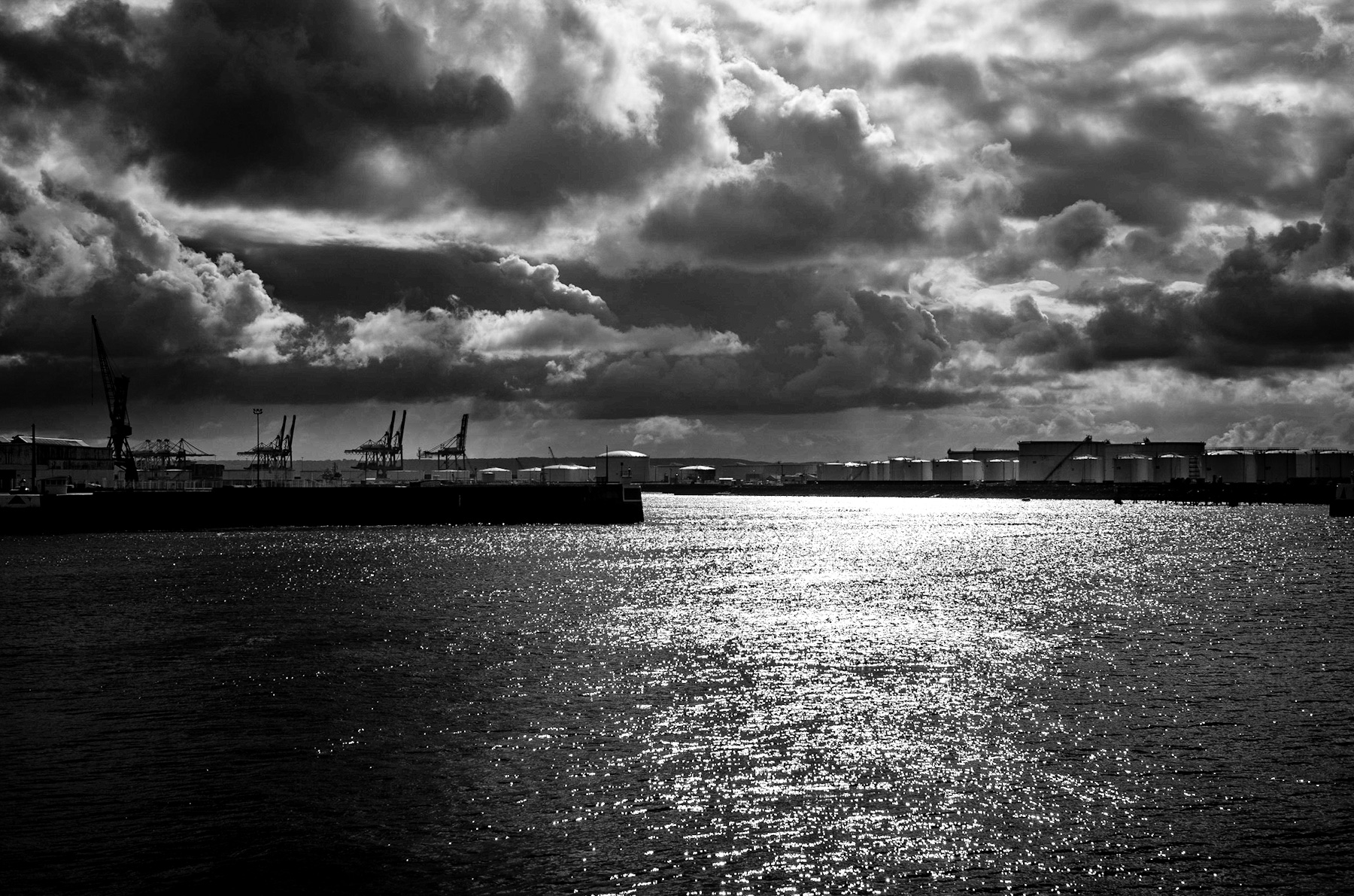
    The presented image captures a compelling black and white vista of an industrial waterfront, a scene where human engineering meets the elemental forces of nature. The composition, characterized by stark contrasts and deep shadows under a dramatic sky, highlights the functional architecture of global commerce and energy infrastructure.
    A Landscape of Logistics and Power
    In the foreground, the water shimmers with reflected light, creating a textured surface that draws the eye across the expanse. Beyond this, the dark silhouette of the landmass reveals a complex array of industrial elements. To the left, a series of towering container cranes stand as sentinels of global trade. These colossal machines, integral to modern port operations, symbolize the efficiency and scale of contemporary shipping industry and maritime logistics. Their presence underscores the continuous movement of goods that underpins the global supply chain, connecting producers and consumers across continents.
    Further along the horizon, to the right, an extensive line of large cylindrical storage tanks dominates the landscape. These structures are typically associated with the energy sector, housing vast quantities of crude oil, refined petroleum products, or various chemicals. Their sheer number and uniform appearance speak to the immense capacity required to manage the world’s energy demands and industrial processes. This segment of the image directly represents the critical role of industrial infrastructure in sustaining modern economies.
    Historical Echoes in Modern Industry
    The historical context of such port infrastructure is deeply rooted in the evolution of trade and industry. From ancient trading posts to the bustling harbors of the Industrial Revolution, ports have consistently served as vital gateways for the exchange of goods and resources. The advent of steam power in the 18th and 19th centuries, followed by the internal combustion engine, revolutionized transport and trade, significantly increasing the volume and speed of maritime commerce.
    The cranes in the image are direct descendants of earlier, less sophisticated lifting mechanisms, evolving to handle the standardized shipping containers that transformed global freight in the mid-20th century. This innovation drastically reduced loading and unloading times, making international trade more efficient and affordable. Similarly, the storage tanks represent a legacy stretching back to the early days of the oil industry in the late 19th century, when the need for bulk storage of petroleum became paramount. These facilities have continuously adapted to meet the escalating requirements of a fossil-fuel-dependent world, playing a pivotal role in economic development and geopolitical dynamics.
    The Monochrome Perspective
    The choice of black and white photography for this scene lends a timeless quality, stripping away the distractions of color to emphasize form, texture, and light. This aesthetic choice highlights the raw, unadorned power of these industrial elements and their stark contrast against the natural environment. The dramatic, cloudy sky further enhances this effect, creating a sense of scale and perhaps a subtle commentary on the powerful, sometimes overwhelming, impact of human industry on the landscape. It encourages contemplation of the enduring nature of these industrial hubs, linking their present function to their long and impactful maritime history.
    This image serves as a visual narrative of the intricate relationship between human innovation, resource management, and the relentless pulse of global commerce, reflecting centuries of industrial landscape development.