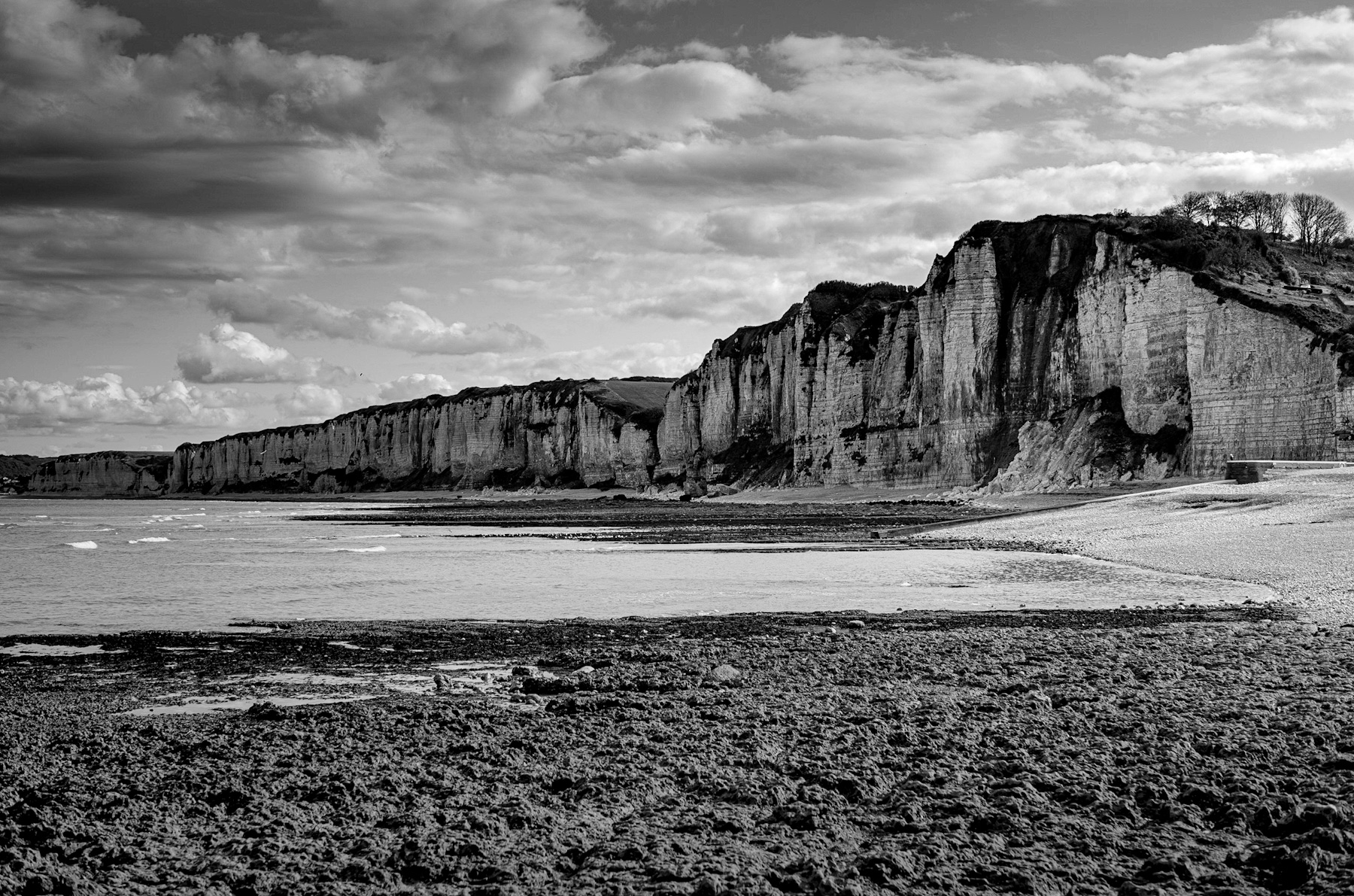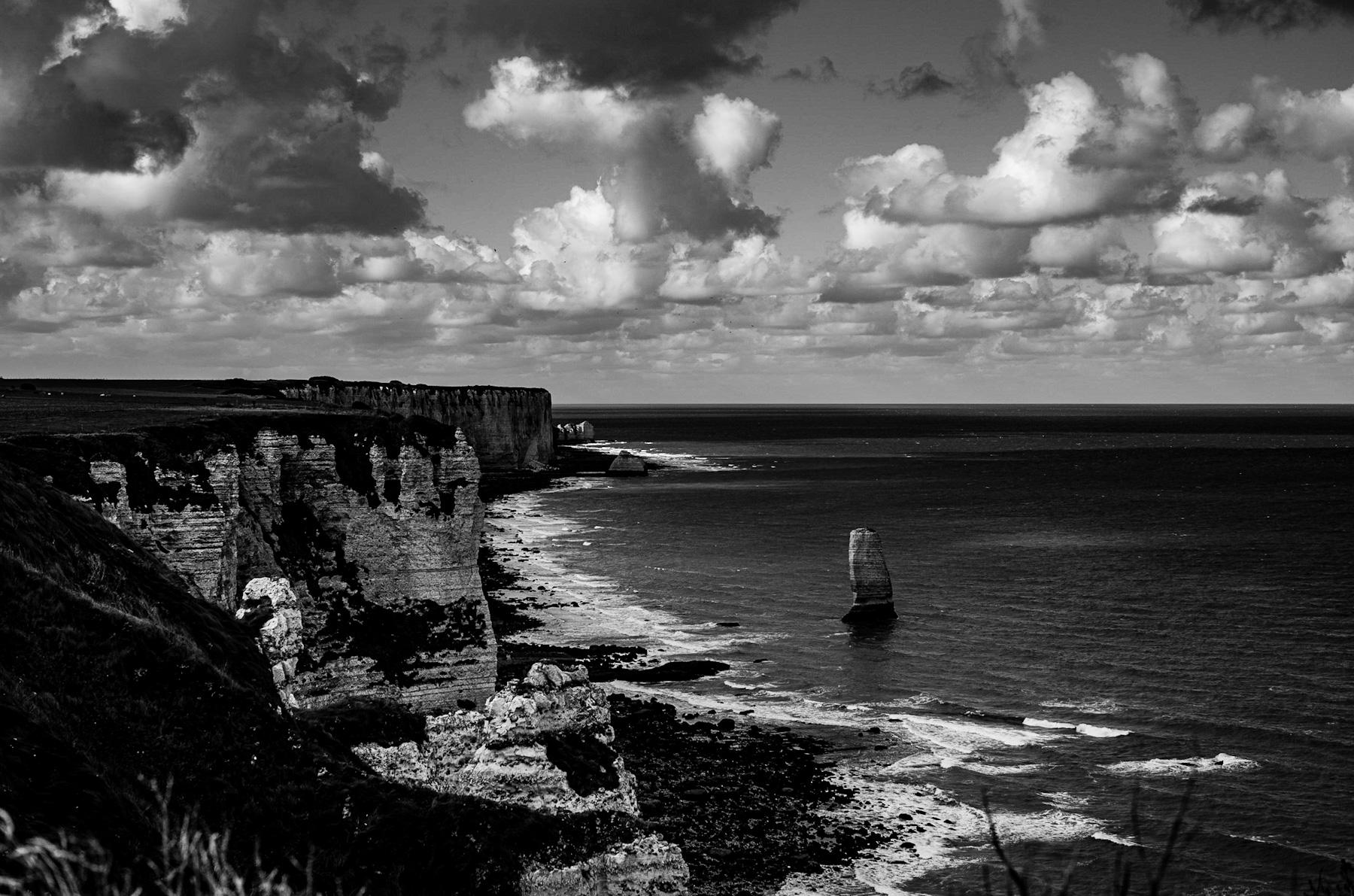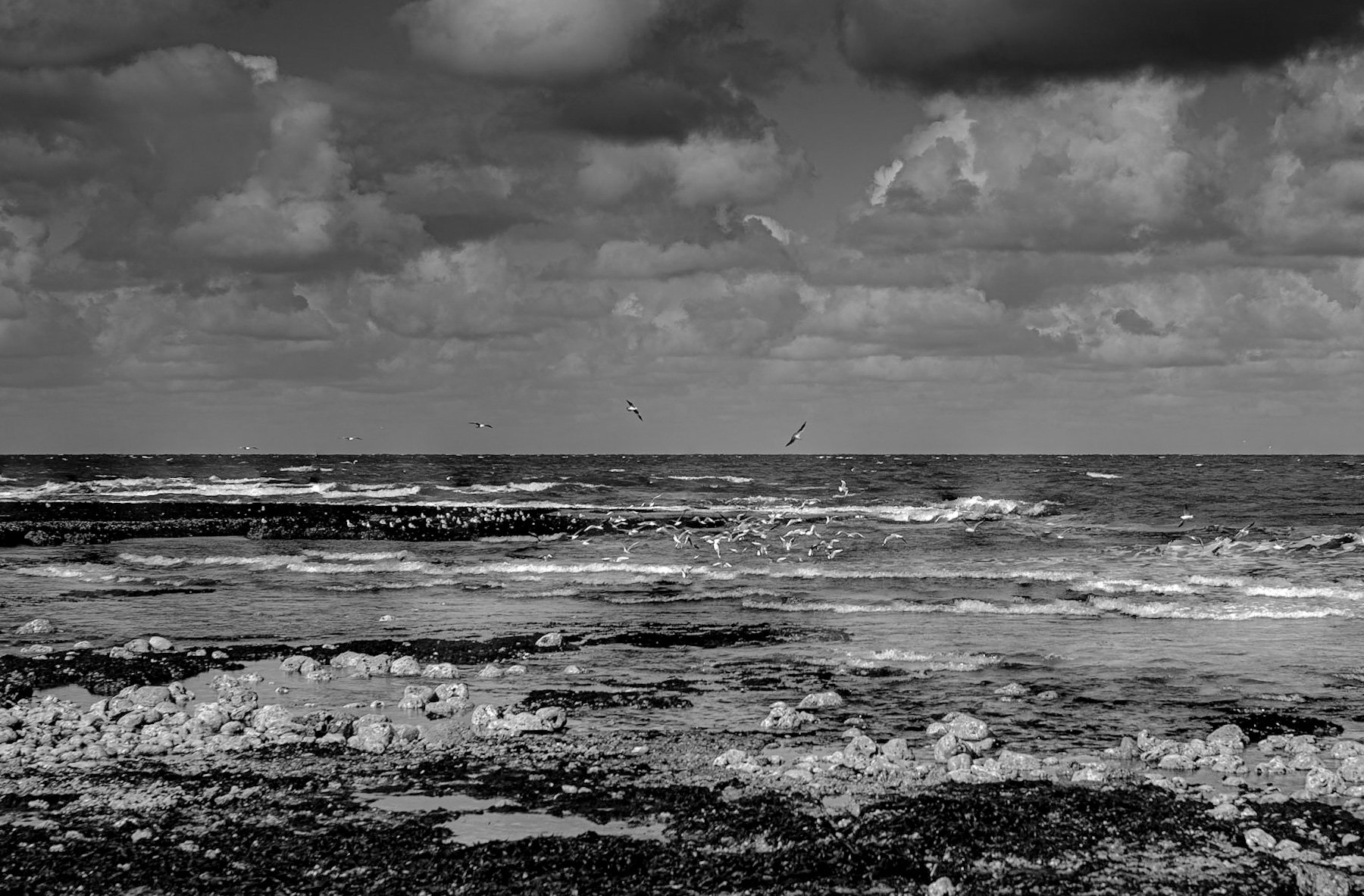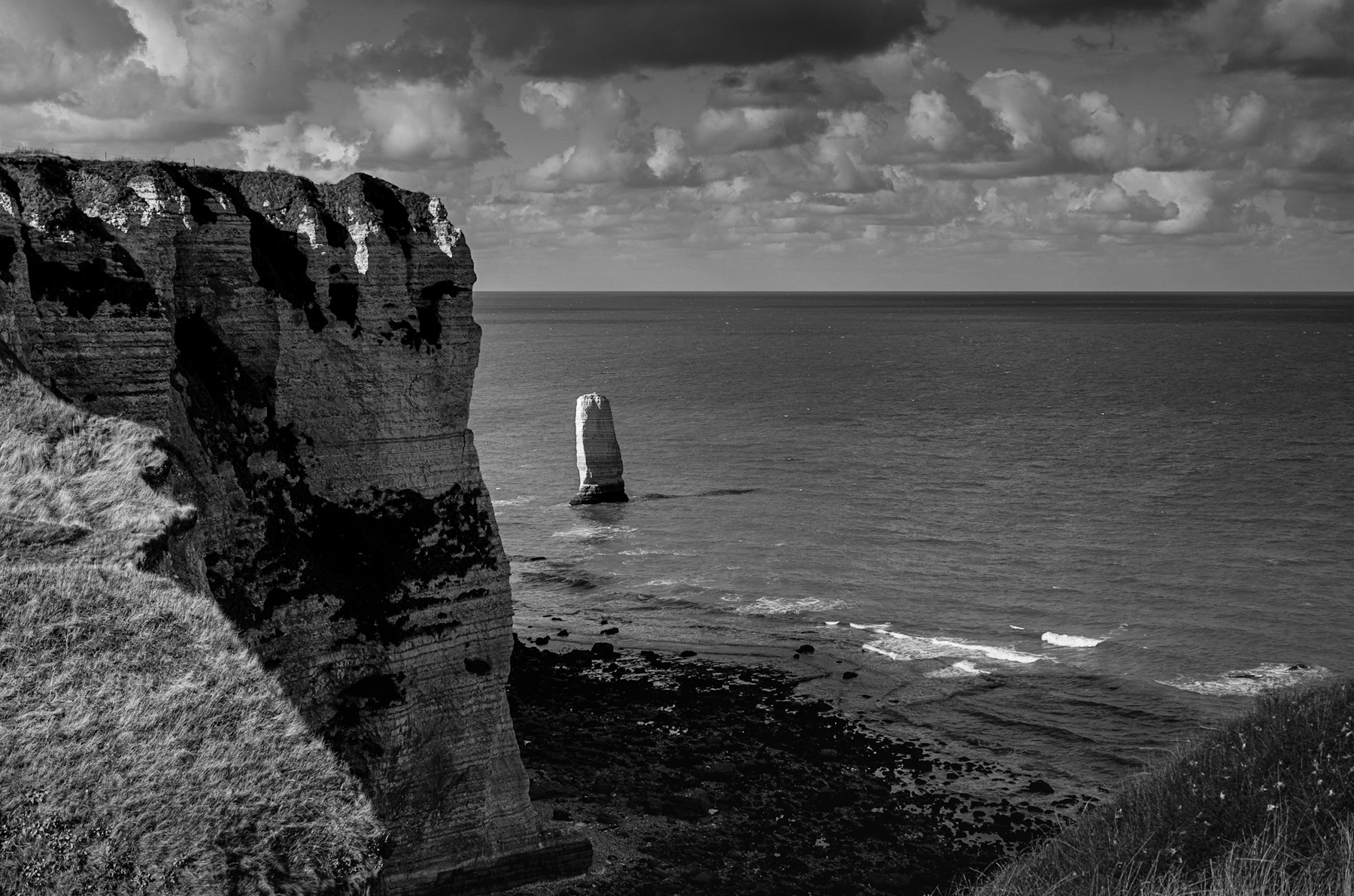
This striking black and white photograph captures the raw, enduring power of a coastal landscape, focusing on the iconic chalk cliffs and a solitary sea stack that stand as sentinels against the relentless forces of nature. The monochromatic palette enhances the dramatic textures of the stratified rock, the turbulent sea, and the brooding sky, conveying a sense of timelessness and natural grandeur.
The Visual Narrative: A Study in Contrast
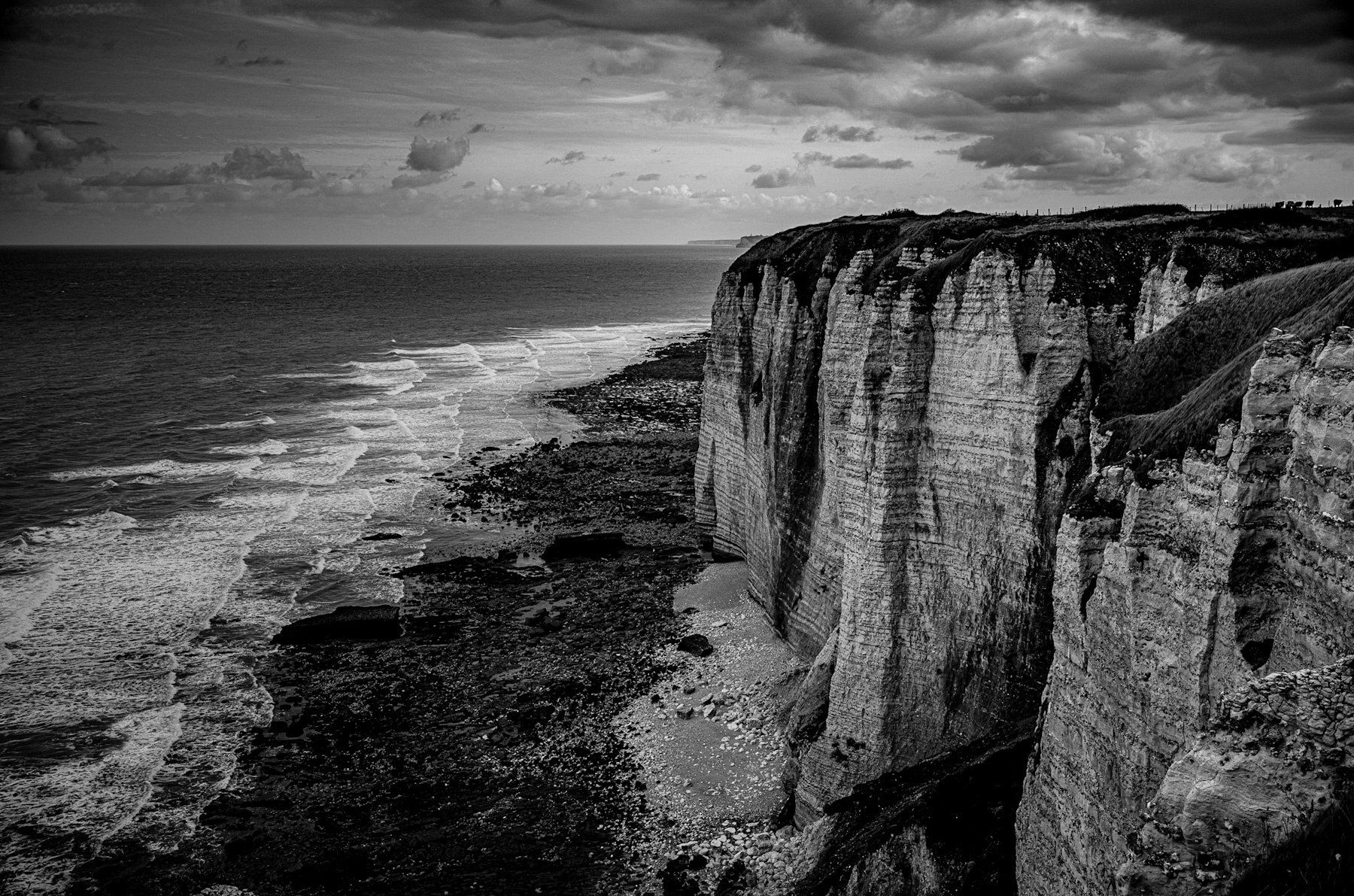
The image presents a dramatic interplay of light and shadow. On the left, a towering chalk cliff dominates the foreground, its layered structure clearly visible, hinting at millions of years of geological formation. The cliff face, rugged and marked by erosion, plunges towards the dark, rocky shoreline below, where gentle waves meet the land. In the mid-ground, an isolated sea stack, often referred to as an „aiguille“ in French, rises majestically from the expansive ocean. Its bright, eroded surface stands in stark contrast to the darker waters surrounding it, drawing the eye and emphasizing its isolation and resilience. The horizon line is a clean cut between the vast, undulating sea and the dynamic cloudscape above, which adds further depth and mood to the scene. The choice of black and white photography strips away distractions, allowing the viewer to appreciate the fundamental forms, textures, and the stark beauty of this natural wonder.
Geological Tapestry: Millions of Years in the Making
The geological history embedded within these cliffs is profound. These formations are primarily composed of **chalk**, a soft, white limestone formed from the skeletal remains of microscopic marine organisms, primarily coccolithophores, that accumulated on the seabed over 90 million years ago during the Late Cretaceous period. As sea levels changed and tectonic forces uplifted the land, these ancient seabeds were exposed, forming the dramatic coastal escarpments seen today.
The distinctive **sea stacks** and arches, such as the one prominently featured, are the result of continuous **coastal erosion**. Waves and wind relentlessly attack the cliff face, exploiting weaknesses and faults in the chalk. Over millennia, caves form, which eventually develop into natural arches. When the arch collapses, a pillar of rock remains isolated from the main cliff, forming a sea stack. This process is ongoing, constantly reshaping the coastline and reminding us of the dynamic nature of Earth’s surface.
Echoes of History: Art, Literature, and Strategic Importance
Beyond their geological significance, these cliffs hold a rich tapestry of human history and cultural importance, particularly those along the **Normandy coast** near Étretat, which this landscape strongly resembles. For centuries, these natural formations served as navigation aids for sailors and as strategic lookout points.
However, their most enduring legacy is perhaps their profound influence on art and literature. The dramatic scenery captivated numerous artists in the 19th and early 20th centuries. Painters like **Claude Monet**, Gustave Courbet, and Eugène Boudin were drawn to the ever-changing light and moods of the **Étretat cliffs**, capturing them in countless masterpieces that helped define Impressionism. Their works immortalized these natural arches and sea stacks, making them globally recognizable symbols of French natural beauty.
Literary figures also found inspiration here. Guy de Maupassant, a native of Normandy, often wrote about the region. Most famously, the French author **Maurice Leblanc** set parts of his **Arsène Lupin** detective stories within these very cliffs, specifically involving the legendary „Aiguille Creuse“ (Hollow Needle), a fictionalized version of one of Étretat’s renowned sea stacks. This blend of natural wonder with fictional intrigue has cemented the cliffs‘ place in popular culture.
The image presented is more than just a photograph of a coastline; it is a window into geological time and a testament to the enduring power of nature, interwoven with centuries of human interaction, artistic expression, and historical narratives.
The Visual Narrative: A Study in Contrast
The image presents a dramatic interplay of light and shadow. On the left, a towering chalk cliff dominates the foreground, its layered structure clearly visible, hinting at millions of years of geological formation. The cliff face, rugged and marked by erosion, plunges towards the dark, rocky shoreline below, where gentle waves meet the land. In the mid-ground, an isolated sea stack, often referred to as an „aiguille“ in French, rises majestically from the expansive ocean. Its bright, eroded surface stands in stark contrast to the darker waters surrounding it, drawing the eye and emphasizing its isolation and resilience. The horizon line is a clean cut between the vast, undulating sea and the dynamic cloudscape above, which adds further depth and mood to the scene. The choice of black and white photography strips away distractions, allowing the viewer to appreciate the fundamental forms, textures, and the stark beauty of this natural wonder.
Geological Tapestry: Millions of Years in the Making
The geological history embedded within these cliffs is profound. These formations are primarily composed of **chalk**, a soft, white limestone formed from the skeletal remains of microscopic marine organisms, primarily coccolithophores, that accumulated on the seabed over 90 million years ago during the Late Cretaceous period. As sea levels changed and tectonic forces uplifted the land, these ancient seabeds were exposed, forming the dramatic coastal escarpments seen today.
The distinctive **sea stacks** and arches, such as the one prominently featured, are the result of continuous **coastal erosion**. Waves and wind relentlessly attack the cliff face, exploiting weaknesses and faults in the chalk. Over millennia, caves form, which eventually develop into natural arches. When the arch collapses, a pillar of rock remains isolated from the main cliff, forming a sea stack. This process is ongoing, constantly reshaping the coastline and reminding us of the dynamic nature of Earth’s surface.
Echoes of History: Art, Literature, and Strategic Importance
Beyond their geological significance, these cliffs hold a rich tapestry of human history and cultural importance, particularly those along the **Normandy coast** near Étretat, which this landscape strongly resembles. For centuries, these natural formations served as navigation aids for sailors and as strategic lookout points.
However, their most enduring legacy is perhaps their profound influence on art and literature. The dramatic scenery captivated numerous artists in the 19th and early 20th centuries. Painters like **Claude Monet**, Gustave Courbet, and Eugène Boudin were drawn to the ever-changing light and moods of the **Étretat cliffs**, capturing them in countless masterpieces that helped define Impressionism. Their works immortalized these natural arches and sea stacks, making them globally recognizable symbols of French natural beauty.
Literary figures also found inspiration here. Guy de Maupassant, a native of Normandy, often wrote about the region. Most famously, the French author **Maurice Leblanc** set parts of his **Arsène Lupin** detective stories within these very cliffs, specifically involving the legendary „Aiguille Creuse“ (Hollow Needle), a fictionalized version of one of Étretat’s renowned sea stacks. This blend of natural wonder with fictional intrigue has cemented the cliffs‘ place in popular culture.
The image presented is more than just a photograph of a coastline; it is a window into geological time and a testament to the enduring power of nature, interwoven with centuries of human interaction, artistic expression, and historical narratives.