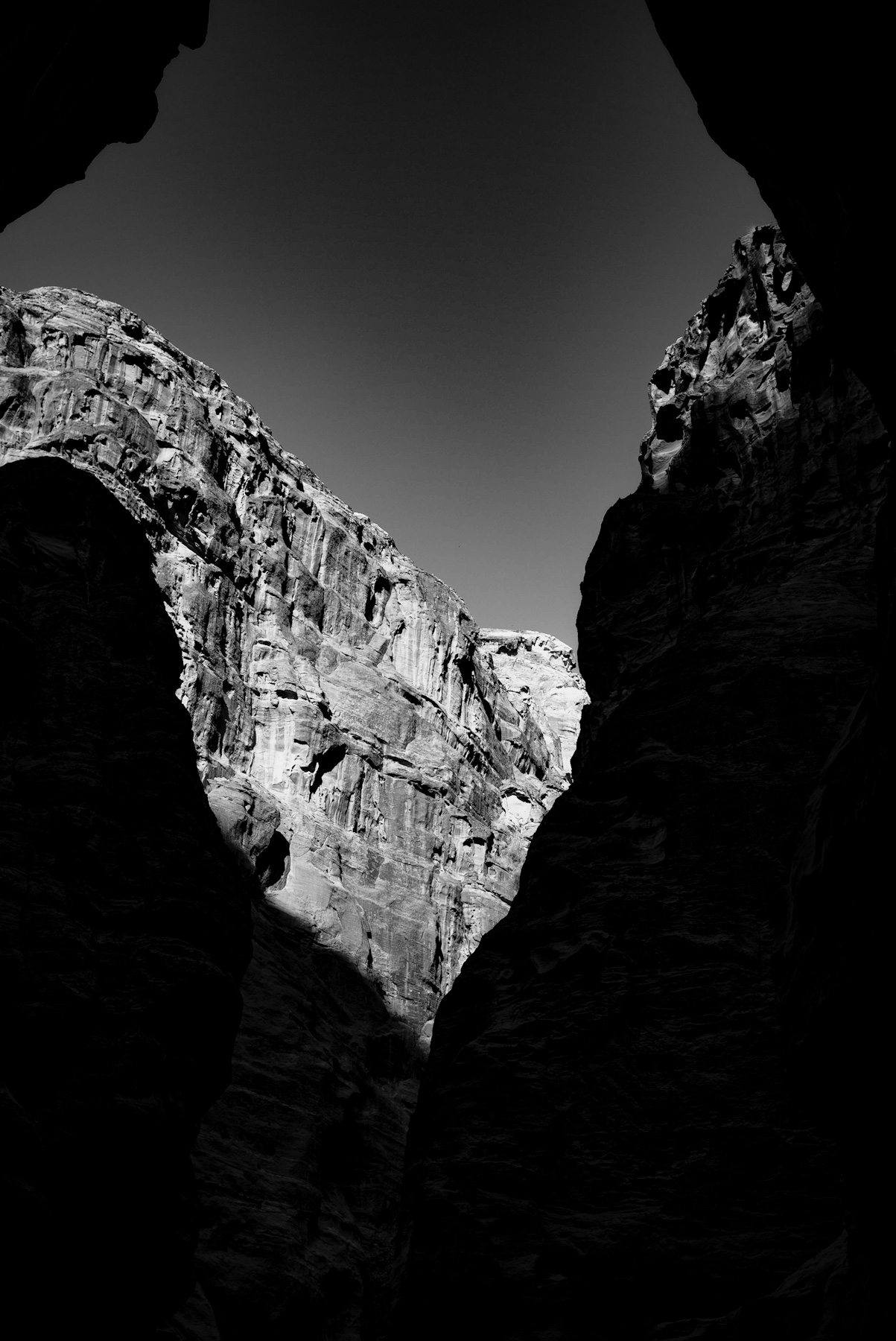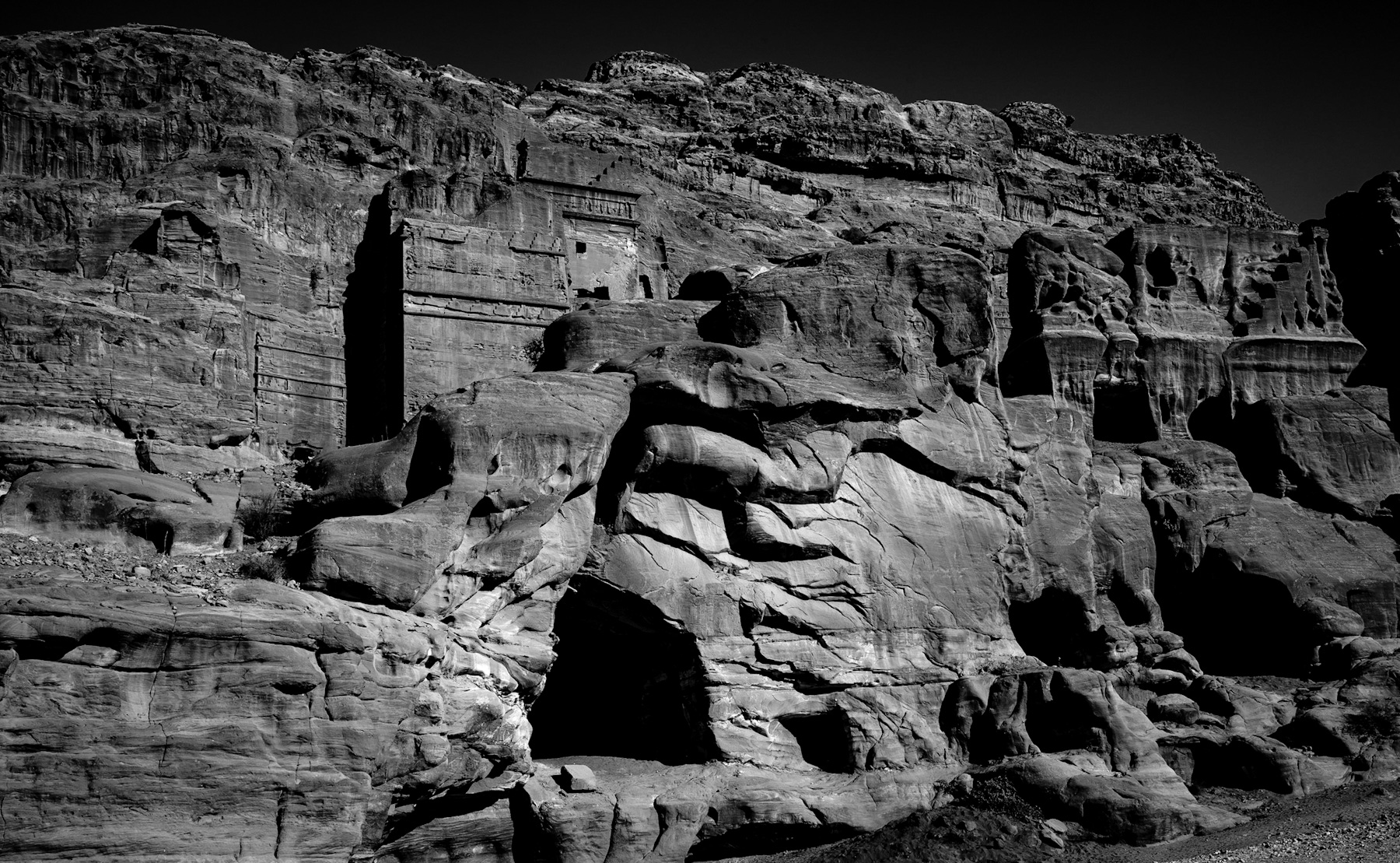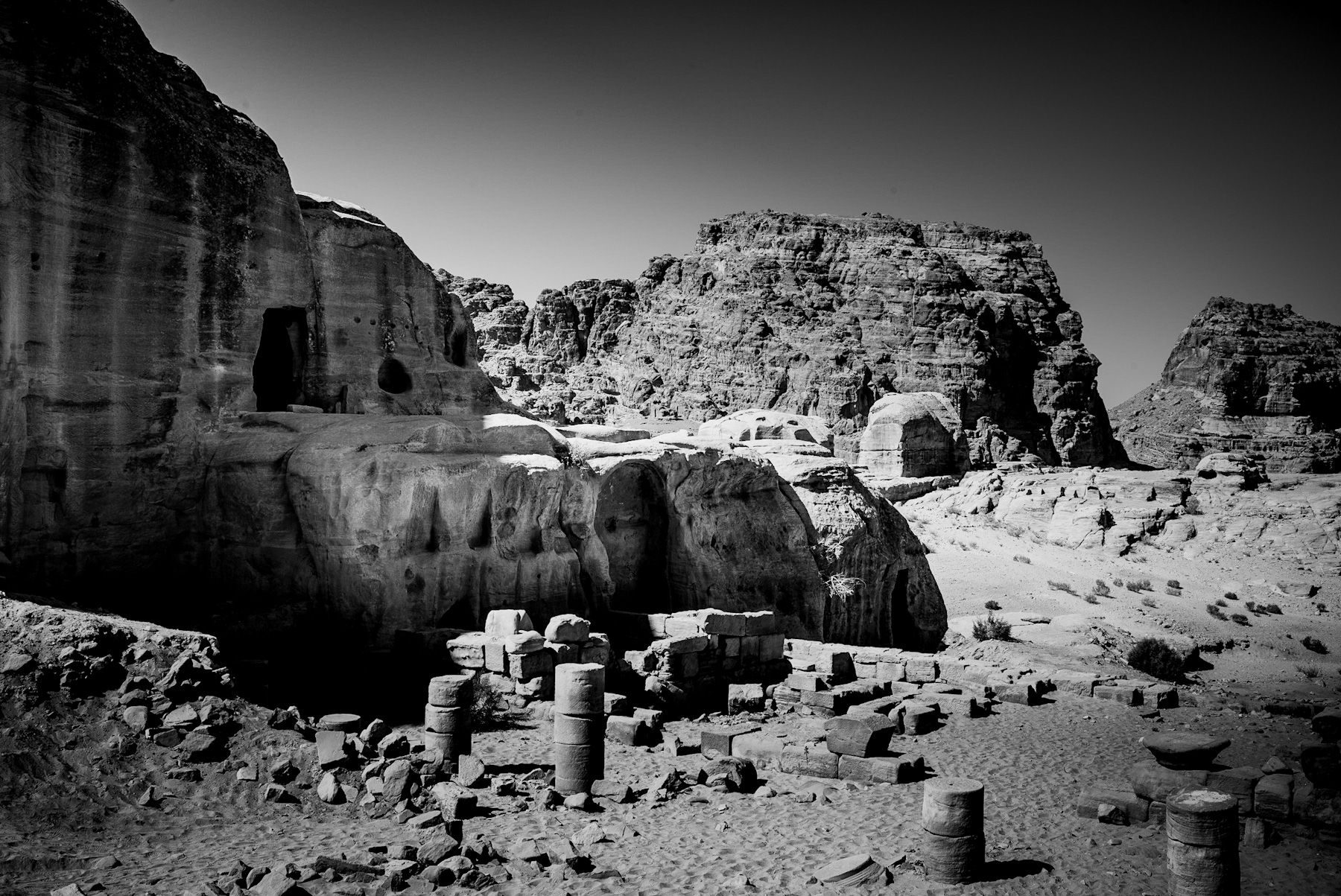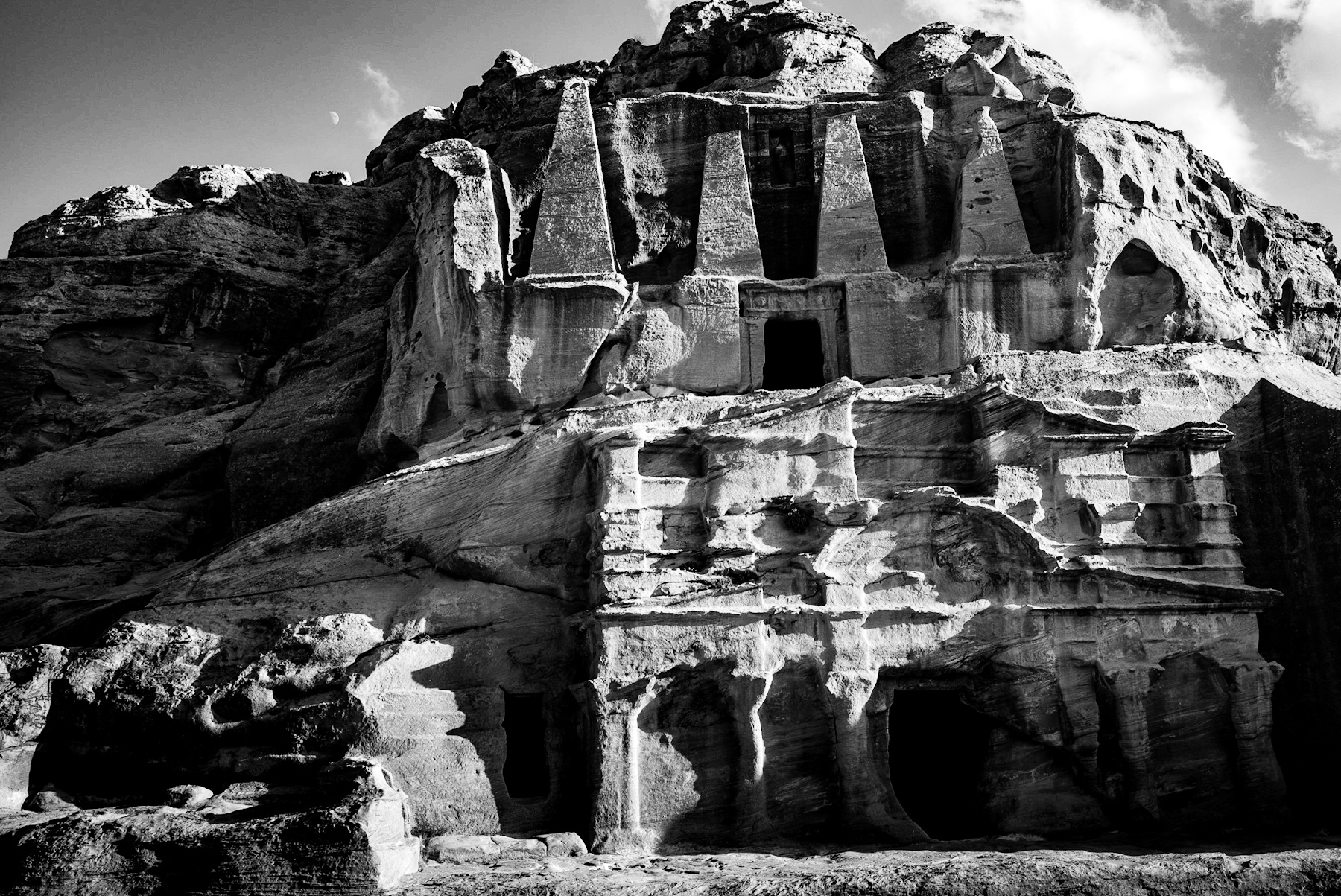
The striking black and white photograph captures a monumental façade carved directly into the sandstone cliffs of Petra, Jordan. Bathed in a dramatic interplay of light and shadow, the image accentuates the intricate details and colossal scale of ancient rock-cut architecture. Above the rugged peaks, a subtle crescent moon hangs, adding a timeless, almost mystical quality to the scene. This structure, known as the Urn Tomb, stands as a profound testament to the ingenuity and cultural sophistication of the Nabataean civilization.
Visual Grandeur and Architectural Detail
The composition immediately draws the eye to the multi-tiered structure dominating the frame. At its apex, four prominent, almost pyramidal or obelisk-like forms (known as *nefesh*) rise, signifying funerary monuments or cultic symbols. Below these, a series of carved recesses and entrances are visible, some appearing as dark voids, inviting contemplation of the secrets within. The main entrance, centrally located on a lower tier, is a deep, shadowed opening. Further down, the rock face reveals multiple levels of carving, featuring architectural elements like pilasters, cornices, and smaller niches, many eroded by centuries of wind and sand. The rough texture of the natural rock contrasts sharply with the relatively smooth, though weathered, surfaces of the carved edifice, highlighting the immense human effort involved in shaping this landscape. The stark monochrome palette emphasizes the architectural forms, textures, and the dramatic depth created by the sun’s angle.
The Nabataean Legacy: Masters of Rock and Trade
This magnificent structure is a prime example of the unique rock-cut architecture for which Petra, the ancient capital of the Nabataeans, is globally renowned. The Nabataeans were an ancient Arab people who flourished from roughly the 4th century BCE until their annexation by the Roman Empire in 106 CE. Situated strategically along vital trade routes connecting Arabia, Mesopotamia, and the Mediterranean, Petra became a wealthy and powerful hub. Their mastery of hydraulic engineering, evident in the complex water systems that sustained their desert city, allowed them to thrive in an arid environment.
The Urn Tomb itself is one of the grandest of Petra’s „Royal Tombs,“ a series of monumental burial sites located on the eastern cliff face of Jabal al-Khubtha. Scholars believe it was likely constructed in the mid-1st century CE, possibly serving as the tomb for a Nabataean king, such as Malichus II, or a prominent royal family. Its design reflects a sophisticated blend of Hellenistic and Roman architectural influences, seamlessly integrated with indigenous Nabataean styles, a characteristic feature of their capital city.
A Site of Enduring Significance
Beyond its original function as a tomb, the Urn Tomb underwent a significant transformation in 446 CE when it was converted into a Byzantine church. This adaptation involved the removal of internal burial chambers and the addition of an apse and altar, illustrating the continuous use and repurposing of these ancient structures across different eras and cultures. This historical layering adds another dimension to Petra’s rich narrative, showcasing its enduring importance as a spiritual and civic center.
Today, Petra stands as a UNESCO World Heritage site and one of the New7Wonders of the World, attracting visitors from across the globe. The Urn Tomb, with its imposing presence and deeply etched history, remains a powerful symbol of Nabataean artistry and their lasting impact on the ancient world. Exploring such sites offers a tangible connection to civilizations past, inviting reflection on human ambition, architectural prowess, and the relentless march of time.
Visual Grandeur and Architectural Detail
The composition immediately draws the eye to the multi-tiered structure dominating the frame. At its apex, four prominent, almost pyramidal or obelisk-like forms (known as *nefesh*) rise, signifying funerary monuments or cultic symbols. Below these, a series of carved recesses and entrances are visible, some appearing as dark voids, inviting contemplation of the secrets within. The main entrance, centrally located on a lower tier, is a deep, shadowed opening. Further down, the rock face reveals multiple levels of carving, featuring architectural elements like pilasters, cornices, and smaller niches, many eroded by centuries of wind and sand. The rough texture of the natural rock contrasts sharply with the relatively smooth, though weathered, surfaces of the carved edifice, highlighting the immense human effort involved in shaping this landscape. The stark monochrome palette emphasizes the architectural forms, textures, and the dramatic depth created by the sun’s angle.
The Nabataean Legacy: Masters of Rock and Trade
This magnificent structure is a prime example of the unique rock-cut architecture for which Petra, the ancient capital of the Nabataeans, is globally renowned. The Nabataeans were an ancient Arab people who flourished from roughly the 4th century BCE until their annexation by the Roman Empire in 106 CE. Situated strategically along vital trade routes connecting Arabia, Mesopotamia, and the Mediterranean, Petra became a wealthy and powerful hub. Their mastery of hydraulic engineering, evident in the complex water systems that sustained their desert city, allowed them to thrive in an arid environment.
The Urn Tomb itself is one of the grandest of Petra’s „Royal Tombs,“ a series of monumental burial sites located on the eastern cliff face of Jabal al-Khubtha. Scholars believe it was likely constructed in the mid-1st century CE, possibly serving as the tomb for a Nabataean king, such as Malichus II, or a prominent royal family. Its design reflects a sophisticated blend of Hellenistic and Roman architectural influences, seamlessly integrated with indigenous Nabataean styles, a characteristic feature of their capital city.
A Site of Enduring Significance
Beyond its original function as a tomb, the Urn Tomb underwent a significant transformation in 446 CE when it was converted into a Byzantine church. This adaptation involved the removal of internal burial chambers and the addition of an apse and altar, illustrating the continuous use and repurposing of these ancient structures across different eras and cultures. This historical layering adds another dimension to Petra’s rich narrative, showcasing its enduring importance as a spiritual and civic center.
Today, Petra stands as a UNESCO World Heritage site and one of the New7Wonders of the World, attracting visitors from across the globe. The Urn Tomb, with its imposing presence and deeply etched history, remains a powerful symbol of Nabataean artistry and their lasting impact on the ancient world. Exploring such sites offers a tangible connection to civilizations past, inviting reflection on human ambition, architectural prowess, and the relentless march of time.