• Echoes in Stone: A Geological Tapestry in Monochrome

    Echoes in Stone: A Geological Tapestry in Monochrome

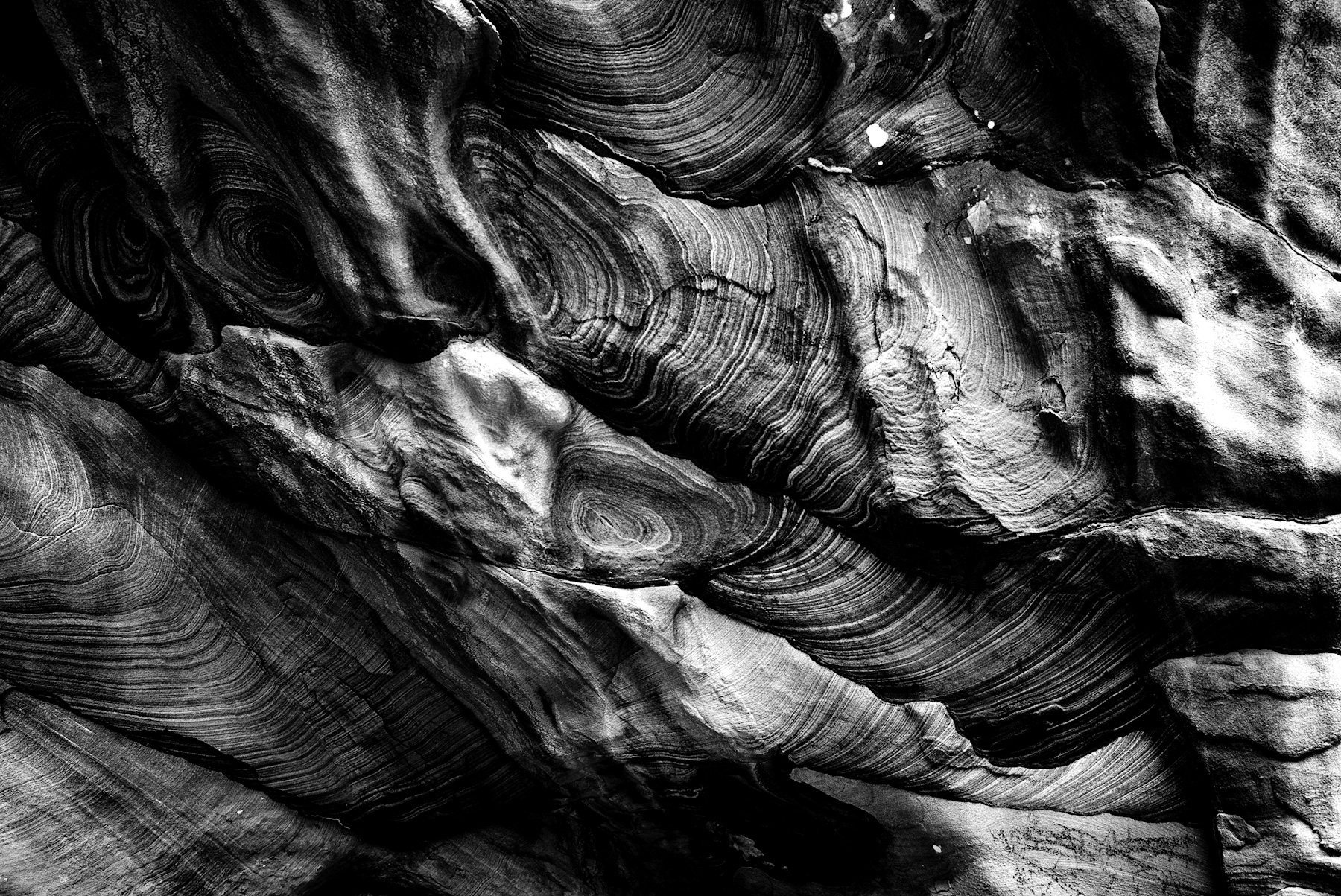
    The image presents a striking close-up of intricate rock formations, rendered in a high-contrast black and white palette. This powerful photographic composition transforms natural geology into an abstract masterpiece, inviting viewers to explore the profound textures and patterns etched into the Earth’s ancient crust. The interplay of light and shadow accentuates every undulation, every curve, and every subtle stratification, creating a dynamic visual narrative of time and transformation.
    Unveiling Nature’s Abstract Canvas
    At first glance, the photograph captivates with its organic, almost fluid, forms. Dominant features include swirling, concentric patterns that resemble petrified whirlpools or ancient tree rings, deeply embedded within the rock face. These „eyes“ or „knots“ of stone draw the viewer’s gaze, hinting at forces that shaped them with immense power and precision. Adjacent to these intricate circles, broad bands of varying shades of grey sweep across the frame, suggesting layers of sediment laid down over countless millennia. The surface is rich with fine lines and subtle cracks, indicating the material’s inherent structure and the persistent effects of erosion.
    The monochromatic treatment of the image strips away the distractions of color, focusing solely on form, texture, and tonal range. This artistic choice amplifies the raw, primordial essence of the rock, allowing the viewer to appreciate the delicate balance between ruggedness and refined detail. Bright highlights illuminate the highest points and edges, while deep, velvety shadows recede into unseen crevices, imparting a profound sense of depth and dimensionality to the geological landscape. This close-up perspective transforms the macroscopic into the microscopic, revealing a universe of detail within a seemingly simple stone.
    A Journey Through Geological Time
    The historical background of such rock formations stretches back millions of years, a testament to Earth’s continuous geological processes. The patterns observed in the image are characteristic of sedimentary rocks, most likely sandstone, which forms from the accumulation and compaction of sand grains over vast periods. The distinct layering, or stratification, visible throughout the image is a direct record of successive depositional events – perhaps ancient riverbeds, migrating sand dunes, or shallow marine environments.
    The remarkable swirling and concentric patterns could be attributed to several geological phenomena. One possibility is cross-bedding, where layers of sediment are deposited at an angle to the main bedding plane, often formed by the migration of ripples or dunes under the influence of water or wind currents. Another explanation could be Liesegang rings, a natural phenomenon involving the rhythmic precipitation of minerals within a porous rock, creating banded patterns similar to those seen in the photograph. Furthermore, the relentless forces of water erosion, particularly in environments like slot canyons, can carve and polish rock surfaces into such sensuous, undulating forms, exposing the internal structure and inherent beauty of the stone. Each curve and line is a chapter in Earth’s autobiography, chronicling epochs of deposition, lithification, uplift, and erosion.
    Monochrome’s Timeless Narrative
    The choice of black and white photography for this subject is particularly apt. It enhances the timeless quality of the rock, evoking a sense of antiquity that transcends specific geological periods. Without the distraction of color, the viewer is compelled to confront the pure sculptural quality of nature, appreciating the abstract art created by natural forces. This image serves as a powerful reminder of the Earth’s dynamic history, inviting contemplation on the immense scales of time and the patient artistry of geological processes. It is a visual ode to the enduring beauty and profound stories hidden within the very ground we stand upon.
  • The Timeless Grandeur of Petra’s Treasury: A Glimpse Through the Siq

    The Timeless Grandeur of Petra’s Treasury: A Glimpse Through the Siq

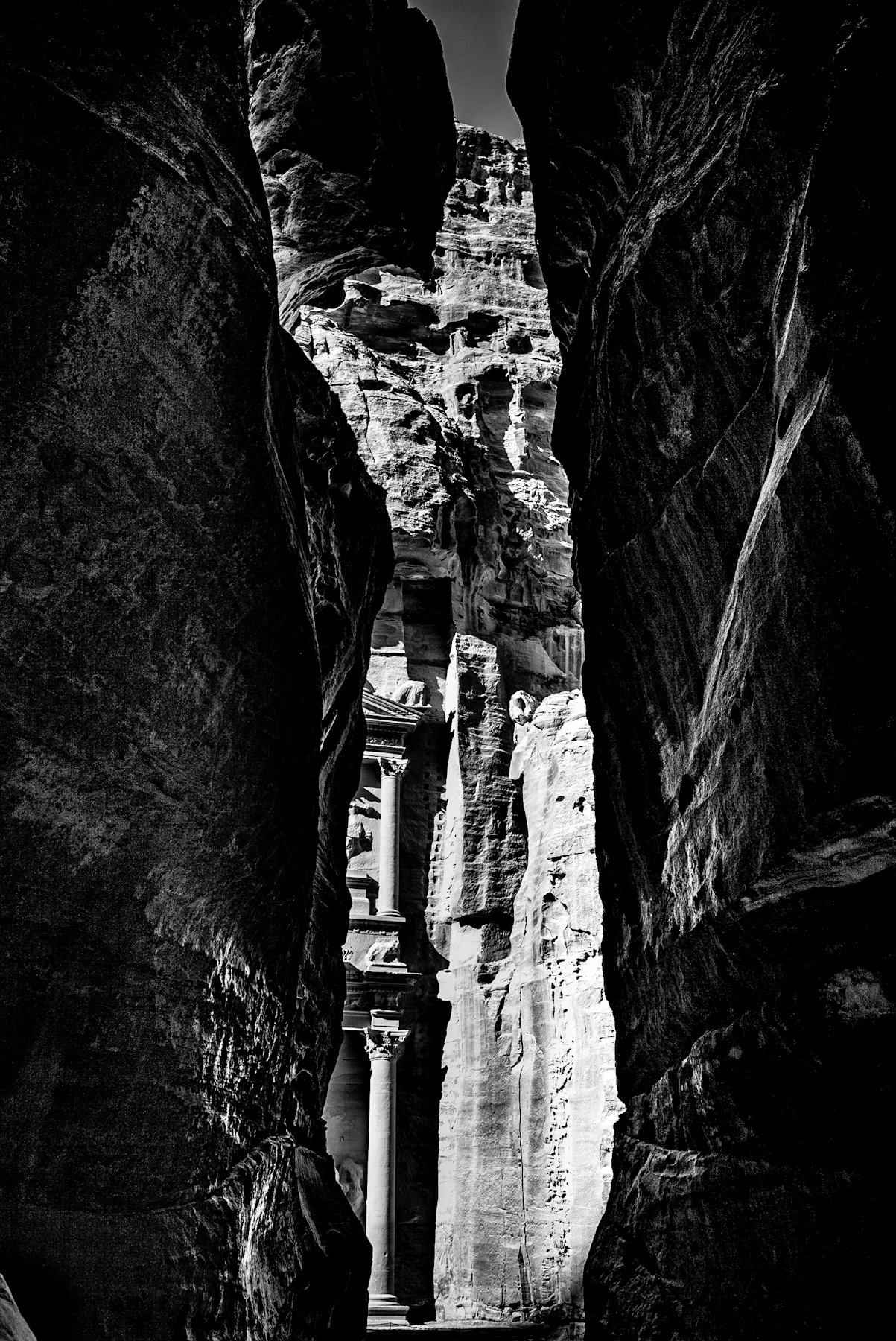
    The accompanying image presents a captivating black and white perspective of Al-Khazneh, commonly known as The Treasury, one of the most iconic structures within the ancient city of Petra, Jordan. Framed dramatically by the towering, shadowed walls of the Siq, the narrow gorge that serves as the primary entrance to Petra, the photograph masterfully captures the architectural marvel emerging from the sandstone cliffs.
    A Striking Visual Narrative
    The monochromatic palette of the image accentuates the profound textures and contrasts inherent in Petra’s landscape. Deep shadows on the foreground rock faces on either side create a powerful visual funnel, drawing the eye directly to the illuminated facade of The Treasury. The intricate details of its Hellenistic architecture, including the towering columns and carved pediments, become apparent despite the partial concealment. The play of light and shadow emphasizes the sheer scale of both the natural rock formations and the man-made structure, highlighting the unique integration of art and environment. The raw, striated surfaces of the Siq walls contrast with the refined, classical lines of the monument, underscoring the journey from the natural world into a realm of ancient human ingenuity.
    Petra: Echoes of an Ancient Civilization
    Petra, a UNESCO World Heritage Site and one of the New7Wonders of the World, stands as a testament to the ingenuity of the Nabataeans, an ancient Arab people who established it as their capital around the 4th century BCE. Strategically located along vital trade routes connecting Arabia, Egypt, and the Levant, Petra flourished as a bustling hub for incense, spices, and other goods. Its unique desert environment also necessitated advanced hydraulic engineering, with the Nabataeans developing sophisticated systems to collect and store water.
    Al-Khazneh: The Treasury’s Enduring Mystery
    Al-Khazneh, meaning „The Treasury,“ is perhaps the most famous and well-preserved structure in Petra. Carved directly into the vibrant sandstone cliff face, its name derives from local Bedouin legends suggesting it once held pharaoh’s treasure. While its exact purpose remains debated by archaeologists, the prevailing theory is that it served as the mausoleum for Nabataean King Aretas IV in the 1st century CE, or perhaps as a temple.
    Architecturally, The Treasury showcases a remarkable fusion of Nabataean rock-carving traditions with classical Greek and Roman influences. Its elaborate facade features six Corinthian columns, intricate friezes, and statues of mythical figures and deities. The structure’s grandeur and its unexpected reveal at the end of the winding Siq were undoubtedly intended to impress visitors and assert the power and sophistication of the Nabataean kingdom.
    The Journey Through the Siq
    The experience of approaching The Treasury, as hinted at by the photograph’s perspective, is an integral part of its allure. The Siq itself is a natural geological fault, a narrow canyon stretching over a kilometer, with towering cliffs reaching up to 80 meters high. As one navigates its winding path, the anticipation builds, culminating in the dramatic reveal of Al-Khazneh through the final crack in the rock. This sensory journey, from the confined, shadowed passage to the sudden emergence into the sunlit grandeur of The Treasury, creates an unforgettable encounter with history and architectural brilliance.
    Petra continues to draw visitors from across the globe, eager to witness the legacy of a remarkable civilization carved into the very earth itself. The image provides a powerful reminder of this ancient wonder’s enduring presence and its capacity to inspire awe.
  • Echoes in Stone: A Timeless Desert Landscape

    Echoes in Stone: A Timeless Desert Landscape

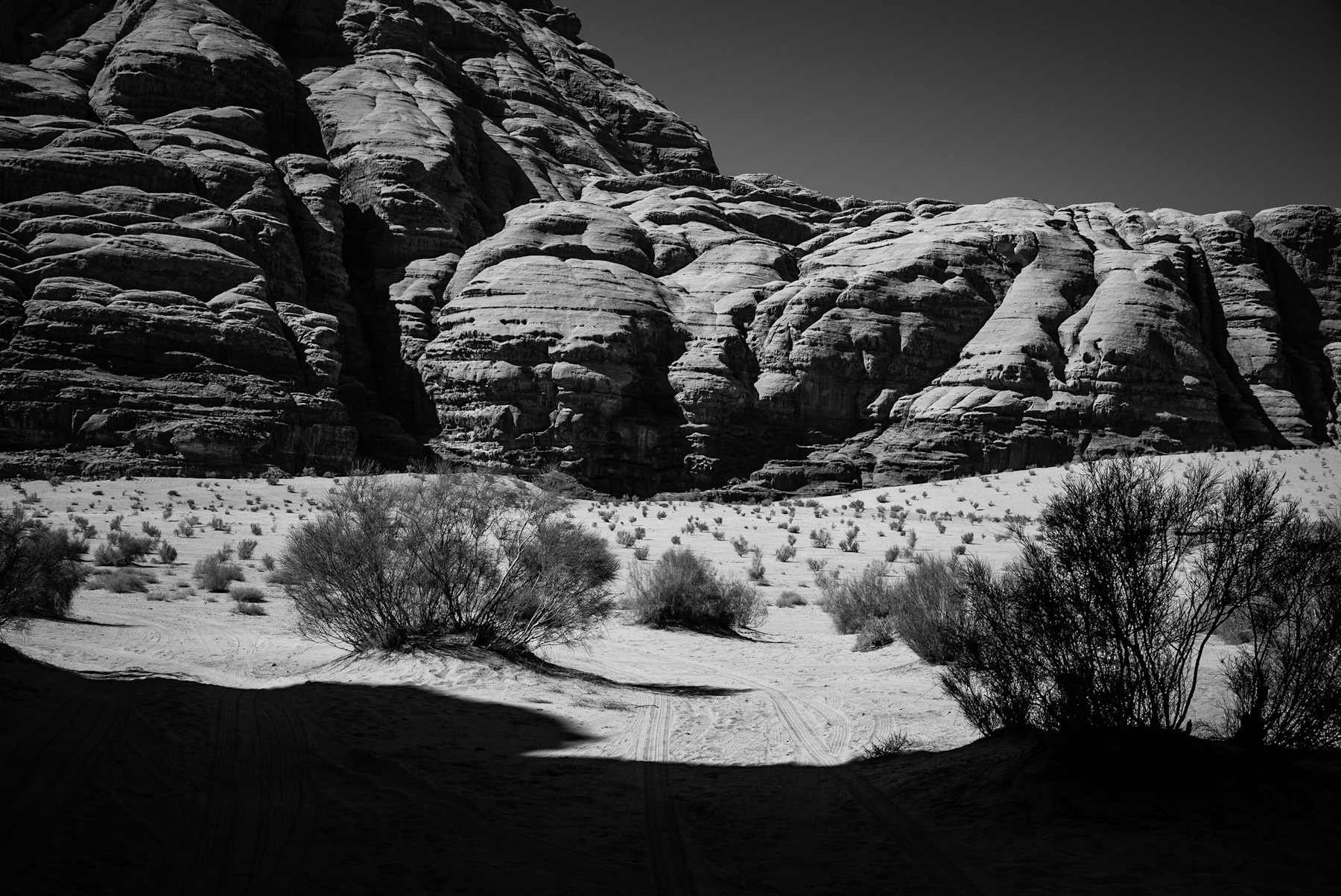
    The image presents a stark, majestic desert landscape rendered in powerful black and white, immediately drawing the viewer into a realm of ancient grandeur. Towering rock formations dominate the upper frame, their surfaces intricately layered and sculpted by millennia of wind and erosion. These colossal structures, likely sandstone, display a complex topography of ridges, crevices, and rounded contours, emphasizing their immense scale and geological history. The absence of color enhances the dramatic interplay of light and shadow, revealing textures and forms that might otherwise be less pronounced. Deep shadows carve out valleys and accentuate the ruggedness, hinting at the harsh, intense sunlight characteristic of such arid regions.
    Below these formidable peaks, a vast expanse of sandy terrain stretches forward. The foreground is marked by gentle undulations and subtle ripples in the sand, suggesting the constant movement of desert winds. Sparse, resilient desert shrubs, characterized by their dense, twiggy branches, are scattered across this sandy plain. Their silhouette, particularly those closer to the viewer, adds a sense of depth and scale, contrasting with the smooth, bright sand. Visible tire tracks cut across the sandy surface, a subtle yet significant detail that introduces a contemporary human element into this otherwise timeless vista, indicating passage and exploration in a remote environment. The dark, sweeping shadow in the lower left foreground further frames the scene, adding to the dramatic contrast and depth of field.
    Geologically, landscapes such as this are a testament to vast stretches of Earth’s history. Formed over millions of years through sedimentary processes and subsequent erosion, these rock formations often consist of sandstone, a material susceptible to the sculpting power of wind and occasional water. The distinct layering visible in the rock faces tells a story of ancient seabeds, river deltas, or vast sand dunes, compacted and uplifted over geological eras. The arid environment, while seemingly barren, is a dynamic system where geological forces continue to shape the terrain, creating the iconic features seen in this photograph.
    Historically, these desert environments, particularly those found in the Arabian Peninsula, are rich with human narrative. Regions like Wadi Rum in Jordan, which this landscape closely resembles, have served as a crucible for civilizations and a backdrop for pivotal historical events. Evidence of ancient cultures, including the Thamudic and Nabataean peoples, can be found in rock carvings and inscriptions, testifying to millennia of human presence and adaptation to these challenging conditions. These deserts were vital pathways for ancient trade routes, connecting civilizations and facilitating cultural exchange across vast distances.
    Perhaps the most renowned historical association for such landscapes in the modern era is with T.E. Lawrence, or Lawrence of Arabia. During the Arab Revolt against the Ottoman Empire in World War I, these deserts provided strategic cover and logistical challenges for the Arab forces. Lawrence’s exploits, chronicled in his work „Seven Pillars of Wisdom,“ vividly portray the arduous yet awe-inspiring nature of this terrain, highlighting its role in shaping the course of history. The Bedouin tribes, with their deep understanding of desert survival and their enduring nomadic traditions, have been the perennial inhabitants and guardians of these lands, their heritage intertwined with every dune and rock formation.
    The black and white rendition of this desert landscape strips away the distractions of color, inviting a deeper contemplation of its form, texture, and the profound historical echoes it holds. It emphasizes the raw power of nature and the enduring spirit of human endeavor against a backdrop of ancient stone and shifting sands. This image captures not just a place, but a legacy, where geological time meets human history in a timeless, majestic embrace.
  • Silent Sentinels: Unveiling Petra’s Royal Tombs and Ancient Legacy

    Silent Sentinels: Unveiling Petra’s Royal Tombs and Ancient Legacy

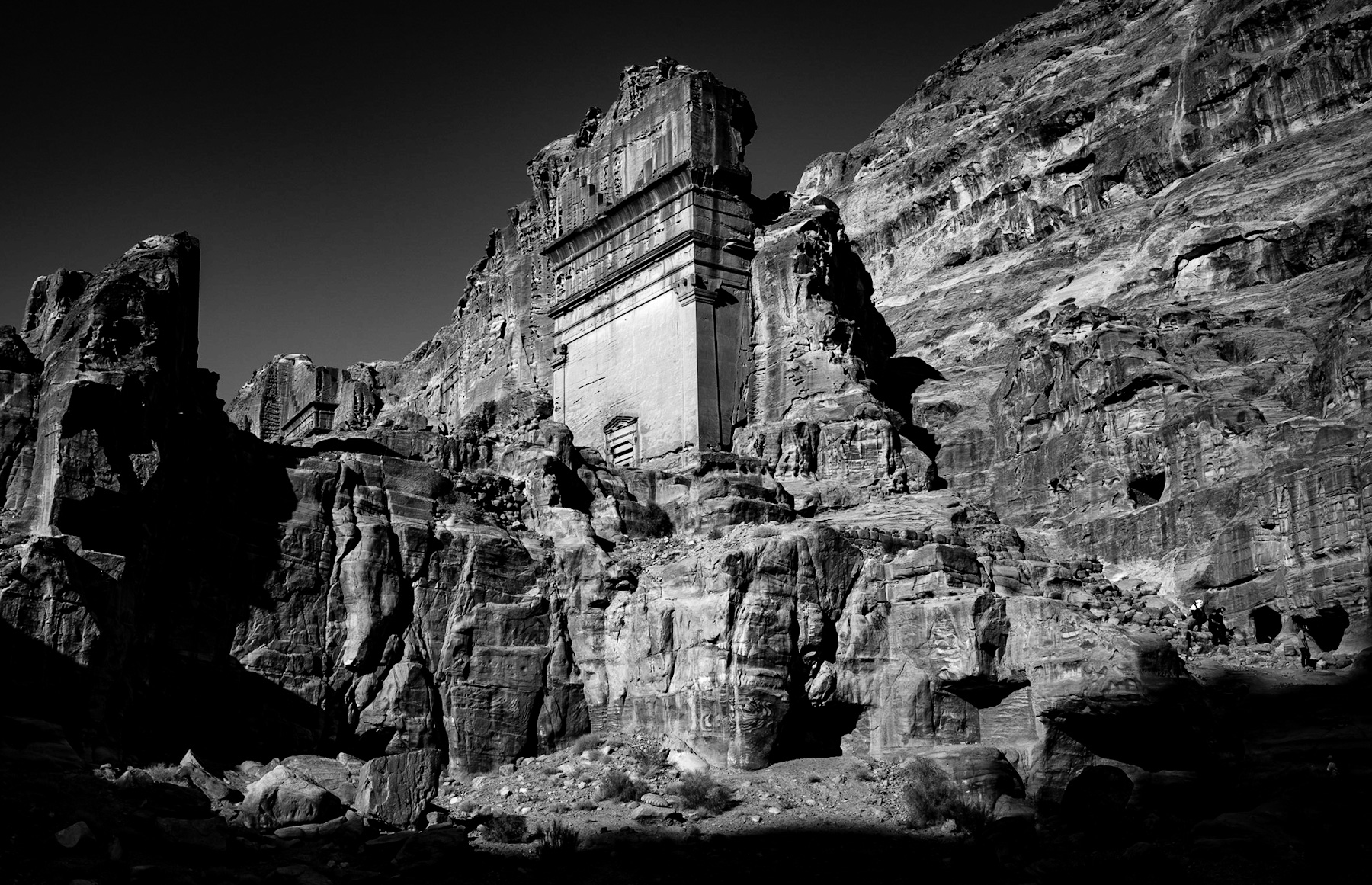
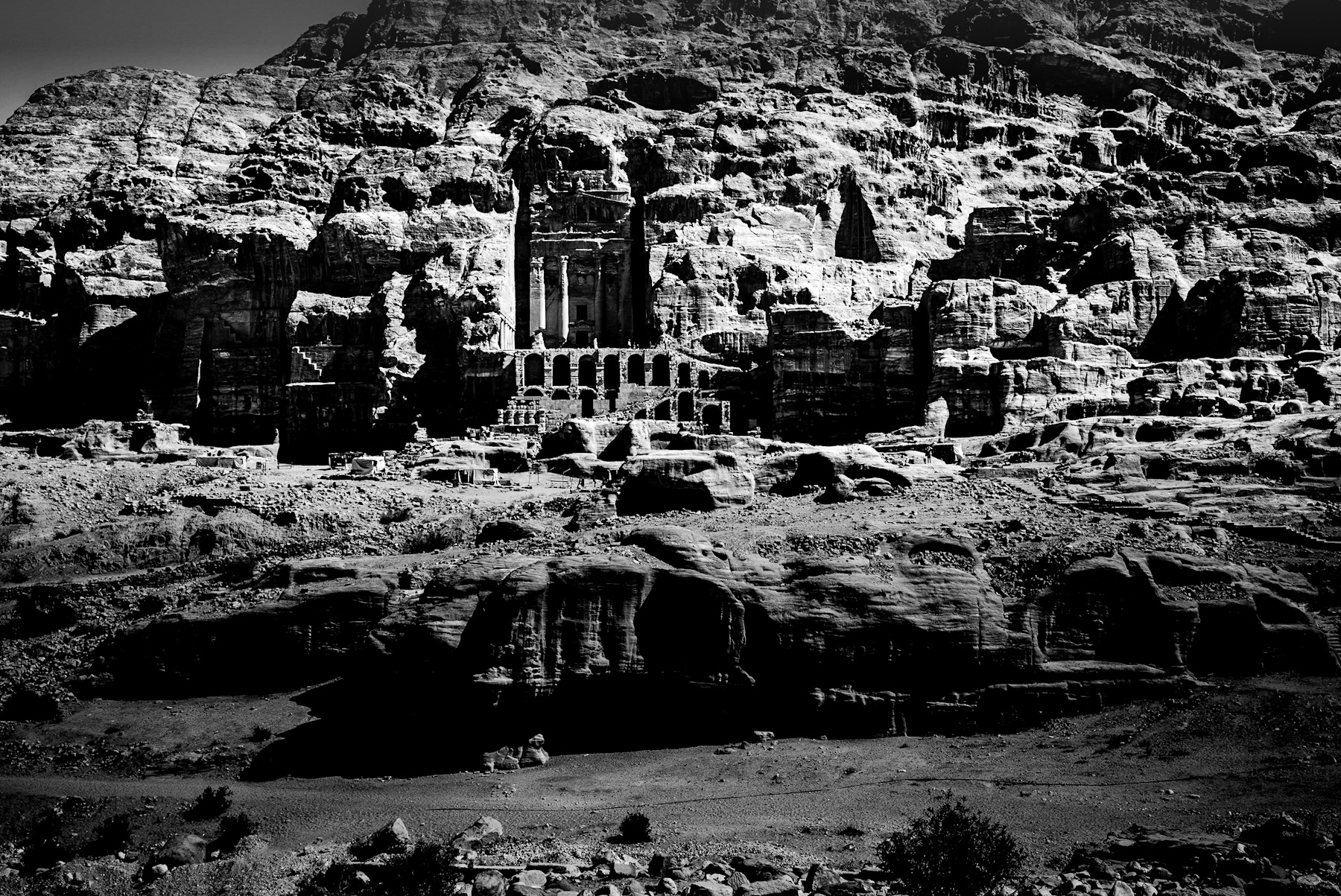
    The monochrome photograph captures a monumental façade carved directly into the rugged sandstone cliffs of Petra, Jordan. This dramatic image showcases the sheer scale and intricate detail of Nabataean rock-cut architecture, specifically highlighting what is widely recognized as the Urn Tomb, a jewel within the sprawling complex of the Royal Tombs. The stark black and white rendering emphasizes the textures of the weathered rock and the interplay of sunlight and deep shadows, lending a timeless, almost ethereal quality to this ancient marvel.
    In the foreground, the rough, uneven terrain suggests the natural desert environment, interspersed with smaller rock formations and remnants of human activity, perhaps archaeological digs or pathways. As the eye moves upwards, the colossal scale of the cliff face becomes apparent, with the central Urn Tomb dominating the composition. Its classical architectural elements—columns, pediments, and a grand entrance—are meticulously carved into the living rock, demonstrating an extraordinary level of craftsmanship and engineering prowess. Below the main tomb, a series of arched chambers and lower structures, also carved from the rock, suggest further uses, possibly as dwellings or additional burial sites, hinting at the extensive infrastructure that once supported this vibrant ancient city.
    Emerging from the desert landscape, Petra was once the thriving capital of the Nabataean Kingdom, an influential Arab people who controlled major trade routes connecting Arabia with the Mediterranean world from the 4th century BCE to the 1st century CE. Their wealth, derived from frankincense, myrrh, and spices, funded the construction of this extraordinary city, which served not only as a commercial hub but also as a testament to their sophisticated culture and artistic sensibilities. The Nabataeans were masters of hydraulic engineering, developing complex systems to manage and conserve water in this arid region, allowing their city to flourish.
    The prominent structure in the image, the Urn Tomb, is part of the larger complex known as the Royal Tombs of Petra. Characterized by its monumental façade, featuring a two-story arrangement of columns and a central entrance, it culminates in a large urn-shaped finial atop its pediment – a distinctive element that gives the tomb its modern name. This grand edifice, likely constructed in the mid-1st century CE, is believed to have served as the burial place for a Nabataean king, possibly Malichus II or Aretas IV, underscoring the power and sophistication of the Nabataean elite. Its architectural style is a fascinating blend of Hellenistic and Roman influences, seamlessly integrated with indigenous Nabataean artistic traditions. The impressive scale and intricate details of the Urn Tomb reflect the Nabataeans‘ reverence for their rulers and their belief in an afterlife.
    Centuries later, during the Byzantine era, the Urn Tomb underwent a significant transformation, being converted into a cathedral, a testament to the site’s enduring importance and adaptability throughout different historical periods. Today, Petra stands as a UNESCO World Heritage site, an archaeological marvel that continues to captivate researchers and visitors alike. The black and white rendition of this scene enhances the timeless quality of the stone, drawing attention to the textures and shadows that define these ancient structures. It serves as a powerful reminder of human ingenuity and the civilizations that once flourished in challenging desert environments. Exploring these ancient wonders of Jordan offers a profound connection to a rich and complex past, inviting contemplation on the rise and fall of empires and the enduring legacy etched in stone.
  • Echoes in Stone: Unveiling Ancient Desert Civilizations

    Echoes in Stone: Unveiling Ancient Desert Civilizations

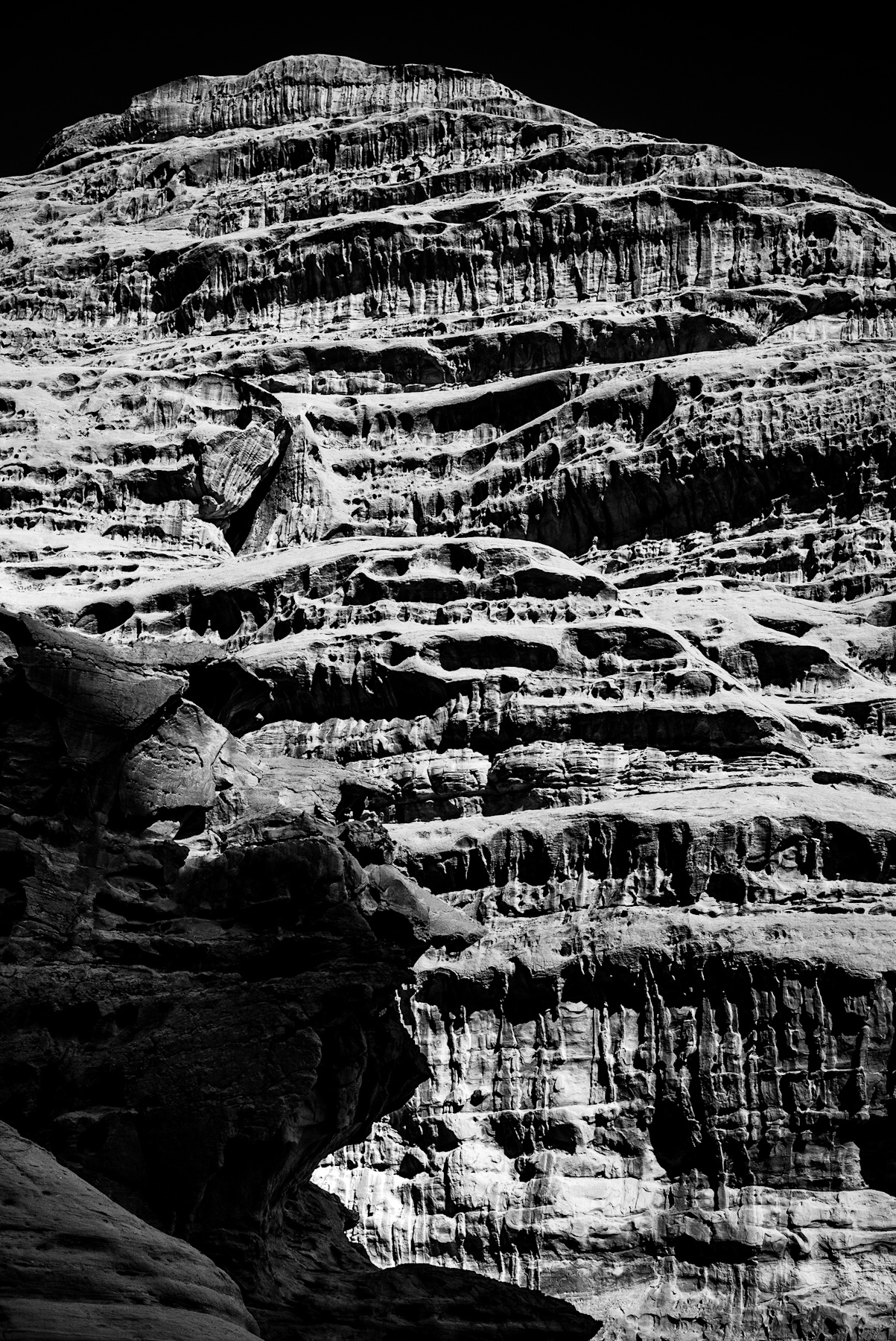
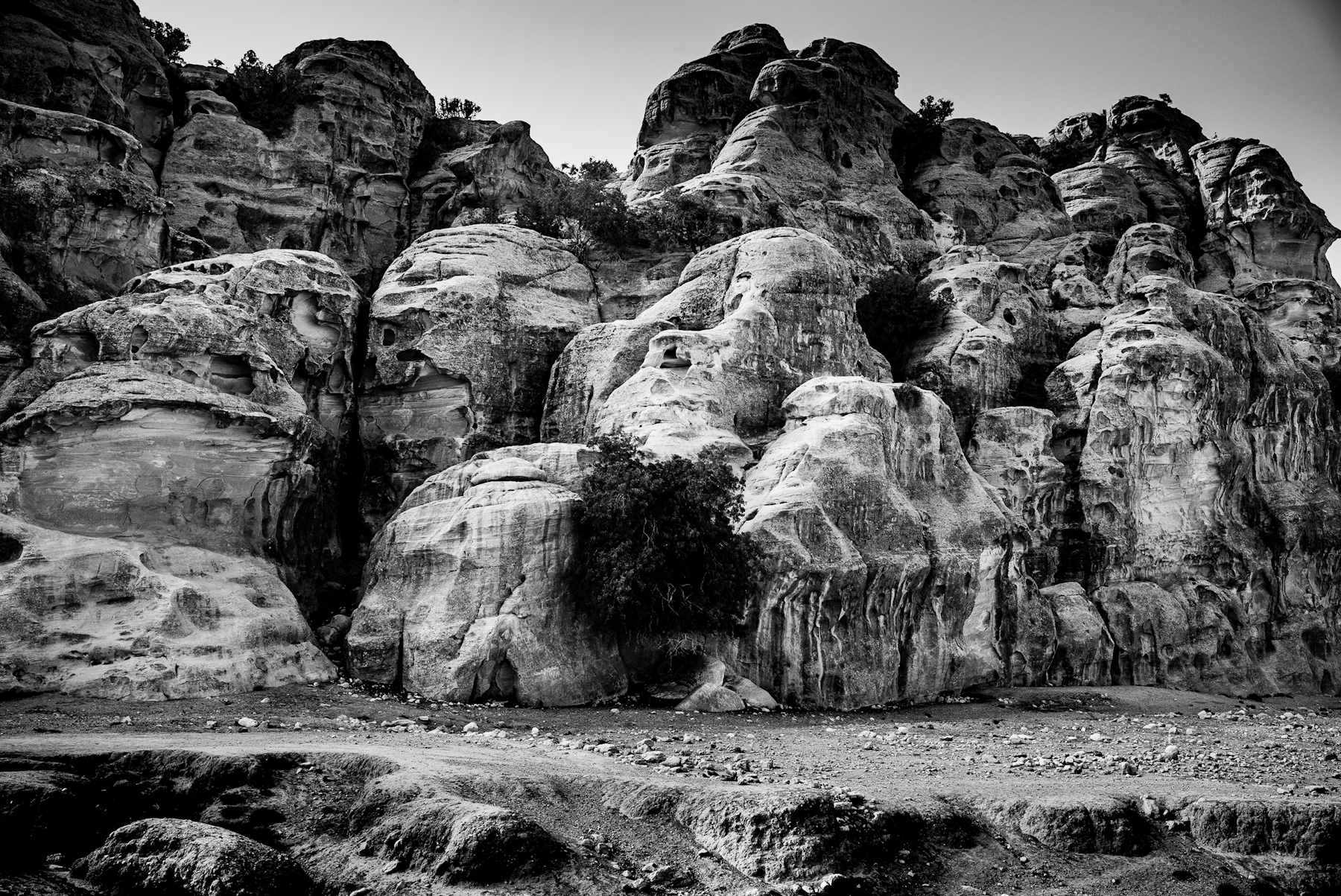
    The stark monochrome captured in this image presents an intricate geological masterpiece, a colossal rock face sculpted by millennia of natural forces. Layers upon layers of sedimentary rock, predominantly sandstone, form horizontal strata, each band telling a story of deposition and compression over vast geological timescales. The dramatic interplay of light and shadow accentuates the deep textures, revealing a landscape that is both awe-inspiring in its scale and mesmerizing in its detail.
    **Nature’s Masterpiece: A Tapestry of Erosion and Time**
    Visually, the photograph highlights the profound impact of erosion. Wind and water have carved countless vertical striations, resembling ancient drapery or the flow of petrified waterfalls down the cliff face. Interspersed within these patterns are numerous small, irregular cavities and larger, cavernous openings. These formations suggest a highly porous and malleable stone, where differential erosion has created a honeycomb effect in some areas, contrasting with more robust, overhanging ledges. The black and white rendition strips away color, emphasizing form, texture, and the raw power of nature’s artistry, transforming the scene into an almost abstract composition of light and dark.
    **From Geological Foundations to Ancient Adaptations**
    Such magnificent sandstone formations are characteristic of ancient desert environments, particularly those found in regions like the Middle East. Geologically, these cliffs are often composed of various sandstone types, laid down in ancient seas or vast desert plains millions of years ago. The erosion processes observed—aeolian (wind) and fluvial (water)—are typical of arid and semi-arid climates, slowly but relentlessly shaping the landscape into dramatic canyons, mesas, and natural rock shelters. Historically, these natural formations were not merely geological curiosities but vital resources for human civilization. The very cavities and sheltered ledges visible in the photograph would have provided essential refuge from the harsh desert elements. Early nomadic tribes and settled communities alike sought out such natural protection, adapting these spaces for shelter, storage, and even sacred purposes.
    **The Enduring Legacy of Rock-Cut Architecture**
    The visual evidence in the image strongly resonates with sites like Petra in modern-day Jordan, a UNESCO World Heritage site and a testament to the ingenuity of the ancient Nabataeans. This Semitic people, flourishing from roughly the 4th century BCE, carved an entire city directly into the rose-red sandstone cliffs. They transformed natural caves into elaborate tombs, temples, and dwellings, integrating their architectural prowess with the existing geology. The intricate layering and potential for rock-cut features seen here are hallmarks of such Nabataean engineering. While the specific structures visible in the photograph may be entirely natural, the resemblance to the landscape surrounding Petra is striking. The Nabataeans mastered water collection and management in this arid environment, creating a thriving trade hub by controlling vital routes. Their civilization’s enduring legacy is etched into these very rocks, demonstrating a profound understanding of their environment and an extraordinary ability to adapt and thrive within it.
    **Preserving Ancient Narratives for Future Generations**
    This image serves as a powerful reminder of the deep connection between geological history and human cultural heritage. The ancient rock formations are not just silent witnesses to time; they are active participants in the narrative of human survival, ingenuity, and spiritual expression. Exploring such landscapes allows us to connect with the distant past, to appreciate the forces that shape our planet, and to marvel at the civilizations that found a way to live in harmony with these monumental natural wonders. Understanding these historical contexts enriches our appreciation for the enduring stories held within the stone, urging us to protect these irreplaceable testaments to both natural and human history.
  • Bankside’s Architectural Dialogue: Where Industrial Heritage Meets Modern Vision

    Bankside’s Architectural Dialogue: Where Industrial Heritage Meets Modern Vision

    This striking black and white photograph captures a quintessential London scene, a dynamic interplay between historical legacy and contemporary urban design. The monochrome palette accentuates the textures, forms, and dramatic contrasts that define this particular stretch of the city, inviting a closer look at its layered narrative.
    **A Glimpse into London’s Urban Fabric**
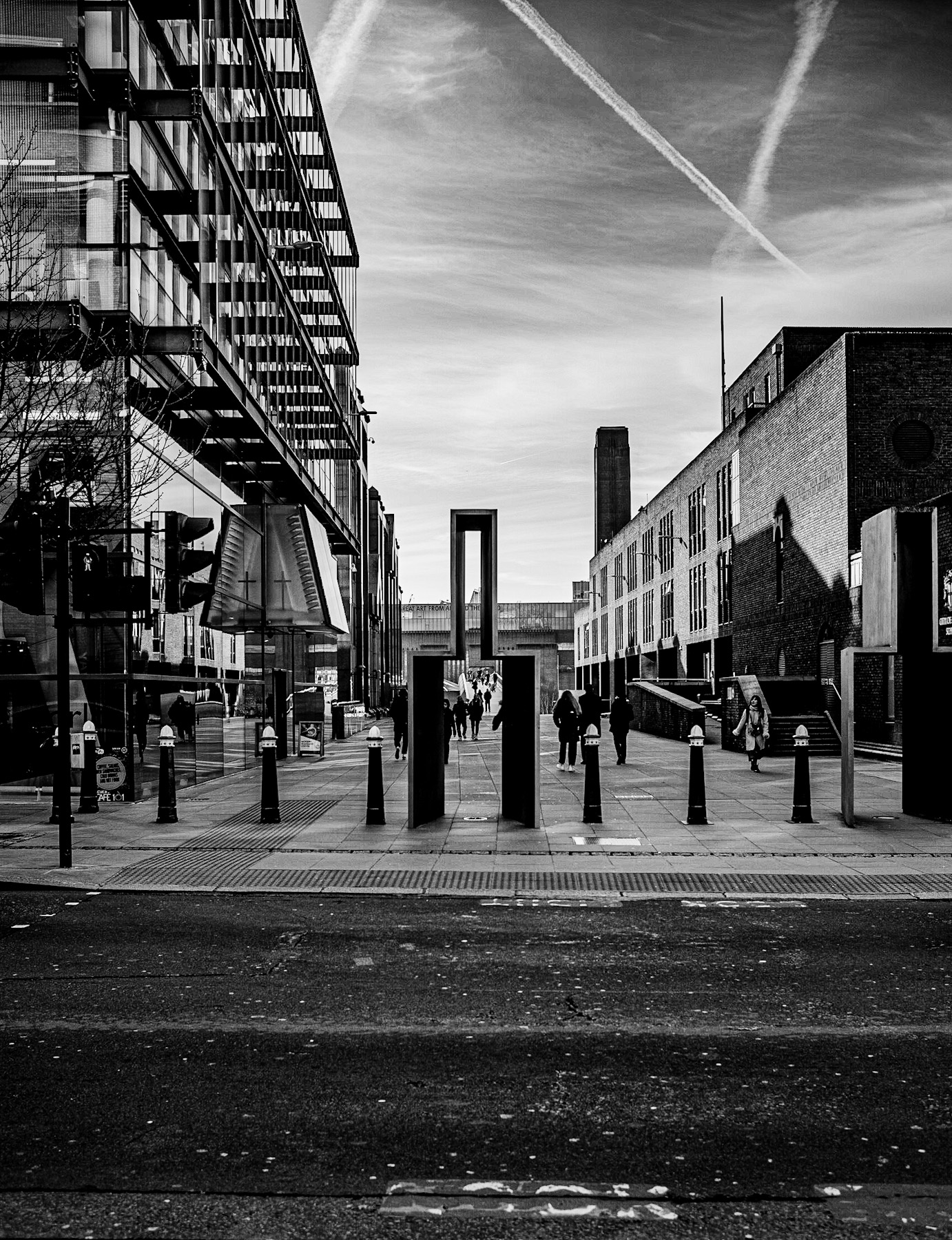
    The image is bisected by a broad pavement, leading the eye towards a distant, imposing structure. On the left, a modern building of glass and steel rises, its reflective surfaces mirroring the sky and fragments of the bare winter trees, creating a complex, almost fragmented visual. Its clean lines and transparency speak to contemporary architectural trends, embodying the continuous evolution of the city’s skyline. In contrast, the right side is dominated by a robust, brick-clad edifice, characterized by its sturdy construction and repetitive window patterns. This building’s heavy, textured facade immediately suggests an older, industrial past, a testament to a different era of urban development.
    **Echoes of Industrial Grandeur: The Tate Modern and Bankside**
    Central to understanding the historical context of this photograph is the prominent brick building on the right, which is unmistakably the former Bankside Power Station, now home to the world-renowned Tate Modern art gallery. Designed by Sir Giles Gilbert Scott, also known for Battersea Power Station and the iconic red telephone boxes, Bankside Power Station was a significant landmark of industrial might when it was operational from 1952 to 1981. Its colossal chimney, visible towering in the background, remains a powerful symbol of its past life, a silent sentinel over the Thames.
    The transformation of Bankside Power Station into the Tate Modern, which opened in 2000, represents a landmark achievement in urban regeneration and adaptive reuse. This conversion not only saved a significant piece of London’s industrial heritage but also repurposed it for a new cultural identity, making contemporary art accessible within a historically rich setting. The area surrounding the Tate Modern, known as Bankside, has since undergone extensive redevelopment, evolving from a post-industrial landscape into a vibrant cultural quarter.
    **Modern Interventions and Public Spaces**
    The foreground and mid-ground of the photograph showcase this ongoing transformation. The wide, pedestrian-friendly pavement is punctuated by a series of dark, rectangular, open-frame structures that act as both architectural elements and subtle public art installations. These modern interventions guide pedestrians and frame views, emphasizing the thoughtful design of public spaces in this regenerated district. People are seen traversing these pathways, a constant flow of life against the backdrop of architectural grandeur, highlighting the area’s role as a bustling hub for both locals and visitors.
    The sky, with its sweeping contrails, adds another layer of modernity, a fleeting reminder of global connectivity above a city deeply rooted in its past. The black and white treatment of the image enhances the dramatic interplay of light and shadow, emphasizing the structural integrity of the buildings and the dynamic patterns of human movement, creating a timeless yet contemporary urban narrative. This photograph encapsulates London’s genius for blending its rich history with an unyielding drive towards the future, making Bankside a compelling example of urban evolution.
  • Echoes of Time: London’s Architectural Dialogue in Moorgate

    Echoes of Time: London’s Architectural Dialogue in Moorgate

    The monochromatic lens captures a compelling urban narrative, illustrating the dynamic interplay between historical permanence and contemporary evolution within London’s financial heart. This photograph from Moorgate, EC2, presents a stark architectural juxtaposition, where centuries of urban development converge in a single frame, inviting contemplation on the city’s enduring character.
    A Glimpse of Modernity: The Glass Frontier
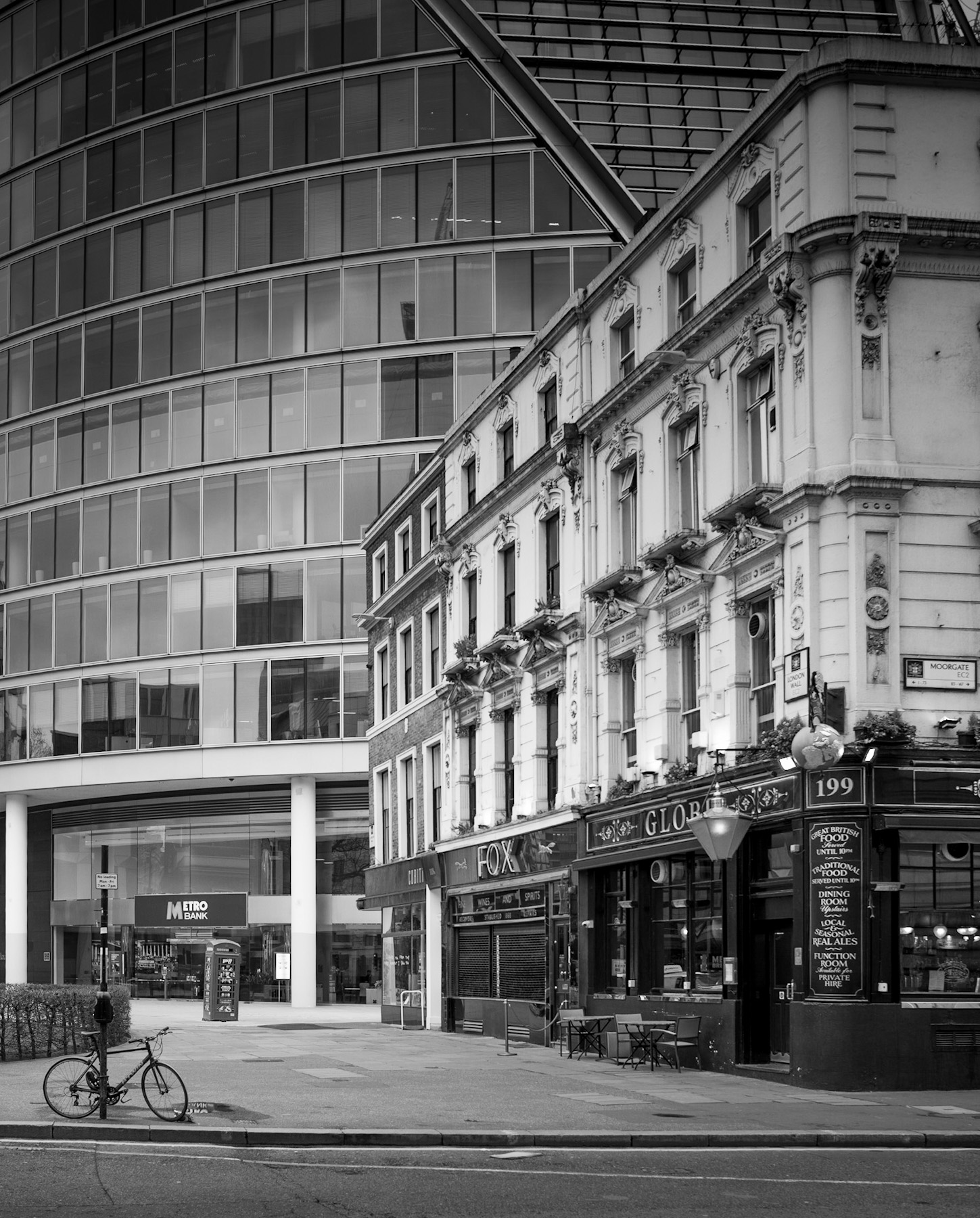
    Dominating the left side of the composition is a sleek, curvilinear glass edifice. Its façade, a meticulously arranged grid of reflective panels, speaks to a modern aesthetic of efficiency and transparency. This contemporary structure, likely an office building, embodies the ongoing transformation of the City of London into a global financial powerhouse. The smooth, unadorned surfaces and expansive windows reflect the surrounding environment, creating a sense of fluidity and integration, yet standing apart in its design philosophy. At its base, a Metro Bank branch signifies the commercial pulse of the area, a testament to the continuous economic activity that shapes this district.
    The Historic Anchor: Traditional London Pubs
    In sharp contrast, the right side of the image reveals an older, ornate building, characteristic of traditional British architecture. Its façade is rich with decorative elements: intricate cornices, detailed window mouldings, and classical embellishments that speak of a bygone era. This building houses „The Globe“ pub, a quintessential London establishment, and „Fox,“ another traditional venue. Pubs like The Globe are more than just drinking establishments; they are historic social institutions, often serving as community hubs, meeting places, and sometimes even informal courts or post offices throughout their long histories. The traditional lamp hanging above the pub’s entrance, alongside the outdoor seating, evokes a sense of timeless hospitality and continuity, a stark reminder of London’s rich cultural heritage. A street sign clearly marks „Moorgate EC2,“ grounding this scene in a historically significant part of the City.
    Juxtaposition and Urban Evolution
    The power of this photograph lies in its depiction of architectural juxtaposition. The modern glass structure, with its clean lines and expansive scale, represents London’s relentless drive towards the future, its role as a leading global city, constantly rebuilding and adapting. This ongoing renewal is a historical characteristic of London, evident after events like the Great Fire of 1666 and the Blitz of World War II, which necessitated widespread reconstruction and modernization.
    Conversely, the ornate traditional building embodies the deep historical layers of the City of London. Moorgate itself is situated within the ancient Roman walls of Londinium, an area that has been a center of commerce and civic life for millennia. The architectural style of the pub building likely dates back to the Victorian or Edwardian era, periods of significant growth and prosperity in London, where such decorative flourishes were common. These older buildings serve as tangible links to the city’s past, providing a sense of place and continuity amidst rapid change.
    London’s Enduring Character
    This black and white image transcends a mere depiction of buildings; it captures London’s unique urban identity. The co-existence of the ultra-modern and the deeply traditional is not merely an accident of planning but a defining characteristic of the city. It illustrates how London embraces innovation while fiercely preserving its heritage. The bicycle casually leaning against a lamppost further integrates a contemporary, sustainable mode of transport into this timeless streetscape, symbolizing the everyday life that unfolds against this rich historical backdrop. The photograph ultimately celebrates London’s ability to evolve without erasing its past, showcasing a city that is both a living museum and a beacon of modernity.
  • A Monochrome Moment: London’s King & Queen Pub, History, and Community

    A Monochrome Moment: London’s King & Queen Pub, History, and Community

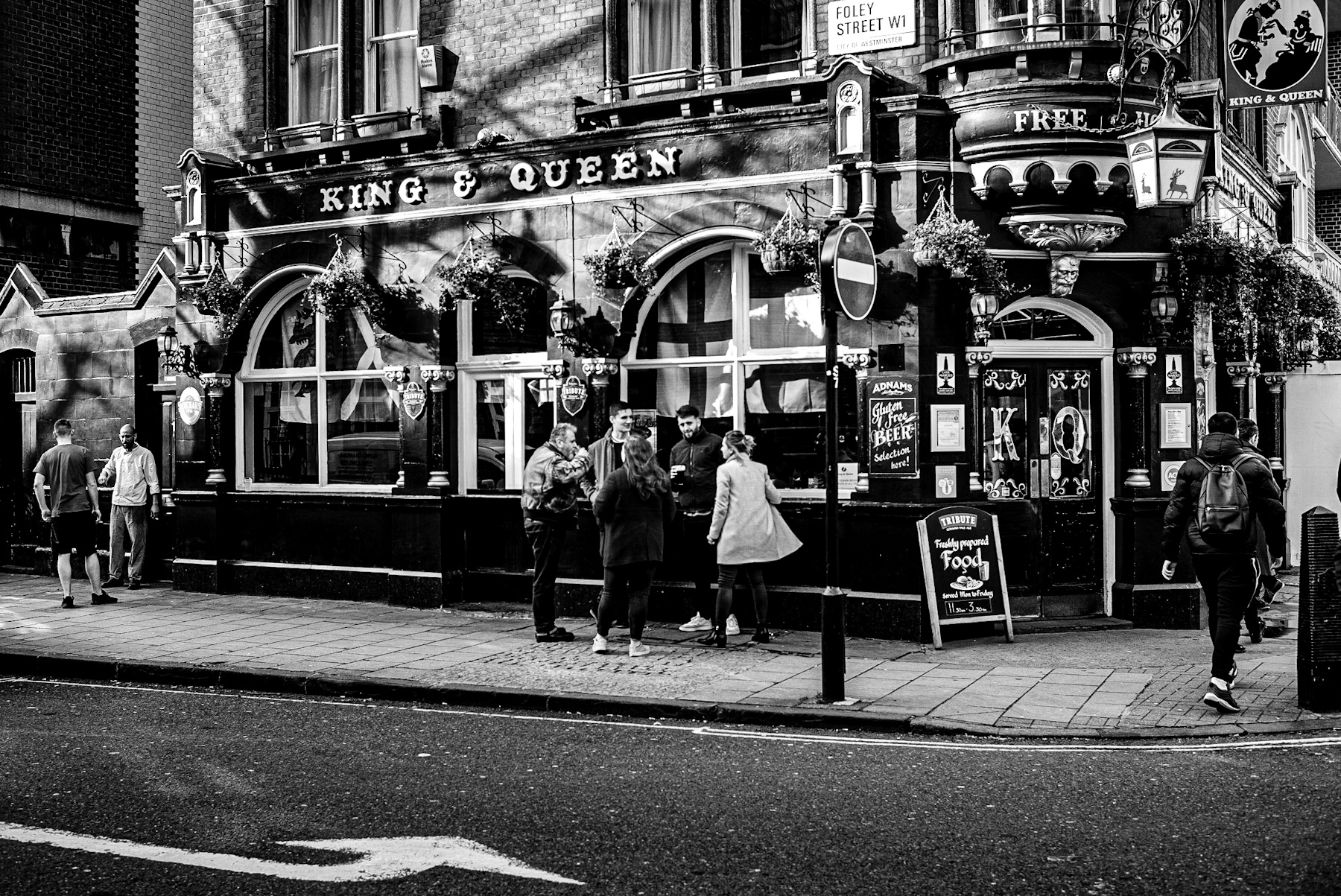
    The striking black and white photograph captures a quintessential London scene, focusing on the ornate facade of „The King & Queen“ pub on Foley Street W1 in the City of Westminster. Sunlight casts sharp shadows, highlighting the architectural details and the bustling activity outside this traditional establishment. Pedestrians navigate the pavement, with a small group conversing near the entrance, embodying the pub’s enduring role as a social nexus. The monochrome palette lends a timeless quality, suggesting that while the faces and fashions may change, the essence of the British pub remains constant.
    **The King & Queen: A Name Rooted in Royalty** The name „King & Queen“ is a common yet profoundly significant choice for a British pub, reflecting centuries of royal heritage and national identity. Such names often emerged during periods of strong monarchical rule, serving as a public display of loyalty or simply honoring popular reigning sovereigns. These establishments historically acted as social and political hubs where news, gossip, and local affairs were discussed, often under the symbolic gaze of the Crown. The very name evokes a sense of tradition and continuity, connecting contemporary patrons to a long lineage of British history.
    **The „Free House“ Distinction: A Legacy of Independence** Prominently displayed on the building’s corner is the sign „FREE HOUSE.“ This designation is more than just a label; it signifies a crucial aspect of British pub history and independence. Historically, many pubs were „tied houses,“ owned by breweries and thus obligated to sell only that brewery’s products. A „Free House,“ in contrast, is independent, allowing its landlord to purchase beers, spirits, and other beverages from any supplier. This freedom often translates into a wider, more diverse selection of drinks, including local craft beers and guest ales, as indicated by the „Adnams Gluten Free Beer“ sign visible in the image. The concept of a Free House represents a spirit of entrepreneurial freedom and a commitment to offering choice to the community, a tradition cherished by many pub-goers.
    **London’s Pub Culture: More Than Just a Drink** British pubs, and particularly those in London, are much more than mere drinking establishments. They have historically served as the heart of communities, acting as meeting places, post offices, courts, and even morgues in centuries past. Their unique architecture, often featuring intricate detailing, stained glass, and welcoming interiors, reflects their importance in the urban fabric. The King & Queen, with its decorative lamps, hanging baskets, and prominent signage, exemplifies this rich architectural tradition. The scene on Foley Street, with people gathered outside, underscores the pub’s ongoing role as a vital social space where friendships are forged, stories are shared, and the day’s events are recounted.
    **An Enduring Urban Landmark** Located on Foley Street W1, within the bustling City of Westminster, The King & Queen stands as a testament to London’s enduring pub culture. It seamlessly blends into the modern urban landscape while holding firm to its historical roots. The presence of contemporary signs alongside traditional architecture highlights the pub’s adaptability and continued relevance in a constantly evolving city. It serves as a living piece of history, offering a tangible link to the past for both locals and visitors, and reinforcing the idea that some traditions, like the British pub, remain timeless and indispensable.
  • London’s Enduring Spirit: A Tempest Over the Thames

    London’s Enduring Spirit: A Tempest Over the Thames

    The captured image presents a dramatic tableau of London, where the timeless River Thames flows beneath a sky consumed by an approaching storm. Lightning forks illuminate the darkened clouds, casting an almost monochromatic pall over the urban landscape. This striking visual narrative blends the city’s robust architectural heritage with the raw power of nature, evoking a sense of both grandeur and vulnerability.
    At the heart of the scene lies the River Thames, its dark, rippling surface reflecting the ominous sky. Historically, the Thames has been London’s lifeblood, a crucial artery for trade, transport, and defense for over two millennia. From Roman Londinium to the bustling port of the British Empire, the river has witnessed epochs of change. The image captures the river at what appears to be a lower tide, revealing a pebbled foreshore on the left bank, a testament to the river’s dynamic nature and a subtle nod to the ancient practice of mudlarking, where artifacts of London’s past are routinely uncovered. This visual detail grounds the modern cityscape in a deep historical context.
    Dominating the mid-ground is the iconic Tower Bridge, its distinctive Gothic Revival towers and suspension structure silhouetted against the stormy horizon. Completed in 1894, this engineering marvel stands as a symbol of Victorian ingenuity and London’s industrial might. Its design, blending a bascule bridge with suspension elements, was revolutionary for its time, allowing large vessels to pass while maintaining vital road links. In this photograph, the bridge appears resilient, a steadfast sentinel enduring the dramatic weather, much like London itself has weathered countless historical storms, both literal and metaphorical. The lightning strikes seem to dance around its formidable structure, emphasizing its enduring presence.
    Along the riverbanks, a blend of architectural styles is visible, reflecting London’s continuous evolution. On the left, older, perhaps Victorian-era brick buildings with intricate facades stand alongside more contemporary structures featuring balconies and modern designs. This juxtaposition highlights the city’s ability to seamlessly integrate its rich past with its ever-developing future. Further along the river, other bridges and distant buildings fade into the atmospheric gloom, suggesting the vast expanse of the metropolis. A distinctive clock tower, possibly a part of a historic building or a lesser-known landmark, adds another layer of architectural interest to the urban panorama.
    The overall mood of the image is one of powerful drama. The heavy, dark clouds and multiple streaks of lightning create an intense atmosphere, suggesting an impending or ongoing tempest. This dramatic weather imbues the familiar London scene with an almost cinematic quality, transforming it into a narrative of resilience. The city, with its historic landmarks and flowing river, stands firm against the elemental fury. It serves as a powerful visual metaphor for London’s enduring spirit, a city that has consistently rebuilt, reinvented, and reaffirmed its place as a global hub, irrespective of the challenges it has faced throughout its long and storied history. This photograph invites contemplation on the deep connection between a city’s physical landscape and its historical and cultural identity.
  • The Urban Mirror: Reflections of History and Presence in Monochrome

    The Urban Mirror: Reflections of History and Presence in Monochrome

    The striking black and white photograph presents a large, highly polished spherical object dominating the foreground, acting as a captivating focal point. Positioned on a textured paved surface, likely a city sidewalk or plaza, this metallic sphere functions as an impromptu mirror, offering a distorted yet rich reflection of its urban surroundings. The monochrome palette accentuates the contrasts, shadows, and intricate details, lending the scene a timeless quality.
    Within the sphere’s curved surface, the world outside is warped into a compelling visual narrative. Prominently reflected are architectural structures, characterized by multiple windows and a classical or perhaps early modern European design, suggesting a setting steeped in history. The buildings appear substantial and well-established, their facades echoing stories of past eras. Interspersed with these structural reflections are the silhouettes of two individuals, seemingly captured in a moment of observation or photography. One figure appears to be holding a device, possibly a camera or smartphone, engaging directly with the reflective surface, becoming both subject and observer in the same frame. Their presence grounds the image in the contemporary, creating a bridge between the historical backdrop and the immediate moment.
    The use of black and white photography is particularly impactful here. It strips away the distractions of color, compelling the viewer to focus on light, shadow, form, and texture. This aesthetic choice enhances the sense of depth and accentuates the metallic sheen of the sphere, making its reflective properties even more pronounced. The subtle imperfections on the sphere’s surface, whether natural wear or artistic texture, add character and a tactile quality, preventing the object from appearing sterile or entirely artificial. The surrounding pavement, with its visible lines and variations in tone, further emphasizes the urban context and the sphere’s integration into its environment.
    Historically, the concept of reflection has fascinated humanity, from ancient polished obsidian mirrors to the sophisticated glass mirrors of the Renaissance. These objects have always offered a glimpse of the self and the world, albeit often altered or inverted. In contemporary urban design, reflective spheres and similar public art installations serve a similar purpose, inviting interaction and providing unique perspectives on familiar landscapes. They act as modern-day scrying tools, momentarily capturing and reinterpreting the dynamic life of a city. This particular sphere, reflecting historical architecture alongside modern individuals, encapsulates the ongoing dialogue between a city’s past and its present. It symbolizes how urban spaces constantly evolve, retaining their historical essence while embracing new forms and interactions.
    This image transcends a simple depiction of a street scene; it is a meditation on perception, presence, and the passage of time. The distorted reflections challenge conventional viewing, inviting viewers to consider multiple realities within a single frame. It highlights how public art can subtly influence our interaction with and understanding of our environment, prompting moments of introspection and visual discovery. The monochrome treatment further solidifies its artistic merit, making it a compelling piece of visual storytelling that resonates with themes of city life, historical continuity, and the subjective nature of observation.