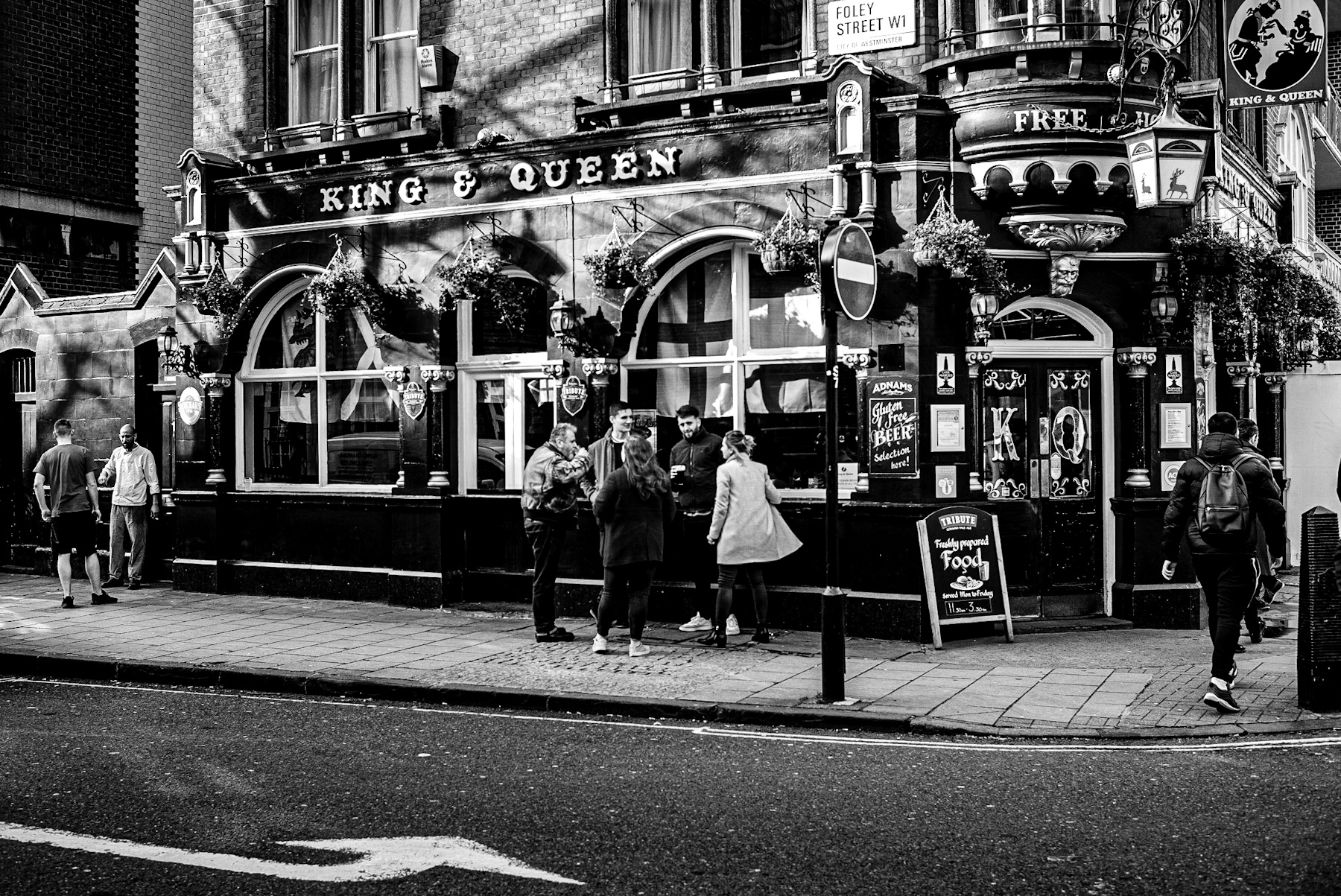
The striking black and white photograph captures a quintessential London scene, focusing on the ornate facade of „The King & Queen“ pub on Foley Street W1 in the City of Westminster. Sunlight casts sharp shadows, highlighting the architectural details and the bustling activity outside this traditional establishment. Pedestrians navigate the pavement, with a small group conversing near the entrance, embodying the pub’s enduring role as a social nexus. The monochrome palette lends a timeless quality, suggesting that while the faces and fashions may change, the essence of the British pub remains constant.
**The King & Queen: A Name Rooted in Royalty** The name „King & Queen“ is a common yet profoundly significant choice for a British pub, reflecting centuries of royal heritage and national identity. Such names often emerged during periods of strong monarchical rule, serving as a public display of loyalty or simply honoring popular reigning sovereigns. These establishments historically acted as social and political hubs where news, gossip, and local affairs were discussed, often under the symbolic gaze of the Crown. The very name evokes a sense of tradition and continuity, connecting contemporary patrons to a long lineage of British history.
**The „Free House“ Distinction: A Legacy of Independence** Prominently displayed on the building’s corner is the sign „FREE HOUSE.“ This designation is more than just a label; it signifies a crucial aspect of British pub history and independence. Historically, many pubs were „tied houses,“ owned by breweries and thus obligated to sell only that brewery’s products. A „Free House,“ in contrast, is independent, allowing its landlord to purchase beers, spirits, and other beverages from any supplier. This freedom often translates into a wider, more diverse selection of drinks, including local craft beers and guest ales, as indicated by the „Adnams Gluten Free Beer“ sign visible in the image. The concept of a Free House represents a spirit of entrepreneurial freedom and a commitment to offering choice to the community, a tradition cherished by many pub-goers.
**London’s Pub Culture: More Than Just a Drink** British pubs, and particularly those in London, are much more than mere drinking establishments. They have historically served as the heart of communities, acting as meeting places, post offices, courts, and even morgues in centuries past. Their unique architecture, often featuring intricate detailing, stained glass, and welcoming interiors, reflects their importance in the urban fabric. The King & Queen, with its decorative lamps, hanging baskets, and prominent signage, exemplifies this rich architectural tradition. The scene on Foley Street, with people gathered outside, underscores the pub’s ongoing role as a vital social space where friendships are forged, stories are shared, and the day’s events are recounted.
**An Enduring Urban Landmark** Located on Foley Street W1, within the bustling City of Westminster, The King & Queen stands as a testament to London’s enduring pub culture. It seamlessly blends into the modern urban landscape while holding firm to its historical roots. The presence of contemporary signs alongside traditional architecture highlights the pub’s adaptability and continued relevance in a constantly evolving city. It serves as a living piece of history, offering a tangible link to the past for both locals and visitors, and reinforcing the idea that some traditions, like the British pub, remain timeless and indispensable.
**The King & Queen: A Name Rooted in Royalty** The name „King & Queen“ is a common yet profoundly significant choice for a British pub, reflecting centuries of royal heritage and national identity. Such names often emerged during periods of strong monarchical rule, serving as a public display of loyalty or simply honoring popular reigning sovereigns. These establishments historically acted as social and political hubs where news, gossip, and local affairs were discussed, often under the symbolic gaze of the Crown. The very name evokes a sense of tradition and continuity, connecting contemporary patrons to a long lineage of British history.
**The „Free House“ Distinction: A Legacy of Independence** Prominently displayed on the building’s corner is the sign „FREE HOUSE.“ This designation is more than just a label; it signifies a crucial aspect of British pub history and independence. Historically, many pubs were „tied houses,“ owned by breweries and thus obligated to sell only that brewery’s products. A „Free House,“ in contrast, is independent, allowing its landlord to purchase beers, spirits, and other beverages from any supplier. This freedom often translates into a wider, more diverse selection of drinks, including local craft beers and guest ales, as indicated by the „Adnams Gluten Free Beer“ sign visible in the image. The concept of a Free House represents a spirit of entrepreneurial freedom and a commitment to offering choice to the community, a tradition cherished by many pub-goers.
**London’s Pub Culture: More Than Just a Drink** British pubs, and particularly those in London, are much more than mere drinking establishments. They have historically served as the heart of communities, acting as meeting places, post offices, courts, and even morgues in centuries past. Their unique architecture, often featuring intricate detailing, stained glass, and welcoming interiors, reflects their importance in the urban fabric. The King & Queen, with its decorative lamps, hanging baskets, and prominent signage, exemplifies this rich architectural tradition. The scene on Foley Street, with people gathered outside, underscores the pub’s ongoing role as a vital social space where friendships are forged, stories are shared, and the day’s events are recounted.
**An Enduring Urban Landmark** Located on Foley Street W1, within the bustling City of Westminster, The King & Queen stands as a testament to London’s enduring pub culture. It seamlessly blends into the modern urban landscape while holding firm to its historical roots. The presence of contemporary signs alongside traditional architecture highlights the pub’s adaptability and continued relevance in a constantly evolving city. It serves as a living piece of history, offering a tangible link to the past for both locals and visitors, and reinforcing the idea that some traditions, like the British pub, remain timeless and indispensable.
Schreibe einen Kommentar