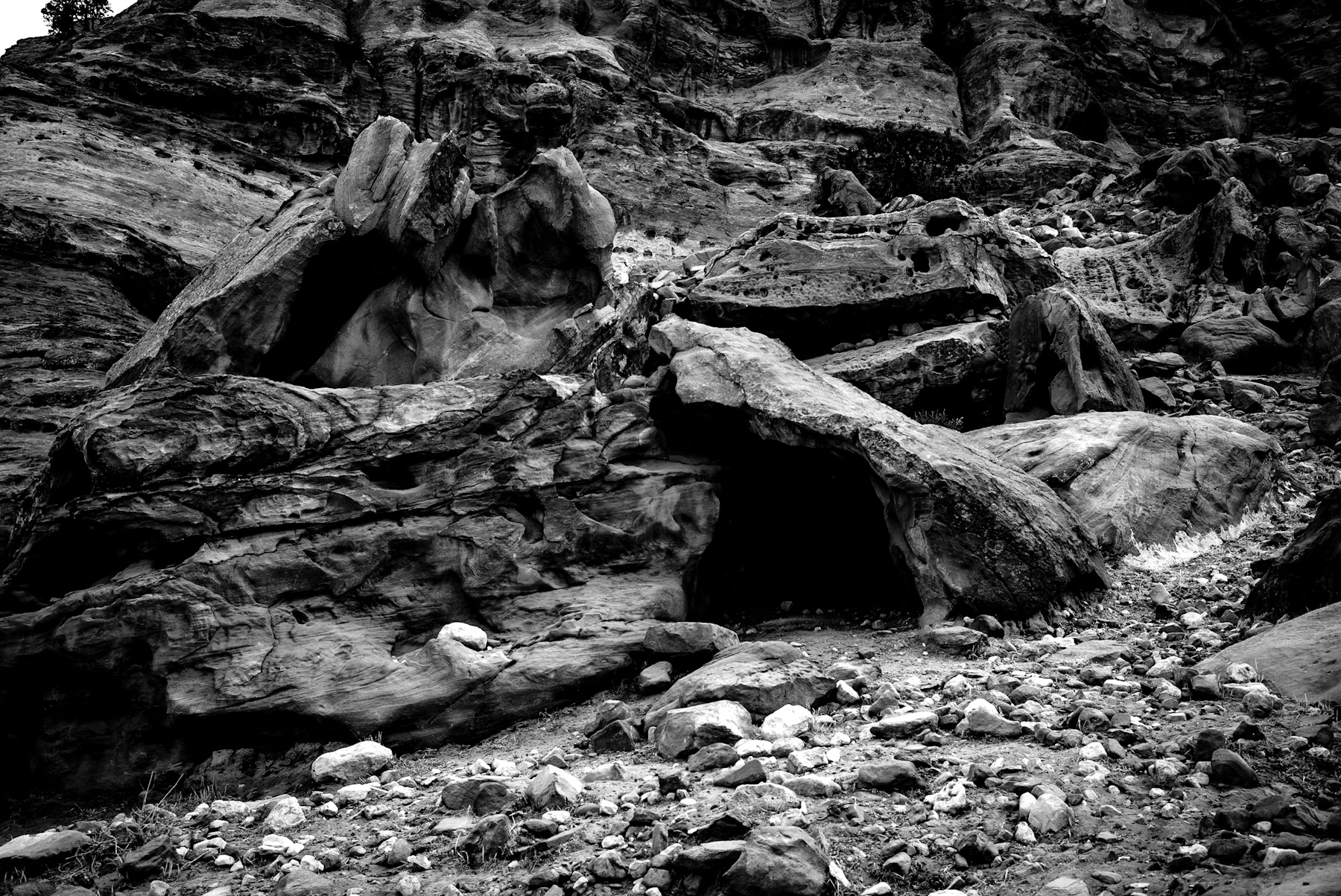
The stark contrast of black and white photography brings a timeless quality to the rugged landscapes of the ancient world. In this captivating image, the raw texture of eroded sandstone formations takes center stage, revealing a dark, mysterious opening that whispers stories of past civilizations. This geological structure, characteristic of the mountainous regions of Jordan, particularly around the ancient city of Petra, serves as a powerful reminder of how nature and human history intertwine.
Visual Analysis of the Rugged Sandstone Terrain
The photograph captures a highly textured rock face composed of layered sandstone. Through the lens of monochrome photography, the dramatic play of light and shadow highlights the deep fissures, crevices, and weathered surfaces of the stone. In the foreground, a scattered field of loose rocks and gravel leads the eye toward a prominent, dark cave-like opening carved into the base of a massive boulder.
This opening is not merely a product of natural erosion. While wind and water have spent millennia shaping the soft sandstone, the structural shape suggests human modification. Throughout history, such natural recesses were often expanded and utilized by ancient inhabitants for shelter, storage, or funerary purposes.
The Historical Context of the Nabataean Kingdom
To understand the significance of these rock formations, one must look to the history of the Nabataeans, an ancient nomadic Arab people who established their capital, Petra, in the rugged canyons of modern-day Jordan around the 4th century BCE. The Nabataeans were masters of water conservation and stone carving, famously chiseling grand temples, tombs, and dwellings directly into the rose-red sandstone cliffs.
While the grand facades like the Treasury (Al-Khazneh) receive the most global attention, the surrounding valleys are filled with hundreds of simpler caves and rock-cut chambers similar to the one pictured. These lesser-known structures played a vital role in daily life. They served as temporary shelters for traders arriving via the lucrative incense routes, homes for the working class, and sacred burial sites. The integration of architecture into the natural topography allowed the Nabataeans to create a highly defensible and sustainable city hidden within the desert mountains.
Geological Evolution and Preservation
The unique appearance of the rock face in the image is the result of millions of years of geological activity. Sandstone is highly susceptible to wind and water erosion, which creates the smooth, flowing contours visible on the rock surfaces. Over centuries, this natural weathering process continues to alter the ancient carvings, slowly reclaiming human craftsmanship back into the natural landscape.
Today, these sites are of immense archaeological value. As part of the Petra UNESCO World Heritage site, they offer researchers invaluable insights into ancient engineering, domestic life, and the environmental adaptation of past societies.
Conclusion
This monochrome depiction of ancient stone formations captures the enduring legacy of human ingenuity adapted to a harsh natural environment. By observing the rugged textures and silent voids of these rock-cut structures, we connect directly with the ancient Nabataeans who once looked upon these very same cliffs, transforming wild stone into a legendary empire.
Visual Analysis of the Rugged Sandstone Terrain
The photograph captures a highly textured rock face composed of layered sandstone. Through the lens of monochrome photography, the dramatic play of light and shadow highlights the deep fissures, crevices, and weathered surfaces of the stone. In the foreground, a scattered field of loose rocks and gravel leads the eye toward a prominent, dark cave-like opening carved into the base of a massive boulder.
This opening is not merely a product of natural erosion. While wind and water have spent millennia shaping the soft sandstone, the structural shape suggests human modification. Throughout history, such natural recesses were often expanded and utilized by ancient inhabitants for shelter, storage, or funerary purposes.
The Historical Context of the Nabataean Kingdom
To understand the significance of these rock formations, one must look to the history of the Nabataeans, an ancient nomadic Arab people who established their capital, Petra, in the rugged canyons of modern-day Jordan around the 4th century BCE. The Nabataeans were masters of water conservation and stone carving, famously chiseling grand temples, tombs, and dwellings directly into the rose-red sandstone cliffs.
While the grand facades like the Treasury (Al-Khazneh) receive the most global attention, the surrounding valleys are filled with hundreds of simpler caves and rock-cut chambers similar to the one pictured. These lesser-known structures played a vital role in daily life. They served as temporary shelters for traders arriving via the lucrative incense routes, homes for the working class, and sacred burial sites. The integration of architecture into the natural topography allowed the Nabataeans to create a highly defensible and sustainable city hidden within the desert mountains.
Geological Evolution and Preservation
The unique appearance of the rock face in the image is the result of millions of years of geological activity. Sandstone is highly susceptible to wind and water erosion, which creates the smooth, flowing contours visible on the rock surfaces. Over centuries, this natural weathering process continues to alter the ancient carvings, slowly reclaiming human craftsmanship back into the natural landscape.
Today, these sites are of immense archaeological value. As part of the Petra UNESCO World Heritage site, they offer researchers invaluable insights into ancient engineering, domestic life, and the environmental adaptation of past societies.
Conclusion
This monochrome depiction of ancient stone formations captures the enduring legacy of human ingenuity adapted to a harsh natural environment. By observing the rugged textures and silent voids of these rock-cut structures, we connect directly with the ancient Nabataeans who once looked upon these very same cliffs, transforming wild stone into a legendary empire.
Schreibe einen Kommentar