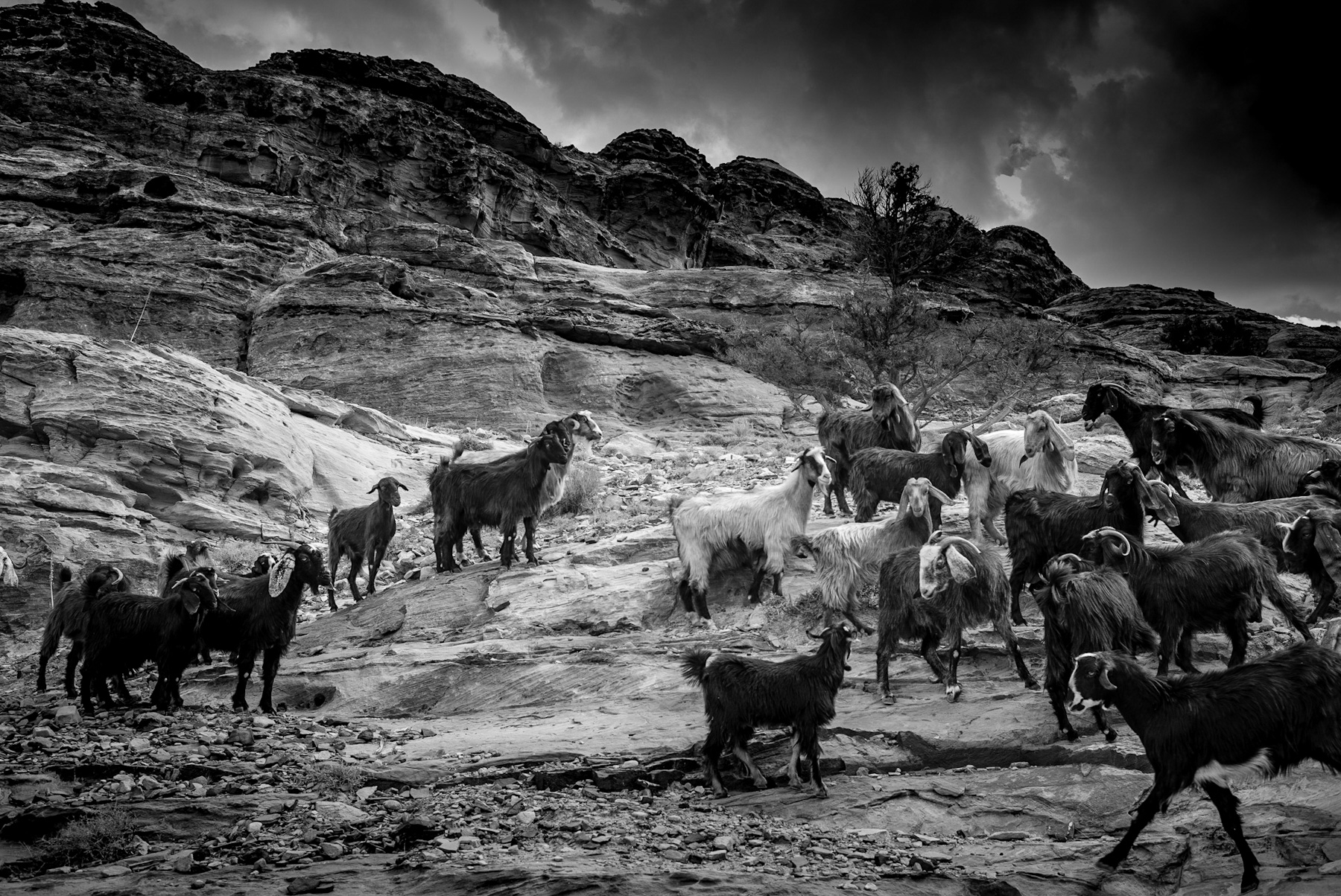
A stark, monochrome tableau unfolds, presenting a rugged landscape dominated by formidable rock formations and a scattered herd of goats. The dramatic black and white tones emphasize the textures of the weathered stone and the varied coats of the animals, from shaggy dark to lighter shades, all navigating the uneven terrain under a brooding, cloudy sky. This visual narrative speaks to resilience and adaptation in an environment that appears both ancient and unforgiving.
### The Goats and Their Arid Habitat
The goats, numbering over a dozen, are central to this scene. Their sturdy build and agile forms are perfectly suited to the rocky slopes, an environment where sparse vegetation offers sustenance. Their presence is not merely incidental; it is a testament to an ancient symbiotic relationship between humans and animals in arid regions. Each animal, with its distinct features and watchful gaze, appears intrinsically linked to the wild beauty of its surroundings, almost a living extension of the landscape itself. The barrenness of the land, punctuated by the resilient scrub and the distant, craggy peaks, underscores the harsh realities of life in such an ecosystem.
### A Glimpse into Historical Pastoralism
Historically, the sight of goats grazing amidst rocky outcrops is deeply embedded in the cultural tapestry of the Middle East and North Africa. These regions, characterized by vast deserts and mountainous terrains, have been home to nomadic and semi-nomadic communities for millennia. Goats were among the earliest domesticated animals, revered for providing milk, meat, fiber, and hides – essential resources for survival in challenging climates. This image vividly captures a practice that dates back to the Neolithic era, showcasing the enduring legacy of pastoralism and its pivotal role in human development across arid lands.
### The Bedouin Connection and Ancient Civilizations
This particular scene strongly evokes the traditional way of life of the Bedouin people, who have historically inhabited areas like the deserts of Jordan, including the vicinity of the ancient city of Petra. The Nabataeans, who carved Petra into the rose-red cliffs, were themselves adept at managing resources in an arid environment, and animal husbandry, including goat herding, would have been integral to their society. For centuries, Bedouin tribes have maintained these ancestral practices, moving their flocks through wadis and over mountains, much like their forebears. The goats in this photograph are not just livestock; they are living symbols of a continuous cultural heritage, embodying a connection to the land that spans thousands of years.
### Enduring Traditions in a Modern World
Even in the 21st century, these pastoral traditions persist. While modern influences are undeniable, the sight of a goat herd traversing a desert landscape remains a powerful reminder of a way of life deeply rooted in sustainability and an intimate understanding of nature. It highlights the ingenuity and resilience required to thrive in harsh conditions, a narrative that continues to shape the identity of many communities in these regions. The photograph, with its timeless black and white aesthetic, beautifully encapsulates this enduring saga, bridging the past with the present and offering a window into a heritage that continues to adapt and survive.
Ultimately, this image is more than a simple depiction of animals; it is a profound visual commentary on history, survival, and the unbreakable bond between culture and environment. It invites contemplation on the deep historical roots of human interaction with nature and the steadfast spirit of those who continue to live off the land, echoing the ancient trails their ancestors once trod.
### The Goats and Their Arid Habitat
The goats, numbering over a dozen, are central to this scene. Their sturdy build and agile forms are perfectly suited to the rocky slopes, an environment where sparse vegetation offers sustenance. Their presence is not merely incidental; it is a testament to an ancient symbiotic relationship between humans and animals in arid regions. Each animal, with its distinct features and watchful gaze, appears intrinsically linked to the wild beauty of its surroundings, almost a living extension of the landscape itself. The barrenness of the land, punctuated by the resilient scrub and the distant, craggy peaks, underscores the harsh realities of life in such an ecosystem.
### A Glimpse into Historical Pastoralism
Historically, the sight of goats grazing amidst rocky outcrops is deeply embedded in the cultural tapestry of the Middle East and North Africa. These regions, characterized by vast deserts and mountainous terrains, have been home to nomadic and semi-nomadic communities for millennia. Goats were among the earliest domesticated animals, revered for providing milk, meat, fiber, and hides – essential resources for survival in challenging climates. This image vividly captures a practice that dates back to the Neolithic era, showcasing the enduring legacy of pastoralism and its pivotal role in human development across arid lands.
### The Bedouin Connection and Ancient Civilizations
This particular scene strongly evokes the traditional way of life of the Bedouin people, who have historically inhabited areas like the deserts of Jordan, including the vicinity of the ancient city of Petra. The Nabataeans, who carved Petra into the rose-red cliffs, were themselves adept at managing resources in an arid environment, and animal husbandry, including goat herding, would have been integral to their society. For centuries, Bedouin tribes have maintained these ancestral practices, moving their flocks through wadis and over mountains, much like their forebears. The goats in this photograph are not just livestock; they are living symbols of a continuous cultural heritage, embodying a connection to the land that spans thousands of years.
### Enduring Traditions in a Modern World
Even in the 21st century, these pastoral traditions persist. While modern influences are undeniable, the sight of a goat herd traversing a desert landscape remains a powerful reminder of a way of life deeply rooted in sustainability and an intimate understanding of nature. It highlights the ingenuity and resilience required to thrive in harsh conditions, a narrative that continues to shape the identity of many communities in these regions. The photograph, with its timeless black and white aesthetic, beautifully encapsulates this enduring saga, bridging the past with the present and offering a window into a heritage that continues to adapt and survive.
Ultimately, this image is more than a simple depiction of animals; it is a profound visual commentary on history, survival, and the unbreakable bond between culture and environment. It invites contemplation on the deep historical roots of human interaction with nature and the steadfast spirit of those who continue to live off the land, echoing the ancient trails their ancestors once trod.
Schreibe einen Kommentar