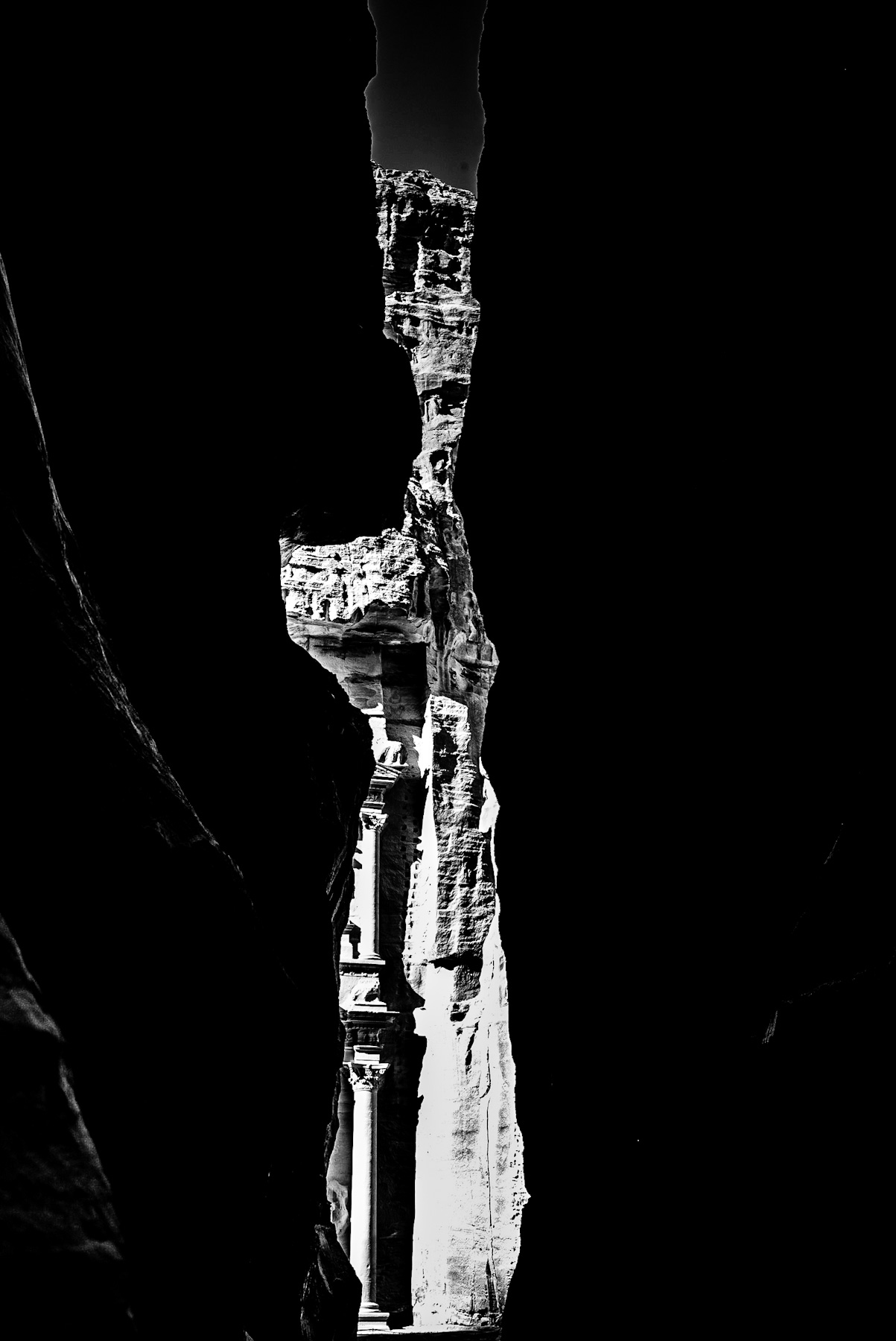
The photograph captures a profound moment of architectural revelation, presenting a dramatic, high-contrast monochrome view of one of the ancient world’s most iconic structures: Al-Khazneh, commonly known as The Treasury, in Petra, Jordan. Framed by the deep, dark shadows of towering rock formations, the image isolates a vertical sliver of light, within which the intricate façade of The Treasury emerges with striking clarity. The stark black and white rendering emphasizes the monumental scale and the delicate details carved into the rose-red sandstone, highlighting the interplay of light and shadow that defines this archaeological wonder.
The Visual Narrative of Revelation
The composition masterfully replicates the experience of approaching The Treasury through the Siq, Petra’s main entrance. This narrow, winding gorge, carved by millennia of water and wind, builds anticipation as its towering walls obscure the outside world. The photograph encapsulates this journey, with the dark, almost silhouetted rock faces on either side creating a natural frame, drawing the eye directly to the illuminated masterpiece within. The upper sections of the facade, including the tholos and the urn, are visible, crowned by a sliver of the sky, suggesting the eventual opening of the canyon. The lower columns and the entrance are also distinctly rendered, showcasing the Hellenistic architectural influences adapted by its Nabataean creators. This visual compression transforms the act of seeing into an act of discovery, mirroring the historical and personal encounter with Petra.
Al-Khazneh: A Testament to Nabataean Ingenuity
Historically, Al-Khazneh is not a treasury in the conventional sense, despite its popular moniker, which stems from local Bedouin legends believing it housed pharaoh’s gold. Archaeological evidence suggests it was more likely a tomb for a Nabataean King, possibly Aretas IV, who reigned in the 1st century AD, or a temple. The Nabataeans, an ancient Arab people, were skilled traders who controlled crucial incense and spice routes connecting the East with the West. Their wealth allowed them to construct Petra, their capital, into a thriving metropolis carved directly into the sandstone cliffs.
The architectural style of Al-Khazneh is a remarkable fusion of classical Hellenistic elements—such as the Corinthian columns, pediments, and friezes—with distinct Nabataean artistic sensibilities. This blend reflects the cosmopolitan nature of the Nabataean kingdom, which absorbed influences from the vast empires it interacted with, including the Greek and Roman worlds. The precision of the carving, executed without the aid of modern tools, speaks volumes about the Nabataeans‘ advanced engineering and artistic capabilities.
Petra’s Enduring Legacy
Petra itself is a UNESCO World Heritage site, celebrated for its unique rock-cut architecture, sophisticated water management systems, and its profound historical significance. The city flourished for centuries, a testament to a desert civilization that mastered its environment. Its decline began with shifts in trade routes and natural disasters, eventually leading to its abandonment and subsequent rediscovery by Swiss explorer Johann Ludwig Burckhardt in 1812.
The image of Al-Khazneh from the Siq remains one of the most powerful symbols of Petra, embodying the ancient city’s hidden grandeur and its capacity to inspire awe. It represents not just a magnificent piece of architecture, but a window into the ingenuity, artistry, and complex history of the Nabataean people, whose legacy continues to captivate visitors and scholars alike. The photograph serves as a poignant reminder of human achievement against the backdrop of natural majesty, preserving a moment of historical revelation for contemporary contemplation.
The Visual Narrative of Revelation
The composition masterfully replicates the experience of approaching The Treasury through the Siq, Petra’s main entrance. This narrow, winding gorge, carved by millennia of water and wind, builds anticipation as its towering walls obscure the outside world. The photograph encapsulates this journey, with the dark, almost silhouetted rock faces on either side creating a natural frame, drawing the eye directly to the illuminated masterpiece within. The upper sections of the facade, including the tholos and the urn, are visible, crowned by a sliver of the sky, suggesting the eventual opening of the canyon. The lower columns and the entrance are also distinctly rendered, showcasing the Hellenistic architectural influences adapted by its Nabataean creators. This visual compression transforms the act of seeing into an act of discovery, mirroring the historical and personal encounter with Petra.
Al-Khazneh: A Testament to Nabataean Ingenuity
Historically, Al-Khazneh is not a treasury in the conventional sense, despite its popular moniker, which stems from local Bedouin legends believing it housed pharaoh’s gold. Archaeological evidence suggests it was more likely a tomb for a Nabataean King, possibly Aretas IV, who reigned in the 1st century AD, or a temple. The Nabataeans, an ancient Arab people, were skilled traders who controlled crucial incense and spice routes connecting the East with the West. Their wealth allowed them to construct Petra, their capital, into a thriving metropolis carved directly into the sandstone cliffs.
The architectural style of Al-Khazneh is a remarkable fusion of classical Hellenistic elements—such as the Corinthian columns, pediments, and friezes—with distinct Nabataean artistic sensibilities. This blend reflects the cosmopolitan nature of the Nabataean kingdom, which absorbed influences from the vast empires it interacted with, including the Greek and Roman worlds. The precision of the carving, executed without the aid of modern tools, speaks volumes about the Nabataeans‘ advanced engineering and artistic capabilities.
Petra’s Enduring Legacy
Petra itself is a UNESCO World Heritage site, celebrated for its unique rock-cut architecture, sophisticated water management systems, and its profound historical significance. The city flourished for centuries, a testament to a desert civilization that mastered its environment. Its decline began with shifts in trade routes and natural disasters, eventually leading to its abandonment and subsequent rediscovery by Swiss explorer Johann Ludwig Burckhardt in 1812.
The image of Al-Khazneh from the Siq remains one of the most powerful symbols of Petra, embodying the ancient city’s hidden grandeur and its capacity to inspire awe. It represents not just a magnificent piece of architecture, but a window into the ingenuity, artistry, and complex history of the Nabataean people, whose legacy continues to captivate visitors and scholars alike. The photograph serves as a poignant reminder of human achievement against the backdrop of natural majesty, preserving a moment of historical revelation for contemporary contemplation.
Schreibe einen Kommentar