Kategorie: Travel

  • Under the Glass Sky: The Art Nouveau Masterpiece of Galeries Lafayette

    Under the Glass Sky: The Art Nouveau Masterpiece of Galeries Lafayette

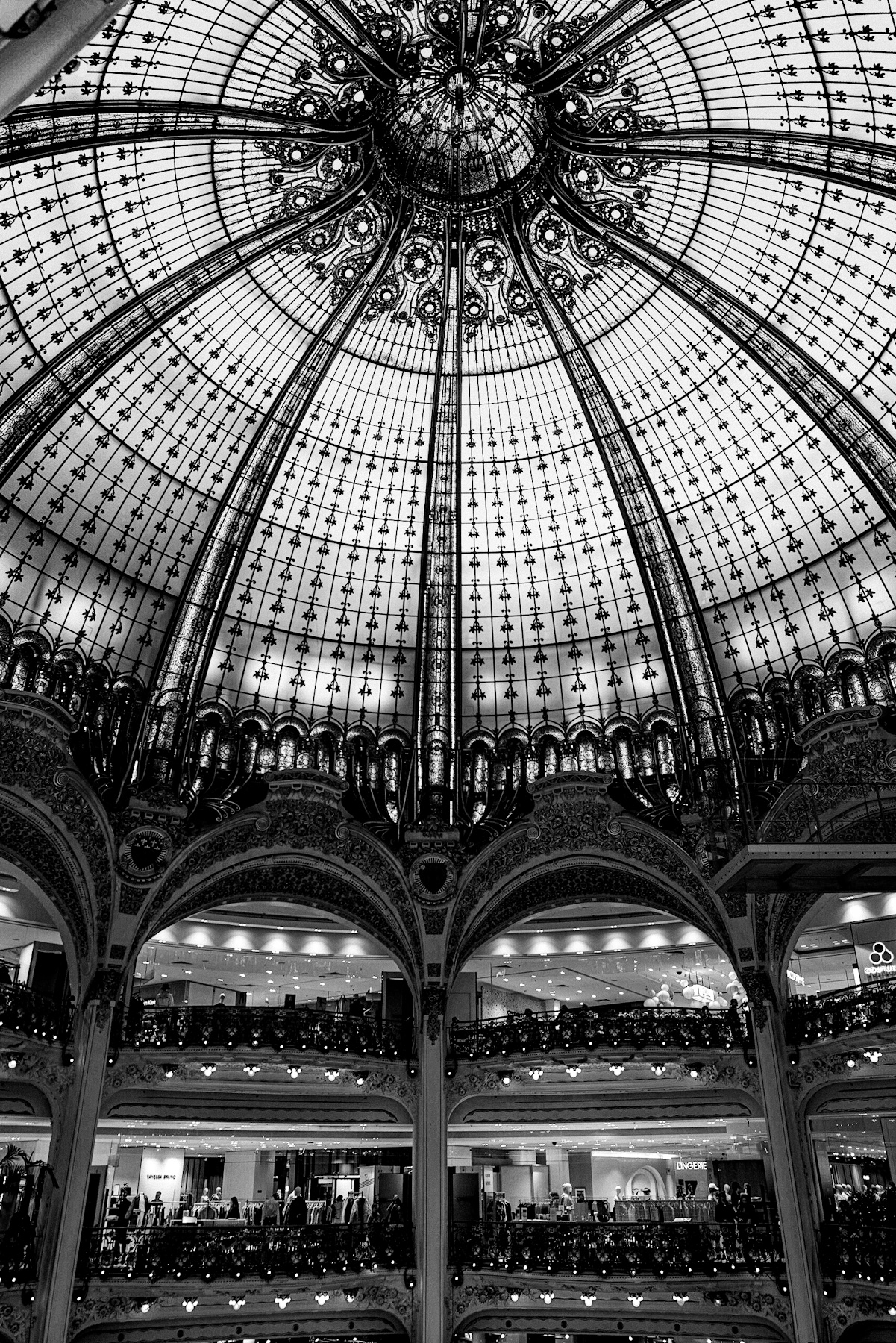
    The photograph captures a breathtaking upward view of an immense glass dome, its intricate structure rendered in stark, dramatic monochrome. This isn’t just any dome; it’s the iconic *coupole* of the Galeries Lafayette Haussmann in Paris, a true testament to the ambition and artistry of the Belle Époque. By stripping away its famous vibrant colors, the black-and-white medium focuses our attention on the pure form, the delicate interplay of light and shadow, and the sheer complexity of its Art Nouveau design.
    A Symphony in Iron and Glass
    At the heart of the image is a masterpiece of Art Nouveau architecture. Its structure is a mesmerizing web of dark ironwork, radiating from a central oculus to form ten distinct segments that soar over the building’s vast atrium. Each segment is filled with glass panels, delicately decorated with repeating floral motifs – think a sophisticated take on the *fleur-de-lys* – adding an ornate layer to the otherwise geometric composition.
    The main ribs of the dome are heavily embellished, featuring swirling, organic forms that are hallmarks of the Art Nouveau style, drawing deep inspiration from the natural world. These ribs gracefully converge at the base, resting upon a ring of elegant arches and pillars. Below, multiple tiers of balconies, adorned with exquisitely detailed balustrades, wrap around the central void, offering a glimpse into the bustling commercial activity of the department store that thrives beneath this architectural marvel. The photograph perfectly captures the stunning contrast between the soaring, light-filled dome and the layered, shadowed elegance of the floors below.
    A Cathedral of Commerce from the Belle Époque
    To truly grasp the dome’s significance, let’s step back in time to its grand inauguration in 1912. The Galeries Lafayette was born from the vision of its founder, Théophile Bader. He dreamt of creating a „luxury bazaar“ that would not only dazzle shoppers but also provide a unique, theatrical experience. To bring this dream to life, he commissioned architect Ferdinand Chanut to design a building that was both highly functional and utterly awe-inspiring.
    The magnificent result was this stunning neo-Byzantine stained-glass dome, masterfully crafted by the renowned glassmaker Jacques Gruber. Rising a staggering 43 meters above the floor, its primary purpose was revolutionary for its time: to bathe the grand hall in abundant natural light. This illuminated the goods on display and imbued the space with an unparalleled sense of grandeur and openness. In an era before widespread electric lighting, this was a groundbreaking concept for a retail environment. The dome transformed the simple act of shopping into a cultural event, placing commerce within a setting as magnificent as an opera house or a cathedral. It stands today as a powerful symbol of the optimism, industrial progress, and artistic innovation that defined Paris during the Belle Époque – a period of peace and prosperity before the world plunged into war. Today, it remains not only the centerpiece of a world-renowned department store but also a protected historical monument and an essential landmark of Parisian architecture.
  • Epicerie d’Aguerre: A Parisian Snapshot of Commerce and History

    Epicerie d’Aguerre: A Parisian Snapshot of Commerce and History

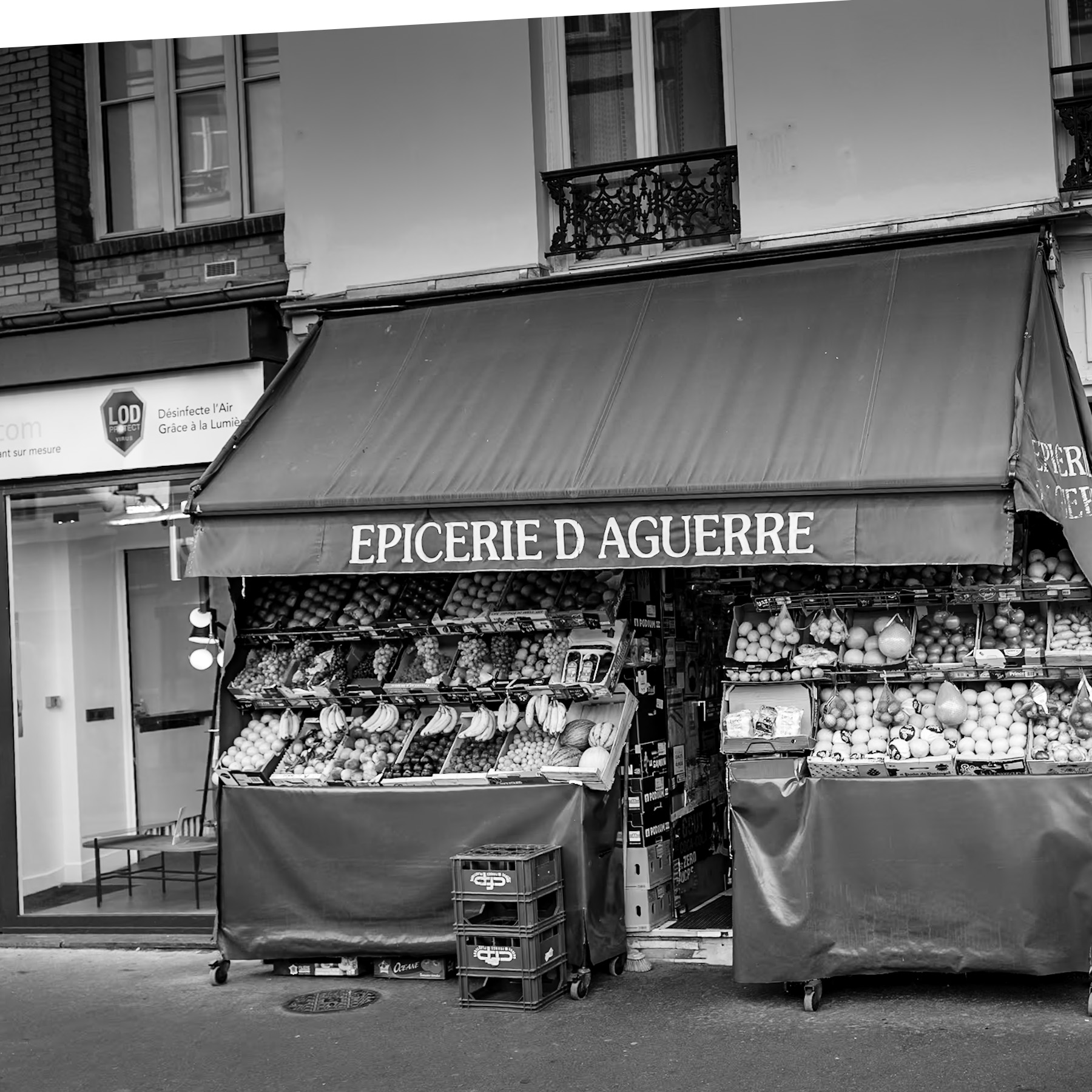
    This captivating black and white photograph offers more than a glimpse of a fruit stand; it’s a frozen moment of daily Parisian life, steeped in cultural and historical layers. We’re introduced to the „Epicerie D Aguerre,“ a quintessential neighborhood grocer, its awning graciously sheltering a vibrant display of produce that artfully spills onto the sidewalk. The monochrome palette instantly lends a timeless quality, evoking generations of Parisians who have found their daily essentials in similar establishments.
    **The Epicerie: A Cornerstone of French Life**
    The *épicerie* is far more than just a shop in French culture; it’s the beating heart of any *quartier*. Historically, these small, often family-run enterprises have been the primary source for fresh fruits, vegetables, cheeses, wines, and countless other necessities. Beyond commerce, they are vibrant hubs of social interaction, places where neighbors exchange pleasantries, and the shopkeeper knows their customers by name and often their preferred weekly staples.
    This image perfectly encapsulates that enduring tradition. The produce – inviting bunches of bananas, sturdy crates of citrus, and lush cascades of grapes – is arranged with meticulous care, presented in abundance rather than pre-packaged. This method encourages customers to browse, touch, and select, fostering a direct, tactile connection with their food. The presence of mobile carts subtly hints at a dynamic, flexible relationship with the street itself, a common and charming sight in Paris where the boundary between public and private commercial space frequently blurs.
    **A Photographic Legacy in a Name**
    The name emblazoned on the awning, „Epicerie D Aguerre,“ is particularly fascinating and offers a striking historical connection. Any visitor to Paris, especially one with an appreciation for history, will likely spot the striking similarity to **Louis Daguerre**, a true pioneer of photography. It was in 1839 that Daguerre introduced the Daguerreotype process, the world’s first commercially successful photographic method, effectively giving birth to this art form right here in Paris.
    This potential nod – whether intentional or a delightful coincidence – creates a beautiful resonance within the image. Here we have a photograph, a modern digital capture, depicting a scene whose very name echoes the origins of photography itself. It transforms the image into a compelling self-referential piece of art. The bustling street scene, a subject deeply favored by early photographers keen on documenting urban life, is here branded with the name of one of the medium’s founding fathers. This subtle yet powerful link elevates the photograph from a simple documentary shot to a profound commentary on the very act of observation and preservation that photography enables.
    **Old World Charm Meets Modern Reality**
    While the scene undeniably radiates an old-world charm, a closer look reveals subtle contemporary details. To the left of the *épicerie*, a sign in a neighboring window reads, „Désinfecte l’Air Grâce à la Lumière“ (Disinfects the Air Thanks to Light). This small, yet significant detail firmly anchors the photograph in the 21st century, reflecting current societal concerns about health and hygiene.
    This compelling juxtaposition is precisely what makes the image so powerful. It showcases a city where ancient traditions, such as the beloved neighborhood grocer, and profound historical legacies, like the name Daguerre, not only coexist but actively adapt to the pressing realities of the modern world. The Parisian street is far from a static museum exhibit; it is a living, breathing entity where history and the present engage in a constant, dynamic dialogue. This photograph stands as a perfect testament to that enduring and spirited Parisian narrative.
  • A Parisian Corner in Time: The Enduring Allure of Le Champ de Mars Bistrot

    A Parisian Corner in Time: The Enduring Allure of Le Champ de Mars Bistrot

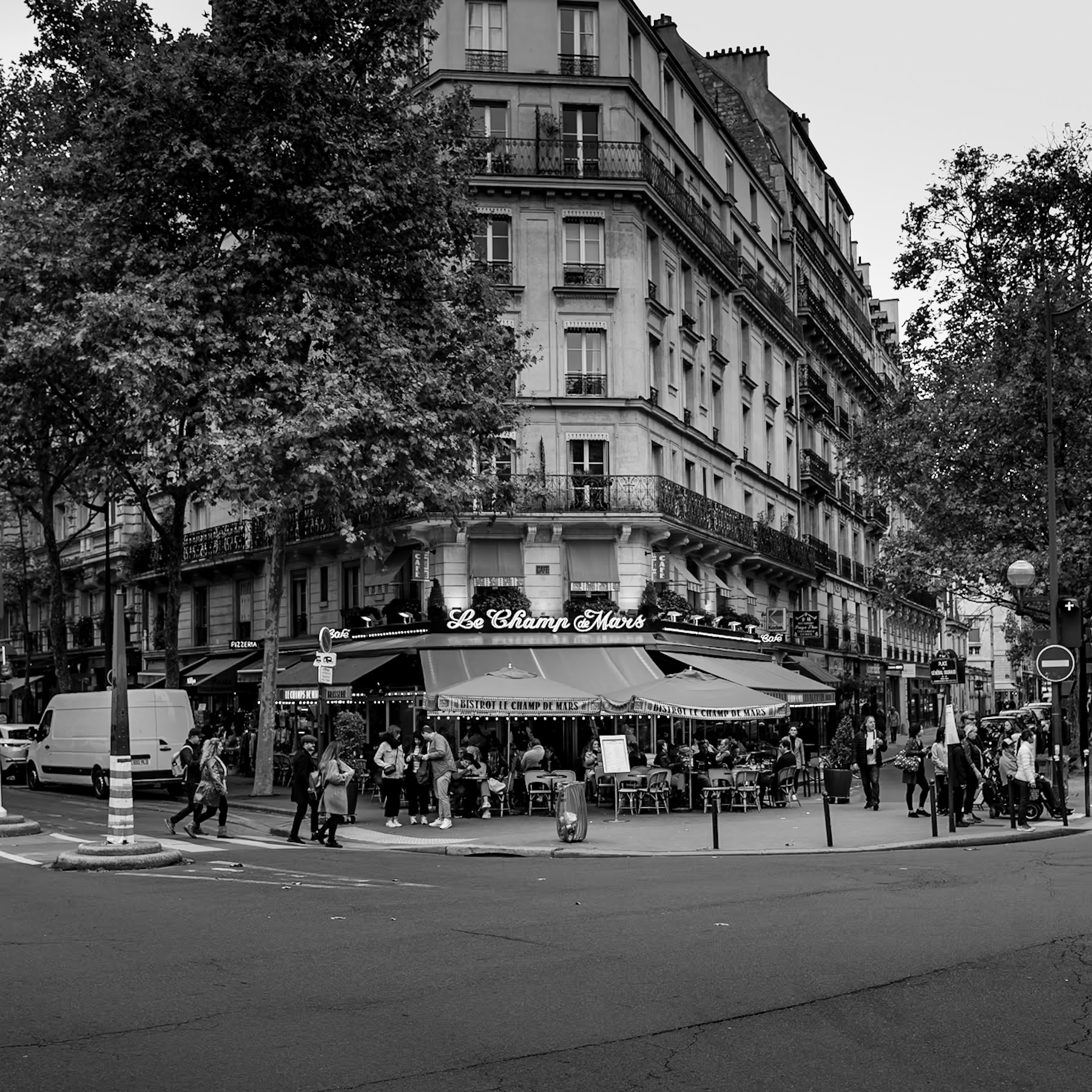
    This black and white photograph captures a quintessential Parisian moment, a scene that feels both contemporary and steeped in history. At the heart of the image is the **Le Champ de Mars** bistrot, its awnings extended over a bustling terrace. Patrons are engaged in conversation, enjoying a meal, or simply watching the world go by—a timeless ritual of Parisian life. The image frames a slice of the city where architecture, daily life, and a significant historical name converge.
    THE ECHO OF HISTORY IN EVERY SIP: LE CHAMP DE MARS
    The name of this charming bistrot, **Le Champ de Mars**, is far from arbitrary; it’s a direct homage to one of Paris’s most famous public spaces. Located nearby in the 7th arrondissement, the actual Champ de Mars (Field of Mars) is that vast, iconic green expanse stretching from the École Militaire to the majestic Eiffel Tower. Its story is deeply woven into the fabric of France itself.
    Historically, the Champ de Mars has played many roles:
    * **Military Origins:** What started as land for market gardening transformed in the mid-18th century into a grand parade ground for the adjacent military school. Its name, referencing the Roman god of war, perfectly encapsulates this primary military purpose. * **The French Revolution:** This vast field became a central stage for some of the grandest spectacles of the French Revolution. It was here, on July 14, 1790, that the Fête de la Fédération (Festival of the Federation) celebrated the new French constitutional monarchy, a fleeting moment of national unity and hope. * **A Stage for the World:** Throughout the 19th and early 20th centuries, the Champ de Mars hosted numerous World’s Fairs (Expositions Universelles). The most enduring legacy of these global showcases? None other than the Eiffel Tower itself, built as the stunning main entrance for the Exposition of 1889.
    By adopting this historic name, the bistrot positions itself within this grand narrative, offering its patrons not just a meal, but a taste of Parisian culture steeped in centuries of history, right in the shadow of historical significance.
    HAUSSMANN’S LEGACY: THE PERFECT BACKDROP FOR PARISIAN LIFE
    The captivating scene is more than just its historical namesake. It’s a perfect illustration of the **Parisian bistrot** as an indispensable cultural institution. These establishments are the social pulse of their neighborhoods—places where locals gather for a morning coffee, enjoy a traditional plat du jour at lunch, or unwind with an apéritif in the evening. The photograph beautifully captures this essential function, showing a lively mix of locals and visitors participating in the daily rhythm of the city.
    Framing this vibrant social hub is the classic **Haussmannian architecture** that so distinctly defines much of Paris. The corner building proudly displays the signature elements of the style mandated by Baron Haussmann’s ambitious urban renewal projects of the mid-19th century:
    * Uniform, elegant cream-colored stone façades. * Continuous wrought-iron balconies gracing the second and fifth floors. * A distinct verticality and harmonious integration with neighboring buildings, creating visually stunning boulevards.
    This iconic architectural style was specifically designed to create wide, light-filled avenues and a pervasive sense of monumental elegance—a backdrop that has become utterly inseparable from the romantic image of Paris itself. The building in the photo, with its graceful lines and understated ornate details, stands as a testament to this enduring urban vision.
    In this single, compelling monochrome frame, we witness a remarkable convergence of elements: the casual, vibrant life of a modern **Parisian street scene**, the profound architectural legacy of the Second Empire, and the resonant name of a place that has witnessed the triumphs and transformations of French history. It is a powerful snapshot that truly captures the soul of Paris—a city where the past is not just remembered, but vibrantly present in every moment.
  • The Timeless Allure of the Champs-Élysées: A View Towards the Arc de Triomphe

    The Timeless Allure of the Champs-Élysées: A View Towards the Arc de Triomphe

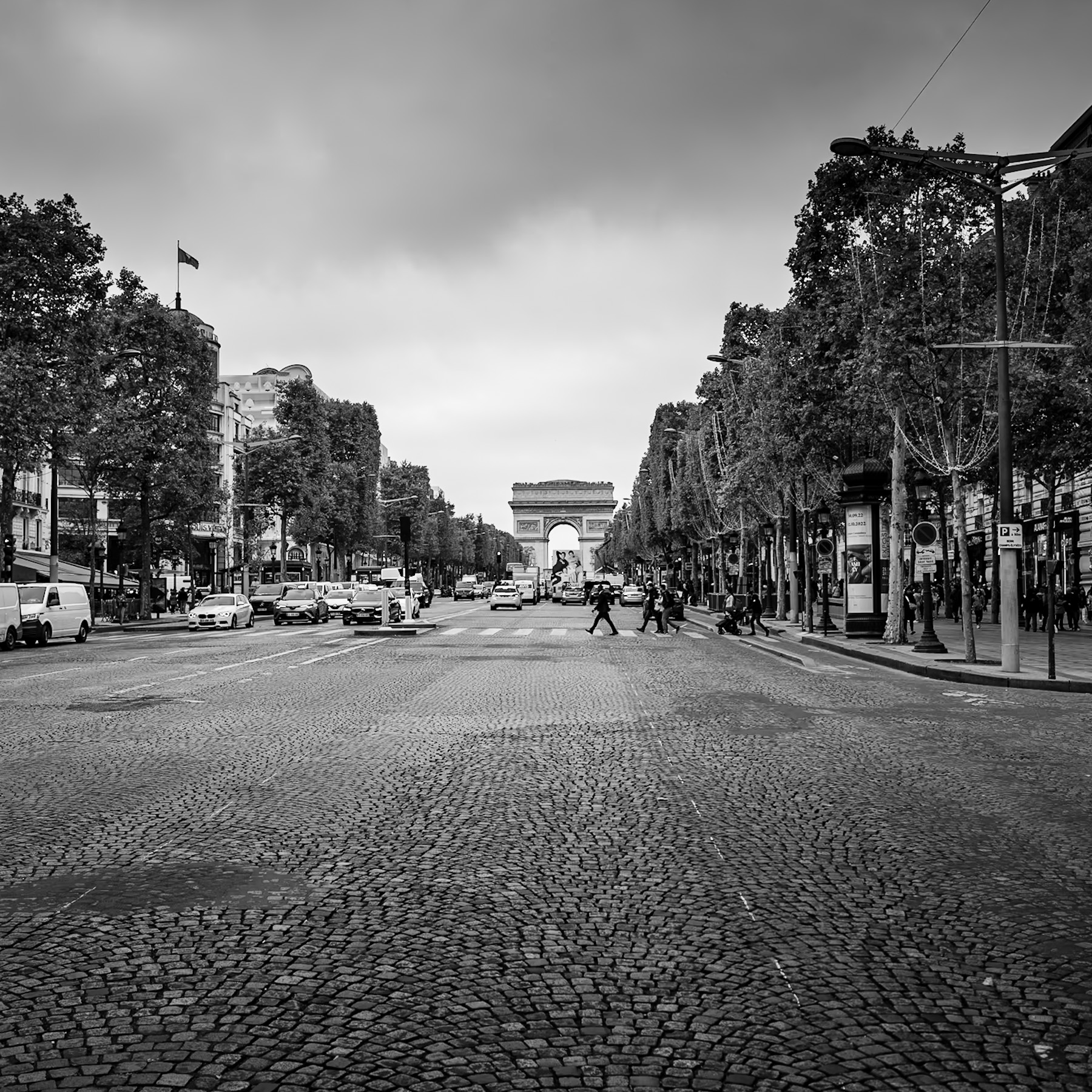
    Imagine strolling down one of the world’s most iconic avenues, the legendary Champs-Élysées in Paris. Our gaze sweeps west, drawn irresistibly towards its majestic anchor: the Arc de Triomphe. This isn’t just a postcard view; it’s a window into history, grandeur, and the vibrant pulse of Parisian life, where every cobblestone tells a story.
    The Champs-Élysées is far more than just a wide road; it’s the beating heart of the *Axe Historique*, Paris’s grand historical axis stretching from the Louvre to the Grande Arche de la Défense. Conceived in the 17th century, this „Triumphal Way“ was built for royalty and later became the stage for France’s most significant military parades. From celebrating World War victories to the annual Bastille Day processions, this avenue has witnessed pivotal moments in French history. Today, while the parades continue, it serves as a bustling corridor for locals and visitors alike, a continuous flow of modern life against a backdrop of centuries-old splendor.
    Dominating the western end of the avenue is the awe-inspiring Arc de Triomphe de l’Étoile. Commissioned by Napoleon Bonaparte in 1806 after his triumph at Austerlitz, it was designed to honor the *Grande Armée* and the brave soldiers of France. Its monumental scale and intricate reliefs depicting scenes from the French Revolutionary and Napoleonic Wars were a powerful statement of imperial might. Today, its role has deepened. Beneath its grand vault lies the Tomb of the Unknown Soldier from World War I, where an eternal flame has burned since 1923. The Arc stands not only as a symbol of victory but also as a poignant memorial to the unidentified fallen, a powerful reminder of both glory and solemn remembrance.
    Look closer at the foreground of this classic Parisian scene, and you’ll notice the distinctive *pavés* – the famous cobblestones. While much of Paris has been modernized with asphalt, sections of the Champs-Élysées proudly retain this historic surface. These stones are more than just part of the road; they are embedded in the city’s revolutionary spirit, famously torn up to build barricades during 19th-century uprisings and the student protests of May 1968. Here, they provide a textured, historical foundation upon which the modern world moves. Pedestrians cross, their contemporary fashion a striking contrast to the neoclassical magnificence surrounding them. This image beautifully captures how Paris effortlessly weaves its profound history into the fabric of everyday life, a place where Roman-inspired arches, 19th-century boulevards, and 21st-century bustle perfectly coexist.
  • The Silent Spin: The History and Solitude of the Modern Laundromat

    The Silent Spin: The History and Solitude of the Modern Laundromat

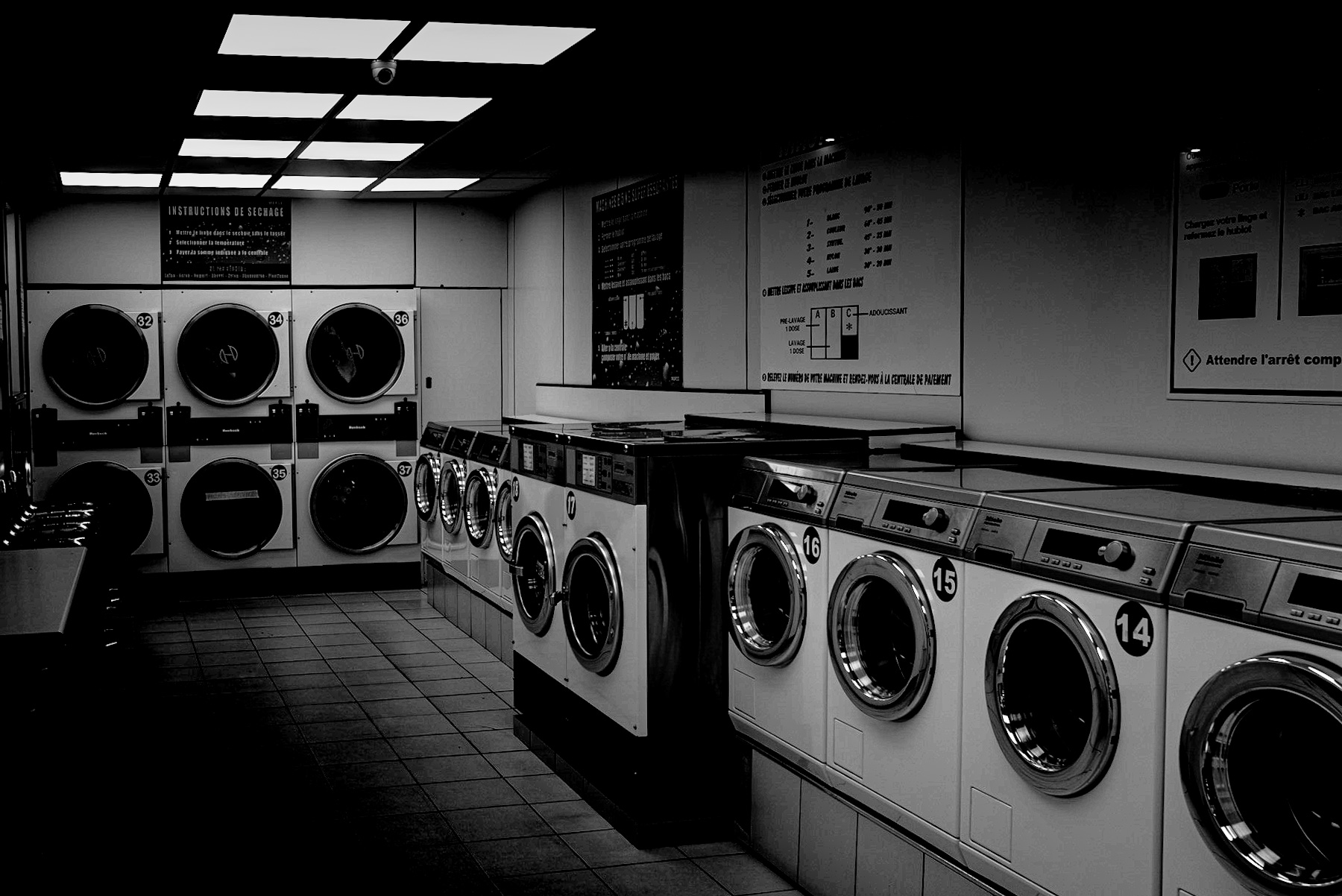
    Captured in stark black and white, this image presents a scene that is both mundane and deeply evocative: an empty laundromat. Rows of front-loading washing machines and dryers stand at attention, their chrome doors reflecting the sterile, gridded fluorescent lights above. The perspective draws the viewer’s eye down the tiled aisle, past numbered machines, creating a sense of order and repetition. The silence is palpable; this is a space of waiting, a pause in the rhythm of urban life. The French instructions on the wall—“Instructions de Séchage“—place us in a specific cultural context, yet the scene itself is universally understood.
    A Post-War Revolution in Cleanliness
    The public laundromat, or *laverie* as it might be called here, is a relatively modern invention, yet it fundamentally altered domestic life. Its origins trace back to the 1930s, but the concept truly flourished in the post-World War II era. Several societal shifts converged to make the self-service laundry a necessity:
    * **Urbanization:** As populations moved into cities, living spaces shrank. Apartments and small homes often lacked the space for a personal washing machine and the yard for a clothesline. * **Economic Factors:** Early automatic washing machines were expensive luxury items. The laundromat offered an affordable, pay-per-use alternative, democratizing access to mechanized cleaning. * **Changing Social Structures:** With more women entering the workforce, the time-consuming chore of hand-washing laundry became increasingly impractical for many households.
    The laundromat was more than a convenience; it was a symbol of post-war progress and efficiency. It outsourced one of the most laborious domestic tasks, freeing up valuable time for individuals and families.
    From Social Hub to Solitary Space
    In its heyday, the laundromat was an unintentional community center. It was a place where neighbors crossed paths, where conversations unfolded over the rhythmic hum and tumble of the machines. It became a unique social landscape, a melting pot of a neighborhood’s residents, all united by a common, simple task. This cultural significance is reflected in countless films and television shows, where the laundromat serves as a backdrop for chance encounters, quiet confessions, and slices of everyday life.
    The image, however, portrays the other side of this coin. The absence of people transforms the space from a social hub into a zone of quiet solitude. The security camera on the ceiling is a subtle reminder of its public, yet often anonymous, nature. In our contemporary, fast-paced world, the laundromat is often visited at odd hours, a place for solitary reflection while the machines perform their cycle.
    The Enduring Cycle
    This photograph captures the essence of the laundromat as a liminal space—a place of transition. Clothes go in dirty and come out clean. It is a place of renewal, of resetting for the week ahead. The stark, high-contrast monochrome aesthetic strips the scene of distraction, focusing our attention on the form and function of the machines and the geometry of the room. It feels both timeless and slightly dated, a testament to an invention that has remained remarkably consistent in its purpose for over 70 years. It stands as a quiet monument to a simple, essential aspect of modern urban existence.
  • The Moulin Rouge in Monochrome: A Timeless Beacon of Parisian Nightlife

    The Moulin Rouge in Monochrome: A Timeless Beacon of Parisian Nightlife

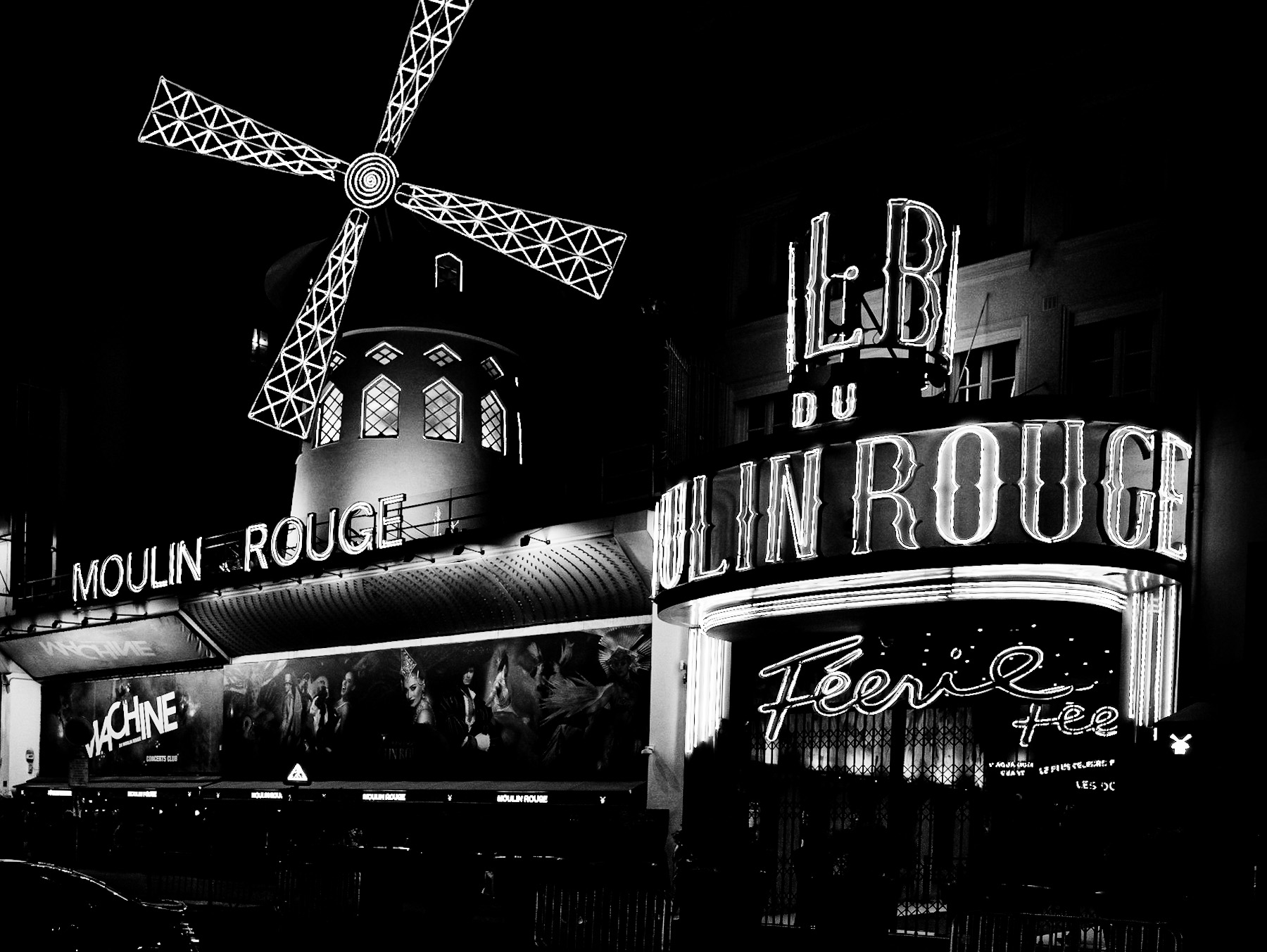
    The image presents a striking, high-contrast black-and-white view of a world-renowned landmark: the Moulin Rouge. Stripped of its famous crimson hue, the scene is reduced to its essential forms of light and shadow. The iconic windmill, its sails intricately latticed and glowing against the pitch-black sky, stands as a silent sentinel. Below, the bold, retro neon letters spelling out „MOULIN ROUGE“ and „Féerie“ burn brightly, carving the cabaret’s identity into the Parisian night. This monochromatic treatment emphasizes not the color, but the enduring energy and architectural character of a place steeped in history.
    The Birth of a Legend in the Belle Époque
    To understand the Moulin Rouge is to step back into the Paris of 1889. Co-founded by Charles Zidler and Joseph Oller, the cabaret opened its doors during the peak of the Belle Époque—a period of optimism, artistic freedom, and industrial progress in France. Situated in the bohemian Montmartre district, it was designed to be a place where people from all social classes could mix, from artists and writers to the wealthy elite and working-class locals. Its unique, extravagant architecture, complete with the now-famous red windmill, was a spectacle in itself, promising a world of fantasy and escape from the moment one approached its doors.
    The Dance and the Artist that Defined an Era
    The Moulin Rouge didn’t just offer a venue; it launched a cultural phenomenon. It is globally recognized as the birthplace of the modern form of the Can-Can, a high-energy, physically demanding dance that was considered scandalous and liberating in equal measure. Dancers like La Goulue and Jane Avril became the first true stars of the cabaret world, their fame immortalized by the artist who became synonymous with Montmartre’s nightlife: Henri de Toulouse-Lautrec. His iconic posters and paintings captured the vibrant, chaotic, and poignant essence of the Moulin Rouge, elevating its performers from entertainers to muses and cementing the cabaret’s place in art history.
    A Modern Beacon with a Storied Past
    Today, as the photograph illustrates, the Moulin Rouge continues to be a major draw in Paris. The sign for „Féerie,“ its current grand spectacle, glows with the same promise of enchantment that has lured audiences for over a century. The posters visible below the main sign depict modern performers, a direct lineage from the dancers Toulouse-Lautrec once sketched.
    By removing the color, the image allows us to see the Moulin Rouge not just as a tourist attraction, but as a historical constant. The light it casts on the Boulevard de Clichy is more than just electricity; it is the lingering glow of the Belle Époque, a testament to Paris’s enduring spirit of joie de vivre. The structure stands as a bridge between the past and present—a symbol of artistic rebellion, extravagant entertainment, and the timeless allure of Parisian nights.
  • The Belly of Paris: A Modern Echo in a Timeless Street Scene

    The Belly of Paris: A Modern Echo in a Timeless Street Scene

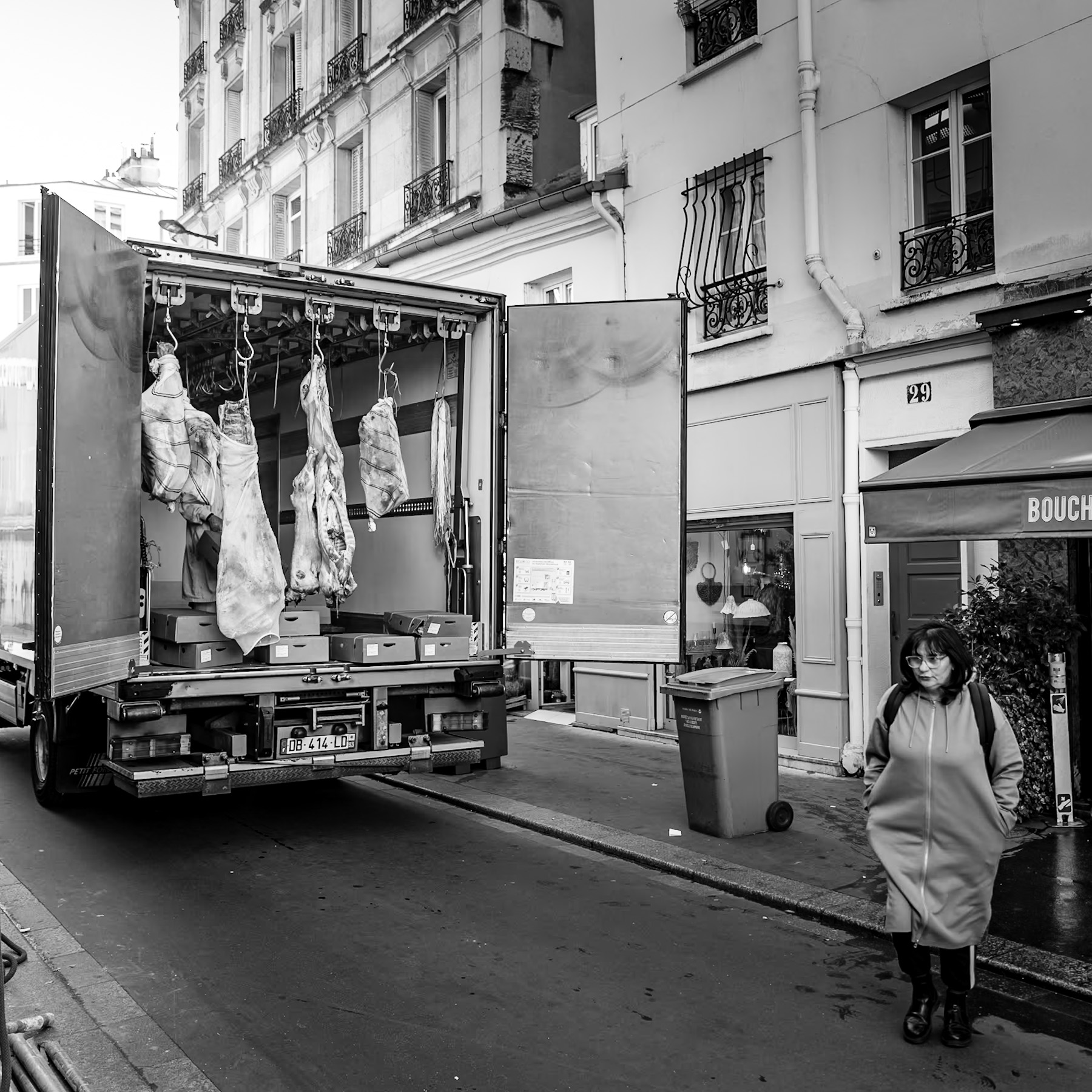
    In the quiet light of a Parisian morning, a refrigerated truck stands with its doors agape, revealing a sight both mundane and primal. Large carcasses of meat hang from steel hooks, a stark and unadorned view of the city’s food supply chain in motion. This black and white photograph captures more than just a delivery; it encapsulates a centuries-old tradition that continues to beat at the heart of Paris, set against the backdrop of its iconic Haussmannian architecture.
    A Glimpse into the Daily Grind
    The scene is set in a narrow street, typical of the French capital. The truck, a modern necessity, is parked directly in front of a boucherie, its destination clear. The raw meat, partially wrapped, is ready to be unloaded and transformed by the skilled hands of the local butcher. This daily ritual is the essential, often unseen, link between the countryside and the consumer’s plate. It’s a moment of transition, where the raw material of French gastronomy begins its journey into the refined products celebrated worldwide. The photograph’s monochrome palette strips the scene of distraction, focusing the viewer on the textures and forms: the rough surfaces of the meat, the cold metal of the truck, and the elegant stone of the surrounding buildings.
    Echoes of Les Halles
    To understand the full weight of this image, one must look to the history of Paris itself, specifically to the legendary market of Les Halles. For over 800 years, this central market was famously dubbed „Le Ventre de Paris“ („The Belly of Paris“) by the novelist Émile Zola. It was a sprawling, chaotic, and vibrant hub where all the food for the city converged. The meat pavilions of Les Halles were a world unto themselves, a place of immense labor and vital importance to the city’s survival and culinary identity.
    While the central market moved to Rungis in 1969, its spirit lives on in scenes like this. This single truck, delivering directly to a neighborhood Parisian boucherie, is a modern, decentralized echo of that massive, historic operation. The fundamental process remains the same: the transportation of animal carcasses from the abattoir to the artisan. This image serves as a powerful reminder that behind the romantic façade of Paris lies a working city, one that relies on a complex and deeply rooted network of trade and craft.
    The Juxtaposition of Life and Architecture
    The photograph masterfully plays with contrast. The organic, almost visceral nature of the hanging meat is juxtaposed with the rigid, ornate geometry of the 19th-century buildings. The wrought-iron balconies and clean architectural lines speak of order, culture, and permanence. The delivery, however, speaks of the transient, cyclical nature of life and sustenance. A woman stands on the pavement, a contemporary observer of this timeless transaction. Her presence grounds the scene in the present moment, a citizen navigating the space where history and daily necessity intersect.
    This single frame is a powerful piece of documentary. It is not the Paris of postcards, but the authentic Paris—a city that honors its culinary traditions not just in its Michelin-starred restaurants, but in the quiet, essential work that happens every day on its historic streets.
  • A Parisian Corner: The Timeless Architecture of the Haussmann Era

    A Parisian Corner: The Timeless Architecture of the Haussmann Era

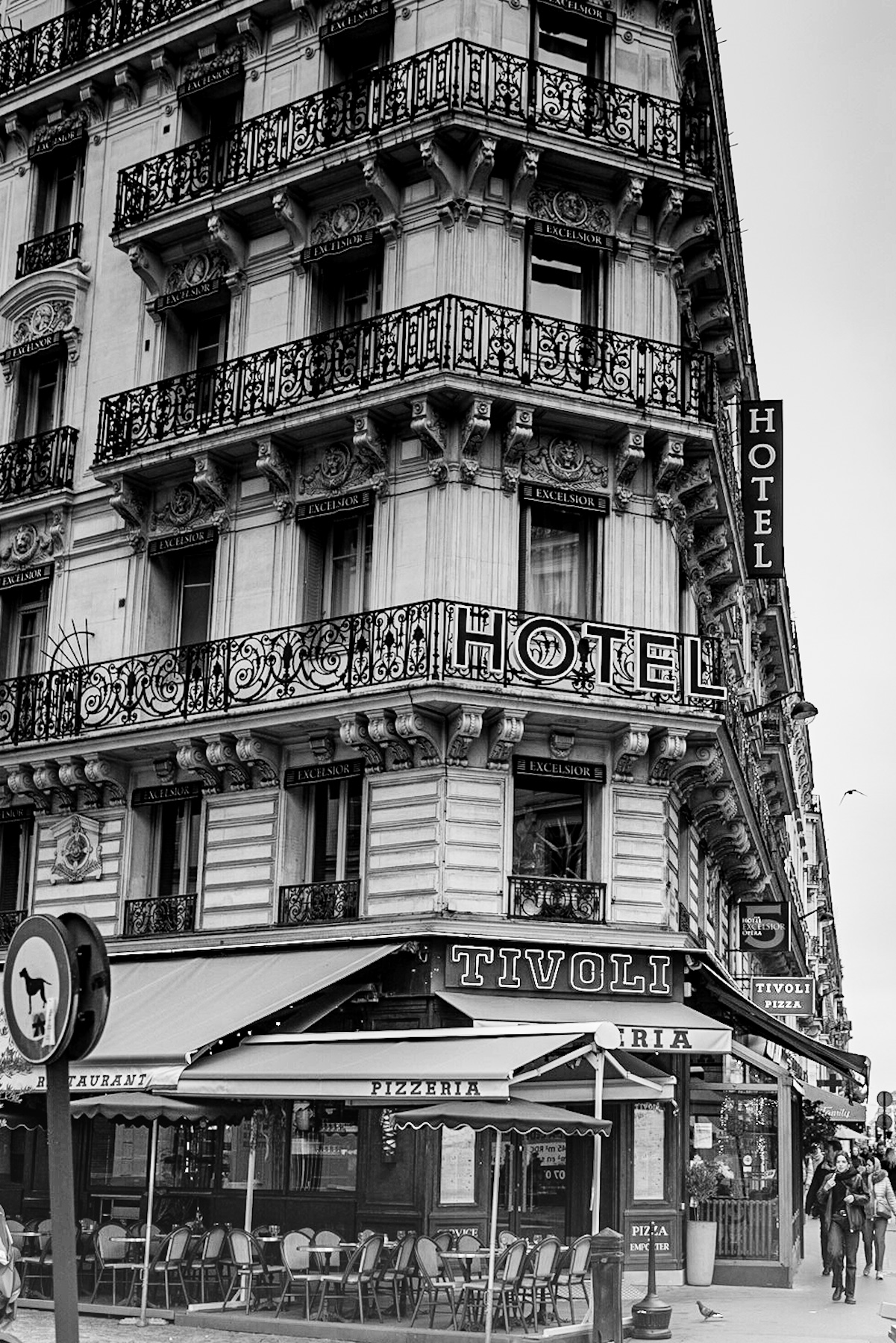
    Captured in monochrome, this image presents a quintessential Parisian street corner, a scene that is both a snapshot of daily life and a window into the city’s rich architectural history. The focal point is a grand corner building, home to the Hotel Excelsior and the Tivoli Pizzeria, which stands as a testament to a transformative period in Paris’s urban development.
    The Haussmannian Blueprint
    The building is a textbook example of Haussmannian architecture, the style that defines much of central Paris today. This architectural identity was forged during the Second French Empire, under the direction of Emperor Napoleon III, who commissioned Baron Georges-Eugène Haussmann to undertake a massive public works program between 1853 and 1870. The goal was to replace the cramped, dark, and unsanitary medieval streets with wide avenues, modern sanitation, and stately, uniform buildings.
    This photograph perfectly illustrates the core principles of Haussmann’s vision:
    * Uniformity and Grandeur: The building adheres to a strict height limit, creating a harmonious roofline with its neighbors (implied outside the frame). The facade is constructed from cream-colored Lutetian limestone, giving the city its characteristic luminous quality. * Structured Facades: The design follows a clear horizontal division. The ground floor is dedicated to commercial use—in this case, the „Tivoli“ restaurant. The floors above are residential or, as indicated by the signs, for the Hotel Excelsior. The second and fifth floors are typically adorned with continuous, ornate balconies. * Ornate Details: While the overall structure is uniform, the details are rich and elaborate. This reflects the influence of the Beaux-Arts style, which emphasized symmetry, hierarchy, and opulent decoration.
    A Closer Look at the Details
    A detailed examination of the facade reveals the craftsmanship of the era. The most striking features are the intricate wrought-iron balconies. These were not merely decorative; they provided private outdoor space for the residents of the étage noble (the noble floor, or second floor), which was considered the most desirable. The flowing, almost floral patterns of the ironwork contrast beautifully with the solid, geometric lines of the stone.
    Beneath the balconies, carved stone corbels provide structural and aesthetic support. Each window is framed with care, and the name „EXCELSIOR“ is elegantly inscribed above many of them, reinforcing the building’s identity. The large „HOTEL“ sign, with its classic typography, is both a functional marker and an integral part of the building’s character, a common sight on the Parisian urban landscape.
    Life at Street Level
    Anchoring this monumental structure is the vibrant life at street level. The „TIVOLI“ Pizzeria, with its wide awnings and outdoor seating, embodies the famous Parisian café culture. The chairs and tables arranged on the sidewalk invite passersby to pause, dine, and observe the city’s flow. This seamless integration of commercial and residential life is a hallmark of Parisian urbanism, creating a dynamic and walkable city. The pedestrians on the right side of the frame add a sense of movement, reminding us that this historic architecture is not a museum piece but the living, breathing backdrop to modern life.
    In conclusion, this photograph captures more than just a building. It encapsulates an entire philosophy of urban design that prioritized beauty, function, and social order. The Hotel Excelsior is a microcosm of Paris itself: a place where historical grandeur meets the simple, everyday pleasures of a meal on a bustling sidewalk.
  • Parisian Harmony: Haussmann Architecture and the Iconic Eiffel Tower

    Parisian Harmony: Haussmann Architecture and the Iconic Eiffel Tower

    A black-and-white photograph immortalizes a quintessential Parisian street corner, a tableau brimming with architectural history and cultural resonance. The low-angle perspective expertly draws the eye upward, from the bustling modern street to a historical skyline, revealing a layered composition where various eras of Parisian development beautifully coexist.
    At the heart of this Parisian vista stands a prime example of Haussmannian architecture, the defining style of central Paris. This aesthetic emerged from the monumental urban renewal project spearheaded by Emperor Napoleon III and Baron Georges-Eugène Haussmann from 1853 to 1870. The buildings of this era, like the one pictured, are instantly recognizable by their uniform facades of cream-colored cut stone, bringing a sense of order to the grand boulevards. Intricate wrought-iron balconies grace the windows, with the continuous, wrap-around balcony on the second floor, known as the ‚étage noble,‘ serving as a distinct status symbol for the city’s wealthiest. Haussmann’s meticulous regulations also dictated specific building heights and floor plans, typically allocating the ground floor for shops and the upper floors for apartments of diminishing prestige. Capping these structures is the distinctive 45-degree pitched mansard roof, often housing attic rooms or ‚chambres de bonne‘ for servants.
    This transformation was far more than cosmetic. Haussmann’s ambitious plan involved the demolition of crowded, medieval neighborhoods to pave the way for wide avenues, expansive parks, and elegant squares. This not only dramatically improved sanitation and traffic flow but also served a strategic military purpose, making it significantly harder for uprisings to erect barricades. The architectural gem in our photograph stands as a direct descendant of this monumental, and at times controversial, chapter in Parisian history.
    Just above these classic Haussmannian rooftops, the unmistakable lattice silhouette of the Eiffel Tower emerges. Its towering presence offers a pivotal historical counterpoint. Erected between 1887 and 1889 as the centerpiece of the Exposition Universelle (World’s Fair), the tower was a groundbreaking symbol of 19th-century industrial engineering and forward-thinking modernism.
    The Eiffel Tower’s arrival was initially met with sharp criticism from Paris’s artistic and literary circles, who decried it as a „monstrous factory chimney“ that clashed with the city’s established classical beauty. It stood in stark contrast to the elegant stone-and-plaster aesthetic of Haussmann’s vision. Yet, with the passage of time, these two iconic symbols have found a profound reconciliation. What was once a jarring contrast is now a harmonious pairing, representing two distinct yet equally defining chapters of the city’s narrative: the ordered, bourgeois elegance of the Second Empire and the audacious industrial ambition of the Third Republic.
    This single photograph beautifully encapsulates this synthesis. The vibrant foreground, complete with parked cars and a bustling pedestrian crossing, firmly roots the scene in the present day. It serves as a powerful reminder that this historic cityscape is far from a mere museum exhibit; it is a living, breathing urban environment where daily life continually unfolds against a backdrop of profound architectural and social history.
  • Unbenannter Beitrag 686

    Haussmann's Legacy: The Timeless Architecture of a Parisian Street

    This black and white photograph captures a quintessential Parisian street, a scene that feels both contemporary and deeply rooted in history. The image presents a quiet moment where the grandeur of 19th-century urban planning meets the rhythm of 21st-century daily life. The cobblestone road, the line of parked cars and bicycles, and the leafy plane trees all exist under the watchful presence of the iconic buildings that define the city's visual identity.

    The dominant feature is the magnificent and uniform facade of the apartment blocks, a direct legacy of Baron Haussmann's radical renovation of Paris between 1853 and 1870. Commissioned by Emperor Napoleon III, Haussmann’s mandate was to modernize the city, replacing its dark, narrow medieval lanes with wide, airy boulevards, parks, and a new, cohesive architectural style. The buildings in the photograph are a perfect example of this vision. Notice the consistent height, the cream-colored stone (Lutetian limestone), and the alignment of balconies. This uniformity was not just for aesthetics; it was designed to create a sense of order, grandeur, and hygiene.

    A closer look reveals the specific characteristics of Haussmannian architecture:

    • Wrought-Iron Balconies: The intricate, black wrought-iron railings are a signature element. They typically wrap around the entire building on the second floor—the étage noble or noble floor, once considered the most desirable—and often appear on the fifth floor as well. These balconies break the monotony of the stone facade and add a layer of delicate ornamentation.
    • Tall French Windows: The long, elegant windows, often with shutters, were designed to let in maximum light, a stark contrast to the small windows of the older buildings Haussmann’s project replaced.
    • Structured Floors: Though not visible in detail, these buildings follow a strict hierarchy. The ground floor was for shops, the mezzanine for storage or the shopkeeper's lodging, the second floor for the wealthiest residents, and the upper floors for the middle class, with the very top floor (attic rooms) reserved for servants.

    Down on the street level, the photograph reveals a blend of eras. The worn pavés, or cobblestones, have paved Parisian roads for centuries and are as much a part of the city's fabric as the buildings themselves. Juxtaposed against this historic foundation are modern vehicles—a Renault sedan, a white van—and a rack of bicycles, reflecting the city's evolving relationship with transportation. The awnings of a café or restaurant hint at the vibrant commercial life that continues to thrive on the ground floors of these historic structures, just as they were designed to do.

    The composition, rendered in monochrome, strips the scene of color, encouraging the viewer to focus on texture, light, and form. It highlights the rough bark of the plane trees, the smooth stone of the buildings, and the uneven surface of the road. This timeless quality underscores the enduring success of Haussmann's vision: a city designed for a specific historical moment that has proven remarkably adaptable, retaining its unparalleled charm and character through the centuries.