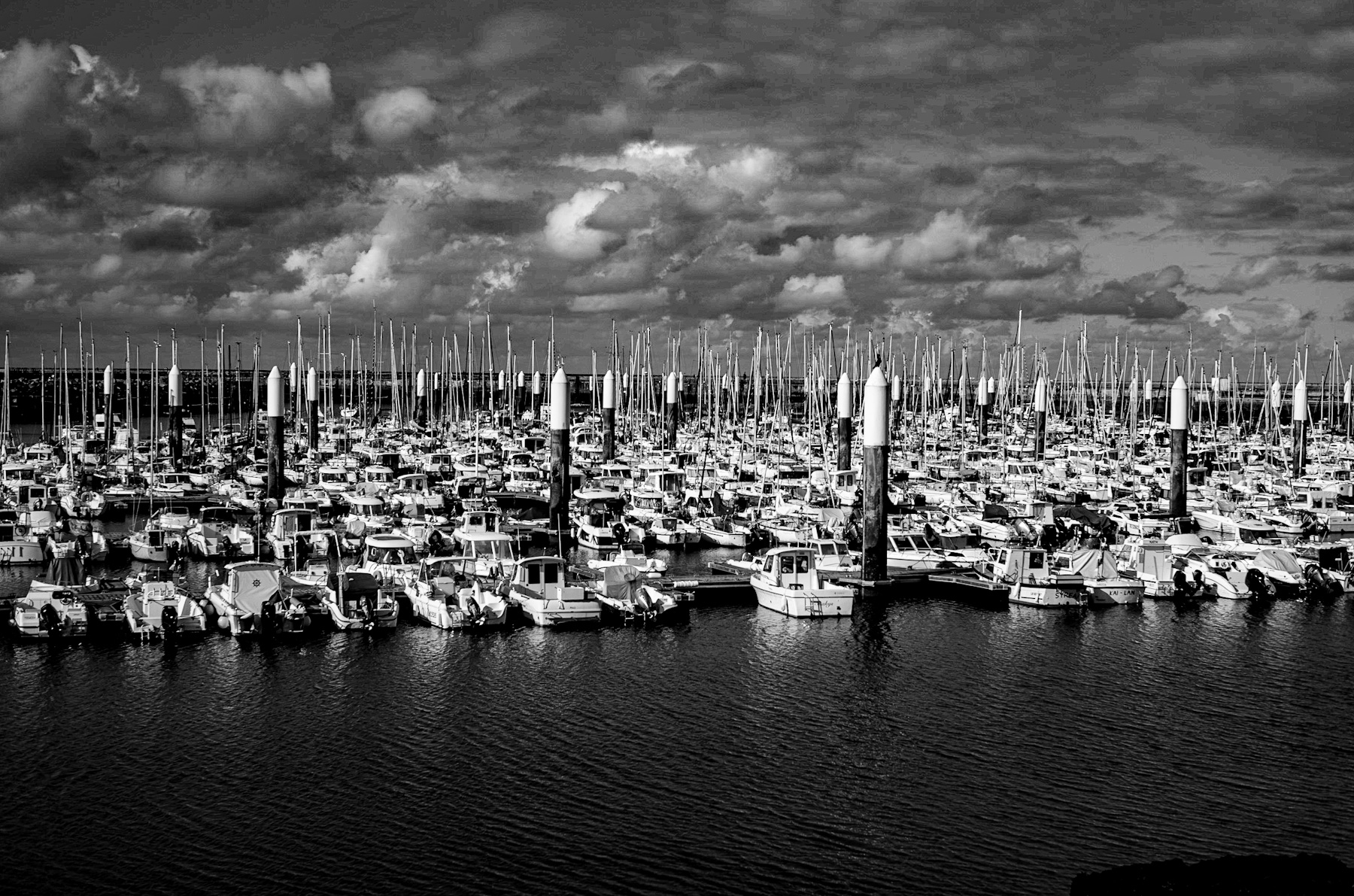
The striking black and white photograph presents a densely packed marina, a vibrant testament to modern maritime culture. Hundreds of boats, primarily sailing yachts and smaller motor cruisers, are meticulously moored, creating a visually compelling pattern across the water’s surface. The monochromatic palette enhances the scene’s dramatic quality, drawing attention to the intricate details of the vessels and the atmospheric sky above.
### A Symphony of Masts and Clouds
In the foreground, the dark, rippled water provides a stark contrast to the gleaming white hulls and superstructures of the boats. Their vertical masts, slender and numerous, rise like a dense forest, puncturing the horizon and reaching towards a sky heavy with dramatic, textured clouds. These clouds, rendered in varying shades of grey, dominate the upper third of the frame, adding a sense of depth and a slightly brooding atmosphere to the scene. The visual effect is one of ordered chaos, where individual vessels contribute to a larger, unified composition. The robust mooring pylons, stark white caps against dark wood, stand guard, anchoring the scene both literally and metaphorically.
### The Modern Marina: A Hub of Leisure
This image captures the essence of a contemporary marina, a dedicated infrastructure designed to house and service recreational vessels. Marinas represent a significant evolution in humanity’s relationship with the sea. Historically, ports were primarily centers for trade, fishing, and naval operations – functional spaces driven by economic necessity or strategic importance. The rise of leisure boating, particularly since the mid-20th century, has transformed coastal landscapes, leading to the proliferation of such dedicated facilities. These hubs offer not just mooring but also a range of services from maintenance and refueling to social amenities, catering to a growing demographic seeking escape, adventure, and community on the water.
### Historical Currents: From Utility to Recreation
The historical roots of maritime activity are profound, stretching back millennia to the earliest forms of navigation, exploration, and commerce. While the vessels depicted here are modern, their presence in a harbor setting connects directly to this enduring legacy. For centuries, boats were essential tools for survival and development. The shift towards recreational yachting began in earnest in the 17th century with royal patronage, evolving into a more widespread leisure pursuit for the affluent during the Victorian era. However, it was the post-World War II economic boom and advancements in boat manufacturing that truly democratized sailing and motorboating, making it accessible to a broader population.
Today’s marinas, like the one pictured, are the physical manifestation of this historical trajectory. They embody a synthesis of ancient seafaring traditions and modern technological and societal trends. Each boat, while a personal vessel, is part of a larger collective, echoing the historical fleets that once navigated these same waters for vastly different purposes. The image, therefore, is not merely a snapshot of boats; it is a visual narrative of human ingenuity, evolving leisure, and an enduring connection to the vastness of the ocean. It encapsulates the spirit of maritime heritage, reinterpreted for the modern age, all under the timeless gaze of a dramatic sky.
### A Symphony of Masts and Clouds
In the foreground, the dark, rippled water provides a stark contrast to the gleaming white hulls and superstructures of the boats. Their vertical masts, slender and numerous, rise like a dense forest, puncturing the horizon and reaching towards a sky heavy with dramatic, textured clouds. These clouds, rendered in varying shades of grey, dominate the upper third of the frame, adding a sense of depth and a slightly brooding atmosphere to the scene. The visual effect is one of ordered chaos, where individual vessels contribute to a larger, unified composition. The robust mooring pylons, stark white caps against dark wood, stand guard, anchoring the scene both literally and metaphorically.
### The Modern Marina: A Hub of Leisure
This image captures the essence of a contemporary marina, a dedicated infrastructure designed to house and service recreational vessels. Marinas represent a significant evolution in humanity’s relationship with the sea. Historically, ports were primarily centers for trade, fishing, and naval operations – functional spaces driven by economic necessity or strategic importance. The rise of leisure boating, particularly since the mid-20th century, has transformed coastal landscapes, leading to the proliferation of such dedicated facilities. These hubs offer not just mooring but also a range of services from maintenance and refueling to social amenities, catering to a growing demographic seeking escape, adventure, and community on the water.
### Historical Currents: From Utility to Recreation
The historical roots of maritime activity are profound, stretching back millennia to the earliest forms of navigation, exploration, and commerce. While the vessels depicted here are modern, their presence in a harbor setting connects directly to this enduring legacy. For centuries, boats were essential tools for survival and development. The shift towards recreational yachting began in earnest in the 17th century with royal patronage, evolving into a more widespread leisure pursuit for the affluent during the Victorian era. However, it was the post-World War II economic boom and advancements in boat manufacturing that truly democratized sailing and motorboating, making it accessible to a broader population.
Today’s marinas, like the one pictured, are the physical manifestation of this historical trajectory. They embody a synthesis of ancient seafaring traditions and modern technological and societal trends. Each boat, while a personal vessel, is part of a larger collective, echoing the historical fleets that once navigated these same waters for vastly different purposes. The image, therefore, is not merely a snapshot of boats; it is a visual narrative of human ingenuity, evolving leisure, and an enduring connection to the vastness of the ocean. It encapsulates the spirit of maritime heritage, reinterpreted for the modern age, all under the timeless gaze of a dramatic sky.
Schreibe einen Kommentar