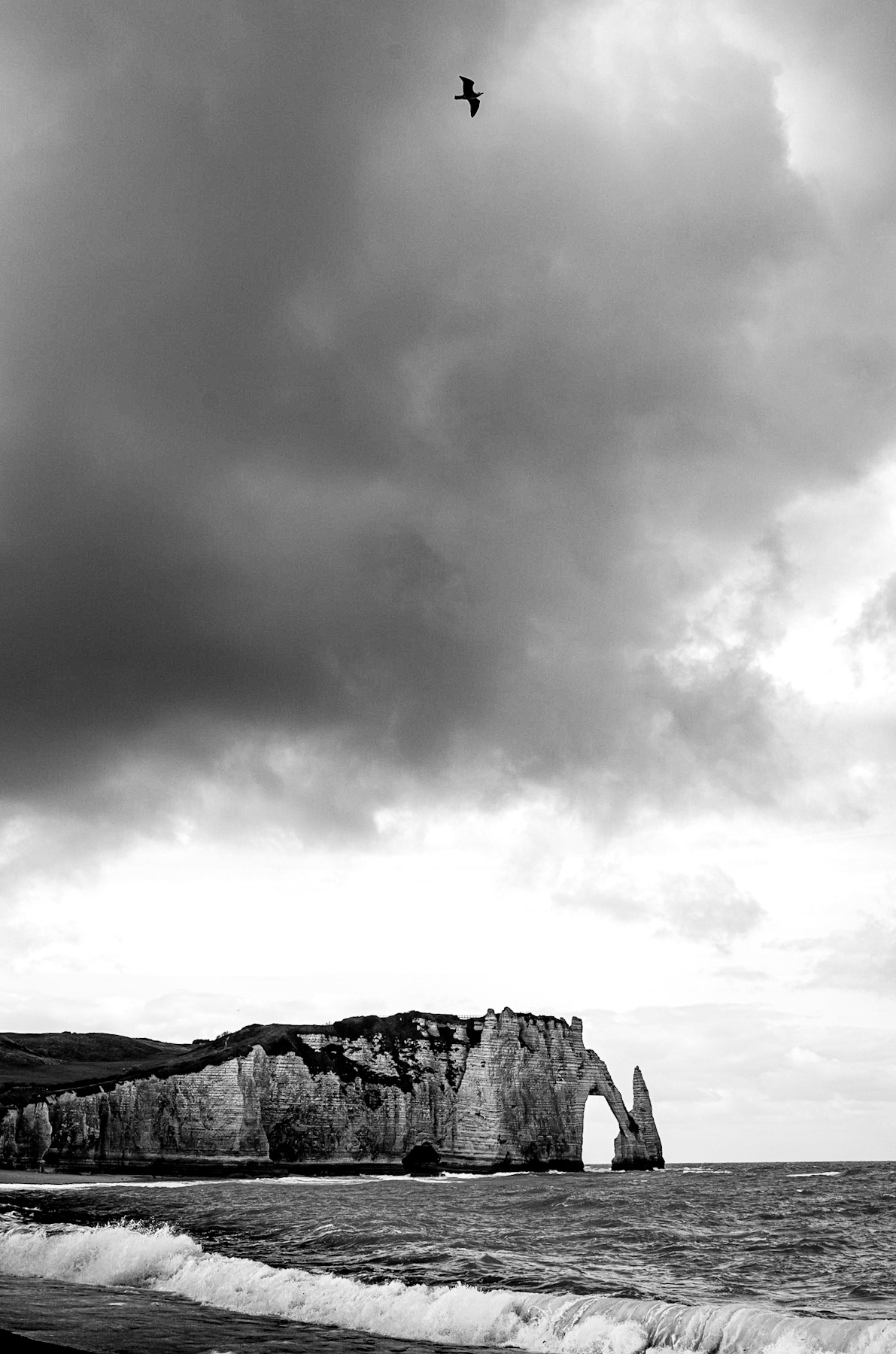
The dramatic sweep of the Normandy coast unfolds in a striking monochrome tableau, where nature’s artistry is etched against a brooding sky. A lone bird, a silhouette of freedom, soars high above the formidable chalk cliffs of Étretat, its flight a silent counterpoint to the powerful, ancient landscape below. The scene is dominated by the monumental **Porte d’Aval natural arch**, its graceful curve carved by millennia of relentless ocean waves, standing sentinel beside the towering **Aiguille** (the Needle), an isolated stack of rock that pierces the horizon.
The Visual Narrative: A Study in Contrast
The photograph masterfully employs black and white to emphasize the raw power and subtle textures of this renowned French landmark. Dark, heavy clouds dominate the upper sky, creating a sense of impending drama and adding depth to the vast expanse above the cliffs. Below, the tumultuous waters of the **English Channel** crash against the shore, their white foam sharply contrasting with the darker tones of the sea. The waves themselves appear dynamic, caught mid-break, conveying the constant, sculpting force of the ocean. The chalk cliffs, with their distinctive striations and rugged contours, reveal layers of geological time, their imposing presence softened yet defined by the monochromatic palette. This absence of color strips away distractions, focusing the viewer’s attention on form, light, and shadow, thereby enhancing the timeless and almost sculptural quality of the scene. The choice of black and white photography further accentuates the dramatic mood, transforming the landscape into an almost abstract study of natural forces.
Étretat: A Canvas for Time and Art
Beyond its immediate visual impact, the Étretat coastline is steeped in history, both geological and cultural. These **chalk cliffs**, part of the larger Alabaster Coast, are remnants of a seabed from the Cretaceous period, approximately 70 to 100 million years ago. The relentless erosion by wind and sea has sculpted these magnificent formations, continually reshaping a landscape that has witnessed countless tides and seasons.
Culturally, Étretat has long been a muse for artists and writers. Its dramatic beauty captivated **Impressionist painters** like **Claude Monet**, who produced numerous series depicting the arches and stack under varying light conditions. His fascination with capturing the fleeting moments of light and atmosphere found a perfect subject in Étretat’s ever-changing scenery. Gustave Courbet and Eugène Boudin also immortalized these vistas, cementing their place in art history.
The site also holds significant literary connections. French author **Maurice Leblanc** famously set parts of his Arsène Lupin stories here, particularly „The Hollow Needle“ (L’Aiguille Creuse), intertwining the natural wonder with tales of mystery and adventure. This blend of natural grandeur and human storytelling adds layers of intrigue to every vista.
An Enduring Legacy of Natural Beauty
The solitary bird soaring above the **Étretat cliffs** serves as a poignant reminder of the enduring wildness of this place. It symbolizes a connection to nature that transcends human timelines, a link to the very forces that shaped these colossal structures. The scene, captured in its stark elegance, invites contemplation on the immense power of nature and the fleeting presence of human existence against such an ancient backdrop. It is a testament to the raw, untamed beauty of the **Normandy coast**, a place where history is written in stone and painted by the sea, continuing to inspire and captivate those who witness its enduring majesty.
The Visual Narrative: A Study in Contrast
The photograph masterfully employs black and white to emphasize the raw power and subtle textures of this renowned French landmark. Dark, heavy clouds dominate the upper sky, creating a sense of impending drama and adding depth to the vast expanse above the cliffs. Below, the tumultuous waters of the **English Channel** crash against the shore, their white foam sharply contrasting with the darker tones of the sea. The waves themselves appear dynamic, caught mid-break, conveying the constant, sculpting force of the ocean. The chalk cliffs, with their distinctive striations and rugged contours, reveal layers of geological time, their imposing presence softened yet defined by the monochromatic palette. This absence of color strips away distractions, focusing the viewer’s attention on form, light, and shadow, thereby enhancing the timeless and almost sculptural quality of the scene. The choice of black and white photography further accentuates the dramatic mood, transforming the landscape into an almost abstract study of natural forces.
Étretat: A Canvas for Time and Art
Beyond its immediate visual impact, the Étretat coastline is steeped in history, both geological and cultural. These **chalk cliffs**, part of the larger Alabaster Coast, are remnants of a seabed from the Cretaceous period, approximately 70 to 100 million years ago. The relentless erosion by wind and sea has sculpted these magnificent formations, continually reshaping a landscape that has witnessed countless tides and seasons.
Culturally, Étretat has long been a muse for artists and writers. Its dramatic beauty captivated **Impressionist painters** like **Claude Monet**, who produced numerous series depicting the arches and stack under varying light conditions. His fascination with capturing the fleeting moments of light and atmosphere found a perfect subject in Étretat’s ever-changing scenery. Gustave Courbet and Eugène Boudin also immortalized these vistas, cementing their place in art history.
The site also holds significant literary connections. French author **Maurice Leblanc** famously set parts of his Arsène Lupin stories here, particularly „The Hollow Needle“ (L’Aiguille Creuse), intertwining the natural wonder with tales of mystery and adventure. This blend of natural grandeur and human storytelling adds layers of intrigue to every vista.
An Enduring Legacy of Natural Beauty
The solitary bird soaring above the **Étretat cliffs** serves as a poignant reminder of the enduring wildness of this place. It symbolizes a connection to nature that transcends human timelines, a link to the very forces that shaped these colossal structures. The scene, captured in its stark elegance, invites contemplation on the immense power of nature and the fleeting presence of human existence against such an ancient backdrop. It is a testament to the raw, untamed beauty of the **Normandy coast**, a place where history is written in stone and painted by the sea, continuing to inspire and captivate those who witness its enduring majesty.
Schreibe einen Kommentar