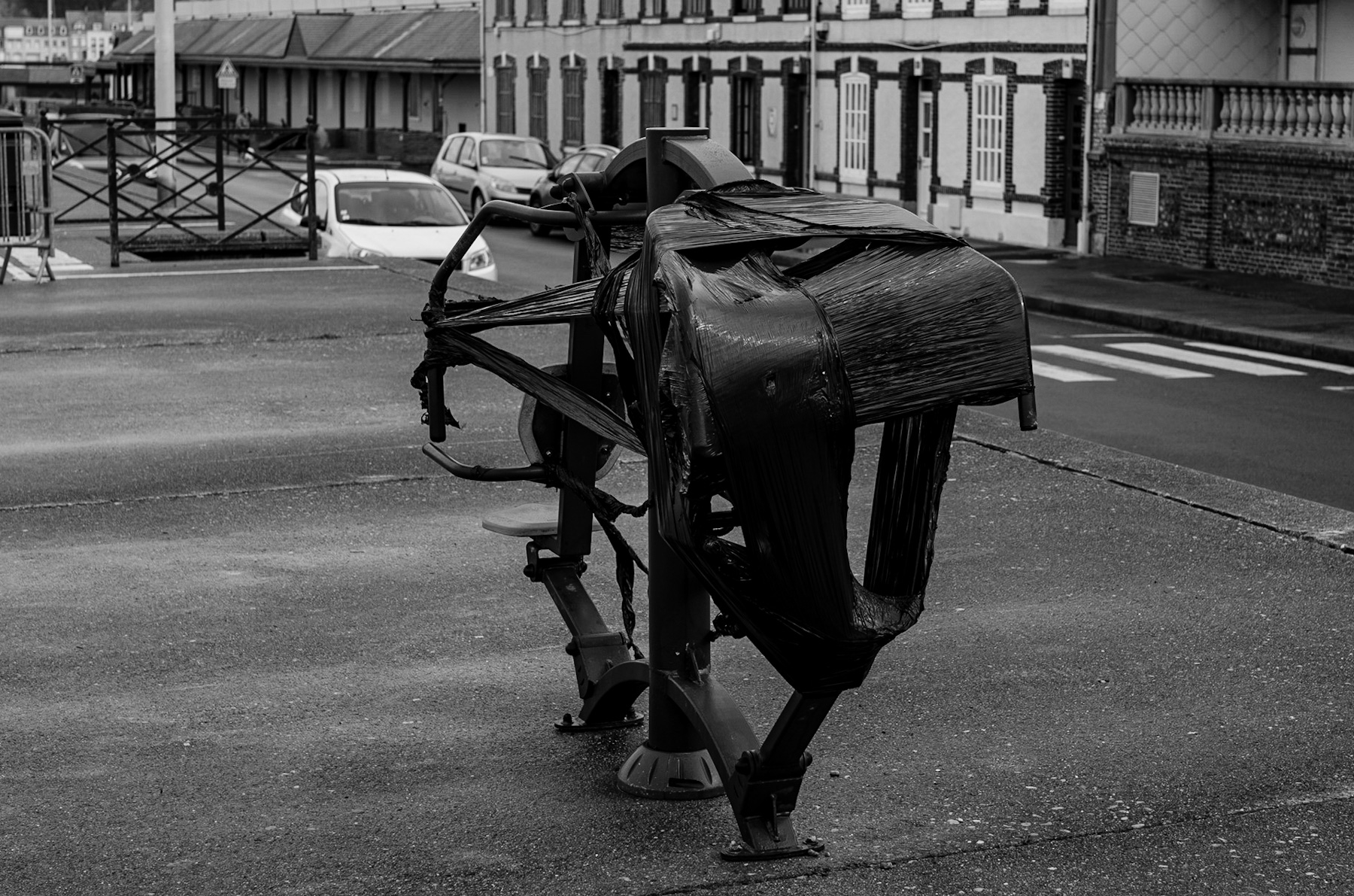
The monochrome photograph captures a striking scene: an outdoor fitness machine, meticulously wrapped in dark plastic, standing stoically on a paved surface. Its form, a modern apparatus designed for public well-being, is rendered temporarily inert, a silent sentinel in an urban tableau. The visual narrative presented here is one of pause and potential, set against a backdrop rich with architectural history.
A Moment of Stillness in the Urban Flow
The central subject, an outdoor leg press or similar exercise apparatus, is entirely enveloped in black plastic sheeting. This wrapping, tightly bound, creates a strong textural contrast against the smooth, gritty asphalt beneath and the muted tones of the distant buildings. It suggests a state of disuse, protection from the elements, or perhaps anticipation of future use, leaving its immediate purpose ambiguous. The choice of black and white photography accentuates the forms and textures, emphasizing the interplay of light and shadow, and lending a timeless, almost contemplative quality to the scene.
The immediate surroundings feature a paved area, likely a pedestrian zone or part of a public square, leading towards a street. Parked cars, contemporary in design, are visible along the roadside, indicating the ongoing rhythm of daily life that continues around this temporarily dormant installation. To the right, a clearly defined zebra crossing further reinforces the urban setting, denoting structured pedestrian movement.
Architectural Heritage and Modern Intervention
Dominating the background are multi-story buildings that exhibit classic European architectural characteristics. Their facades feature regularly spaced windows, many adorned with traditional shutters, some of which are painted in lighter tones, providing subtle visual interest despite the monochrome palette. The brickwork and detailing on these structures suggest a heritage that predates the modern fitness equipment, hinting at a long-established urban fabric. A prominent balcony with a balustrade on one building further enriches this historical architectural context. These buildings stand as tangible links to a deeper past, providing a robust sense of place and continuity.
Bridging Eras: Public Spaces and Their Evolution
This image, while capturing a contemporary object, subtly invites reflection on the historical evolution of public spaces. From the ancient agoras of Greece and the forums of Rome, which served as vibrant centers for civic life, commerce, and discourse, to the meticulously planned boulevards of 19th-century European capitals designed for grand promenades, urban areas have continually adapted to societal needs.
The advent of outdoor fitness equipment itself is a relatively recent phenomenon, emerging from a growing global emphasis on public health and accessible wellness initiatives in the late 20th and early 21st centuries. Historically, physical activity was often integrated into daily labor, military training, or confined to specific sporting arenas. Modern public gyms, like the one depicted, represent a democratization of fitness, transforming urban landscapes into communal wellness zones. They embody a contemporary societal value placed on health and leisure, accessible to all.
The wrapped machine can be interpreted as a metaphor for the cyclical nature of urban development – periods of construction, active use, renovation, and temporary closure. Just as historical buildings undergo restoration to preserve their legacy, modern public amenities require maintenance and occasional pauses, reflecting ongoing investment in community infrastructure. This temporary state of inactivity, whether for repair, seasonal protection, or logistical reasons, echoes the broader historical narrative of cities constantly renewing themselves, sometimes hiding elements only to reveal them anew. The enduring architecture in the background stands as a testament to the past, while the covered machine points to the ongoing, dynamic story of urban adaptation and public service in a changing world.
A Moment of Stillness in the Urban Flow
The central subject, an outdoor leg press or similar exercise apparatus, is entirely enveloped in black plastic sheeting. This wrapping, tightly bound, creates a strong textural contrast against the smooth, gritty asphalt beneath and the muted tones of the distant buildings. It suggests a state of disuse, protection from the elements, or perhaps anticipation of future use, leaving its immediate purpose ambiguous. The choice of black and white photography accentuates the forms and textures, emphasizing the interplay of light and shadow, and lending a timeless, almost contemplative quality to the scene.
The immediate surroundings feature a paved area, likely a pedestrian zone or part of a public square, leading towards a street. Parked cars, contemporary in design, are visible along the roadside, indicating the ongoing rhythm of daily life that continues around this temporarily dormant installation. To the right, a clearly defined zebra crossing further reinforces the urban setting, denoting structured pedestrian movement.
Architectural Heritage and Modern Intervention
Dominating the background are multi-story buildings that exhibit classic European architectural characteristics. Their facades feature regularly spaced windows, many adorned with traditional shutters, some of which are painted in lighter tones, providing subtle visual interest despite the monochrome palette. The brickwork and detailing on these structures suggest a heritage that predates the modern fitness equipment, hinting at a long-established urban fabric. A prominent balcony with a balustrade on one building further enriches this historical architectural context. These buildings stand as tangible links to a deeper past, providing a robust sense of place and continuity.
Bridging Eras: Public Spaces and Their Evolution
This image, while capturing a contemporary object, subtly invites reflection on the historical evolution of public spaces. From the ancient agoras of Greece and the forums of Rome, which served as vibrant centers for civic life, commerce, and discourse, to the meticulously planned boulevards of 19th-century European capitals designed for grand promenades, urban areas have continually adapted to societal needs.
The advent of outdoor fitness equipment itself is a relatively recent phenomenon, emerging from a growing global emphasis on public health and accessible wellness initiatives in the late 20th and early 21st centuries. Historically, physical activity was often integrated into daily labor, military training, or confined to specific sporting arenas. Modern public gyms, like the one depicted, represent a democratization of fitness, transforming urban landscapes into communal wellness zones. They embody a contemporary societal value placed on health and leisure, accessible to all.
The wrapped machine can be interpreted as a metaphor for the cyclical nature of urban development – periods of construction, active use, renovation, and temporary closure. Just as historical buildings undergo restoration to preserve their legacy, modern public amenities require maintenance and occasional pauses, reflecting ongoing investment in community infrastructure. This temporary state of inactivity, whether for repair, seasonal protection, or logistical reasons, echoes the broader historical narrative of cities constantly renewing themselves, sometimes hiding elements only to reveal them anew. The enduring architecture in the background stands as a testament to the past, while the covered machine points to the ongoing, dynamic story of urban adaptation and public service in a changing world.
Schreibe einen Kommentar