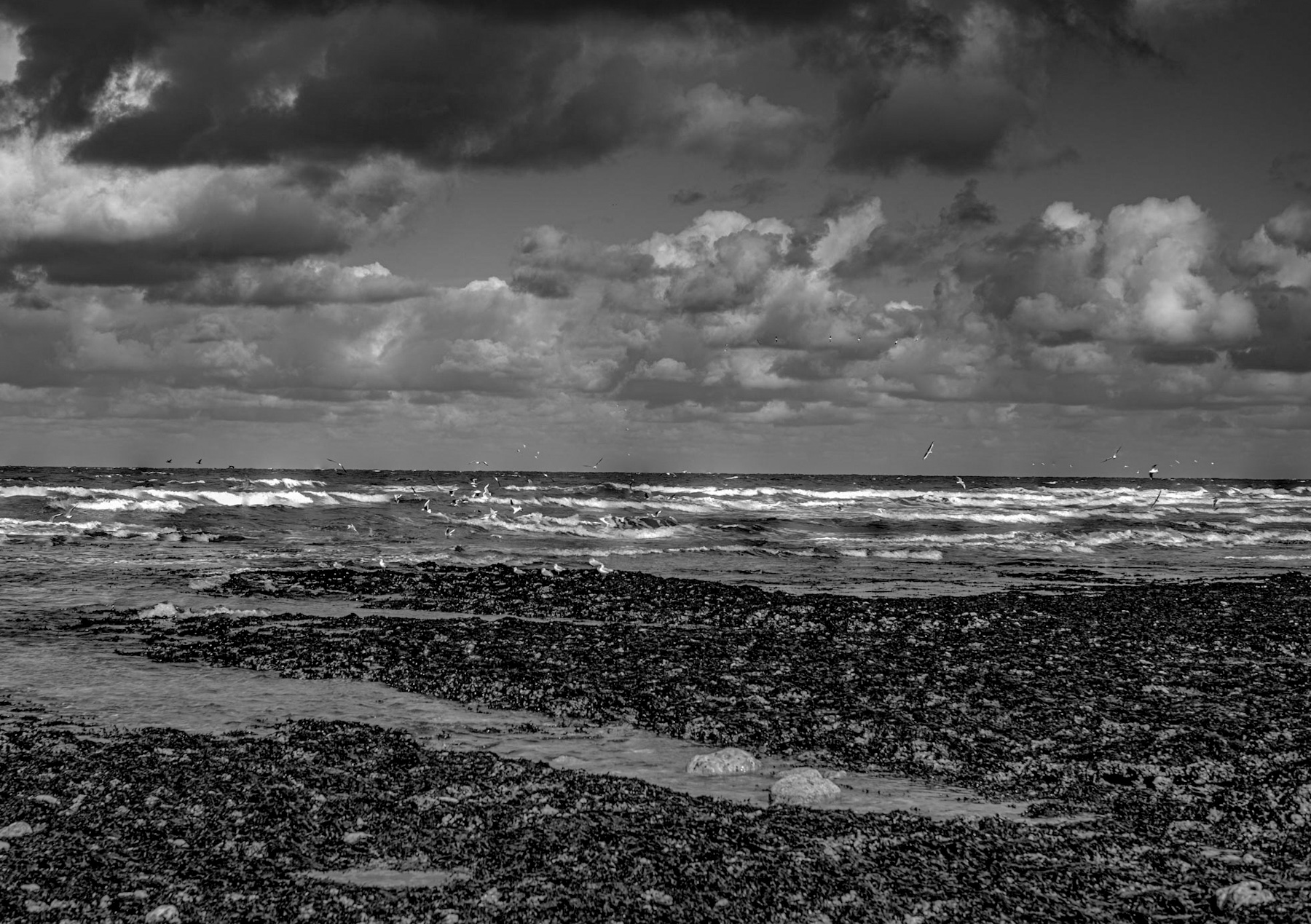
The scene unfolds in a striking monochrome, immediately drawing the viewer into a world of raw power and timeless natural beauty. Dominated by a dramatic sky, the photograph captures a rugged coastal landscape under a canopy of heavy, brooding clouds. The absence of color strips away distractions, emphasizing textures, contrasts, and the sheer force of the elements.
In the foreground, the dark, exposed seabed or foreshore is densely covered with what appears to be seaweed and small rocks, creating a rich, textured tapestry. A small pool of water reflects the muted light, and two larger, lighter-toned stones stand out, anchoring the composition. This detail suggests an intertidal zone, a dynamic boundary where land and sea perpetually interact, revealing the hidden life and geological foundations beneath the waves. The uneven, organic patterns of the foreground speak to the constant ebb and flow, a testament to countless cycles of tides and storms.
Beyond this intricate foreground, the ocean stretches out, alive with motion. Vigorous waves, capped with streaks of white foam, crash and roll towards the shore, conveying the restless energy of the sea. The turbulent surface is punctuated by numerous seagulls, some soaring gracefully against the dark sky, others dipping low over the water, perhaps seeking sustenance in the churned-up waters. Their presence adds a vital element of life and movement, highlighting the ecosystem that thrives even in such wild conditions. The horizon line, though distant, is clearly defined, separating the tumultuous waters from the equally dramatic sky.
Historically, coastlines like the one depicted have been central to human civilization. For millennia, these rugged shores have served as both a barrier and a gateway. They were the frontiers for ancient mariners, who navigated these challenging waters with rudimentary tools, embarking on voyages of trade, exploration, and migration. Coastal communities have historically adapted to the sea’s unpredictable moods, relying on its bounty for fishing and trade, while simultaneously building defenses against its destructive power. The constant erosion and deposition witnessed on such shores are a continuous geological process, shaping landforms over eons, telling a story of Earth’s relentless transformation.
This photograph, with its powerful black and white aesthetic, evokes the enduring spirit of these historical interactions. It reflects the timeless struggle and coexistence between humanity and the wild ocean, a relationship forged by the very forces visible here: the powerful waves, the dramatic skies, and the resilient life forms, both marine and avian. The monochrome palette further amplifies this sense of historical depth, inviting contemplation on the countless generations who have gazed upon similar scenes, feeling the same awe and respect for nature’s untamed grandeur. It is a visual reminder of the planet’s dynamic systems and the profound influence they have exerted throughout human history.
In the foreground, the dark, exposed seabed or foreshore is densely covered with what appears to be seaweed and small rocks, creating a rich, textured tapestry. A small pool of water reflects the muted light, and two larger, lighter-toned stones stand out, anchoring the composition. This detail suggests an intertidal zone, a dynamic boundary where land and sea perpetually interact, revealing the hidden life and geological foundations beneath the waves. The uneven, organic patterns of the foreground speak to the constant ebb and flow, a testament to countless cycles of tides and storms.
Beyond this intricate foreground, the ocean stretches out, alive with motion. Vigorous waves, capped with streaks of white foam, crash and roll towards the shore, conveying the restless energy of the sea. The turbulent surface is punctuated by numerous seagulls, some soaring gracefully against the dark sky, others dipping low over the water, perhaps seeking sustenance in the churned-up waters. Their presence adds a vital element of life and movement, highlighting the ecosystem that thrives even in such wild conditions. The horizon line, though distant, is clearly defined, separating the tumultuous waters from the equally dramatic sky.
Historically, coastlines like the one depicted have been central to human civilization. For millennia, these rugged shores have served as both a barrier and a gateway. They were the frontiers for ancient mariners, who navigated these challenging waters with rudimentary tools, embarking on voyages of trade, exploration, and migration. Coastal communities have historically adapted to the sea’s unpredictable moods, relying on its bounty for fishing and trade, while simultaneously building defenses against its destructive power. The constant erosion and deposition witnessed on such shores are a continuous geological process, shaping landforms over eons, telling a story of Earth’s relentless transformation.
This photograph, with its powerful black and white aesthetic, evokes the enduring spirit of these historical interactions. It reflects the timeless struggle and coexistence between humanity and the wild ocean, a relationship forged by the very forces visible here: the powerful waves, the dramatic skies, and the resilient life forms, both marine and avian. The monochrome palette further amplifies this sense of historical depth, inviting contemplation on the countless generations who have gazed upon similar scenes, feeling the same awe and respect for nature’s untamed grandeur. It is a visual reminder of the planet’s dynamic systems and the profound influence they have exerted throughout human history.
Schreibe einen Kommentar