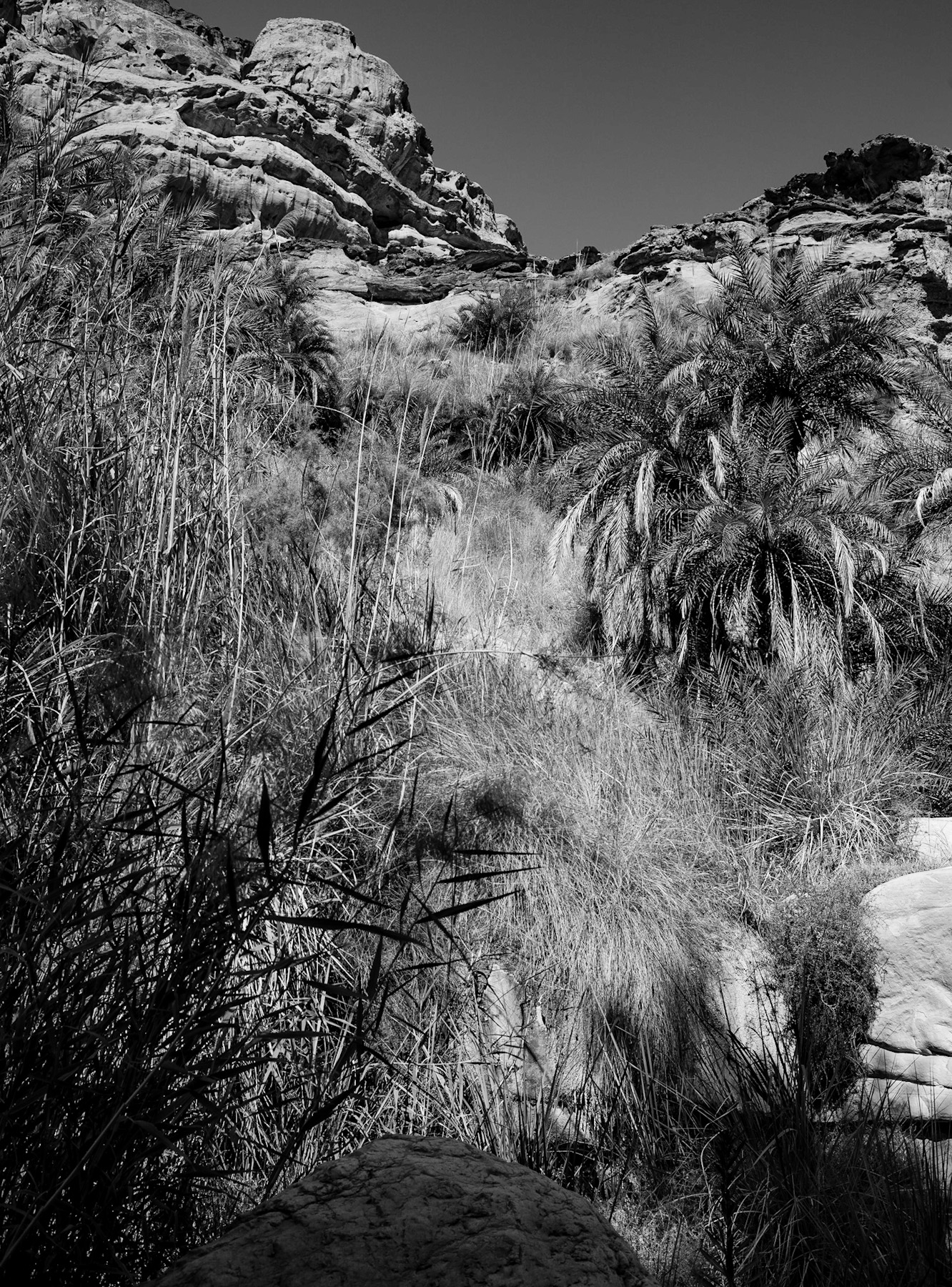
The striking black and white photograph presents a compelling view of a rugged, arid environment, where nature’s resilience is prominently displayed. Dominated by towering, stratified rock formations, the landscape speaks of ancient geological processes and millennia of erosion. These formidable cliffs, with their intricate patterns and deep crevices, form a dramatic backdrop, suggesting a world shaped by time and elemental forces.
A Tapestry of Life and Stone
In stark contrast to the seemingly barren rock, the foreground and mid-ground are rich with vibrant vegetation. Tall, slender grasses and reeds intertwine, creating a dense, textured layer that hints at hidden moisture. Several majestic palm trees, likely date palms, punctuate the scene, their distinctive fronds fanning out, providing shade and a focal point of life. The monochrome palette accentuates the textures and forms, transforming the scene into a study of light and shadow, emphasizing the raw beauty and dramatic contrasts inherent in such environments. The strong sunlight casts deep shadows, further enhancing the three-dimensional quality of the rocks and the lushness of the plant life.
Oases: Lifelines of Ancient Civilizations
This particular confluence of rocky terrain and flourishing vegetation strongly suggests the presence of an oasis or a wadi – a dry riverbed that periodically fills with water. Historically, such locations were not merely scenic spots but critical lifelines. Oases served as indispensable hubs in vast desert expanses, providing the vital resources of water, food, and shelter that enabled human and animal survival.
For millennia, these green pockets were the beating hearts of ancient trade routes, connecting distant civilizations across formidable deserts. Caravans laden with precious goods – spices, silk, gold, and frankincense – relied on oases like these as essential stopping points. They offered respite for weary travelers, a place to replenish supplies, and often served as burgeoning market towns where cultures intersected and commerce thrived. Iconic routes such as the Silk Road, the Incense Route, and trans-Saharan trade networks would have been impossible without the strategic distribution of oases.
The Enduring Legacy of Date Palms
The presence of date palms in particular holds significant historical weight. The date palm (Phoenix dactylifera) has been cultivated for thousands of years in the Middle East and North Africa, serving as a cornerstone of survival and culture. Its fruit provided a highly nutritious and storable food source, while its fronds were used for shelter, baskets, and other necessities. The very existence of ancient settlements in many desert regions was often predicated on the successful cultivation and management of date palm groves around a reliable water source.
A Timeless Testament to Resilience
This photograph, devoid of modern intrusions, transports the viewer to a timeless landscape. It is a visual testament to the enduring power of nature to foster life even in the most challenging conditions. Beyond its aesthetic appeal, it evokes the rich tapestry of human history woven around these precious desert sanctuaries – a narrative of exploration, trade, survival, and the profound human connection to the land. The image serves as a powerful reminder of how natural resources have shaped societies and continue to hold deep cultural and historical significance.
A Tapestry of Life and Stone
In stark contrast to the seemingly barren rock, the foreground and mid-ground are rich with vibrant vegetation. Tall, slender grasses and reeds intertwine, creating a dense, textured layer that hints at hidden moisture. Several majestic palm trees, likely date palms, punctuate the scene, their distinctive fronds fanning out, providing shade and a focal point of life. The monochrome palette accentuates the textures and forms, transforming the scene into a study of light and shadow, emphasizing the raw beauty and dramatic contrasts inherent in such environments. The strong sunlight casts deep shadows, further enhancing the three-dimensional quality of the rocks and the lushness of the plant life.
Oases: Lifelines of Ancient Civilizations
This particular confluence of rocky terrain and flourishing vegetation strongly suggests the presence of an oasis or a wadi – a dry riverbed that periodically fills with water. Historically, such locations were not merely scenic spots but critical lifelines. Oases served as indispensable hubs in vast desert expanses, providing the vital resources of water, food, and shelter that enabled human and animal survival.
For millennia, these green pockets were the beating hearts of ancient trade routes, connecting distant civilizations across formidable deserts. Caravans laden with precious goods – spices, silk, gold, and frankincense – relied on oases like these as essential stopping points. They offered respite for weary travelers, a place to replenish supplies, and often served as burgeoning market towns where cultures intersected and commerce thrived. Iconic routes such as the Silk Road, the Incense Route, and trans-Saharan trade networks would have been impossible without the strategic distribution of oases.
The Enduring Legacy of Date Palms
The presence of date palms in particular holds significant historical weight. The date palm (Phoenix dactylifera) has been cultivated for thousands of years in the Middle East and North Africa, serving as a cornerstone of survival and culture. Its fruit provided a highly nutritious and storable food source, while its fronds were used for shelter, baskets, and other necessities. The very existence of ancient settlements in many desert regions was often predicated on the successful cultivation and management of date palm groves around a reliable water source.
A Timeless Testament to Resilience
This photograph, devoid of modern intrusions, transports the viewer to a timeless landscape. It is a visual testament to the enduring power of nature to foster life even in the most challenging conditions. Beyond its aesthetic appeal, it evokes the rich tapestry of human history woven around these precious desert sanctuaries – a narrative of exploration, trade, survival, and the profound human connection to the land. The image serves as a powerful reminder of how natural resources have shaped societies and continue to hold deep cultural and historical significance.
Schreibe einen Kommentar