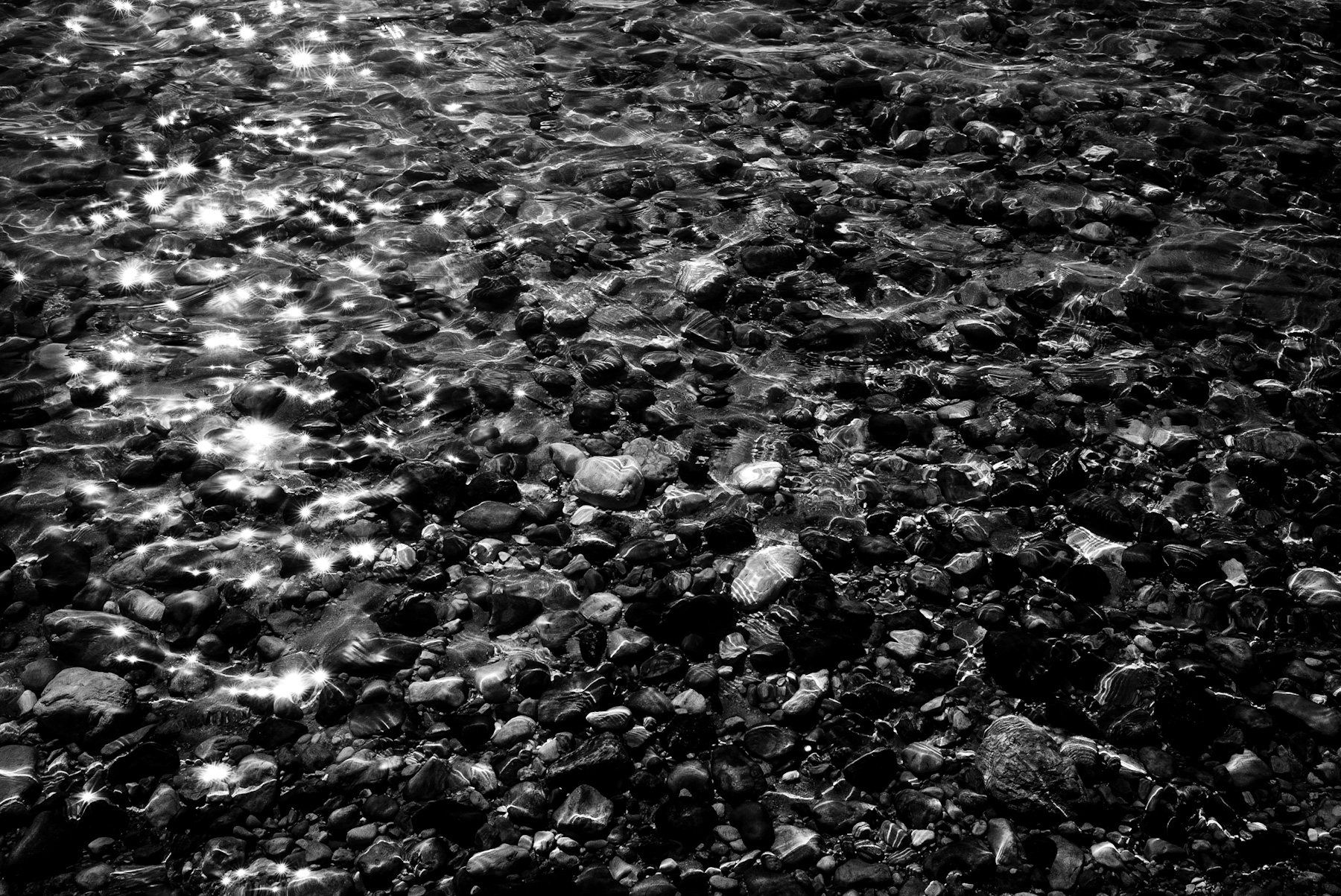
The interplay of light, water, and stone has captivated observers for millennia. In this high-contrast black-and-white photograph, the surface of a shallow body of water ripples with brilliant, star-like reflections of sunlight. Beneath this shimmering surface lies a dense bed of smooth, rounded river stones. The absence of color emphasizes the textures, shapes, and elemental contrast between the fluid movement of the water and the solid permanence of the rocks.
While visually striking as an abstract study of nature, this scene represents a complex geological history and a fundamental element of human development.
The Science of Erosion and Geological Time
Every rounded pebble visible in the image tells a story of immense time and physical forces. Originally, these stones were jagged fragments of bedrock, broken off by tectonic activity, frost weathering, or volcanic events. Through the process of fluvial erosion—the action of moving water—these fragments were transported downstream.
Over thousands of years, the constant tumbling action in the river current caused the stones to collide with one another and the riverbed. This natural grinding process, known as attrition, gradually wore away the sharp edges, resulting in the smooth, oval shapes seen here. The varying shades of grey and patterns on the stones indicate different mineral compositions, likely ranging from quartz and basalt to sedimentary rocks, each resisting erosion at different rates.
Rivers as the Cradle of Human History
Beyond geology, riverbeds like the one photographed played a crucial role in human evolution and history. During the Paleolithic era (the Stone Age), access to river pebbles was vital for survival. Early hominids selected specific types of river stones to create the first tools.
Smooth, heavy pebbles were used as hammerstones to flake flint, creating sharp edges for cutting and hunting. The abundance of accessible stone resources along ancient riverbanks is one of the primary reasons early human settlements flourished near water sources. Rivers provided not only hydration and food but also the raw materials needed for technological advancement.
The Monochromatic Aesthetic in Photographic History
From an artistic perspective, rendering this scene in black and white connects it to the rich history of landscape photography. Pioneers of the medium, such as Ansel Adams and the members of the f/64 Group in the early 20th century, championed sharp-focus photography that celebrated the raw textures of the natural world.
By stripping away color, the photograph redirects the viewer’s focus to the essential elements: the geometry of the pebbles, the organic patterns of the water currents, and the dramatic play of light. The glittering „sun stars“ on the water’s surface contrast sharply with the dark, mysterious depths of the riverbed, creating a timeless visual narrative.
Conclusion
A simple glance at a stony riverbed reveals a landscape shaped by the patient hands of time, water, and gravity. These smooth stones are not merely debris; they are geological archives and historical catalysts that have supported human life since the dawn of civilization. Through the lens of monochrome photography, this quiet aquatic world is elevated from a common natural occurrence to a profound reflection on history and nature.
While visually striking as an abstract study of nature, this scene represents a complex geological history and a fundamental element of human development.
The Science of Erosion and Geological Time
Every rounded pebble visible in the image tells a story of immense time and physical forces. Originally, these stones were jagged fragments of bedrock, broken off by tectonic activity, frost weathering, or volcanic events. Through the process of fluvial erosion—the action of moving water—these fragments were transported downstream.
Over thousands of years, the constant tumbling action in the river current caused the stones to collide with one another and the riverbed. This natural grinding process, known as attrition, gradually wore away the sharp edges, resulting in the smooth, oval shapes seen here. The varying shades of grey and patterns on the stones indicate different mineral compositions, likely ranging from quartz and basalt to sedimentary rocks, each resisting erosion at different rates.
Rivers as the Cradle of Human History
Beyond geology, riverbeds like the one photographed played a crucial role in human evolution and history. During the Paleolithic era (the Stone Age), access to river pebbles was vital for survival. Early hominids selected specific types of river stones to create the first tools.
Smooth, heavy pebbles were used as hammerstones to flake flint, creating sharp edges for cutting and hunting. The abundance of accessible stone resources along ancient riverbanks is one of the primary reasons early human settlements flourished near water sources. Rivers provided not only hydration and food but also the raw materials needed for technological advancement.
The Monochromatic Aesthetic in Photographic History
From an artistic perspective, rendering this scene in black and white connects it to the rich history of landscape photography. Pioneers of the medium, such as Ansel Adams and the members of the f/64 Group in the early 20th century, championed sharp-focus photography that celebrated the raw textures of the natural world.
By stripping away color, the photograph redirects the viewer’s focus to the essential elements: the geometry of the pebbles, the organic patterns of the water currents, and the dramatic play of light. The glittering „sun stars“ on the water’s surface contrast sharply with the dark, mysterious depths of the riverbed, creating a timeless visual narrative.
Conclusion
A simple glance at a stony riverbed reveals a landscape shaped by the patient hands of time, water, and gravity. These smooth stones are not merely debris; they are geological archives and historical catalysts that have supported human life since the dawn of civilization. Through the lens of monochrome photography, this quiet aquatic world is elevated from a common natural occurrence to a profound reflection on history and nature.
Schreibe einen Kommentar