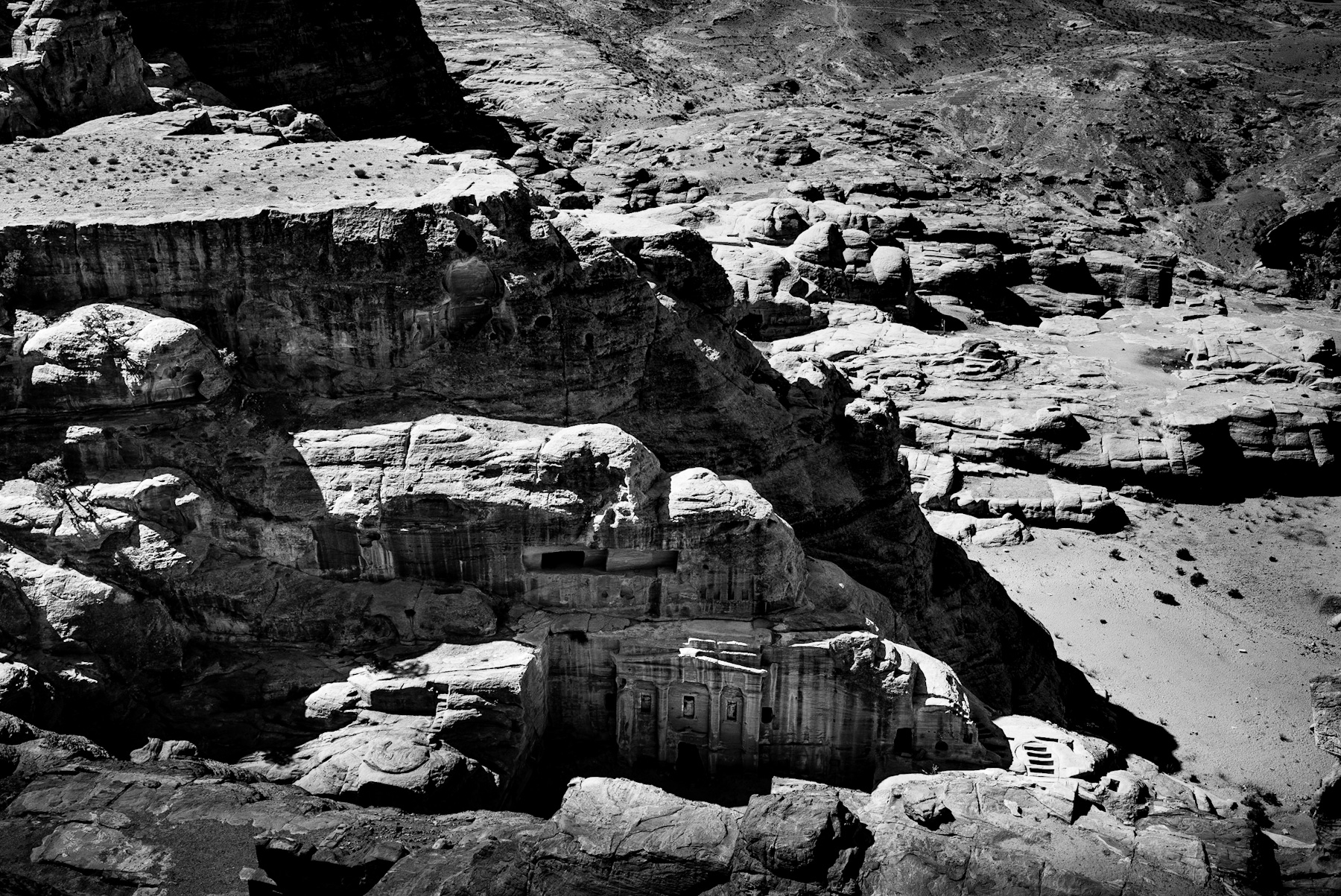
The rugged canyons of Jordan guard one of the most astonishing archaeological treasures of the ancient world. Imagine standing high above, looking down on a scene where natural geology meets human genius, captured in a dramatic high-contrast monochrome photograph. Here, nestled within the harsh, sun-drenched sandstone cliffs, a classical facade emerges, carved directly into the living rock—the unmistakable signature of the ancient city of Petra.
This striking black-and-white vision immediately accentuates the raw textures of the desert terrain and the powerful dance of light and shadow. From this elevated perspective, the sheer vastness of the mountainous landscape unfolds, revealing how ancient builders ingeniously leveraged the natural topography for both security and shelter. Deeper within the frame, a meticulously detailed rock-cut facade springs from the shadows, flanked by rectangular openings hinting at ancient cave dwellings or elaborate tombs. It’s a testament to how every available inch of the cliff face was utilized, surrounded by a labyrinth of eroded sandstone that speaks volumes about the isolation and formidable defensibility of this remarkable ancient urban center.
But what incredible story lies behind this architectural marvel? Petra was once the bustling capital of the Nabataean Kingdom, flourishing between the 4th century BCE and the 1st century CE. The Nabataeans, originally nomadic Arab traders, forged an empire built on commerce, skillfully establishing a vast network that connected Arabia, Egypt, and the vibrant Mediterranean world. Their control over these vital trade routes brought immense wealth, allowing them to transform a seemingly barren desert canyon into a sophisticated, cosmopolitan metropolis. Beyond their merchant prowess, the Nabataeans were engineering geniuses. They developed complex systems of dams, cisterns, and aqueducts, meticulously harvesting rainwater to sustain a population that could reach up to 30,000 people in an incredibly arid environment.
The distinctive rock-cut architecture we see today is a breathtaking fusion of diverse cultural influences. As a major trading hub, Petra was a melting pot, absorbing artistic styles from across the entire ancient world. The facade captured in our image proudly displays classical Hellenistic and Roman architectural elements—think grand columns, elegant pediments, and perfectly symmetrical entryways. Yet, these Western classical features were not merely copied; they were ingeniously adapted to local Nabataean tastes, seamlessly integrating with the natural rock formations. Instead of constructing buildings from quarried stone, Nabataean stonemasons performed an astonishing feat: they carved these monumental structures from the top down, using elaborate scaffolding and sheer manual labor to chisel away the very sandstone of the mountain itself.
However, even the grandest empires face shifts. Following the Roman annexation in 106 CE, trade routes gradually shifted towards northern maritime paths, ushering in a slow economic decline for Petra. Severe earthquakes in the 4th and 6th centuries CE further ravaged much of the city’s infrastructure, and by the Middle Ages, this magnificent site lay largely abandoned, known only to the local Bedouin tribes who held its secrets.
It wasn’t until 1812 that Swiss explorer Johann Ludwig Burckhardt reintroduced Petra to the Western world, sparking global fascination. Today, this awe-inspiring site is proudly recognized as a UNESCO World Heritage Site and stands as one of the New Seven Wonders of the World. Petra remains a profound testament to the enduring power of ancient engineering, cultural exchange, and the timeless artistry carved directly into the heart of the desert.
This striking black-and-white vision immediately accentuates the raw textures of the desert terrain and the powerful dance of light and shadow. From this elevated perspective, the sheer vastness of the mountainous landscape unfolds, revealing how ancient builders ingeniously leveraged the natural topography for both security and shelter. Deeper within the frame, a meticulously detailed rock-cut facade springs from the shadows, flanked by rectangular openings hinting at ancient cave dwellings or elaborate tombs. It’s a testament to how every available inch of the cliff face was utilized, surrounded by a labyrinth of eroded sandstone that speaks volumes about the isolation and formidable defensibility of this remarkable ancient urban center.
But what incredible story lies behind this architectural marvel? Petra was once the bustling capital of the Nabataean Kingdom, flourishing between the 4th century BCE and the 1st century CE. The Nabataeans, originally nomadic Arab traders, forged an empire built on commerce, skillfully establishing a vast network that connected Arabia, Egypt, and the vibrant Mediterranean world. Their control over these vital trade routes brought immense wealth, allowing them to transform a seemingly barren desert canyon into a sophisticated, cosmopolitan metropolis. Beyond their merchant prowess, the Nabataeans were engineering geniuses. They developed complex systems of dams, cisterns, and aqueducts, meticulously harvesting rainwater to sustain a population that could reach up to 30,000 people in an incredibly arid environment.
The distinctive rock-cut architecture we see today is a breathtaking fusion of diverse cultural influences. As a major trading hub, Petra was a melting pot, absorbing artistic styles from across the entire ancient world. The facade captured in our image proudly displays classical Hellenistic and Roman architectural elements—think grand columns, elegant pediments, and perfectly symmetrical entryways. Yet, these Western classical features were not merely copied; they were ingeniously adapted to local Nabataean tastes, seamlessly integrating with the natural rock formations. Instead of constructing buildings from quarried stone, Nabataean stonemasons performed an astonishing feat: they carved these monumental structures from the top down, using elaborate scaffolding and sheer manual labor to chisel away the very sandstone of the mountain itself.
However, even the grandest empires face shifts. Following the Roman annexation in 106 CE, trade routes gradually shifted towards northern maritime paths, ushering in a slow economic decline for Petra. Severe earthquakes in the 4th and 6th centuries CE further ravaged much of the city’s infrastructure, and by the Middle Ages, this magnificent site lay largely abandoned, known only to the local Bedouin tribes who held its secrets.
It wasn’t until 1812 that Swiss explorer Johann Ludwig Burckhardt reintroduced Petra to the Western world, sparking global fascination. Today, this awe-inspiring site is proudly recognized as a UNESCO World Heritage Site and stands as one of the New Seven Wonders of the World. Petra remains a profound testament to the enduring power of ancient engineering, cultural exchange, and the timeless artistry carved directly into the heart of the desert.
Schreibe einen Kommentar