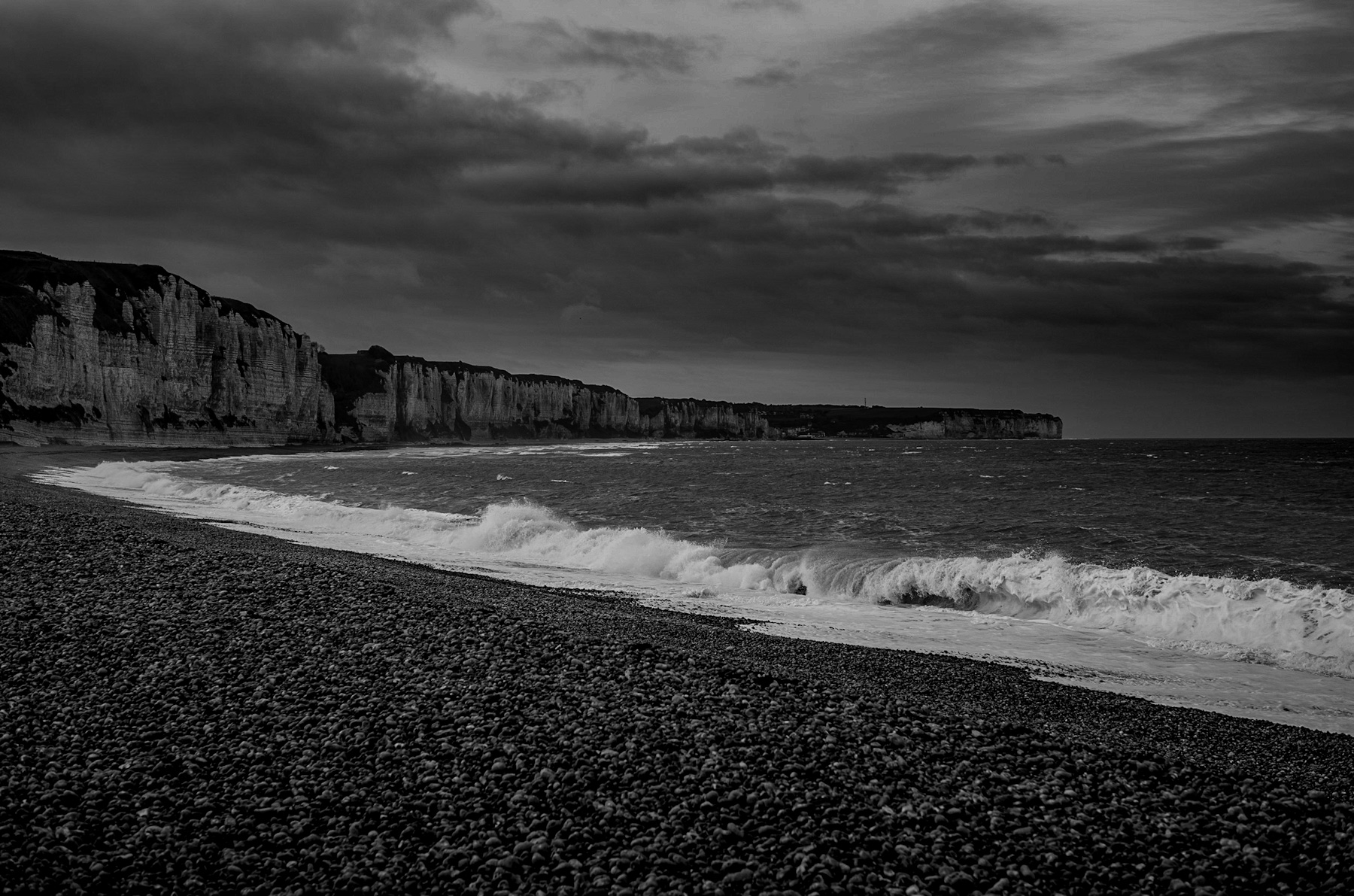
The stark black and white photograph captures a profound sense of raw nature and historical weight along a dramatic coastline. Dominating the scene are imposing chalk cliffs, stretching majestically into the distance on the left, their layered rock formations testament to millennia of geological processes. Below them, a tempestuous sea churns, dark and powerful, with waves breaking into foamy white crests that crash against the shore. The foreground is defined by a vast pebble beach, its myriad stones forming a textured carpet that leads the eye towards the turbulent waters. Overhead, a heavy, overcast sky presses down, its dark clouds mirroring the mood of the sea and lending an almost melancholic atmosphere to the entire panorama.
**The Visual Narrative of a Rugged Coastline**
This monochrome rendition accentuates the inherent drama of the landscape. The absence of color highlights the textures and contrasts: the rough, weathered surfaces of the majestic cliffs, the frothy spray of the powerful waves, and the smooth, wet sheen of the pebbles on the beach. The composition draws the viewer’s gaze along the sweeping curve of the **coastline**, emphasizing the sheer scale of these natural formations. The dark tones evoke a sense of solemnity and timelessness, suggesting a place where the forces of nature hold undeniable sway. It is a visual narrative of resilience, where land and sea continually sculpt each other under a perpetually changing sky.
**Echoes of History: Normandy’s Strategic Shores**
While the image primarily showcases natural grandeur, the specific appearance of these **chalk cliffs**, particularly their characteristic white hue and the restless waters of the **English Channel**, strongly evokes the historical landscape of **Normandy, France**. This region has borne witness to pivotal moments in European **history**, making these seemingly serene shores repositories of profound human stories.
Most prominently, the **Normandy coastline** is inextricably linked to World War II and the **D-Day landings** of June 6, 1944. These very cliffs and beaches, or others very similar in appearance along the Atlantic Wall, formed part of the formidable German defensive line. Allied forces faced immense challenges in breaching these natural and man-made fortifications. Locations such as Omaha Beach, Utah Beach, Gold, Juno, and Sword were chosen for their strategic value, but the broader coastline, including areas with such imposing cliffs, represented a constant threat and a strategic barrier throughout the conflict. The dramatic, often unforgiving terrain depicted here would have been a familiar and daunting sight to those who fought here, or those who defended it.
Beyond WWII, these coasts have played a critical role in numerous historical epochs. From the Norman Conquest of England in 1066, launched from these shores, to countless naval battles and trade routes throughout the centuries, the **English Channel** has been a vital artery and a contested frontier. The enduring presence of these **cliffs**, steadfast against the relentless sea, serves as a silent witness to millennia of human ambition, conflict, and resilience.
**A Timeless Reflection**
The black and white aesthetic of the photograph further amplifies this historical connection, stripping away modern distractions and presenting the scene with a raw, almost archival quality. It invites contemplation on the passage of time, the cyclical nature of history, and the unchanging power of the natural world. These **Normandy cliffs** and **pebble beaches** continue to stand as monuments not only to geological time but also to the human events that have unfolded upon and around them. They are more than just scenic vistas; they are living testaments to an enduring legacy.
**The Visual Narrative of a Rugged Coastline**
This monochrome rendition accentuates the inherent drama of the landscape. The absence of color highlights the textures and contrasts: the rough, weathered surfaces of the majestic cliffs, the frothy spray of the powerful waves, and the smooth, wet sheen of the pebbles on the beach. The composition draws the viewer’s gaze along the sweeping curve of the **coastline**, emphasizing the sheer scale of these natural formations. The dark tones evoke a sense of solemnity and timelessness, suggesting a place where the forces of nature hold undeniable sway. It is a visual narrative of resilience, where land and sea continually sculpt each other under a perpetually changing sky.
**Echoes of History: Normandy’s Strategic Shores**
While the image primarily showcases natural grandeur, the specific appearance of these **chalk cliffs**, particularly their characteristic white hue and the restless waters of the **English Channel**, strongly evokes the historical landscape of **Normandy, France**. This region has borne witness to pivotal moments in European **history**, making these seemingly serene shores repositories of profound human stories.
Most prominently, the **Normandy coastline** is inextricably linked to World War II and the **D-Day landings** of June 6, 1944. These very cliffs and beaches, or others very similar in appearance along the Atlantic Wall, formed part of the formidable German defensive line. Allied forces faced immense challenges in breaching these natural and man-made fortifications. Locations such as Omaha Beach, Utah Beach, Gold, Juno, and Sword were chosen for their strategic value, but the broader coastline, including areas with such imposing cliffs, represented a constant threat and a strategic barrier throughout the conflict. The dramatic, often unforgiving terrain depicted here would have been a familiar and daunting sight to those who fought here, or those who defended it.
Beyond WWII, these coasts have played a critical role in numerous historical epochs. From the Norman Conquest of England in 1066, launched from these shores, to countless naval battles and trade routes throughout the centuries, the **English Channel** has been a vital artery and a contested frontier. The enduring presence of these **cliffs**, steadfast against the relentless sea, serves as a silent witness to millennia of human ambition, conflict, and resilience.
**A Timeless Reflection**
The black and white aesthetic of the photograph further amplifies this historical connection, stripping away modern distractions and presenting the scene with a raw, almost archival quality. It invites contemplation on the passage of time, the cyclical nature of history, and the unchanging power of the natural world. These **Normandy cliffs** and **pebble beaches** continue to stand as monuments not only to geological time but also to the human events that have unfolded upon and around them. They are more than just scenic vistas; they are living testaments to an enduring legacy.
Schreibe einen Kommentar