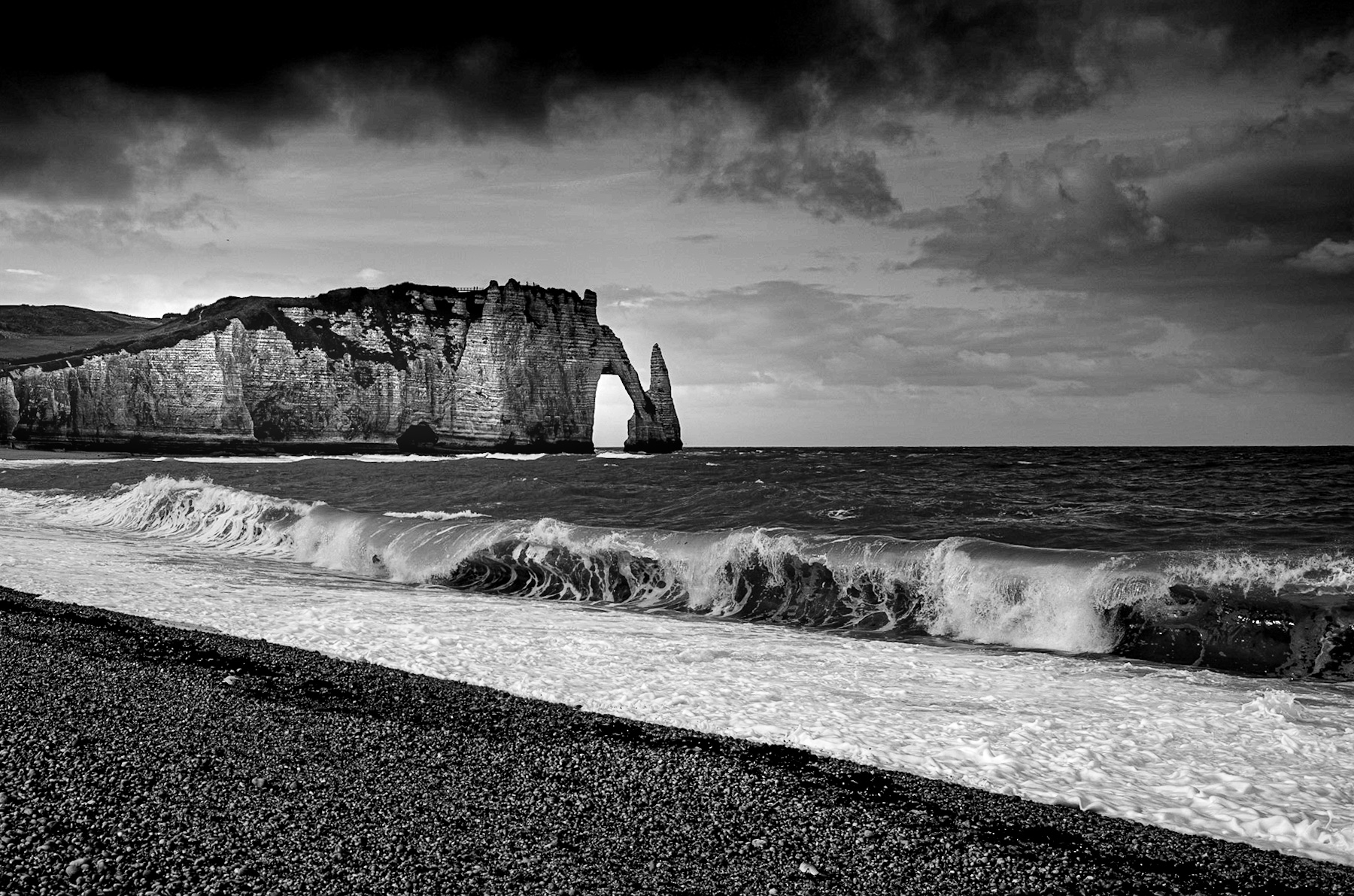
The photograph captures a striking monochrome vista of the Etretat cliffs in Normandy, France, presenting a dramatic interplay of natural elements under a brooding sky. The composition draws the viewer into a scene where the raw power of the ocean meets the enduring strength of geological formations, rendered with a depth and texture unique to black and white photography.
A Glimpse of Nature’s Sculpture
In the foreground, a dark, pebbled beach stretches diagonally across the frame, providing a stark contrast to the frothy white lines of breaking waves. These waves, captured mid-surge, convey the dynamic energy of the English Channel, their foam creating intricate patterns as they recede and advance. The sea itself appears turbulent, its dark surface reflecting the muted light of an overcast day, hinting at the vastness and unpredictable nature of the Atlantic.
Dominating the midground and background are the iconic chalk cliffs of Etretat, specifically the Falaise d’Aval. Their sheer, stratified faces, carved by millennia of wind and water, rise majestically from the sea. The most prominent feature is the Porte d’Aval, a colossal natural arch, with the slender Aiguille (the Needle rock) standing sentinel behind it. The texture of the chalk is finely detailed, revealing layers of geological history. Above, the sky is a tapestry of shifting clouds, dark and heavy, enhancing the dramatic atmosphere and emphasizing the monumental scale of the landscape. The absence of color accentuates the forms, shadows, and light, giving the scene a timeless, almost sculptural quality.
Echoes of History and Artistic Inspiration
The Etretat cliffs are not merely a geological marvel; they are a landscape steeped in history and cultural significance. Formed over millions of years by the deposition of marine sediments, these towering chalk formations are a testament to Earth’s continuous processes of creation and erosion. The iconic arches and needles, such as the Porte d’Aval and the Aiguille, are the result of relentless wave action and weathering, slowly sculpting the coastline into its distinctive shapes.
Beyond their geological narrative, the Etretat cliffs have captivated human imagination for centuries. In the 19th century, this stretch of the Normandy coast became a magnet for artists and writers. Impressionist master Claude Monet frequently painted here, capturing the changing light and moods of the cliffs in numerous canvases, making Etretat synonymous with his artistic legacy. His series of paintings depicting the various arches and the Aiguille at different times of day and seasons exemplify the profound impact this landscape had on the art world.
Literary figures also found inspiration in Etretat’s dramatic scenery. Guy de Maupassant, a native of Normandy, often wrote about the region, and the cliffs of Etretat feature prominently in his work. Perhaps most famously, Maurice Leblanc chose Etretat as a pivotal setting for his Arsène Lupin mysteries, particularly „The Hollow Needle“ (L’Aiguille Creuse). This novel weaves a thrilling tale around the secrets hidden within the Aiguille, cementing Etretat’s place in French literary folklore and drawing countless readers to explore its mysteries.
An Enduring Legacy
The photograph, rendered in stark black and white, strips away modern distractions, inviting contemplation of Etretat’s enduring legacy. It highlights the raw, elemental beauty that has drawn artists, writers, and travelers for generations. This coastal panorama serves as a powerful reminder of nature’s artistry and the deep historical and cultural connections that can be forged with a landscape of such profound character. Etretat remains an iconic destination, a place where geological grandeur, artistic inspiration, and literary intrigue converge.
A Glimpse of Nature’s Sculpture
In the foreground, a dark, pebbled beach stretches diagonally across the frame, providing a stark contrast to the frothy white lines of breaking waves. These waves, captured mid-surge, convey the dynamic energy of the English Channel, their foam creating intricate patterns as they recede and advance. The sea itself appears turbulent, its dark surface reflecting the muted light of an overcast day, hinting at the vastness and unpredictable nature of the Atlantic.
Dominating the midground and background are the iconic chalk cliffs of Etretat, specifically the Falaise d’Aval. Their sheer, stratified faces, carved by millennia of wind and water, rise majestically from the sea. The most prominent feature is the Porte d’Aval, a colossal natural arch, with the slender Aiguille (the Needle rock) standing sentinel behind it. The texture of the chalk is finely detailed, revealing layers of geological history. Above, the sky is a tapestry of shifting clouds, dark and heavy, enhancing the dramatic atmosphere and emphasizing the monumental scale of the landscape. The absence of color accentuates the forms, shadows, and light, giving the scene a timeless, almost sculptural quality.
Echoes of History and Artistic Inspiration
The Etretat cliffs are not merely a geological marvel; they are a landscape steeped in history and cultural significance. Formed over millions of years by the deposition of marine sediments, these towering chalk formations are a testament to Earth’s continuous processes of creation and erosion. The iconic arches and needles, such as the Porte d’Aval and the Aiguille, are the result of relentless wave action and weathering, slowly sculpting the coastline into its distinctive shapes.
Beyond their geological narrative, the Etretat cliffs have captivated human imagination for centuries. In the 19th century, this stretch of the Normandy coast became a magnet for artists and writers. Impressionist master Claude Monet frequently painted here, capturing the changing light and moods of the cliffs in numerous canvases, making Etretat synonymous with his artistic legacy. His series of paintings depicting the various arches and the Aiguille at different times of day and seasons exemplify the profound impact this landscape had on the art world.
Literary figures also found inspiration in Etretat’s dramatic scenery. Guy de Maupassant, a native of Normandy, often wrote about the region, and the cliffs of Etretat feature prominently in his work. Perhaps most famously, Maurice Leblanc chose Etretat as a pivotal setting for his Arsène Lupin mysteries, particularly „The Hollow Needle“ (L’Aiguille Creuse). This novel weaves a thrilling tale around the secrets hidden within the Aiguille, cementing Etretat’s place in French literary folklore and drawing countless readers to explore its mysteries.
An Enduring Legacy
The photograph, rendered in stark black and white, strips away modern distractions, inviting contemplation of Etretat’s enduring legacy. It highlights the raw, elemental beauty that has drawn artists, writers, and travelers for generations. This coastal panorama serves as a powerful reminder of nature’s artistry and the deep historical and cultural connections that can be forged with a landscape of such profound character. Etretat remains an iconic destination, a place where geological grandeur, artistic inspiration, and literary intrigue converge.
Schreibe einen Kommentar