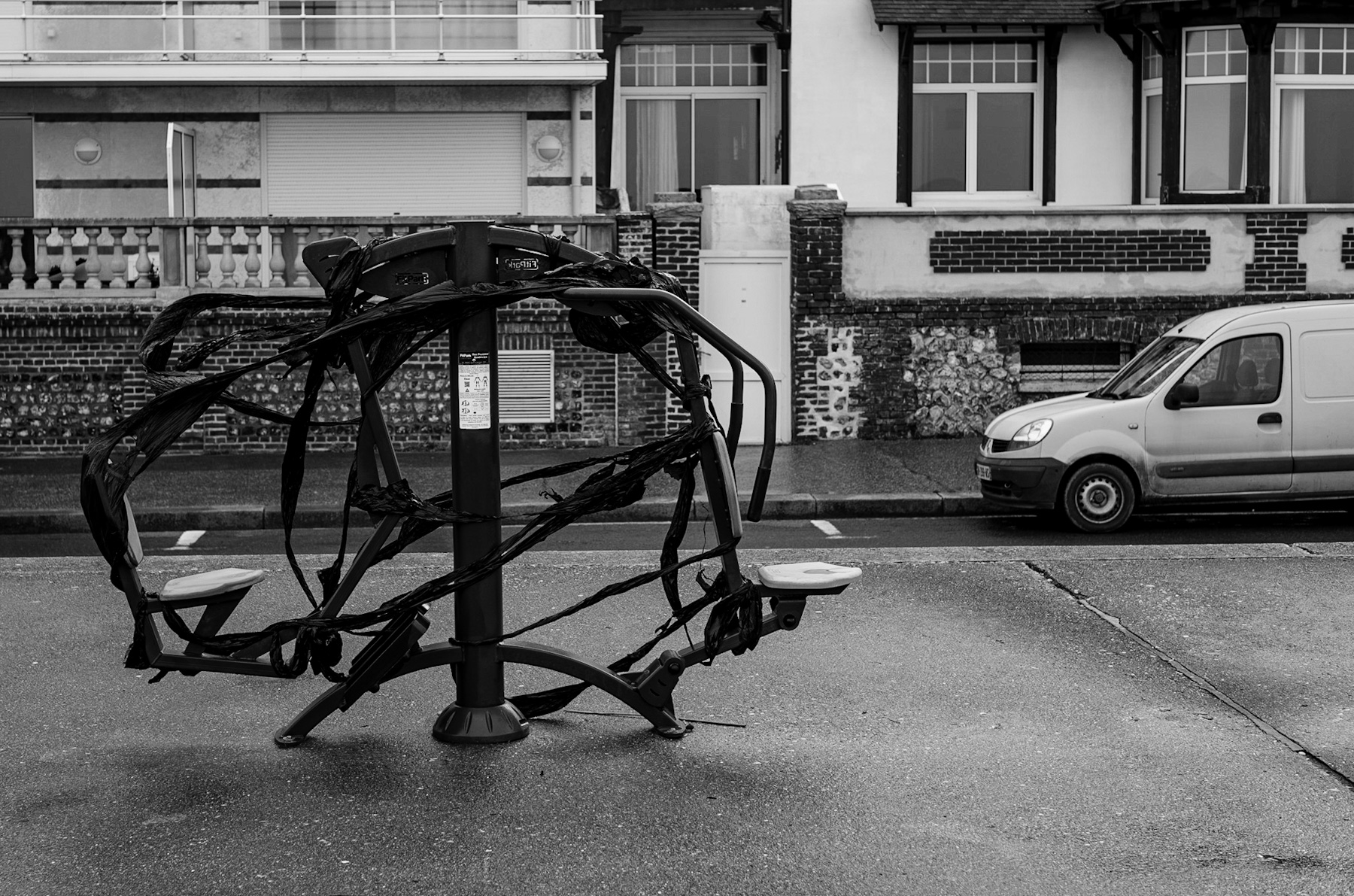
The monochrome rendering of this photograph immediately draws the viewer into a detailed observation of an urban scene, where contemporary elements meet historical architecture under a muted sky. A central outdoor fitness machine, conspicuously shrouded in dark, flowing material, dominates the foreground, its temporary disuse creating a focal point amidst the everyday streetscape. The wet asphalt reflects a recent rain, contributing to a quiet, contemplative atmosphere that underscores the textures and forms within the frame.
This outdoor fitness apparatus, a common feature in modern public spaces, typically promotes community health and active lifestyles. Its current state, however, wrapped and seemingly decommissioned, introduces a narrative of pause. The black material, tightly secured, hints at seasonal closure, necessary maintenance, or perhaps a temporary measure in response to broader societal factors affecting public access. A small, indistinct sign affixed to the machine’s central pole likely displays usage instructions or safety warnings, emphasizing its intended function as an amenity designed for public engagement, now temporarily withdrawn from active use. This element distinctly represents a modern trend in urban planning: integrating wellness infrastructure into the public realm to enhance quality of life.
Behind this contemporary installation, the backdrop is defined by buildings that present a striking architectural dialogue across different eras. To the left, a structure with a smooth, concrete facade, a balcony featuring robust railings, and a modern roller shutter suggests a more recent construction or a significantly updated design. Its clean lines and functional aesthetic stand in direct contrast to the building on the right. This latter structure exhibits a rich blend of historical architectural elements: a robust foundation composed of rugged, irregular stone and brickwork, supporting lighter walls adorned with traditional multi-paned windows. Dark beams visible beneath the eaves further hint at a classic, potentially even half-timbered, architectural heritage.
The distinctive use of flint and brick in the lower section of the older building is particularly significant, pointing to specific regional architectural traditions. Flint, a durable stone often found in chalk deposits, was a prevalent building material for centuries in coastal regions of Northern France (such as Normandy and Picardy) and Southern England (including Kent and Sussex). Its characteristic irregular texture and resilience made it a practical and aesthetically unique choice for foundations and walls, frequently combined with brick for structural reinforcement and decorative patterns. This building style reflects a history of local resourcefulness and craftsmanship, illustrating the evolution of these towns from early maritime settlements to, in many cases, popular seaside resorts or established residential areas. The visual interplay between this historically rich construction and the more contemporary building highlights the ongoing process of urban development and the layering of distinct historical periods within a single streetscape.
The entire scene encapsulates the dynamic nature of urban environments, where the enduring past continually shapes and coexists with the evolving present. The historical architecture provides a steadfast backdrop, a testament to resilient building practices and the inexorable passage of time. Against this, the modern fitness equipment, temporarily inactive, symbolizes contemporary life and public health initiatives. The presence of a commercial van, a ubiquitous element of modern urban logistics, further grounds the image in the everyday present. The black and white aesthetic strips away the distractions of color, compelling the viewer to focus on the interplay of light, shadow, texture, and the silent narrative of urban evolution embedded within this singular frame. It serves as a visual commentary on how communities adapt, preserve, and integrate new elements into their historical fabric.
This outdoor fitness apparatus, a common feature in modern public spaces, typically promotes community health and active lifestyles. Its current state, however, wrapped and seemingly decommissioned, introduces a narrative of pause. The black material, tightly secured, hints at seasonal closure, necessary maintenance, or perhaps a temporary measure in response to broader societal factors affecting public access. A small, indistinct sign affixed to the machine’s central pole likely displays usage instructions or safety warnings, emphasizing its intended function as an amenity designed for public engagement, now temporarily withdrawn from active use. This element distinctly represents a modern trend in urban planning: integrating wellness infrastructure into the public realm to enhance quality of life.
Behind this contemporary installation, the backdrop is defined by buildings that present a striking architectural dialogue across different eras. To the left, a structure with a smooth, concrete facade, a balcony featuring robust railings, and a modern roller shutter suggests a more recent construction or a significantly updated design. Its clean lines and functional aesthetic stand in direct contrast to the building on the right. This latter structure exhibits a rich blend of historical architectural elements: a robust foundation composed of rugged, irregular stone and brickwork, supporting lighter walls adorned with traditional multi-paned windows. Dark beams visible beneath the eaves further hint at a classic, potentially even half-timbered, architectural heritage.
The distinctive use of flint and brick in the lower section of the older building is particularly significant, pointing to specific regional architectural traditions. Flint, a durable stone often found in chalk deposits, was a prevalent building material for centuries in coastal regions of Northern France (such as Normandy and Picardy) and Southern England (including Kent and Sussex). Its characteristic irregular texture and resilience made it a practical and aesthetically unique choice for foundations and walls, frequently combined with brick for structural reinforcement and decorative patterns. This building style reflects a history of local resourcefulness and craftsmanship, illustrating the evolution of these towns from early maritime settlements to, in many cases, popular seaside resorts or established residential areas. The visual interplay between this historically rich construction and the more contemporary building highlights the ongoing process of urban development and the layering of distinct historical periods within a single streetscape.
The entire scene encapsulates the dynamic nature of urban environments, where the enduring past continually shapes and coexists with the evolving present. The historical architecture provides a steadfast backdrop, a testament to resilient building practices and the inexorable passage of time. Against this, the modern fitness equipment, temporarily inactive, symbolizes contemporary life and public health initiatives. The presence of a commercial van, a ubiquitous element of modern urban logistics, further grounds the image in the everyday present. The black and white aesthetic strips away the distractions of color, compelling the viewer to focus on the interplay of light, shadow, texture, and the silent narrative of urban evolution embedded within this singular frame. It serves as a visual commentary on how communities adapt, preserve, and integrate new elements into their historical fabric.
Schreibe einen Kommentar