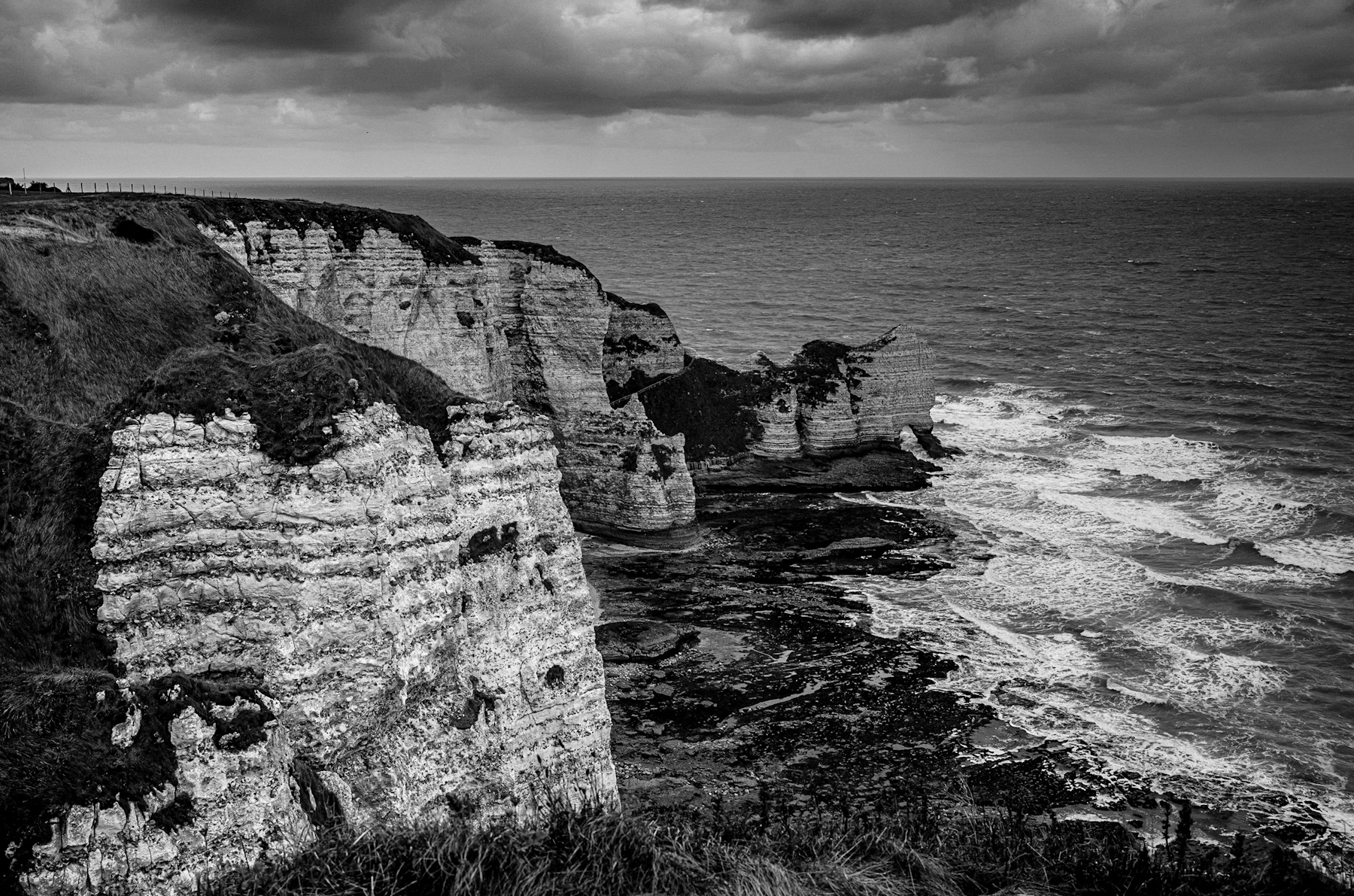
The striking monochrome photograph captures a raw, powerful vista of towering **chalk cliffs** meeting the turbulent waters of the ocean. Dominated by shades of grey, from the brooding, cloud-laden sky to the frothy white caps of the waves, the image conveys a sense of dramatic grandeur and timelessness. The intricate horizontal layering of the chalk is prominently featured, detailing centuries of geological formation, while the rugged coastline reveals the relentless sculpting power of wind and sea. Patches of dark, resilient vegetation cling to the cliff tops and slopes, providing a stark contrast to the pale rock. In the distance, the vast expanse of the **English Channel** stretches to the horizon, hinting at both boundless freedom and formidable power.
### A Geological Tapestry of Time
These formidable white cliffs are characteristic of the **Alabaster Coast (Côte d’Albâtre)** in **Normandy, France**, a landscape renowned for its iconic formations, most notably around **Étretat**. Composed primarily of chalk, a soft, white limestone formed from the skeletal remains of microscopic marine organisms over millions of years during the Late Cretaceous period, these cliffs represent a profound geological archive.
The distinct horizontal banding visible in the photograph testifies to successive layers of sediment deposition, uplift, and subsequent erosion. The relentless action of the English Channel’s waves and weather continues to carve natural arches, stacks, and coves, perpetually reshaping this dynamic shoreline. This ongoing process of **coastal erosion** highlights the Earth’s continuous, slow-motion artistry.
### Echoes of History on the French Coastline
Beyond their geological wonder, these cliffs are steeped in human history, having borne witness to pivotal moments over millennia. Strategically located along the English Channel, the **Normandy coast** has always been a significant gateway. From the early Viking incursions that shaped the region’s name and culture, to the maritime trade routes that connected nations, these shores have played a silent role in countless narratives.
Perhaps most profoundly, these very cliffs formed part of the formidable **Atlantic Wall** during **World War II**. While the famous **D-Day landings** of June 1944 occurred further west on the sandy beaches, the entire coastline was heavily fortified by German forces. The sheer scale and natural defenses offered by these cliffs made them integral to the defensive strategy, with bunkers and observation posts often camouflaged into the landscape. The dramatic landscape seen in the photograph, with its commanding views over the Channel, underscores the strategic importance of such vantage points during wartime. The silent sentinels of chalk stood witness to intense human conflict, a stark contrast to their serene natural beauty today.
### Cultural and Artistic Legacy
The breathtaking beauty of these **French chalk cliffs** has also captivated artists and writers for centuries. **Claude Monet**, a pioneer of Impressionism, frequently depicted the Étretat cliffs, exploring the changing light and moods of the sea in his numerous paintings. His works, alongside those of other artists, cemented the visual identity of this unique coastline in the global artistic consciousness. Similarly, the dramatic scenery provided inspiration for writers like Maurice Leblanc, whose Arsène Lupin adventures are famously set against the backdrop of the Étretat arches and „the hollow needle,“ intertwining the landscape with literary intrigue.
### A Timeless Perspective Through Photography
The **black and white photography** rendition of this image enhances its timeless quality, stripping away color to emphasize form, texture, and the interplay of light and shadow. It invites contemplation of the enduring forces of nature and the layers of history etched into the landscape. Standing on these cliffs, one is connected to deep time – geological epochs, ancient migrations, and the more recent, poignant echoes of conflict and artistic endeavor. This view is not merely a landscape; it is a living testament to Earth’s power and humanity’s interwoven story, offering a profound sense of perspective to any visitor.
### A Geological Tapestry of Time
These formidable white cliffs are characteristic of the **Alabaster Coast (Côte d’Albâtre)** in **Normandy, France**, a landscape renowned for its iconic formations, most notably around **Étretat**. Composed primarily of chalk, a soft, white limestone formed from the skeletal remains of microscopic marine organisms over millions of years during the Late Cretaceous period, these cliffs represent a profound geological archive.
The distinct horizontal banding visible in the photograph testifies to successive layers of sediment deposition, uplift, and subsequent erosion. The relentless action of the English Channel’s waves and weather continues to carve natural arches, stacks, and coves, perpetually reshaping this dynamic shoreline. This ongoing process of **coastal erosion** highlights the Earth’s continuous, slow-motion artistry.
### Echoes of History on the French Coastline
Beyond their geological wonder, these cliffs are steeped in human history, having borne witness to pivotal moments over millennia. Strategically located along the English Channel, the **Normandy coast** has always been a significant gateway. From the early Viking incursions that shaped the region’s name and culture, to the maritime trade routes that connected nations, these shores have played a silent role in countless narratives.
Perhaps most profoundly, these very cliffs formed part of the formidable **Atlantic Wall** during **World War II**. While the famous **D-Day landings** of June 1944 occurred further west on the sandy beaches, the entire coastline was heavily fortified by German forces. The sheer scale and natural defenses offered by these cliffs made them integral to the defensive strategy, with bunkers and observation posts often camouflaged into the landscape. The dramatic landscape seen in the photograph, with its commanding views over the Channel, underscores the strategic importance of such vantage points during wartime. The silent sentinels of chalk stood witness to intense human conflict, a stark contrast to their serene natural beauty today.
### Cultural and Artistic Legacy
The breathtaking beauty of these **French chalk cliffs** has also captivated artists and writers for centuries. **Claude Monet**, a pioneer of Impressionism, frequently depicted the Étretat cliffs, exploring the changing light and moods of the sea in his numerous paintings. His works, alongside those of other artists, cemented the visual identity of this unique coastline in the global artistic consciousness. Similarly, the dramatic scenery provided inspiration for writers like Maurice Leblanc, whose Arsène Lupin adventures are famously set against the backdrop of the Étretat arches and „the hollow needle,“ intertwining the landscape with literary intrigue.
### A Timeless Perspective Through Photography
The **black and white photography** rendition of this image enhances its timeless quality, stripping away color to emphasize form, texture, and the interplay of light and shadow. It invites contemplation of the enduring forces of nature and the layers of history etched into the landscape. Standing on these cliffs, one is connected to deep time – geological epochs, ancient migrations, and the more recent, poignant echoes of conflict and artistic endeavor. This view is not merely a landscape; it is a living testament to Earth’s power and humanity’s interwoven story, offering a profound sense of perspective to any visitor.
Schreibe einen Kommentar