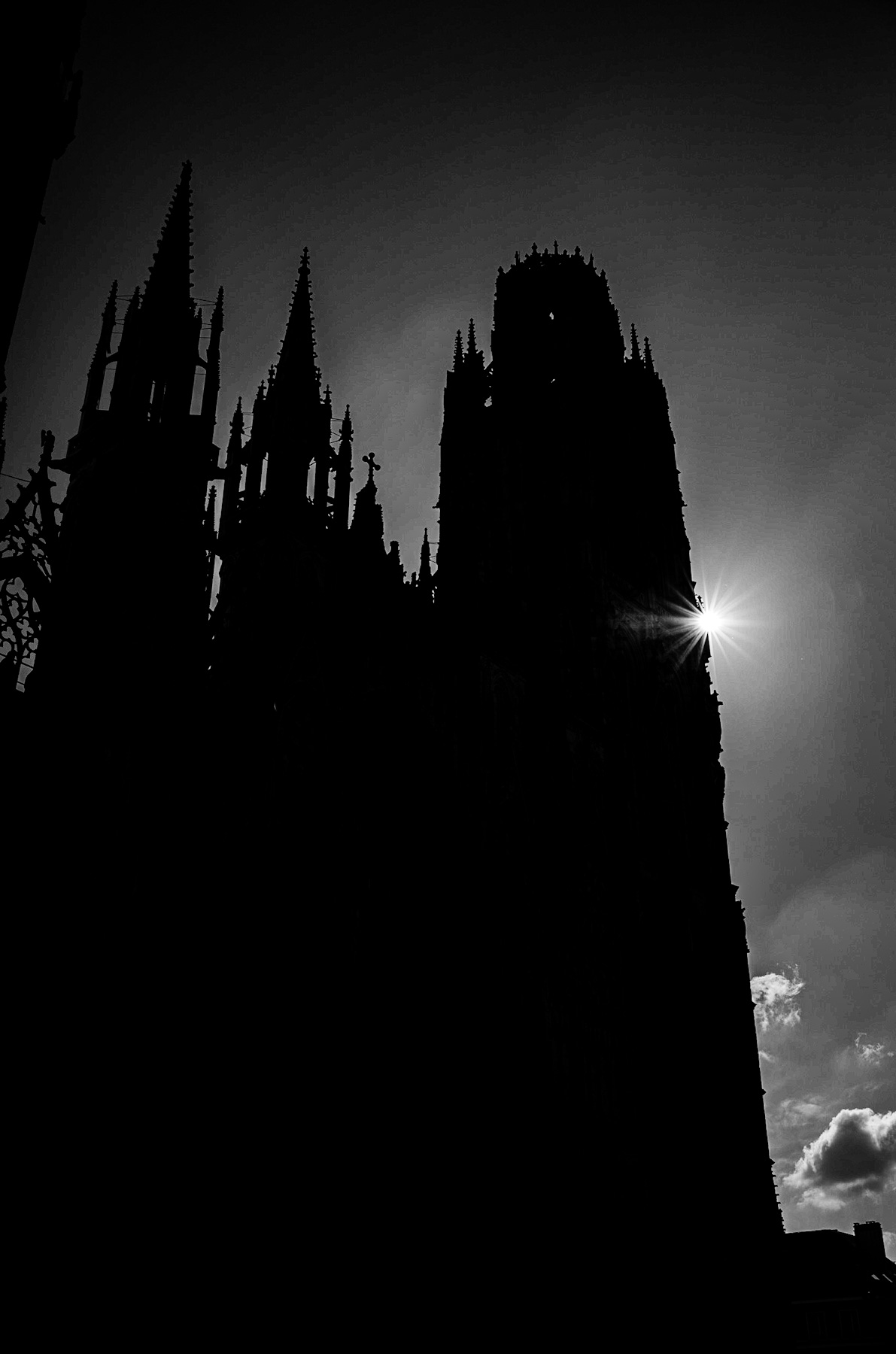
The striking black and white photograph presents the majestic silhouette of a grand Gothic cathedral, its intricate spires and imposing towers piercing a dramatic sky. Captured from a low angle, the monumental structure dominates the frame, rendered almost entirely in deep shadow, emphasizing its sheer scale and complex form. A brilliant sunburst, a powerful starburst of light, emerges from behind one of the colossal towers, creating a focal point that contrasts sharply with the solemn darkness of the edifice. This interplay of light and shadow transforms the building into a timeless sentinel, hinting at centuries of history etched into its stone.
**The Visual Narrative: Silhouette and Illumination**
The image masterfully utilizes the silhouette technique, stripping away color and surface detail to highlight the pure architectural form. The viewer’s eye is drawn upwards along the sharply defined edges of pinnacles, flying buttresses, and the distinctive pointed arches characteristic of Gothic design. Despite the lack of direct light on the stone, the sheer complexity of the structure is evident, suggesting the laborious craftsmanship involved in its creation. The sun’s radiant burst, positioned strategically, acts as a symbolic beacon, perhaps representing divine presence, enduring hope, or simply the cyclical passage of time against an immovable testament to human ambition. The partial visibility of clouds in the lower right adds depth to the sky, preventing it from being a uniform void and hinting at the vastness above.
**A Legacy in Stone: The Historical Context of Gothic Architecture**
The building depicted, strongly resembling the iconic Cologne Cathedral (Kölner Dom) in Germany, embodies the zenith of Gothic architecture. Originating in 12th-century France, Gothic cathedrals were revolutionary, pushing the boundaries of engineering and aesthetics. They replaced the heavy, dark Romanesque structures with soaring edifices characterized by pointed arches, ribbed vaults, and most importantly, the flying buttress system, which allowed for thinner walls and vast expanses of stained glass. This innovation enabled architects to achieve unprecedented heights, drawing the gaze, and metaphorically, the spirit, towards the heavens.
The construction of cathedrals like Cologne Cathedral was an undertaking spanning generations, often centuries. Begun in 1248, Cologne Cathedral’s construction famously paused for over 300 years before resuming in the 19th century, finally reaching completion in 1880. This protracted construction period reflects the immense resources, collective faith, and technical skill required. These structures were not merely places of worship; they were the cultural, social, and economic hearts of medieval cities, symbols of civic pride and spiritual devotion. They housed precious relics, served as pilgrimage sites, and stood as enduring monuments to human ingenuity and perseverance.
**Enduring Grandeur: A Symbol Through Time**
The dark silhouette against the bright sky in the photograph serves as a powerful metaphor for the cathedral’s enduring presence through history. Cologne Cathedral, a UNESCO World Heritage site, notably survived extensive bombing during World War II, standing remarkably intact amidst a devastated city. This resilience solidified its status as a symbol of endurance and hope for post-war Germany. The interplay of light and shadow in the image captures this duality: the profound weight of history and the persistent glimmer of light, representing continuity and renewal. The photograph invites contemplation on the monumental effort of past generations and the timeless beauty of architectural heritage that continues to inspire awe.
**The Visual Narrative: Silhouette and Illumination**
The image masterfully utilizes the silhouette technique, stripping away color and surface detail to highlight the pure architectural form. The viewer’s eye is drawn upwards along the sharply defined edges of pinnacles, flying buttresses, and the distinctive pointed arches characteristic of Gothic design. Despite the lack of direct light on the stone, the sheer complexity of the structure is evident, suggesting the laborious craftsmanship involved in its creation. The sun’s radiant burst, positioned strategically, acts as a symbolic beacon, perhaps representing divine presence, enduring hope, or simply the cyclical passage of time against an immovable testament to human ambition. The partial visibility of clouds in the lower right adds depth to the sky, preventing it from being a uniform void and hinting at the vastness above.
**A Legacy in Stone: The Historical Context of Gothic Architecture**
The building depicted, strongly resembling the iconic Cologne Cathedral (Kölner Dom) in Germany, embodies the zenith of Gothic architecture. Originating in 12th-century France, Gothic cathedrals were revolutionary, pushing the boundaries of engineering and aesthetics. They replaced the heavy, dark Romanesque structures with soaring edifices characterized by pointed arches, ribbed vaults, and most importantly, the flying buttress system, which allowed for thinner walls and vast expanses of stained glass. This innovation enabled architects to achieve unprecedented heights, drawing the gaze, and metaphorically, the spirit, towards the heavens.
The construction of cathedrals like Cologne Cathedral was an undertaking spanning generations, often centuries. Begun in 1248, Cologne Cathedral’s construction famously paused for over 300 years before resuming in the 19th century, finally reaching completion in 1880. This protracted construction period reflects the immense resources, collective faith, and technical skill required. These structures were not merely places of worship; they were the cultural, social, and economic hearts of medieval cities, symbols of civic pride and spiritual devotion. They housed precious relics, served as pilgrimage sites, and stood as enduring monuments to human ingenuity and perseverance.
**Enduring Grandeur: A Symbol Through Time**
The dark silhouette against the bright sky in the photograph serves as a powerful metaphor for the cathedral’s enduring presence through history. Cologne Cathedral, a UNESCO World Heritage site, notably survived extensive bombing during World War II, standing remarkably intact amidst a devastated city. This resilience solidified its status as a symbol of endurance and hope for post-war Germany. The interplay of light and shadow in the image captures this duality: the profound weight of history and the persistent glimmer of light, representing continuity and renewal. The photograph invites contemplation on the monumental effort of past generations and the timeless beauty of architectural heritage that continues to inspire awe.
Schreibe einen Kommentar