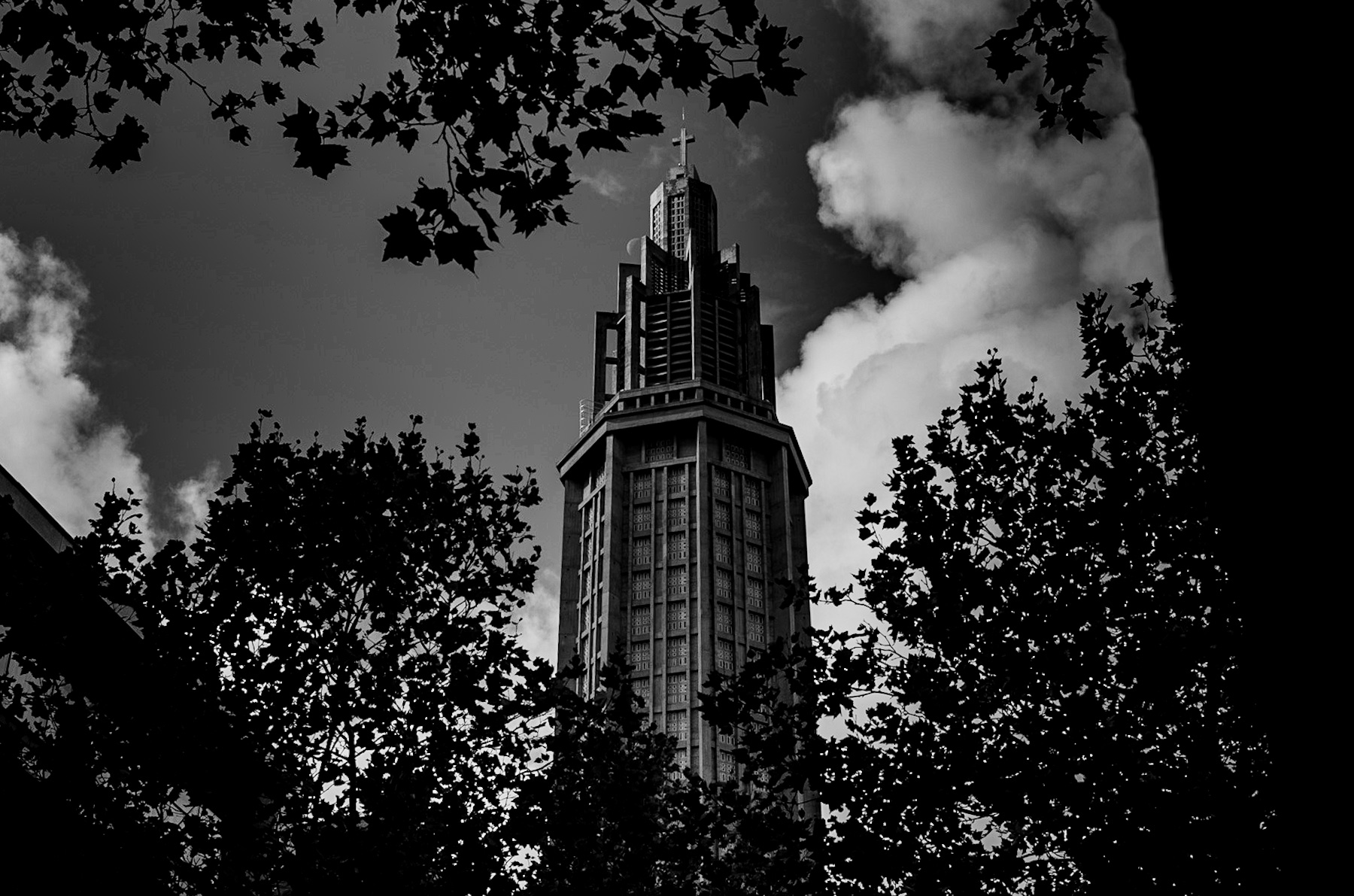
The accompanying photograph presents a striking architectural marvel, captured in a dramatic monochrome palette. Framed by the intricate silhouettes of tree branches and foliage, a towering structure pierces the sky, its geometric forms asserting a powerful presence against a backdrop of dynamic clouds. The black and white rendering accentuates the building’s robust textures and intricate detailing, transforming light and shadow into key elements of its visual narrative.
Architectural Grandeur in Monochrome
At the heart of the image stands a formidable tower, distinguished by its octagonal base and a series of receding, stepped tiers culminating in a cross. The repetitive, almost cellular patterns of its windows or structural elements hint at a sophisticated design, while the material appears to be concrete, giving it a raw yet refined aesthetic. The low-angle perspective emphasizes the sheer scale and verticality of the edifice, drawing the viewer’s gaze upwards towards the heavens. The dark, organic shapes of the surrounding trees provide a natural, almost reverent frame, contrasting sharply with the rigid, man-made monument and adding a layer of depth and visual intrigue. This interplay between nature and architecture, captured without the distraction of color, creates a timeless and evocative scene.
A Symbol of Resilience: St. Joseph’s Church, Le Havre
This distinctive structure is none other than the bell tower of St. Joseph’s Church (Église Saint-Joseph) in Le Havre, France. Designed by the renowned architect Auguste Perret, a pioneer in the use of reinforced concrete, the church stands as a profound testament to post-war reconstruction and architectural innovation. Perret, often celebrated as „the poet of concrete,“ utilized this then-revolutionary material to rebuild large parts of Le Havre after its devastating destruction during World War II. The city’s rebuilt center, including St. Joseph’s, was later recognized as a UNESCO World Heritage site for its unique urban planning and modernist architecture.
Post-War Reconstruction and Modernist Vision
The construction of St. Joseph’s Church between 1951 and 1957 embodies the spirit of resilience that characterized post-war Europe. Le Havre, a crucial port city, suffered immense damage, necessitating a complete re-imagining of its urban fabric. Perret’s vision for the church was not merely to replace what was lost but to create a new landmark that symbolized hope and renewal. The choice of reinforced concrete was deliberate; it offered durability, efficiency, and the ability to realize bold, unadorned forms that reflected the era’s functionalist ideals. The church’s 107-meter-high lantern tower, visible from afar, served as a beacon for sailors and a spiritual anchor for the city.
Art Deco Influence and Spiritual Design
While rooted in Modernism, the church’s aesthetic also carries echoes of the Art Deco movement, particularly in its geometric precision, vertical emphasis, and the rhythmic repetition of its structural elements. The tower, in particular, showcases Perret’s mastery of concrete, transforming a utilitarian material into a medium for sculptural expression. Inside, the tower is adorned with 6,500 stained glass panes, which, though not visible in this external shot, bathe the interior in a kaleidoscope of light, creating a spiritual atmosphere that contrasts with the exterior’s stark grandeur. The cross at the apex reinforces its sacred purpose, merging modern architectural principles with enduring religious symbolism.
Enduring Legacy
The photograph captures more than just a building; it encapsulates a moment in history where innovation met necessity, and art emerged from destruction. St. Joseph’s Church remains a powerful landmark, not only for its architectural significance but also as a monument to human perseverance and the enduring capacity for creation in the face of adversity. It stands as a silent sentinel, watching over Le Havre, a beacon of concrete hope against the ever-changing sky.
Architectural Grandeur in Monochrome
At the heart of the image stands a formidable tower, distinguished by its octagonal base and a series of receding, stepped tiers culminating in a cross. The repetitive, almost cellular patterns of its windows or structural elements hint at a sophisticated design, while the material appears to be concrete, giving it a raw yet refined aesthetic. The low-angle perspective emphasizes the sheer scale and verticality of the edifice, drawing the viewer’s gaze upwards towards the heavens. The dark, organic shapes of the surrounding trees provide a natural, almost reverent frame, contrasting sharply with the rigid, man-made monument and adding a layer of depth and visual intrigue. This interplay between nature and architecture, captured without the distraction of color, creates a timeless and evocative scene.
A Symbol of Resilience: St. Joseph’s Church, Le Havre
This distinctive structure is none other than the bell tower of St. Joseph’s Church (Église Saint-Joseph) in Le Havre, France. Designed by the renowned architect Auguste Perret, a pioneer in the use of reinforced concrete, the church stands as a profound testament to post-war reconstruction and architectural innovation. Perret, often celebrated as „the poet of concrete,“ utilized this then-revolutionary material to rebuild large parts of Le Havre after its devastating destruction during World War II. The city’s rebuilt center, including St. Joseph’s, was later recognized as a UNESCO World Heritage site for its unique urban planning and modernist architecture.
Post-War Reconstruction and Modernist Vision
The construction of St. Joseph’s Church between 1951 and 1957 embodies the spirit of resilience that characterized post-war Europe. Le Havre, a crucial port city, suffered immense damage, necessitating a complete re-imagining of its urban fabric. Perret’s vision for the church was not merely to replace what was lost but to create a new landmark that symbolized hope and renewal. The choice of reinforced concrete was deliberate; it offered durability, efficiency, and the ability to realize bold, unadorned forms that reflected the era’s functionalist ideals. The church’s 107-meter-high lantern tower, visible from afar, served as a beacon for sailors and a spiritual anchor for the city.
Art Deco Influence and Spiritual Design
While rooted in Modernism, the church’s aesthetic also carries echoes of the Art Deco movement, particularly in its geometric precision, vertical emphasis, and the rhythmic repetition of its structural elements. The tower, in particular, showcases Perret’s mastery of concrete, transforming a utilitarian material into a medium for sculptural expression. Inside, the tower is adorned with 6,500 stained glass panes, which, though not visible in this external shot, bathe the interior in a kaleidoscope of light, creating a spiritual atmosphere that contrasts with the exterior’s stark grandeur. The cross at the apex reinforces its sacred purpose, merging modern architectural principles with enduring religious symbolism.
Enduring Legacy
The photograph captures more than just a building; it encapsulates a moment in history where innovation met necessity, and art emerged from destruction. St. Joseph’s Church remains a powerful landmark, not only for its architectural significance but also as a monument to human perseverance and the enduring capacity for creation in the face of adversity. It stands as a silent sentinel, watching over Le Havre, a beacon of concrete hope against the ever-changing sky.
Schreibe einen Kommentar