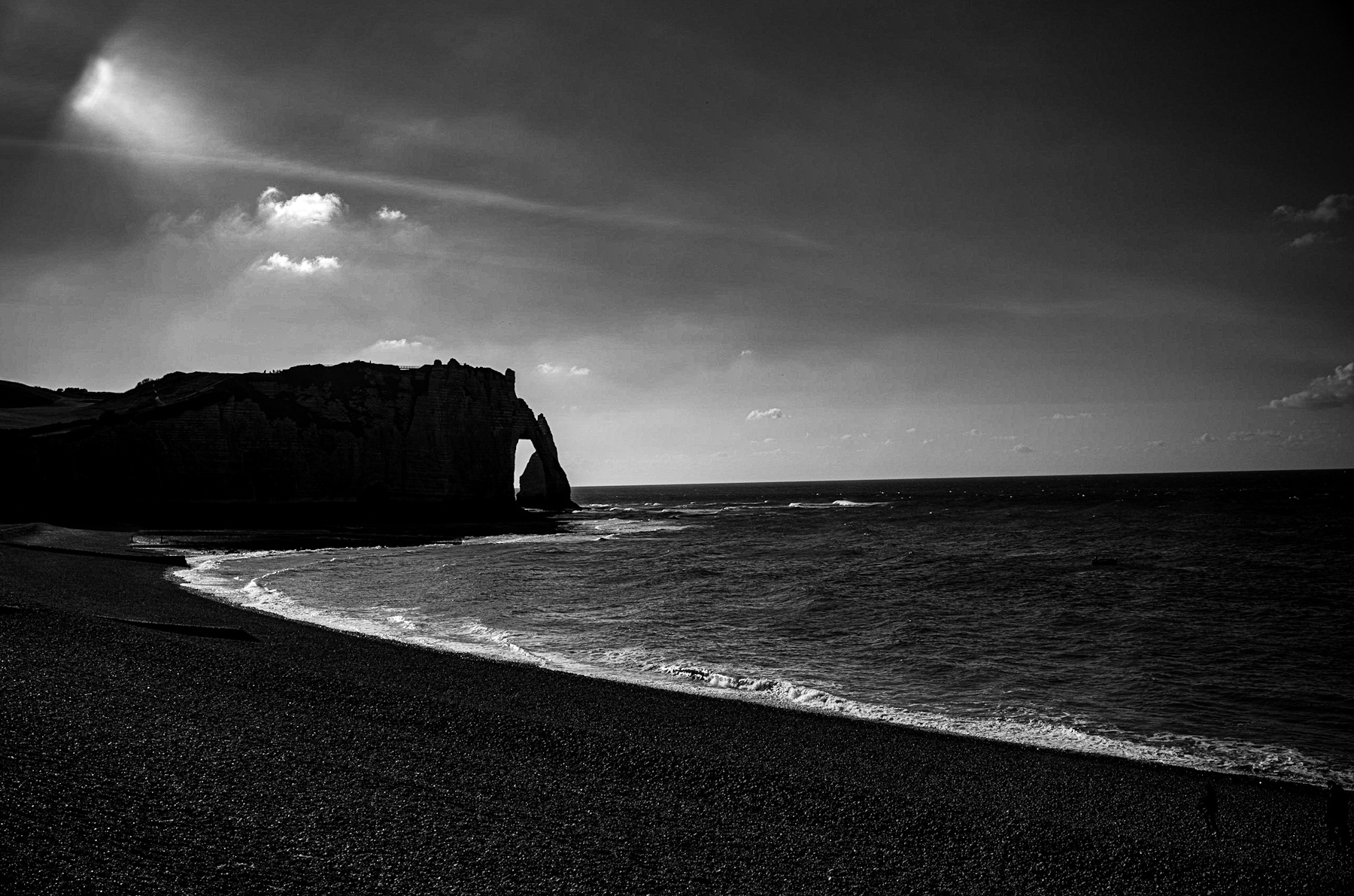
Étretat, a name synonymous with breathtaking beauty along France’s Alabaster Coast in Normandy. Imagine a timeless vista, captured in striking black and white, where the iconic chalk cliffs and natural arches stand as colossal sentinels. This isn’t just a photograph; it’s an invitation to contemplate the raw power and subtle grandeur that nature has sculpted over millennia, creating a true geological wonder.
The power of monochrome here is undeniable. The absence of color masterfully accentuates texture, light, and shadow, drawing your eye immediately to the majestic Falaise d’Aval. You’ll spot its distinctive natural arch, the Porte d’Aval, a testament to relentless coastal erosion. Right next to it, the famous L’Aiguille (the Needle), a freestanding chalk stack, stands guard against the vast expanse of the English Channel. These cliffs appear as ancient ramparts, their dark silhouette sharply contrasting with the brighter sky and the foamy white crests of waves breaking on the pebble beach below. A dramatic ray of light often pierces through the clouds, illuminating a section of the sky and casting an ethereal glow that adds depth and an almost spiritual quality to the Étretat scene. This interplay of light and shadow enhances the dramatic contours, making intricate details of the rock formations pronounced. The wide expanse of dark, textured pebbles in the foreground gently leads your gaze towards the dynamic sea, where rhythmic waves meet the shore. It’s a powerful landscape photography composition that evokes both tranquility and immense natural power.
These iconic Étretat formations are far more than just picturesque; they are a profound testament to geological history. Rising up to 90 meters, these magnificent chalk cliffs began forming around 100 million years ago during the Cretaceous period, from accumulated marine micro-organisms. Over countless eons, the relentless action of wind and sea sculpted this relatively soft rock, carving out the dramatic arches, caves, and stacks we see today. The Porte d’Aval, a highlight, is one of three major arches at Étretat, alongside the Porte d’Amont and the Manneporte. And that famous L’Aiguille, the 70-meter-high needle-like rock, is another product of this ongoing erosion, once connected to the mainland. These natural wonders are dynamic, constantly reshaped by the elements, offering a living lesson in geomorphology.
Beyond its geological marvel, Étretat holds a significant place in cultural history. In the 19th century, it transformed from a quiet fishing village into a fashionable seaside resort, attracting artists, writers, and aristocrats. Its dramatic coastline became an inexhaustible source of inspiration for Impressionist painters, most notably Claude Monet. He famously painted Étretat repeatedly, capturing its changing moods and light in over 80 canvases. His series vividly illustrates the very arches and cliffs, often depicting them under various weather conditions and times of day, much like the atmospheric rendering in a monochrome photograph. Literary figures like Guy de Maupassant, Gustave Courbet, and Maurice Leblanc (creator of Arsène Lupin, who famously hid a treasure within the „Hollow Needle“) also found their muse in Étretat’s unique beauty. This rich artistic and literary legacy imbues the historical landscape with layers of human experience and interpretation, adding depth to its natural splendor.
The Étretat coastline, whether captured in a powerful black and white image or experienced firsthand, remains an enduring symbol of natural resilience and artistic inspiration. It invites us to appreciate the slow, powerful processes of the Earth and to reflect on the countless stories, both natural and human, etched into its ancient face. A visit to this geological wonder offers a tangible connection to both deep geological time and a vibrant cultural past, making it a truly unique and memorable travel destination in Normandy, France.
The power of monochrome here is undeniable. The absence of color masterfully accentuates texture, light, and shadow, drawing your eye immediately to the majestic Falaise d’Aval. You’ll spot its distinctive natural arch, the Porte d’Aval, a testament to relentless coastal erosion. Right next to it, the famous L’Aiguille (the Needle), a freestanding chalk stack, stands guard against the vast expanse of the English Channel. These cliffs appear as ancient ramparts, their dark silhouette sharply contrasting with the brighter sky and the foamy white crests of waves breaking on the pebble beach below. A dramatic ray of light often pierces through the clouds, illuminating a section of the sky and casting an ethereal glow that adds depth and an almost spiritual quality to the Étretat scene. This interplay of light and shadow enhances the dramatic contours, making intricate details of the rock formations pronounced. The wide expanse of dark, textured pebbles in the foreground gently leads your gaze towards the dynamic sea, where rhythmic waves meet the shore. It’s a powerful landscape photography composition that evokes both tranquility and immense natural power.
These iconic Étretat formations are far more than just picturesque; they are a profound testament to geological history. Rising up to 90 meters, these magnificent chalk cliffs began forming around 100 million years ago during the Cretaceous period, from accumulated marine micro-organisms. Over countless eons, the relentless action of wind and sea sculpted this relatively soft rock, carving out the dramatic arches, caves, and stacks we see today. The Porte d’Aval, a highlight, is one of three major arches at Étretat, alongside the Porte d’Amont and the Manneporte. And that famous L’Aiguille, the 70-meter-high needle-like rock, is another product of this ongoing erosion, once connected to the mainland. These natural wonders are dynamic, constantly reshaped by the elements, offering a living lesson in geomorphology.
Beyond its geological marvel, Étretat holds a significant place in cultural history. In the 19th century, it transformed from a quiet fishing village into a fashionable seaside resort, attracting artists, writers, and aristocrats. Its dramatic coastline became an inexhaustible source of inspiration for Impressionist painters, most notably Claude Monet. He famously painted Étretat repeatedly, capturing its changing moods and light in over 80 canvases. His series vividly illustrates the very arches and cliffs, often depicting them under various weather conditions and times of day, much like the atmospheric rendering in a monochrome photograph. Literary figures like Guy de Maupassant, Gustave Courbet, and Maurice Leblanc (creator of Arsène Lupin, who famously hid a treasure within the „Hollow Needle“) also found their muse in Étretat’s unique beauty. This rich artistic and literary legacy imbues the historical landscape with layers of human experience and interpretation, adding depth to its natural splendor.
The Étretat coastline, whether captured in a powerful black and white image or experienced firsthand, remains an enduring symbol of natural resilience and artistic inspiration. It invites us to appreciate the slow, powerful processes of the Earth and to reflect on the countless stories, both natural and human, etched into its ancient face. A visit to this geological wonder offers a tangible connection to both deep geological time and a vibrant cultural past, making it a truly unique and memorable travel destination in Normandy, France.
Schreibe einen Kommentar