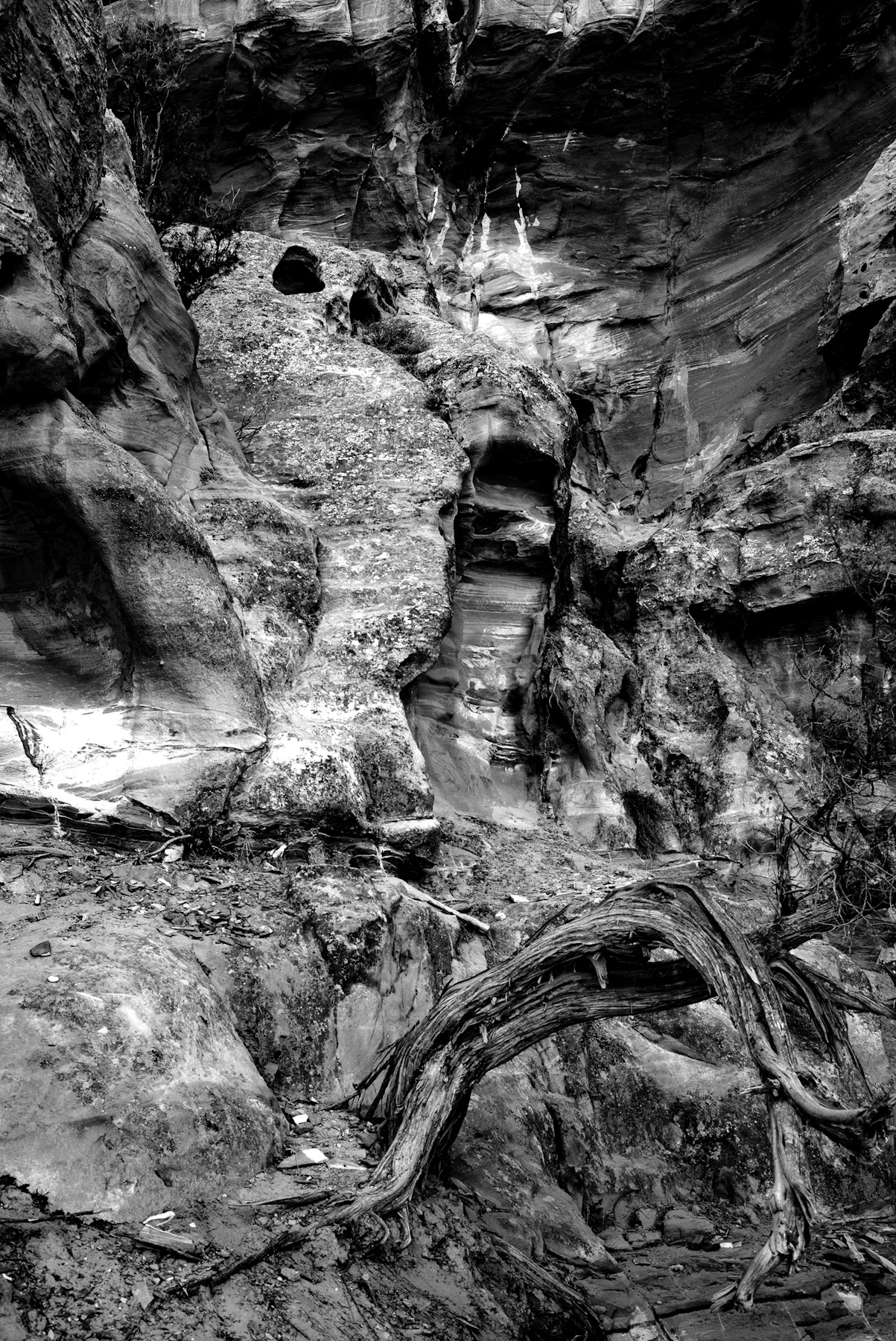
The black and white image presents a powerful study of a rugged canyon landscape, devoid of color to emphasize its profound textures, forms, and the interplay of light and shadow. The vertical composition draws the eye deep into the chasm, revealing layers of geological history etched into the rock face.
The foreground is dominated by a dramatically twisted, gnarled tree root or branch, forming a natural arch that acts as a visual gateway into the scene. Its rough, weathered surface contrasts sharply with the smoother, sculpted rock behind it. Beyond this natural arch, the canyon walls rise steeply, revealing intricate patterns of stratification and erosion. Sedimentary layers are clearly visible, telling a silent story of ancient deposition.
Mid-frame, several small alcoves or shallow caves are discernible within the rock, their dark openings hinting at hidden depths. The rock surfaces exhibit varying textures, from smooth, water-worn sections to rough, lichen-covered patches, particularly on a prominent boulder in the mid-left. Streaks of lighter rock material, possibly mineral deposits or areas of recent water flow, cascade down the darker rock faces, adding a dynamic vertical element. The ground is littered with debris – smaller rocks, twigs, and detritus, suggesting the relentless forces of nature that shape this environment. The stark contrast between the bright highlights on exposed rock and the deep, absorbing shadows in crevices and underhangs amplifies the sense of depth and ruggedness inherent in this **canyon landscape**.
This imagery speaks volumes about the immense **geological processes** that sculpt our planet. Such **canyon formations** are typically the result of millions of years of **erosion**, primarily by water. Over vast timescales, rivers and streams cut through layers of rock, progressively deepening and widening the channels. The distinct horizontal layering visible in the rock walls points to sedimentary origins, where sands, silts, and clays were deposited in ancient seas or floodplains, then compressed and lithified into rock. Subsequent uplift of the Earth’s crust exposed these layers to the relentless forces of wind and water, carving the intricate forms seen today. The smooth, undulating surfaces within the canyon are characteristic of water erosion, where abrasive sediments carried by flowing water act like sandpaper, slowly grinding away the rock, revealing the **desert geology** of this **ancient landscape**.
Beyond geological time, these landscapes often hold deep historical significance for human cultures. In regions resembling the American Southwest, where such canyons are prevalent, these natural shelters and travel corridors were vital to **indigenous peoples** for millennia. Tribes such as the Ancestral Puebloans, Navajo, and Ute utilized alcoves and caves within canyon walls for shelter, storage, and ceremonial purposes. The presence of natural overhangs and hidden nooks could have provided refuge from extreme weather and served as strategic vantage points. These canyons were not merely physical spaces but were imbued with spiritual meaning, connecting communities to their land and ancestors. The silent walls bear witness to countless generations who lived, traveled, and thrived in harmony with these formidable environments, leaving behind a rich **Ancestral Puebloan heritage** etched into the very fabric of the land.
The **black and white photography** rendition of this **canyon landscape** underscores its timeless quality. Without the distraction of color, the focus shifts entirely to form, texture, and the raw power of nature. It invites contemplation on the enduring processes that shape our world and the transient nature of human existence against such a backdrop. The gnarled wood in the foreground, itself a product of growth and decay, serves as a poignant reminder of life’s resilience and its inevitable return to the earth, echoing the grand cycles of **geological history**. This image is a testament to the enduring **natural beauty** and historical depth embedded within the Earth’s **ancient landscapes** and the **Southwest wilderness**.
The foreground is dominated by a dramatically twisted, gnarled tree root or branch, forming a natural arch that acts as a visual gateway into the scene. Its rough, weathered surface contrasts sharply with the smoother, sculpted rock behind it. Beyond this natural arch, the canyon walls rise steeply, revealing intricate patterns of stratification and erosion. Sedimentary layers are clearly visible, telling a silent story of ancient deposition.
Mid-frame, several small alcoves or shallow caves are discernible within the rock, their dark openings hinting at hidden depths. The rock surfaces exhibit varying textures, from smooth, water-worn sections to rough, lichen-covered patches, particularly on a prominent boulder in the mid-left. Streaks of lighter rock material, possibly mineral deposits or areas of recent water flow, cascade down the darker rock faces, adding a dynamic vertical element. The ground is littered with debris – smaller rocks, twigs, and detritus, suggesting the relentless forces of nature that shape this environment. The stark contrast between the bright highlights on exposed rock and the deep, absorbing shadows in crevices and underhangs amplifies the sense of depth and ruggedness inherent in this **canyon landscape**.
This imagery speaks volumes about the immense **geological processes** that sculpt our planet. Such **canyon formations** are typically the result of millions of years of **erosion**, primarily by water. Over vast timescales, rivers and streams cut through layers of rock, progressively deepening and widening the channels. The distinct horizontal layering visible in the rock walls points to sedimentary origins, where sands, silts, and clays were deposited in ancient seas or floodplains, then compressed and lithified into rock. Subsequent uplift of the Earth’s crust exposed these layers to the relentless forces of wind and water, carving the intricate forms seen today. The smooth, undulating surfaces within the canyon are characteristic of water erosion, where abrasive sediments carried by flowing water act like sandpaper, slowly grinding away the rock, revealing the **desert geology** of this **ancient landscape**.
Beyond geological time, these landscapes often hold deep historical significance for human cultures. In regions resembling the American Southwest, where such canyons are prevalent, these natural shelters and travel corridors were vital to **indigenous peoples** for millennia. Tribes such as the Ancestral Puebloans, Navajo, and Ute utilized alcoves and caves within canyon walls for shelter, storage, and ceremonial purposes. The presence of natural overhangs and hidden nooks could have provided refuge from extreme weather and served as strategic vantage points. These canyons were not merely physical spaces but were imbued with spiritual meaning, connecting communities to their land and ancestors. The silent walls bear witness to countless generations who lived, traveled, and thrived in harmony with these formidable environments, leaving behind a rich **Ancestral Puebloan heritage** etched into the very fabric of the land.
The **black and white photography** rendition of this **canyon landscape** underscores its timeless quality. Without the distraction of color, the focus shifts entirely to form, texture, and the raw power of nature. It invites contemplation on the enduring processes that shape our world and the transient nature of human existence against such a backdrop. The gnarled wood in the foreground, itself a product of growth and decay, serves as a poignant reminder of life’s resilience and its inevitable return to the earth, echoing the grand cycles of **geological history**. This image is a testament to the enduring **natural beauty** and historical depth embedded within the Earth’s **ancient landscapes** and the **Southwest wilderness**.
Schreibe einen Kommentar