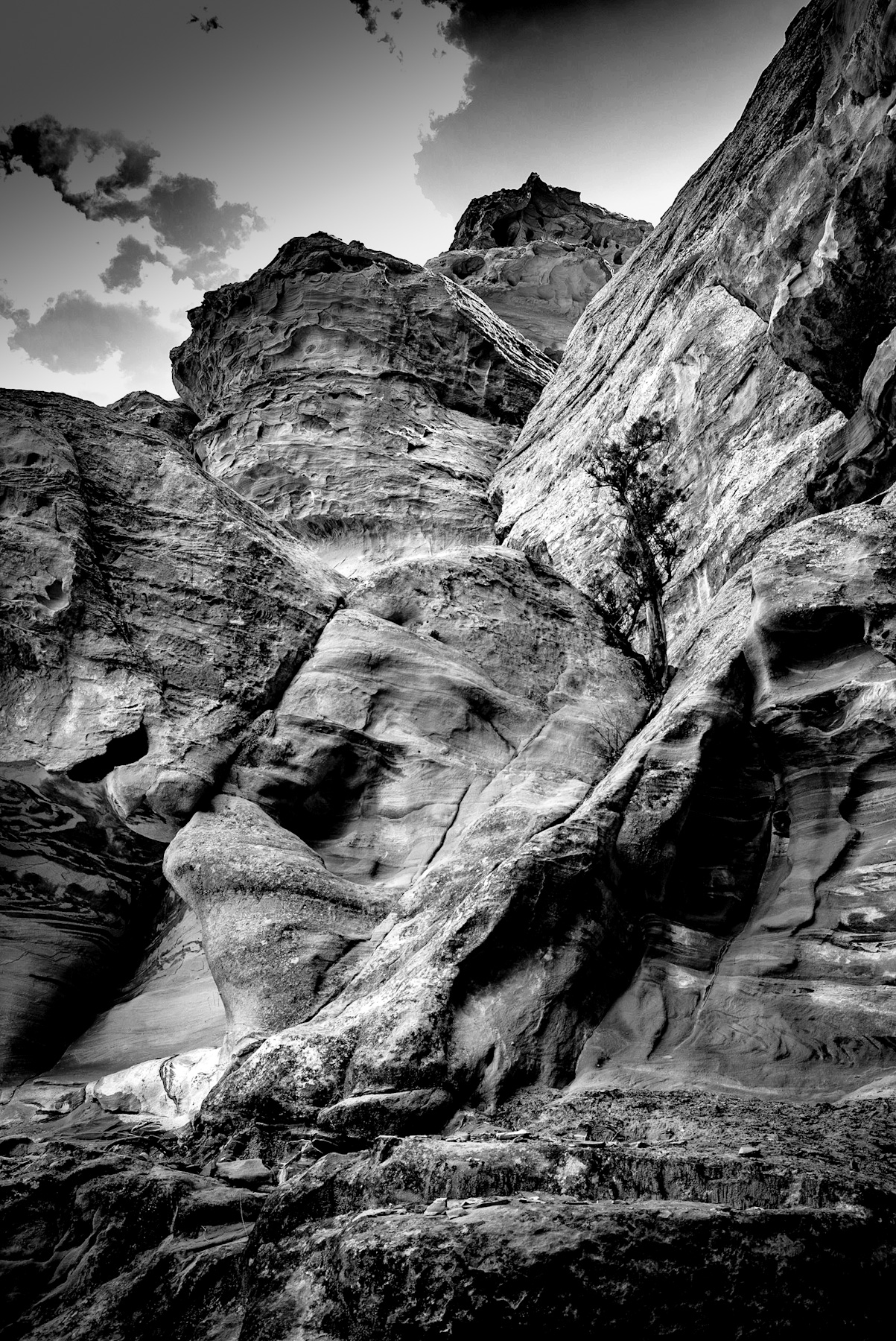
The monochrome lens captures a scene of profound geological artistry, a dramatic expanse of towering **sandstone cliffs** that rise with immense presence. The image, rendered in stark black and white, emphasizes the intricate textures and deep contours of the rock formations, transforming the landscape into a study of light and shadow. Jagged peaks pierce a sky dotted with wisps of clouds, while the lower sections of the cliffs plunge into deep, almost impenetrable darkness, highlighting the extreme contrasts inherent in this rugged environment.
The visual narrative is dominated by the raw power of nature’s sculpting hand. Layers of sediment, millennia in the making, are visible as horizontal striations across the rock faces, testament to ancient geological processes. Erosion has carved deep channels, smooth curves, and cavernous hollows into the stone, creating a dynamic interplay of forms that suggest both immense strength and delicate fragility. A solitary, resilient tree clings precariously to a crevice high on one of the sheer walls, a poignant symbol of life enduring amidst the harsh, arid conditions. Its dark silhouette against the lighter rock underscores the tenacity required to thrive in such an environment. The upward perspective of the photograph reinforces the monumental scale, inviting contemplation of the vastness of geological time and the forces that shaped this unique terrain.
This dramatic landscape is undeniably reminiscent of **Petra, Jordan**, the legendary **ancient city** of the **Nabataeans**. While the image itself showcases natural rock formations rather than explicit architectural carvings, it provides a crucial context for understanding the historical significance of this **UNESCO World Heritage Site**. The Nabataeans, an ancient Arab people, ingeniously harnessed and adapted to this very topography, carving their magnificent city directly into the **sandstone cliffs** from around the 4th century BCE. The natural protection offered by these towering rock walls and narrow gorges, such as the famous Siq, was instrumental in Petra’s strategic importance as a hub on ancient **trade routes** for incense, spices, and other valuable goods.
The **desert geology** seen in the photograph is not merely a backdrop but an active participant in Petra’s story. The soft, malleable sandstone allowed the Nabataeans to meticulously craft their elaborate tombs, temples, and dwellings. The natural erosion patterns, visible in the image, parallel the processes that would have continually reshaped the landscape around their rock-cut facades, making the city a living testament to the interplay between human endeavor and natural forces. The **historical landscape** of Petra is a profound example of how a civilization can emerge, flourish, and leave an indelible mark by harmonizing with its environment.
In essence, the photograph captures the very essence of Petra before the chisel, displaying the raw, majestic canvas upon which an extraordinary civilization was built. It speaks of endurance—both of the stone itself, shaped by eons, and of the human spirit that chose to dwell within and transform such an imposing natural wonder. This **black and white photography** distills the scene to its fundamental elements, emphasizing the timeless beauty and profound historical resonance of these ancient rock formations.
The visual narrative is dominated by the raw power of nature’s sculpting hand. Layers of sediment, millennia in the making, are visible as horizontal striations across the rock faces, testament to ancient geological processes. Erosion has carved deep channels, smooth curves, and cavernous hollows into the stone, creating a dynamic interplay of forms that suggest both immense strength and delicate fragility. A solitary, resilient tree clings precariously to a crevice high on one of the sheer walls, a poignant symbol of life enduring amidst the harsh, arid conditions. Its dark silhouette against the lighter rock underscores the tenacity required to thrive in such an environment. The upward perspective of the photograph reinforces the monumental scale, inviting contemplation of the vastness of geological time and the forces that shaped this unique terrain.
This dramatic landscape is undeniably reminiscent of **Petra, Jordan**, the legendary **ancient city** of the **Nabataeans**. While the image itself showcases natural rock formations rather than explicit architectural carvings, it provides a crucial context for understanding the historical significance of this **UNESCO World Heritage Site**. The Nabataeans, an ancient Arab people, ingeniously harnessed and adapted to this very topography, carving their magnificent city directly into the **sandstone cliffs** from around the 4th century BCE. The natural protection offered by these towering rock walls and narrow gorges, such as the famous Siq, was instrumental in Petra’s strategic importance as a hub on ancient **trade routes** for incense, spices, and other valuable goods.
The **desert geology** seen in the photograph is not merely a backdrop but an active participant in Petra’s story. The soft, malleable sandstone allowed the Nabataeans to meticulously craft their elaborate tombs, temples, and dwellings. The natural erosion patterns, visible in the image, parallel the processes that would have continually reshaped the landscape around their rock-cut facades, making the city a living testament to the interplay between human endeavor and natural forces. The **historical landscape** of Petra is a profound example of how a civilization can emerge, flourish, and leave an indelible mark by harmonizing with its environment.
In essence, the photograph captures the very essence of Petra before the chisel, displaying the raw, majestic canvas upon which an extraordinary civilization was built. It speaks of endurance—both of the stone itself, shaped by eons, and of the human spirit that chose to dwell within and transform such an imposing natural wonder. This **black and white photography** distills the scene to its fundamental elements, emphasizing the timeless beauty and profound historical resonance of these ancient rock formations.
Schreibe einen Kommentar