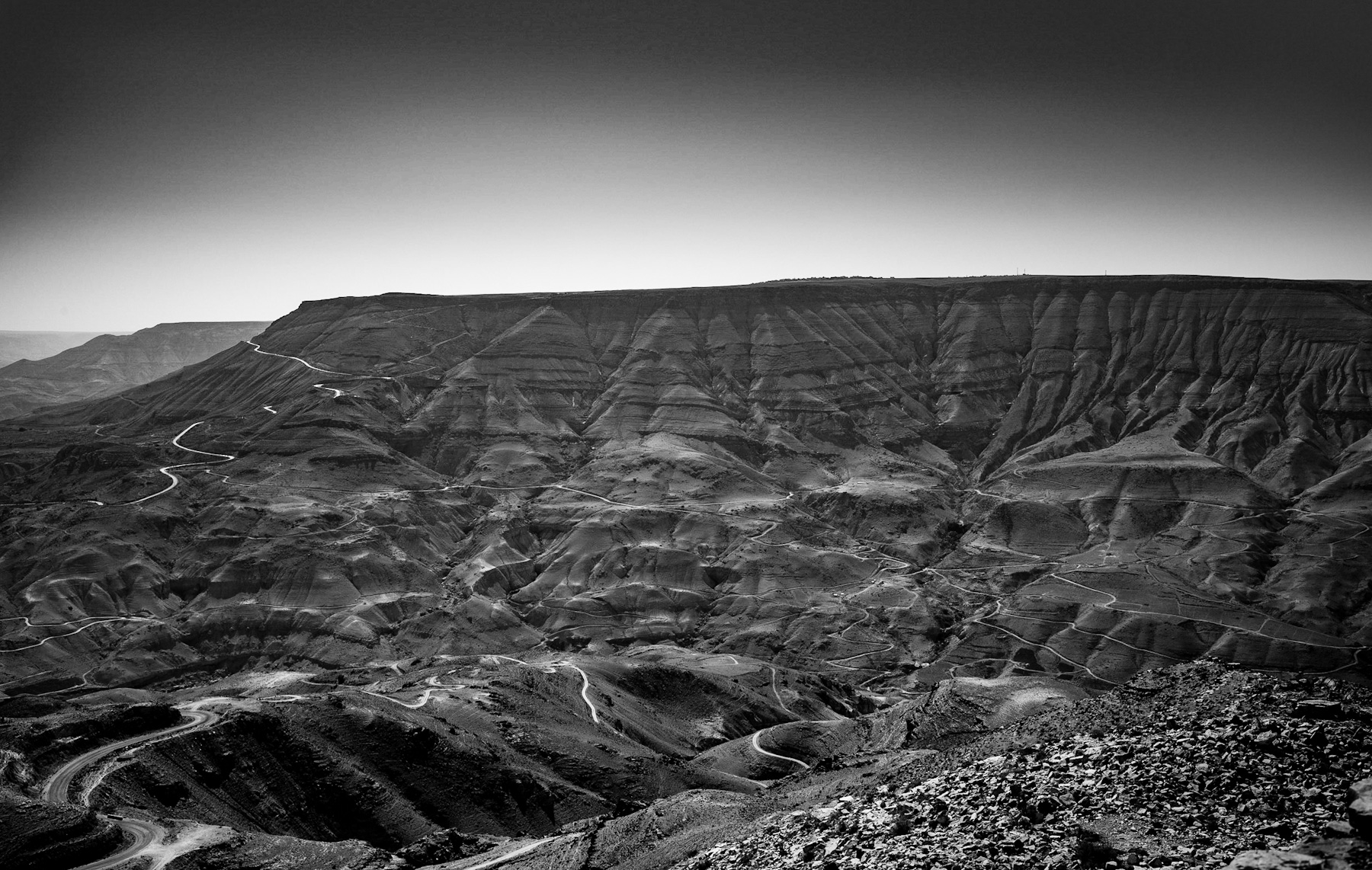
The accompanying photograph captures a dramatic, expansive mountainous landscape rendered in stark black and white, immediately drawing the viewer into its rugged grandeur. A vast expanse of undulating terrain dominates the frame, characterized by deep valleys, steep slopes, and prominent geological layering that speaks to eons of natural formation. The monochrome palette accentuates the textures and contrasts, highlighting every ridge, crevice, and shadow, imbuing the scene with a profound sense of antiquity and raw beauty.
A Tapestry of Terrain and Human Endeavor
At the heart of this formidable panorama lies an intricate network of winding roads, their pale lines snaking across the dark, contoured earth. These serpentine paths, a testament to human ingenuity and persistence, ascend and descend the challenging topography with remarkable precision. Each curve, each switchback, represents an engineering feat designed to conquer the formidable elevation changes. The roads appear both ancient and enduring, seamlessly integrated into the natural contours of the land, hinting at countless journeys undertaken across this formidable terrain. The sheer number of visible paths suggests a vital arteries system, meticulously carved into the very fabric of the earth.
Echoes of Ancient Civilizations
Landscapes such as this, particularly prevalent in regions like the Middle East, have historically served as crucial conduits for human interaction. For millennia, these mountain passes and valley routes were not merely paths but lifelines – arteries of trade, pilgrimage, and military movement. They connected disparate civilizations, facilitating the exchange of goods, ideas, and cultures.
One of the most famous examples is the King’s Highway (Via Regia), an ancient trade route in Jordan, believed to be one of the oldest continuously used roads in the world. Dating back to the Bronze Age, this route connected Egypt with Mesopotamia, Syria, and Arabia, playing a pivotal role in the rise and fall of empires. The Nabataeans, renowned for their mastery of desert environments and intricate trade networks, utilized and likely improved sections of such routes to transport spices, incense, and other valuable commodities. Later, the Romans further developed these paths into a sophisticated network, leaving behind vestiges of their engineering prowess. Crusaders and Ottoman forces also traversed these strategic corridors, each era adding another layer to the rich historical tapestry woven into the very ground. The roads depicted in the photograph embody this enduring legacy, mirroring the ancient paths that once buzzed with caravans, soldiers, and travelers.
Enduring Legacy and Modern Pathways
The black and white aesthetic of the image profoundly emphasizes the timeless quality of this landscape. It strips away the distractions of color, focusing instead on form, texture, and the enduring narrative of human interaction with the natural world. These roads, whether modern iterations or ancient remnants, continue to serve as vital connections in a challenging environment. The image is a powerful reminder of how human civilization has consistently adapted, built, and persevered, carving out existence and connection even in the most rugged of places. It invites contemplation on the countless stories embedded within these ancient and formidable mountain passes.
A Tapestry of Terrain and Human Endeavor
At the heart of this formidable panorama lies an intricate network of winding roads, their pale lines snaking across the dark, contoured earth. These serpentine paths, a testament to human ingenuity and persistence, ascend and descend the challenging topography with remarkable precision. Each curve, each switchback, represents an engineering feat designed to conquer the formidable elevation changes. The roads appear both ancient and enduring, seamlessly integrated into the natural contours of the land, hinting at countless journeys undertaken across this formidable terrain. The sheer number of visible paths suggests a vital arteries system, meticulously carved into the very fabric of the earth.
Echoes of Ancient Civilizations
Landscapes such as this, particularly prevalent in regions like the Middle East, have historically served as crucial conduits for human interaction. For millennia, these mountain passes and valley routes were not merely paths but lifelines – arteries of trade, pilgrimage, and military movement. They connected disparate civilizations, facilitating the exchange of goods, ideas, and cultures.
One of the most famous examples is the King’s Highway (Via Regia), an ancient trade route in Jordan, believed to be one of the oldest continuously used roads in the world. Dating back to the Bronze Age, this route connected Egypt with Mesopotamia, Syria, and Arabia, playing a pivotal role in the rise and fall of empires. The Nabataeans, renowned for their mastery of desert environments and intricate trade networks, utilized and likely improved sections of such routes to transport spices, incense, and other valuable commodities. Later, the Romans further developed these paths into a sophisticated network, leaving behind vestiges of their engineering prowess. Crusaders and Ottoman forces also traversed these strategic corridors, each era adding another layer to the rich historical tapestry woven into the very ground. The roads depicted in the photograph embody this enduring legacy, mirroring the ancient paths that once buzzed with caravans, soldiers, and travelers.
Enduring Legacy and Modern Pathways
The black and white aesthetic of the image profoundly emphasizes the timeless quality of this landscape. It strips away the distractions of color, focusing instead on form, texture, and the enduring narrative of human interaction with the natural world. These roads, whether modern iterations or ancient remnants, continue to serve as vital connections in a challenging environment. The image is a powerful reminder of how human civilization has consistently adapted, built, and persevered, carving out existence and connection even in the most rugged of places. It invites contemplation on the countless stories embedded within these ancient and formidable mountain passes.
Schreibe einen Kommentar