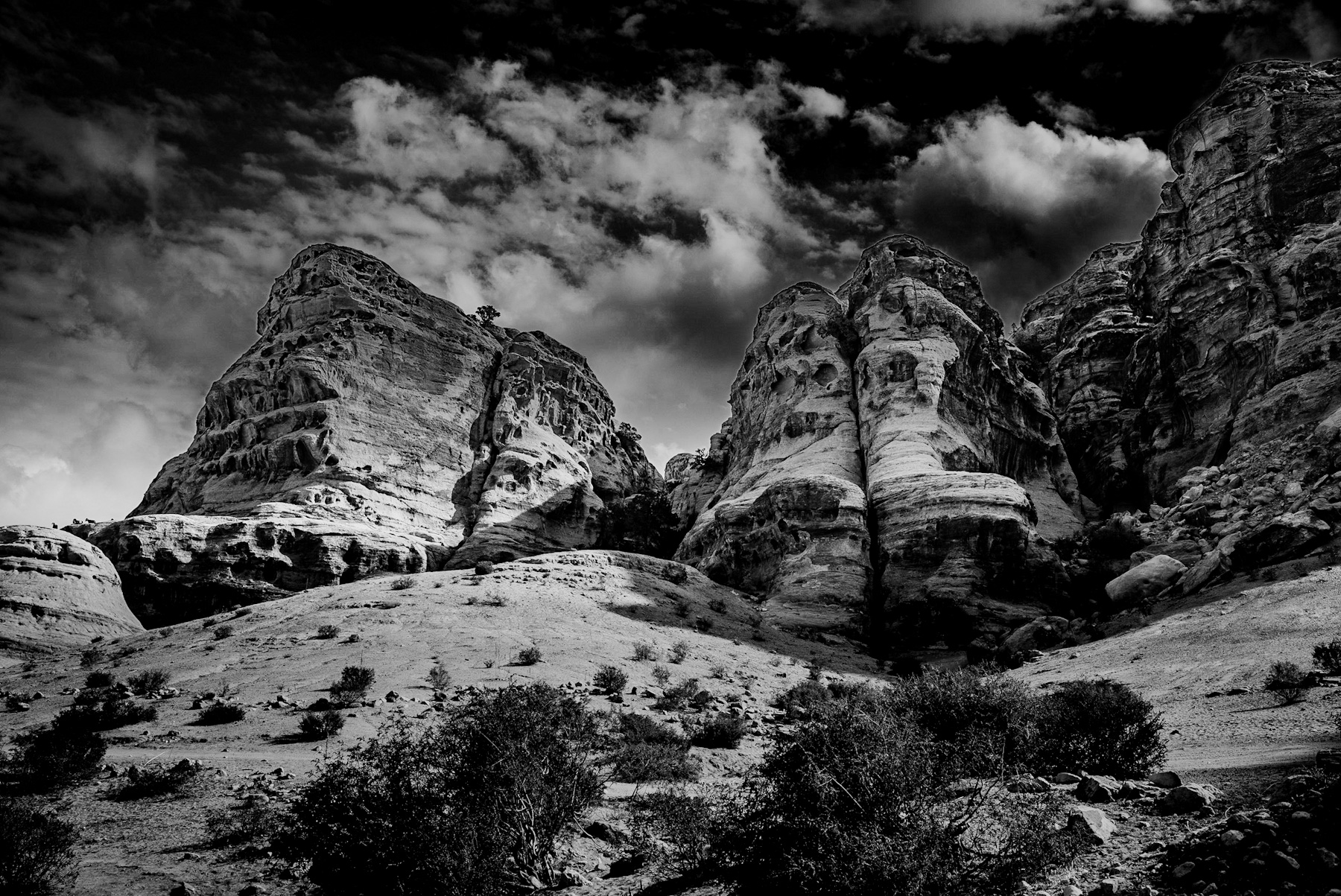
The monochromatic intensity of this image immediately captivates, presenting a landscape where time seems to stand still. Dominant rock formations rise majestically, their surfaces etched with the millennia of wind and sand. Above, a turbulent sky, heavy with dark clouds, casts a dramatic shadow, enhancing the rugged contours of the terrain. This stark contrast between the luminous rock faces and the brooding heavens imbues the scene with a profound sense of ancient grandeur and untamed wilderness.
A Tapestry of Stone and Sky
The geological tapestry is rich with detail; layered sandstone cliffs showcase distinct stratifications, indicative of immense geological pressures and depositional history. Numerous small caves and eroded hollows pepper the rock faces, hinting at natural processes and perhaps early human interventions. Sparse, resilient desert flora dots the foreground, a testament to life’s persistence in arid conditions, their dark silhouettes adding depth to the composition. The interplay of light and shadow, expertly captured in black and white, accentuates every crevice and curve, transforming the landscape into a sculptural masterpiece. This dramatic visual narrative emphasizes the raw power and enduring beauty of Earth’s ancient formations.
Echoes of an Ancient Civilization
Beyond its striking natural beauty, this landscape resonates with a rich historical narrative, strongly reminiscent of the iconic ancient city of Petra in modern-day Jordan. The distinctive rock formations and the characteristic erosion patterns are hallmarks of this UNESCO World Heritage site, a place where nature and human ingenuity converged to create an unparalleled civilization. The very sandstone that forms these formidable cliffs was the medium for one of history’s most remarkable architectural achievements.
The Legacy of the Nabataeans
Petra, meaning ‚rock‘ in Greek, was the capital city of the Nabataeans, an ancient Arab people who settled here as early as the 4th century BC. Masters of hydraulic engineering and trade, they carved an entire city out of these very sandstone cliffs, transforming a seemingly inhospitable desert into a thriving metropolis. Their sophisticated water management systems allowed them to control vital trade routes, establishing Petra as a crucial hub connecting the East and West. The Nabataeans‘ architectural prowess is evident in the iconic facades of buildings like Al-Khazneh (The Treasury) and Ad Deir (The Monastery), though even the unadorned rock faces shown here speak volumes of the environment they mastered and revered. These monumental structures, hidden within a labyrinth of gorges and canyons, represent a peak of ancient civilization’s adaptability and artistic vision.
Enduring Majesty and Historical Significance
This photograph, therefore, is more than a mere depiction of natural beauty; it serves as a powerful reminder of an advanced civilization that thrived amidst challenging conditions. The enduring structures, both natural and man-made, stand as silent witnesses to millennia of human endeavor, cultural exchange, and artistic expression. The scene evokes the spirit of explorers, traders, and pilgrims who once traversed these very paths, leaving behind a legacy etched into the very fabric of the earth. The site’s historical layers, from Nabataean ingenuity to Roman influence and Byzantine presence, contribute to its archaeological wonder and global significance.
In its raw, monochromatic splendor, the image invites contemplation on the deep interconnectedness between humanity and its environment. It underscores the profound stories held within ancient landscapes, urging us to appreciate both their intrinsic beauty and the historical echoes that continue to define them. This is a testament to nature’s enduring power and the indelible mark left by those who once called these majestic rocks home.
A Tapestry of Stone and Sky
The geological tapestry is rich with detail; layered sandstone cliffs showcase distinct stratifications, indicative of immense geological pressures and depositional history. Numerous small caves and eroded hollows pepper the rock faces, hinting at natural processes and perhaps early human interventions. Sparse, resilient desert flora dots the foreground, a testament to life’s persistence in arid conditions, their dark silhouettes adding depth to the composition. The interplay of light and shadow, expertly captured in black and white, accentuates every crevice and curve, transforming the landscape into a sculptural masterpiece. This dramatic visual narrative emphasizes the raw power and enduring beauty of Earth’s ancient formations.
Echoes of an Ancient Civilization
Beyond its striking natural beauty, this landscape resonates with a rich historical narrative, strongly reminiscent of the iconic ancient city of Petra in modern-day Jordan. The distinctive rock formations and the characteristic erosion patterns are hallmarks of this UNESCO World Heritage site, a place where nature and human ingenuity converged to create an unparalleled civilization. The very sandstone that forms these formidable cliffs was the medium for one of history’s most remarkable architectural achievements.
The Legacy of the Nabataeans
Petra, meaning ‚rock‘ in Greek, was the capital city of the Nabataeans, an ancient Arab people who settled here as early as the 4th century BC. Masters of hydraulic engineering and trade, they carved an entire city out of these very sandstone cliffs, transforming a seemingly inhospitable desert into a thriving metropolis. Their sophisticated water management systems allowed them to control vital trade routes, establishing Petra as a crucial hub connecting the East and West. The Nabataeans‘ architectural prowess is evident in the iconic facades of buildings like Al-Khazneh (The Treasury) and Ad Deir (The Monastery), though even the unadorned rock faces shown here speak volumes of the environment they mastered and revered. These monumental structures, hidden within a labyrinth of gorges and canyons, represent a peak of ancient civilization’s adaptability and artistic vision.
Enduring Majesty and Historical Significance
This photograph, therefore, is more than a mere depiction of natural beauty; it serves as a powerful reminder of an advanced civilization that thrived amidst challenging conditions. The enduring structures, both natural and man-made, stand as silent witnesses to millennia of human endeavor, cultural exchange, and artistic expression. The scene evokes the spirit of explorers, traders, and pilgrims who once traversed these very paths, leaving behind a legacy etched into the very fabric of the earth. The site’s historical layers, from Nabataean ingenuity to Roman influence and Byzantine presence, contribute to its archaeological wonder and global significance.
In its raw, monochromatic splendor, the image invites contemplation on the deep interconnectedness between humanity and its environment. It underscores the profound stories held within ancient landscapes, urging us to appreciate both their intrinsic beauty and the historical echoes that continue to define them. This is a testament to nature’s enduring power and the indelible mark left by those who once called these majestic rocks home.
Schreibe einen Kommentar