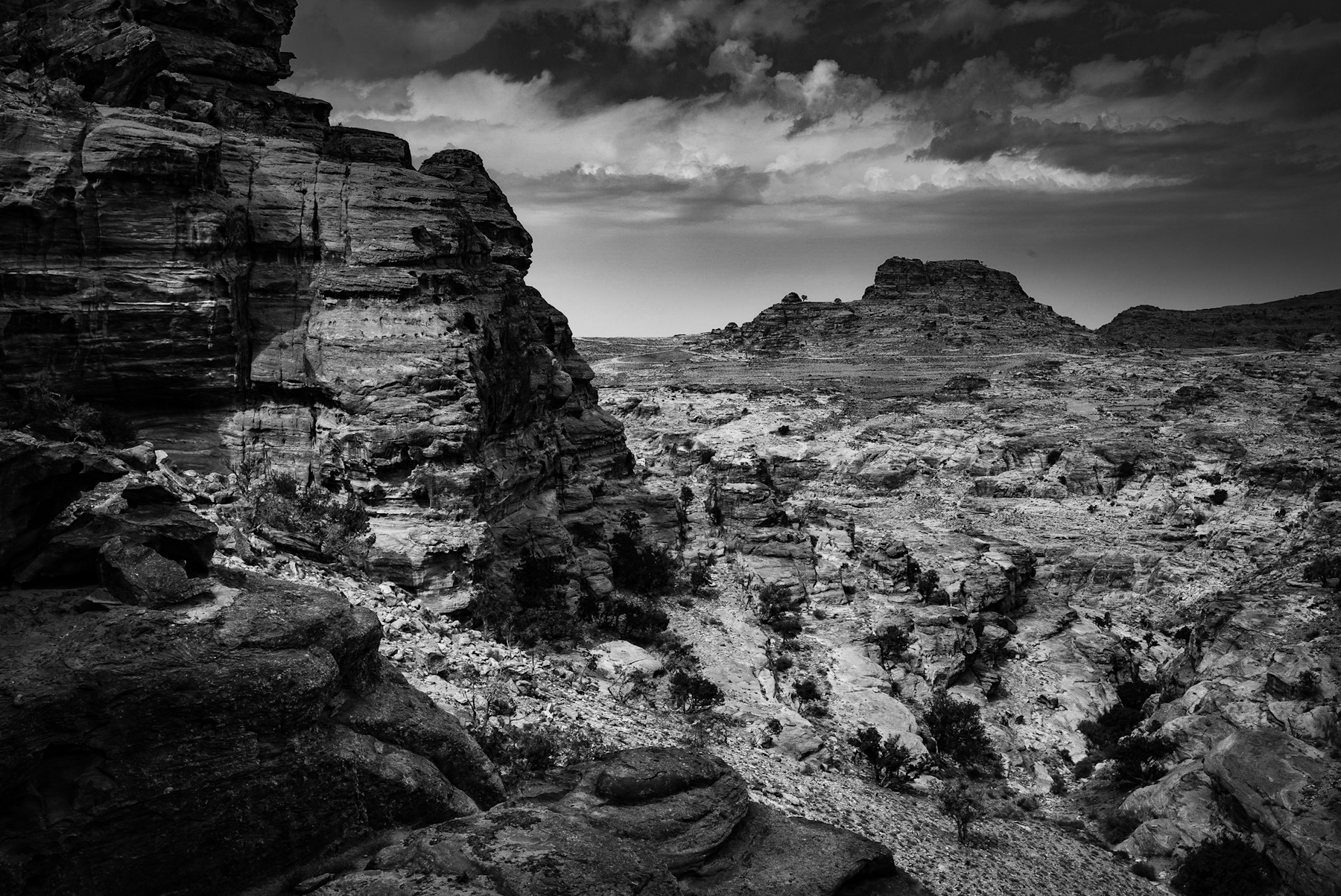
The monochromatic lens captures a landscape of profound geological drama and historical resonance. This black and white photograph presents a rugged, arid environment dominated by massive, layered rock formations. The scene unfolds with a striking contrast, where deep shadows carve out the intricate textures of the sandstone cliffs, while brighter areas reveal the weathered surfaces of a vast, rocky plain stretching towards the horizon.
Visualizing the Ancient Terrain
In the foreground, a colossal rock face anchors the left side of the frame, its sheer bulk displaying millennia of erosion. Horizontal striations across its surface speak to layers of sediment deposited over geological epochs, each line telling a silent story of time. The rough, broken contours of the rock suggest a landscape shaped by powerful natural forces – wind, water, and seismic activity. Sparse, resilient vegetation clings to pockets within the rocks and scattered across the terrain, a testament to life’s persistence in harsh conditions.
Mid-ground reveals a sprawling expanse of fractured rock and debris, a chaotic yet beautiful tapestry of nature’s raw power. Undulating hills and smaller rock outcrops punctuate this terrain, leading the eye deeper into the composition. The distant horizon is softened by a hazy sky, partially obscured by dramatic, brooding clouds that add a sense of weight and atmosphere to the scene. The absence of color intensifies the focus on form, texture, and the interplay of light and shadow, emphasizing the raw, untamed character of this ancient land.
Historical Footprints in the Sandstone
This landscape, with its distinctive sandstone formations and arid climate, strongly evokes regions like Petra in modern-day Jordan. Such geological settings were not merely backdrops but fundamental to the rise and endurance of ancient civilizations. The Nabataeans, an ancient Arab people, famously carved their magnificent city of Petra directly into similar sandstone cliffs. Flourishing from the 4th century BCE, Petra became a crucial hub for trade routes connecting Arabia with the Mediterranean, facilitating the exchange of spices, frankincense, and myrrh.
The Nabataeans were master hydrologists, devising sophisticated systems to collect, store, and transport water across their desert kingdom, enabling agriculture and supporting a thriving population in an otherwise inhospitable environment. Their architectural genius is evident in the intricate facades of temples, tombs, and dwellings sculpted directly from the living rock, showcasing a unique blend of Hellenistic, Roman, and indigenous artistic styles. This photograph, while not depicting explicit archaeological structures, provides a visceral sense of the natural environment that cradled such a remarkable civilization. The very rocks depicted likely stood silent witness to the daily lives, trade, and cultural exchanges of the Nabataean people.
An Enduring Legacy
The visual narrative of this image extends beyond mere geological description. It invites contemplation on the deep connection between humanity and its environment. These ancient rock formations have endured countless cycles of erosion, yet they continue to stand, mirroring the resilience of the civilizations that once thrived within their embrace. The photograph serves as a powerful reminder of the historical layers embedded within our natural world, urging us to look beyond the surface and appreciate the profound stories etched into the very fabric of the earth. It is a testament to both nature’s grandeur and the enduring human spirit that adapted, innovated, and left its indelible mark on such formidable landscapes.
Petra, Jordan, Nabataean, ancient civilizations, desert landscape, sandstone formations, historical sites, archaeological wonder, Middle East history, black and white photography, geological features, cultural heritage, arid environment.
Visualizing the Ancient Terrain
In the foreground, a colossal rock face anchors the left side of the frame, its sheer bulk displaying millennia of erosion. Horizontal striations across its surface speak to layers of sediment deposited over geological epochs, each line telling a silent story of time. The rough, broken contours of the rock suggest a landscape shaped by powerful natural forces – wind, water, and seismic activity. Sparse, resilient vegetation clings to pockets within the rocks and scattered across the terrain, a testament to life’s persistence in harsh conditions.
Mid-ground reveals a sprawling expanse of fractured rock and debris, a chaotic yet beautiful tapestry of nature’s raw power. Undulating hills and smaller rock outcrops punctuate this terrain, leading the eye deeper into the composition. The distant horizon is softened by a hazy sky, partially obscured by dramatic, brooding clouds that add a sense of weight and atmosphere to the scene. The absence of color intensifies the focus on form, texture, and the interplay of light and shadow, emphasizing the raw, untamed character of this ancient land.
Historical Footprints in the Sandstone
This landscape, with its distinctive sandstone formations and arid climate, strongly evokes regions like Petra in modern-day Jordan. Such geological settings were not merely backdrops but fundamental to the rise and endurance of ancient civilizations. The Nabataeans, an ancient Arab people, famously carved their magnificent city of Petra directly into similar sandstone cliffs. Flourishing from the 4th century BCE, Petra became a crucial hub for trade routes connecting Arabia with the Mediterranean, facilitating the exchange of spices, frankincense, and myrrh.
The Nabataeans were master hydrologists, devising sophisticated systems to collect, store, and transport water across their desert kingdom, enabling agriculture and supporting a thriving population in an otherwise inhospitable environment. Their architectural genius is evident in the intricate facades of temples, tombs, and dwellings sculpted directly from the living rock, showcasing a unique blend of Hellenistic, Roman, and indigenous artistic styles. This photograph, while not depicting explicit archaeological structures, provides a visceral sense of the natural environment that cradled such a remarkable civilization. The very rocks depicted likely stood silent witness to the daily lives, trade, and cultural exchanges of the Nabataean people.
An Enduring Legacy
The visual narrative of this image extends beyond mere geological description. It invites contemplation on the deep connection between humanity and its environment. These ancient rock formations have endured countless cycles of erosion, yet they continue to stand, mirroring the resilience of the civilizations that once thrived within their embrace. The photograph serves as a powerful reminder of the historical layers embedded within our natural world, urging us to look beyond the surface and appreciate the profound stories etched into the very fabric of the earth. It is a testament to both nature’s grandeur and the enduring human spirit that adapted, innovated, and left its indelible mark on such formidable landscapes.
Petra, Jordan, Nabataean, ancient civilizations, desert landscape, sandstone formations, historical sites, archaeological wonder, Middle East history, black and white photography, geological features, cultural heritage, arid environment.
Schreibe einen Kommentar