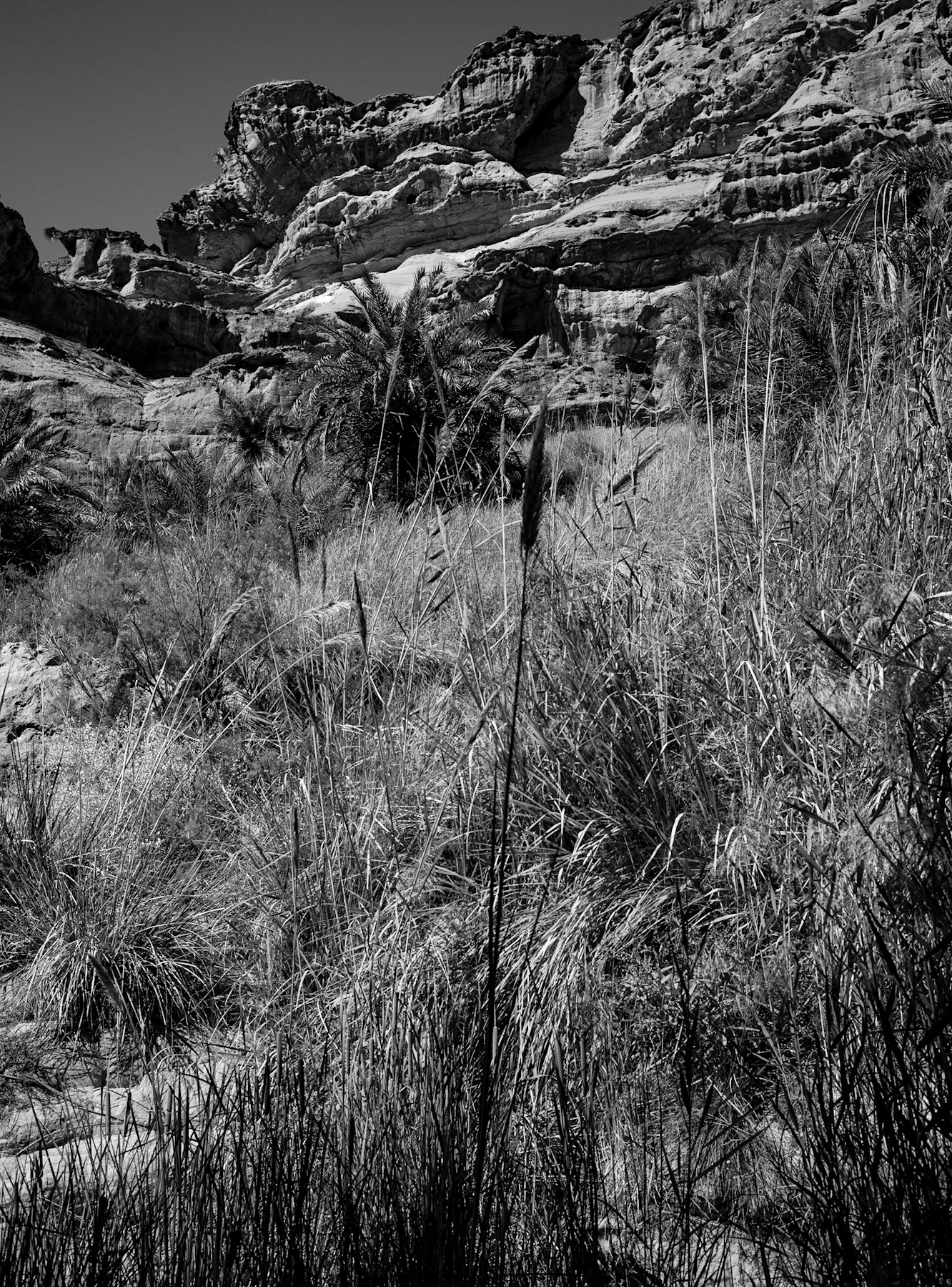
The monochromatic image presents a dramatic tableau, a testament to nature’s enduring power and the deep historical narratives embedded within arid environments. Dominated by stark contrasts and intricate textures, the scene captures a vibrant ecosystem thriving against a backdrop of ancient geological formations.
A Study in Contrasts: Rock and Reed
In the foreground, a dense thicket of tall grasses and reeds commands attention. Their slender stalks and feathery seed heads create a dynamic, almost wild texture, catching the light and casting subtle shadows that emphasize depth. This lush vegetation speaks to the presence of water, hinting at a wadi – a dry riverbed that periodically fills with life-giving rain, or a hidden spring that nourishes this micro-environment. The resilience of these plants underscores the delicate balance of life in an otherwise harsh setting.
Transitioning to the midground, the verdant expanse gives way to a cluster of palm trees, their fronds a darker silhouette against the brighter tones of the rock face. These palms further reinforce the notion of an oasis or a fertile pocket within the desert, a vital anchor for both flora and fauna. Beyond the immediate vegetation, the landscape ascends dramatically, revealing majestic rock formations. These colossal sandstone cliffs, characterized by their layered strata and weathered surfaces, bear the marks of millennia of erosion by wind and water. Their rugged contours and deep crevices evoke a sense of immense age and geological grandeur.
Whispers of Civilizations Past
This type of landscape, where water sources meet towering rock formations, has historically served as a cradle for human civilization and a critical waypoint for ancient trade. Regions across the Arabian Peninsula, such as AlUla or the broader landscapes associated with the Nabataeans, offer striking parallels. These environments were not merely obstacles but strategic arteries, facilitating the flow of goods, ideas, and cultures across vast distances.
The very presence of wadis and oases dictated the routes of the ancient Incense Trade, connecting distant empires and supporting vibrant communities. Settlements often emerged at these vital water points, with inhabitants utilizing the natural protection of the cliffs and sometimes carving dwellings, tombs, and temples directly into the rock face. The layered appearance of the cliffs in the image could conceal such forgotten histories, echoing the architectural marvels found in places like Petra and Hegra, where human ingenuity transformed natural rock into enduring monuments. These sites stand as powerful reminders of human adaptation and the profound relationship between early societies and their challenging natural surroundings.
Nature’s Resilience, Humanity’s Footprint
The black and white rendition of this scene enhances its timeless quality, stripping away the distraction of color to focus on form, light, and texture. It emphasizes the enduring struggle and triumph of life in an arid environment and the silent witness of the ancient rocks to countless generations. The interplay between the vibrant, ephemeral reeds and the immutable, monumental cliffs encapsulates the dynamic relationship between fleeting life and geological permanence.
Such landscapes continue to hold immense cultural and historical significance, inviting contemplation of the past and admiration for the natural world’s capacity for resilience. They are living museums, where every stone and every plant tells a part of a larger story – a narrative of ecological adaptation, ancient journeys, and the enduring human spirit that sought sustenance and meaning amidst the desert’s embrace.
A Study in Contrasts: Rock and Reed
In the foreground, a dense thicket of tall grasses and reeds commands attention. Their slender stalks and feathery seed heads create a dynamic, almost wild texture, catching the light and casting subtle shadows that emphasize depth. This lush vegetation speaks to the presence of water, hinting at a wadi – a dry riverbed that periodically fills with life-giving rain, or a hidden spring that nourishes this micro-environment. The resilience of these plants underscores the delicate balance of life in an otherwise harsh setting.
Transitioning to the midground, the verdant expanse gives way to a cluster of palm trees, their fronds a darker silhouette against the brighter tones of the rock face. These palms further reinforce the notion of an oasis or a fertile pocket within the desert, a vital anchor for both flora and fauna. Beyond the immediate vegetation, the landscape ascends dramatically, revealing majestic rock formations. These colossal sandstone cliffs, characterized by their layered strata and weathered surfaces, bear the marks of millennia of erosion by wind and water. Their rugged contours and deep crevices evoke a sense of immense age and geological grandeur.
Whispers of Civilizations Past
This type of landscape, where water sources meet towering rock formations, has historically served as a cradle for human civilization and a critical waypoint for ancient trade. Regions across the Arabian Peninsula, such as AlUla or the broader landscapes associated with the Nabataeans, offer striking parallels. These environments were not merely obstacles but strategic arteries, facilitating the flow of goods, ideas, and cultures across vast distances.
The very presence of wadis and oases dictated the routes of the ancient Incense Trade, connecting distant empires and supporting vibrant communities. Settlements often emerged at these vital water points, with inhabitants utilizing the natural protection of the cliffs and sometimes carving dwellings, tombs, and temples directly into the rock face. The layered appearance of the cliffs in the image could conceal such forgotten histories, echoing the architectural marvels found in places like Petra and Hegra, where human ingenuity transformed natural rock into enduring monuments. These sites stand as powerful reminders of human adaptation and the profound relationship between early societies and their challenging natural surroundings.
Nature’s Resilience, Humanity’s Footprint
The black and white rendition of this scene enhances its timeless quality, stripping away the distraction of color to focus on form, light, and texture. It emphasizes the enduring struggle and triumph of life in an arid environment and the silent witness of the ancient rocks to countless generations. The interplay between the vibrant, ephemeral reeds and the immutable, monumental cliffs encapsulates the dynamic relationship between fleeting life and geological permanence.
Such landscapes continue to hold immense cultural and historical significance, inviting contemplation of the past and admiration for the natural world’s capacity for resilience. They are living museums, where every stone and every plant tells a part of a larger story – a narrative of ecological adaptation, ancient journeys, and the enduring human spirit that sought sustenance and meaning amidst the desert’s embrace.
Schreibe einen Kommentar