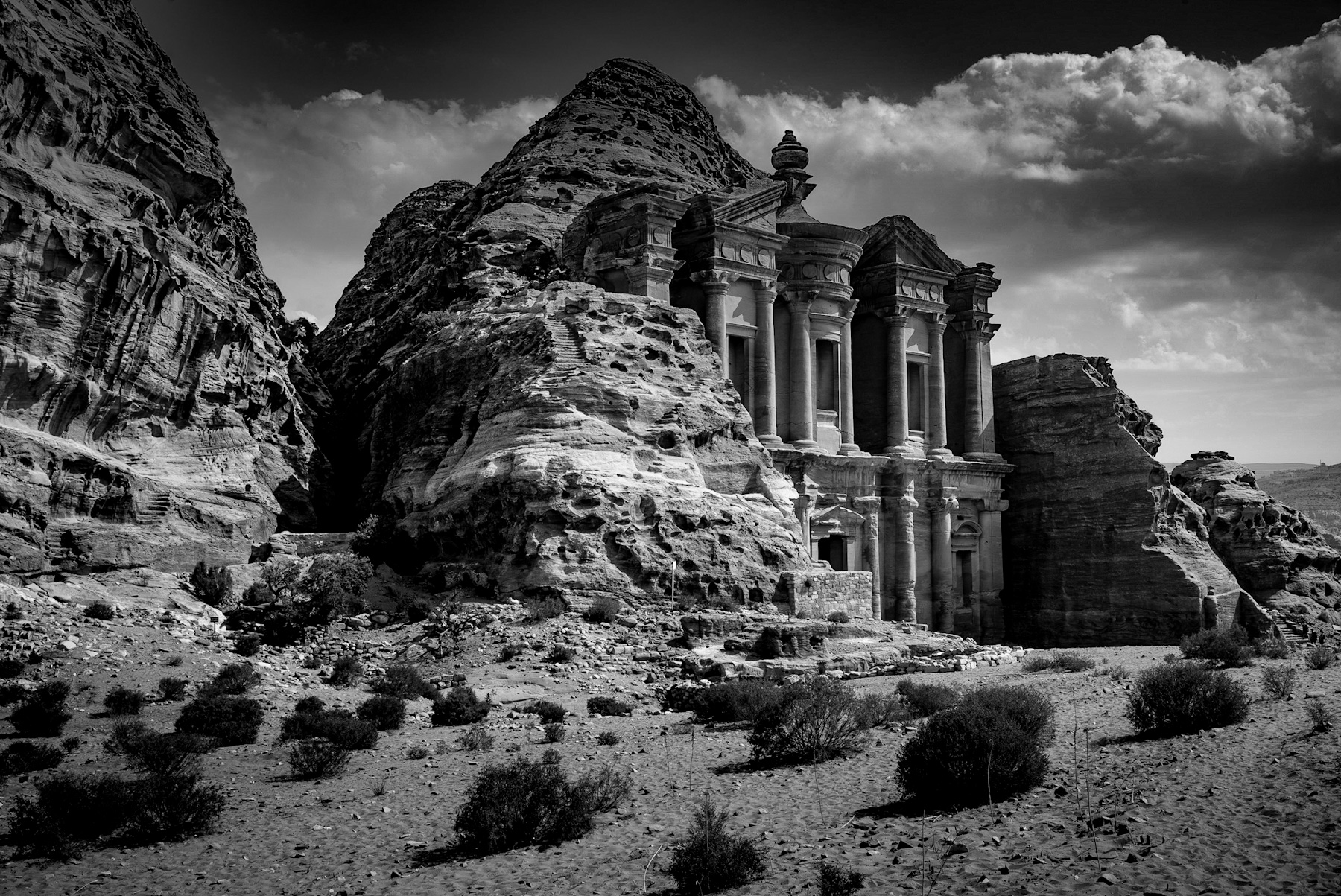
The monochromatic lens captures a profound sense of antiquity and drama, presenting Al-Deir, often known as The Monastery, as a monumental testament to ancient ingenuity. Carved directly into the formidable sandstone cliffs of Petra, Jordan, this iconic structure dominates the frame, its classical facade emerging with striking clarity from the rugged natural landscape. The use of black and white photography accentuates the intricate details of the rock-cut architecture, highlighting the interplay of light and shadow across its towering columns, elaborate pediment, and the weathered texture of the surrounding rock formations. In the foreground, sparse desert vegetation dots the sandy, rocky terrain, emphasizing the remote and challenging environment in which this architectural marvel was created. Overhead, dramatic clouds sweep across the sky, adding an ethereal depth and contributing to the timeless, almost otherworldly atmosphere of the scene.
Petra: A Nabataean Legacy
Al-Deir stands as a pinnacle of the Nabataean civilization, an ancient Arab people who flourished from the 4th century BCE to the 1st century CE. Petra, their capital city, was strategically located at the crossroads of major trade routes, connecting the Arabian Peninsula with Mesopotamia, Egypt, and the Mediterranean. The Nabataeans were master traders, engineers, and architects, renowned for their sophisticated water management systems that allowed them to thrive in the arid desert. Their wealth and cultural exchange fostered a unique artistic style, blending indigenous traditions with Hellenistic and Roman influences, evident in the intricate carvings that adorn their city. Petra’s hidden valleys and towering canyons provided natural defenses, making it a formidable stronghold and a bustling economic hub.
Al-Deir: Architectural Grandeur and Purpose
Al-Deir is one of Petra’s largest and most imposing monuments, often overshadowed by the more famous Treasury (Al-Khazneh) but equally significant. Its colossal dimensions—approximately 47 meters wide and 48 meters high—demonstrate an extraordinary feat of engineering and artistic vision, meticulously carved downwards from the top of the cliff. The facade features a grand portico with four massive columns, topped by a large urn, similar in style to the Treasury but with a more austere and monumental presence.
While its exact original function remains a subject of scholarly debate, it is widely believed to have served as a temple, possibly dedicated to a deified Nabataean king or a major deity. The interior, though largely unadorned, features a vast chamber with a raised platform, suggesting its use for religious ceremonies or royal audiences. Its later use as a Christian monastery during the Byzantine era gave it its current name, with crosses etched into the walls. The arduous ascent to Al-Deir adds to its mystique, signifying its importance as a sacred or regal site.
Enduring Significance
Today, Al-Deir, along with the entire city of Petra, is recognized as a UNESCO World Heritage site and one of the New7Wonders of the World. The photograph eloquently captures the profound sense of history and human achievement embedded in its stone. It serves as a powerful reminder of the sophisticated civilization that once thrived in this rugged landscape, leaving behind an indelible mark on human history. The enduring majesty of Al-Deir continues to captivate visitors and scholars, inviting contemplation on the ingenuity, spirituality, and resilience of the ancient Nabataeans.
Petra: A Nabataean Legacy
Al-Deir stands as a pinnacle of the Nabataean civilization, an ancient Arab people who flourished from the 4th century BCE to the 1st century CE. Petra, their capital city, was strategically located at the crossroads of major trade routes, connecting the Arabian Peninsula with Mesopotamia, Egypt, and the Mediterranean. The Nabataeans were master traders, engineers, and architects, renowned for their sophisticated water management systems that allowed them to thrive in the arid desert. Their wealth and cultural exchange fostered a unique artistic style, blending indigenous traditions with Hellenistic and Roman influences, evident in the intricate carvings that adorn their city. Petra’s hidden valleys and towering canyons provided natural defenses, making it a formidable stronghold and a bustling economic hub.
Al-Deir: Architectural Grandeur and Purpose
Al-Deir is one of Petra’s largest and most imposing monuments, often overshadowed by the more famous Treasury (Al-Khazneh) but equally significant. Its colossal dimensions—approximately 47 meters wide and 48 meters high—demonstrate an extraordinary feat of engineering and artistic vision, meticulously carved downwards from the top of the cliff. The facade features a grand portico with four massive columns, topped by a large urn, similar in style to the Treasury but with a more austere and monumental presence.
While its exact original function remains a subject of scholarly debate, it is widely believed to have served as a temple, possibly dedicated to a deified Nabataean king or a major deity. The interior, though largely unadorned, features a vast chamber with a raised platform, suggesting its use for religious ceremonies or royal audiences. Its later use as a Christian monastery during the Byzantine era gave it its current name, with crosses etched into the walls. The arduous ascent to Al-Deir adds to its mystique, signifying its importance as a sacred or regal site.
Enduring Significance
Today, Al-Deir, along with the entire city of Petra, is recognized as a UNESCO World Heritage site and one of the New7Wonders of the World. The photograph eloquently captures the profound sense of history and human achievement embedded in its stone. It serves as a powerful reminder of the sophisticated civilization that once thrived in this rugged landscape, leaving behind an indelible mark on human history. The enduring majesty of Al-Deir continues to captivate visitors and scholars, inviting contemplation on the ingenuity, spirituality, and resilience of the ancient Nabataeans.
Schreibe einen Kommentar