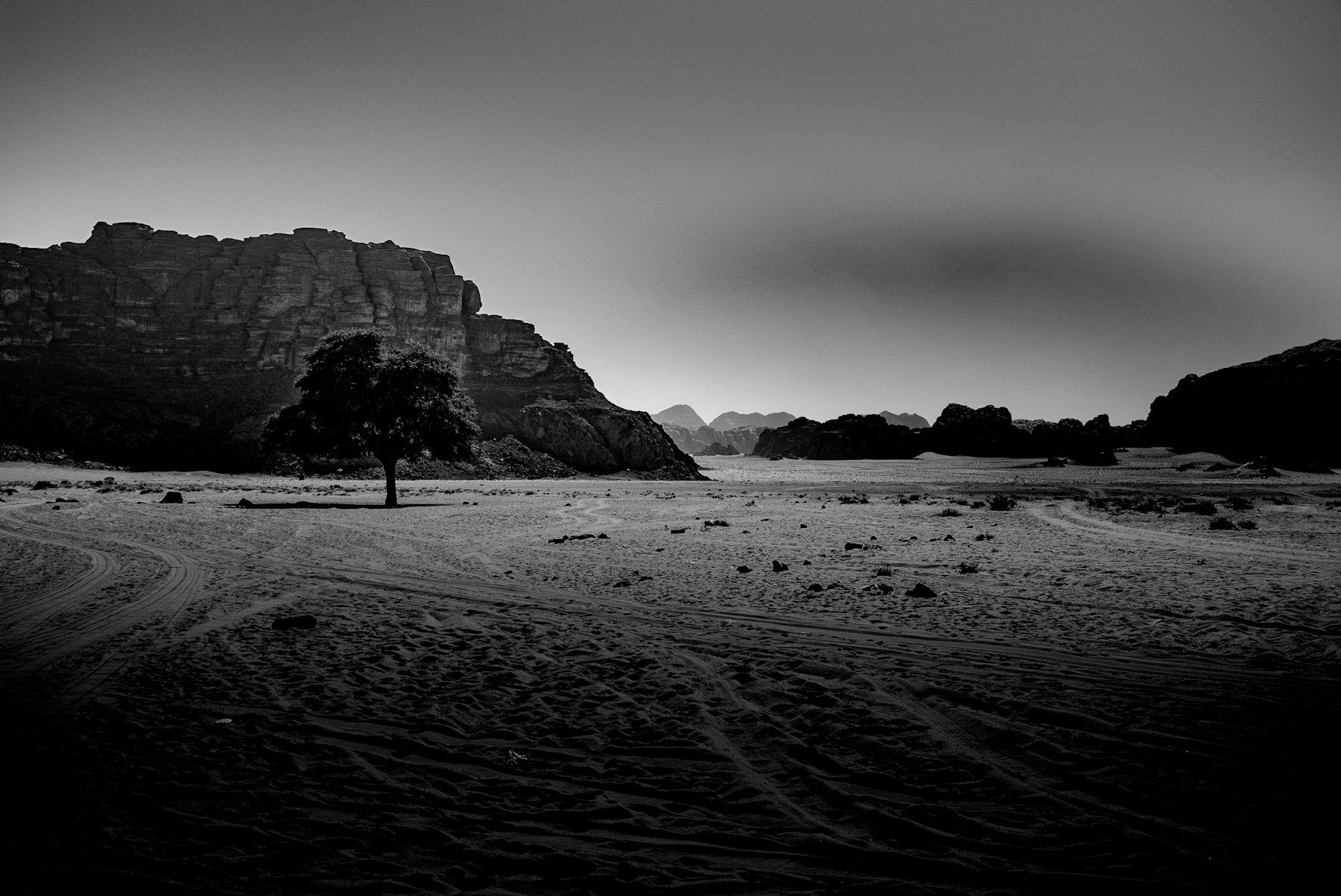
The stark contrast of black-and-white photography often reveals the raw, unfiltered essence of a landscape. In this striking monochrome image, we are presented with a vast desert valley, characterized by towering, weathered rock formations, a sandy floor marked by vehicle tracks, and a solitary tree standing resiliently against the elements. This landscape is instantly recognizable as Wadi Rum, also known as the Valley of the Moon, located in southern Jordan.
While the photograph captures a moment of quiet isolation, this region is steeped in thousands of years of human history, serving as a vital crossroads for ancient civilizations, traders, and historical figures.
The Visual Narrative: Resilience in the Desert
At first glance, the photograph highlights the dramatic geological features of Wadi Rum. The massive sandstone and granite cliffs rise abruptly from the desert floor, shaped by millions of years of wind and water erosion.
In the lower-left quadrant, a single, leafy tree stands as a powerful symbol of life surviving in a hyper-arid environment. The presence of tire tracks winding through the sand introduces a modern element, indicating how contemporary travelers navigate this ancient terrain. The high-contrast black-and-white medium emphasizes the textures of the sand, the ruggedness of the rock faces, and the vast expanse of the sky, creating a timeless atmosphere.
Ancient Crossroads: Nabataeans and Thamudic Tribes
To understand the historical significance of the landscape in the photo, one must look back thousands of years. Wadi Rum has been inhabited since prehistoric times. Various cultures, including the Nabataeans—the master builders responsible for the ancient city of Petra—left their mark here.
The valley served as a crucial route for merchant caravans transporting spices, incense, and valuable goods between the Arabian Peninsula and the Mediterranean. Throughout the canyons of Wadi Rum, thousands of rock inscriptions and petroglyphs can still be found. These inscriptions, written in Thamudic, Nabataean, and early Arabic scripts, document ancient journeys, religious practices, and the fauna that once roamed the region.
The Era of Lawrence of Arabia and the Arab Revolt
In modern history, the landscape of Wadi Rum is inextricably linked to the events of World War I and the Arab Revolt (1916–1918). British officer T.E. Lawrence, widely known as „Lawrence of Arabia,“ used the valley as a strategic base of operations.
Along with Sharif Faisal Bin Al-Hussein, Lawrence coordinated guerrilla warfare tactics against the Ottoman forces from these very canyons. The rugged topography shown in the photograph provided natural fortifications and hiding places, making it a key tactical location during the conflict. Lawrence famously described the landscape of Wadi Rum in his autobiographical account, *Seven Pillars of Wisdom*, cementing the desert’s place in global literary and historical consciousness.
A UNESCO World Heritage Site
Today, the historical and ecological importance of this landscape is internationally recognized. In 2011, Wadi Rum was designated a UNESCO World Heritage Site. It is classified as a mixed natural and cultural site, acknowledging not only its spectacular desert landforms but also its 12,000 years of human occupation.
The photograph captures the enduring spirit of this protected wilderness. While modern tourism brings visitors from around the world to trace the steps of ancient nomads and historical figures, the desert itself remains largely unchanged—a silent monument to the passage of time.
While the photograph captures a moment of quiet isolation, this region is steeped in thousands of years of human history, serving as a vital crossroads for ancient civilizations, traders, and historical figures.
The Visual Narrative: Resilience in the Desert
At first glance, the photograph highlights the dramatic geological features of Wadi Rum. The massive sandstone and granite cliffs rise abruptly from the desert floor, shaped by millions of years of wind and water erosion.
In the lower-left quadrant, a single, leafy tree stands as a powerful symbol of life surviving in a hyper-arid environment. The presence of tire tracks winding through the sand introduces a modern element, indicating how contemporary travelers navigate this ancient terrain. The high-contrast black-and-white medium emphasizes the textures of the sand, the ruggedness of the rock faces, and the vast expanse of the sky, creating a timeless atmosphere.
Ancient Crossroads: Nabataeans and Thamudic Tribes
To understand the historical significance of the landscape in the photo, one must look back thousands of years. Wadi Rum has been inhabited since prehistoric times. Various cultures, including the Nabataeans—the master builders responsible for the ancient city of Petra—left their mark here.
The valley served as a crucial route for merchant caravans transporting spices, incense, and valuable goods between the Arabian Peninsula and the Mediterranean. Throughout the canyons of Wadi Rum, thousands of rock inscriptions and petroglyphs can still be found. These inscriptions, written in Thamudic, Nabataean, and early Arabic scripts, document ancient journeys, religious practices, and the fauna that once roamed the region.
The Era of Lawrence of Arabia and the Arab Revolt
In modern history, the landscape of Wadi Rum is inextricably linked to the events of World War I and the Arab Revolt (1916–1918). British officer T.E. Lawrence, widely known as „Lawrence of Arabia,“ used the valley as a strategic base of operations.
Along with Sharif Faisal Bin Al-Hussein, Lawrence coordinated guerrilla warfare tactics against the Ottoman forces from these very canyons. The rugged topography shown in the photograph provided natural fortifications and hiding places, making it a key tactical location during the conflict. Lawrence famously described the landscape of Wadi Rum in his autobiographical account, *Seven Pillars of Wisdom*, cementing the desert’s place in global literary and historical consciousness.
A UNESCO World Heritage Site
Today, the historical and ecological importance of this landscape is internationally recognized. In 2011, Wadi Rum was designated a UNESCO World Heritage Site. It is classified as a mixed natural and cultural site, acknowledging not only its spectacular desert landforms but also its 12,000 years of human occupation.
The photograph captures the enduring spirit of this protected wilderness. While modern tourism brings visitors from around the world to trace the steps of ancient nomads and historical figures, the desert itself remains largely unchanged—a silent monument to the passage of time.
Schreibe einen Kommentar