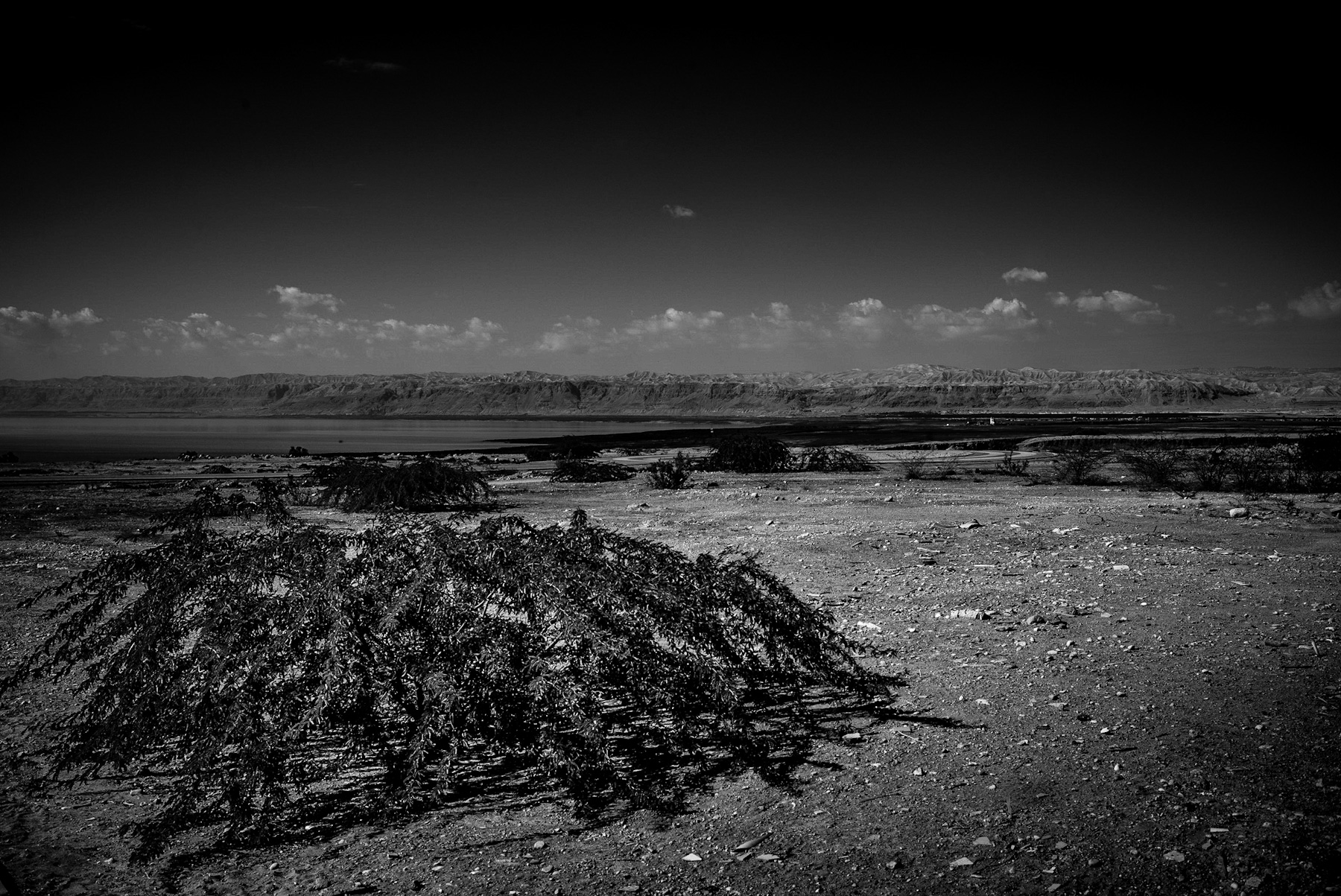
The stark, monochromatic landscape captured in this photograph evokes a profound sense of timelessness and raw beauty. Dominating the foreground is a sprawling, low-lying shrub, its intricate branches casting long, dramatic shadows across the arid, rocky terrain. This immediate visual anchors the viewer in a desolate yet captivating environment, hinting at stories etched deep within the earth.
Beyond the foreground vegetation, the eye is drawn to the serene expanse of a vast body of water, its surface reflecting the subtle light under a partly clouded sky. This expansive lake, appearing calm and almost ethereal in monochrome, is framed by rugged, ancient mountain ranges that stretch across the horizon. Their contours, softened by distance yet still commanding attention, speak of geological processes spanning eons. The minimalist palette of black, white, and myriad shades of grey accentuates the textural contrasts – the rough, gravelly ground, the smooth, reflective water, and the craggy, layered peaks. The scattered clouds across the dark, vast sky add a dynamic element, preventing the scene from being entirely static and hinting at the immense scale of the natural world. A discernible road or path subtly traces the water’s edge in the midground, a rare and understated human imprint on an otherwise wild and seemingly untouched expanse.
This iconic vista is unmistakably that of the Dead Sea basin, a region steeped in millennia of human history and legend. Historically, this area has been a crucible of ancient civilizations and significant biblical events. The dramatic mountains in the background, likely the Judean Desert highlands or the mountains of Moab, have witnessed countless tales of prophets, kings, and empires. From the ancient settlements of Qumran, where the Dead Sea Scrolls were discovered, to the formidable fortress of Masada, a symbol of Jewish resistance against the Roman Empire, the very stones of this landscape resonate with echoes of the past. The biblical narratives of Sodom and Gomorrah are often associated with this unique geographical depression, further imbuing the area with a profound sense of historical and spiritual weight that continues to fascinate scholars and pilgrims alike.
Beyond its rich historical narrative, the Dead Sea itself represents a marvel of natural history. As the lowest point on Earth, its hypersaline waters support a unique, albeit limited, ecosystem. The hardy vegetation visible in the foreground, likely a species adapted to extreme desert conditions, is a testament to the harsh realities of the surrounding environment. It demonstrates nature’s remarkable resilience in an area where fresh water is scarce and temperatures can be unforgiving. This interplay between barrenness and life, scarcity and survival, is a constant and compelling theme in the Dead Sea region, offering profound insights into ecological adaptation.
The choice of black and white photography for this scene profoundly amplifies its timeless quality, stripping away the potential distractions of color to reveal the fundamental forms, textures, and stark realities of the land. It underscores the enduring nature of this unique landscape, which has remained largely unchanged for centuries, even as the ebb and flow of human history unfolded around its shores. Today, the Dead Sea faces significant environmental challenges, with its waters receding at an alarming rate due to human intervention and climate change. Yet, powerful photographs like this serve as a poignant reminder of its majestic beauty and profound historical significance, urging us to appreciate and actively preserve this irreplaceable natural and cultural treasure for future generations.
Ultimately, this photograph is more than just a visual record; it is an invitation to contemplate the vast sweep of time, the resilience of nature, and the indelible marks left by human endeavor on one of the planet’s most extraordinary landscapes.
Beyond the foreground vegetation, the eye is drawn to the serene expanse of a vast body of water, its surface reflecting the subtle light under a partly clouded sky. This expansive lake, appearing calm and almost ethereal in monochrome, is framed by rugged, ancient mountain ranges that stretch across the horizon. Their contours, softened by distance yet still commanding attention, speak of geological processes spanning eons. The minimalist palette of black, white, and myriad shades of grey accentuates the textural contrasts – the rough, gravelly ground, the smooth, reflective water, and the craggy, layered peaks. The scattered clouds across the dark, vast sky add a dynamic element, preventing the scene from being entirely static and hinting at the immense scale of the natural world. A discernible road or path subtly traces the water’s edge in the midground, a rare and understated human imprint on an otherwise wild and seemingly untouched expanse.
This iconic vista is unmistakably that of the Dead Sea basin, a region steeped in millennia of human history and legend. Historically, this area has been a crucible of ancient civilizations and significant biblical events. The dramatic mountains in the background, likely the Judean Desert highlands or the mountains of Moab, have witnessed countless tales of prophets, kings, and empires. From the ancient settlements of Qumran, where the Dead Sea Scrolls were discovered, to the formidable fortress of Masada, a symbol of Jewish resistance against the Roman Empire, the very stones of this landscape resonate with echoes of the past. The biblical narratives of Sodom and Gomorrah are often associated with this unique geographical depression, further imbuing the area with a profound sense of historical and spiritual weight that continues to fascinate scholars and pilgrims alike.
Beyond its rich historical narrative, the Dead Sea itself represents a marvel of natural history. As the lowest point on Earth, its hypersaline waters support a unique, albeit limited, ecosystem. The hardy vegetation visible in the foreground, likely a species adapted to extreme desert conditions, is a testament to the harsh realities of the surrounding environment. It demonstrates nature’s remarkable resilience in an area where fresh water is scarce and temperatures can be unforgiving. This interplay between barrenness and life, scarcity and survival, is a constant and compelling theme in the Dead Sea region, offering profound insights into ecological adaptation.
The choice of black and white photography for this scene profoundly amplifies its timeless quality, stripping away the potential distractions of color to reveal the fundamental forms, textures, and stark realities of the land. It underscores the enduring nature of this unique landscape, which has remained largely unchanged for centuries, even as the ebb and flow of human history unfolded around its shores. Today, the Dead Sea faces significant environmental challenges, with its waters receding at an alarming rate due to human intervention and climate change. Yet, powerful photographs like this serve as a poignant reminder of its majestic beauty and profound historical significance, urging us to appreciate and actively preserve this irreplaceable natural and cultural treasure for future generations.
Ultimately, this photograph is more than just a visual record; it is an invitation to contemplate the vast sweep of time, the resilience of nature, and the indelible marks left by human endeavor on one of the planet’s most extraordinary landscapes.
Schreibe einen Kommentar