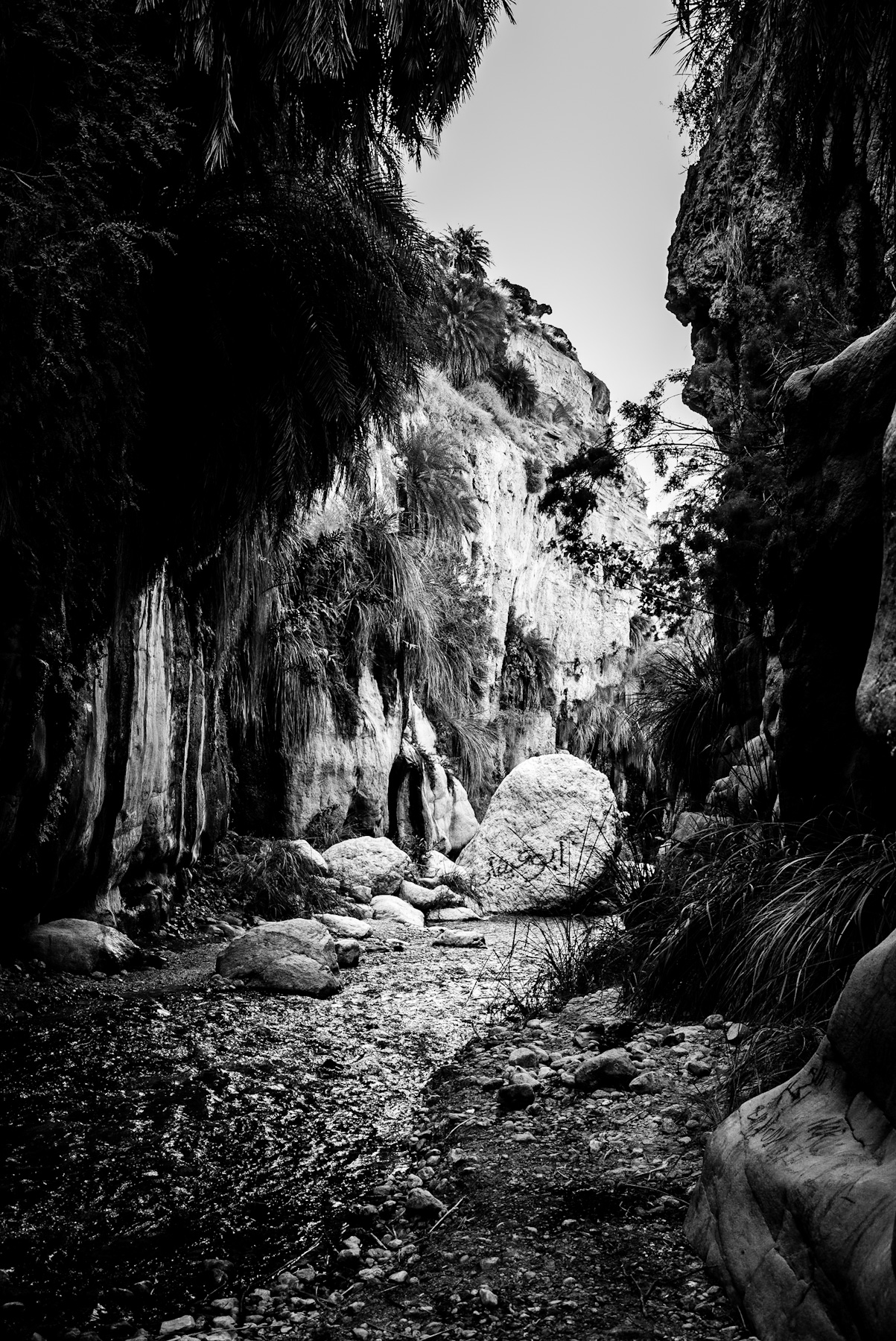
The monochromatic lens captures a dramatic natural gorge, a testament to geological forces and the persistent flow of water in an arid environment. This striking image reveals a deeply carved wadi, its rugged rock walls rising steeply, framing a narrow sliver of sky above. The scene is dominated by the interplay of light and shadow, characteristic of stark desert landscapes under a bright sun, rendered timeless through the black and white medium.
The floor of the wadi is a rocky bed, likely a seasonal watercourse, strewn with various sized boulders and coarse gravel. Clinging precariously to the almost vertical cliffs are hardy date palms and other resilient, long-leafed vegetation, their fronds cascading downwards, creating a verdant contrast against the pale rock. These plants are indicative of a consistent, albeit often subterranean, water source, transforming this narrow passage into a vital lifeline. The textures are rich and varied, from the smooth, worn surfaces of river stones to the intricate patterns of rock erosion and the feathery details of the foliage.
Historically, such wadis have been indispensable arteries in the vast, often formidable desert landscapes of the Middle East and North Africa. Far from being mere geographical features, they represent ancient pathways of survival and connection. For millennia, these natural corridors provided essential water, shelter, and navigable routes for nomadic tribes, traders, and explorers. They facilitated the movement of goods, ideas, and cultures across formidable distances, serving as critical links in historical trade networks like the Incense Route or various trans-Saharan paths. Civilizations often emerged and thrived around these rare sources of sustenance.
Within this ancient tableau, a modern human imprint is visible: graffiti etched onto a prominent boulder in the foreground, appearing to be in Arabic script. This detail adds a contemporary layer to the historical narrative, underscoring the enduring human connection to these landscapes. It mirrors a long tradition of leaving marks, from ancient petroglyphs in similar regions to modern expressions. This act of inscription, whether recent or decades old, speaks to the continuous human interaction with these profound natural spaces, bridging the gap between ancient travelers and present-day visitors.
The image, therefore, is more than a simple landscape; it is a visual portal to a rich tapestry of natural history and human endeavor. It encapsulates the resilience of life in challenging environments and the timeless allure of places where water carves its way through stone. Exploring such wadis today offers a tangible link to the past, inviting contemplation of the journeys taken, the lives sustained, and the stories embedded within these enduring rock formations and vital oases.
The floor of the wadi is a rocky bed, likely a seasonal watercourse, strewn with various sized boulders and coarse gravel. Clinging precariously to the almost vertical cliffs are hardy date palms and other resilient, long-leafed vegetation, their fronds cascading downwards, creating a verdant contrast against the pale rock. These plants are indicative of a consistent, albeit often subterranean, water source, transforming this narrow passage into a vital lifeline. The textures are rich and varied, from the smooth, worn surfaces of river stones to the intricate patterns of rock erosion and the feathery details of the foliage.
Historically, such wadis have been indispensable arteries in the vast, often formidable desert landscapes of the Middle East and North Africa. Far from being mere geographical features, they represent ancient pathways of survival and connection. For millennia, these natural corridors provided essential water, shelter, and navigable routes for nomadic tribes, traders, and explorers. They facilitated the movement of goods, ideas, and cultures across formidable distances, serving as critical links in historical trade networks like the Incense Route or various trans-Saharan paths. Civilizations often emerged and thrived around these rare sources of sustenance.
Within this ancient tableau, a modern human imprint is visible: graffiti etched onto a prominent boulder in the foreground, appearing to be in Arabic script. This detail adds a contemporary layer to the historical narrative, underscoring the enduring human connection to these landscapes. It mirrors a long tradition of leaving marks, from ancient petroglyphs in similar regions to modern expressions. This act of inscription, whether recent or decades old, speaks to the continuous human interaction with these profound natural spaces, bridging the gap between ancient travelers and present-day visitors.
The image, therefore, is more than a simple landscape; it is a visual portal to a rich tapestry of natural history and human endeavor. It encapsulates the resilience of life in challenging environments and the timeless allure of places where water carves its way through stone. Exploring such wadis today offers a tangible link to the past, inviting contemplation of the journeys taken, the lives sustained, and the stories embedded within these enduring rock formations and vital oases.
Schreibe einen Kommentar