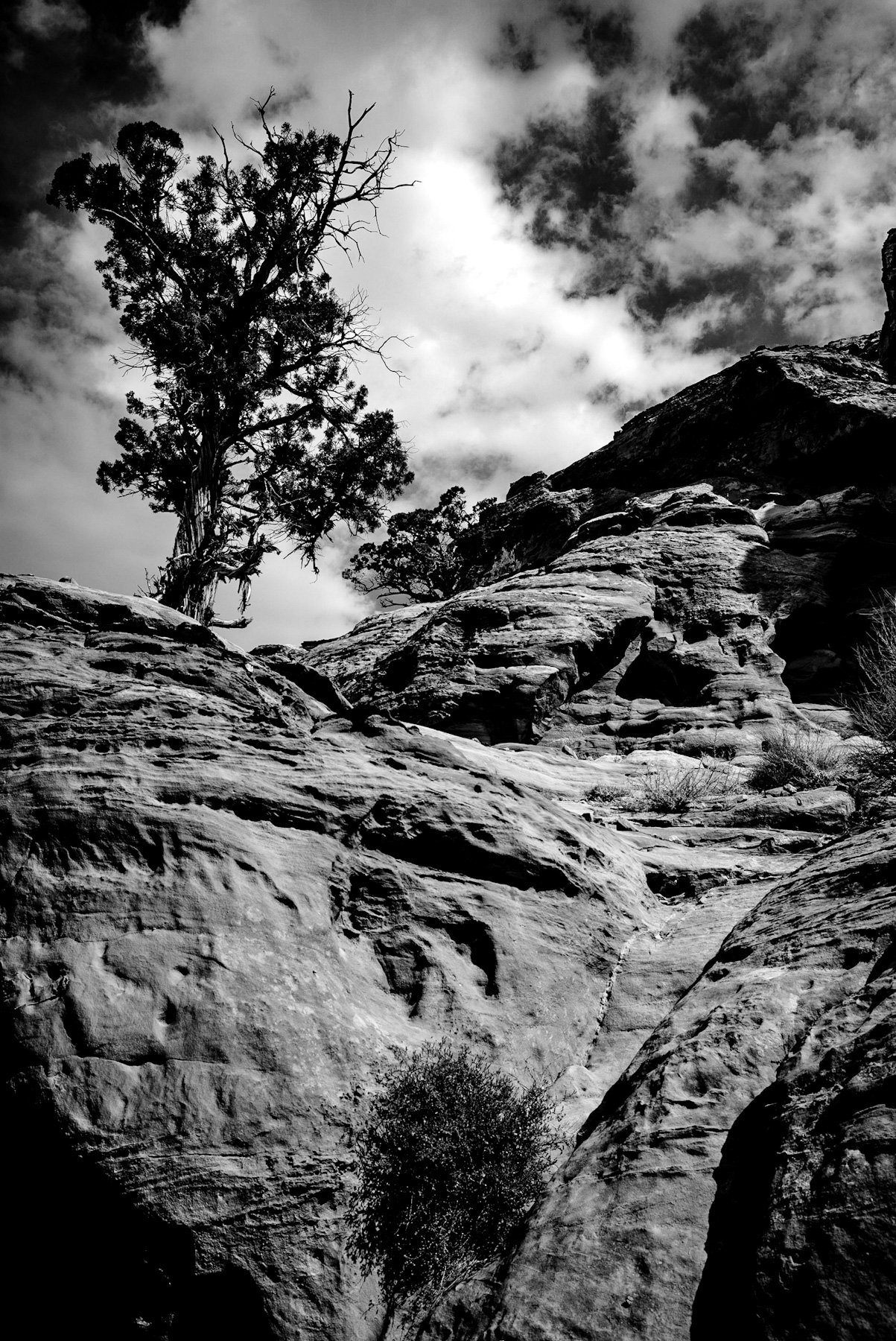
Monochrome photography has a unique ability to strip away distractions, revealing the raw texture, form, and structural integrity of the natural world. The featured image captures a stark, high-contrast desert landscape, dominated by weathered sandstone formations, a dramatic sky, and a solitary, resilient tree clinging to the rocky edge. This visual narrative isn’t just a study in light and shadow; it’s a profound testament to millions of years of geological evolution and the enduring power of nature.
The Visual Story: Contrast and Unyielding Texture
In this captivating black and white photograph, we’re drawn in by a low-angle perspective that magnifies the sheer monumentality of the rock formations. The foreground and midground reveal deeply eroded, layered sandstone, its surface a canvas of pits, grooves, and fractures. These intricate textures whisper tales of centuries-long exposure to relentless wind, water, and drastic temperature shifts.
Perched precariously on the upper-left ridge stands a weathered conifer – likely a tenacious juniper or pine perfectly adapted to arid environments. Its gnarled trunk and sparse foliage create a striking silhouette against a turbulent sky, alive with high-contrast cumulus clouds. This masterful composition weaves a powerful tension between the static permanence of ancient stone and the dynamic, fleeting nature of the sky and the tenacious flora.
Deep Roots: The Ancient Origins of Sandstone Giants
The majestic rock structures in the image are hallmarks of sedimentary formations found across arid regions, particularly the iconic American Southwest (think Utah, Nevada, and Arizona). These incredible formations typically trace their lineage back to the Mesozoic Era, specifically the Jurassic period – a staggering 150 to 200 million years ago.
During that ancient era, vast, sweeping deserts dominated these landscapes. Over countless millennia, wind-blown sand dunes piled up in colossal layers. Through a process called lithification, immense pressure from overlying sediments combined with mineral-rich groundwater, cementing these sand grains together. This powerful transformation birthed the solid rock we now know, often famously referred to as Navajo Sandstone.
Notice the distinct horizontal layering visible in the photograph? These are the fossilized cross-bedding patterns of those ancient dunes, perfectly preserving the direction of prehistoric winds – a geological compass pointing to the past.
Nature’s Sculptors: The Relentless Dance of Erosion
The breathtaking landscape we see today is a masterpiece sculpted by two powerful forces: tectonic uplift followed by relentless erosion. Millions of years after the sandstone solidified, dramatic tectonic activity gradually elevated the entire region, exposing these deep rock layers to the elements.
Even in arid climates where water is scarce, it remains the primary sculptor. Rare but incredibly intense flash floods dramatically carve deep canyons and meticulously smooth rock surfaces. Simultaneously, a symphony of other forces plays its part: wind erosion, the silent power of frost wedging (where freezing water expands in cracks), and subtle chemical weathering all tirelessly work to break down the sandstone, meticulously creating the rugged, pitted surfaces so strikingly captured in this photograph.
Life’s Tenacity: Survival in Extreme Environments
The solitary tree, a beacon of life in this harsh terrain, beautifully illustrates the ecological triumph of survival in extreme environments. Trees thriving in these rocky landscapes, like the resilient Utah Juniper (*Juniperus osteosperma*), have evolved extraordinary adaptations to persist with minimal water.
These incredible plants develop dual root systems: extensive, shallow networks that spread wide to expertly capture every drop of rainfall, alongside deep taproots designed to access precious moisture stored far within rock fractures. Their remarkably slow growth rates are key to their longevity, allowing them to endure for centuries – with some ancient specimens living for over a thousand years. Historically, indigenous populations revered and relied on these resilient trees for vital resources like fuel, medicine, and construction. They are, without doubt, integral components of both the natural and profound human history of these majestic regions.
The Visual Story: Contrast and Unyielding Texture
In this captivating black and white photograph, we’re drawn in by a low-angle perspective that magnifies the sheer monumentality of the rock formations. The foreground and midground reveal deeply eroded, layered sandstone, its surface a canvas of pits, grooves, and fractures. These intricate textures whisper tales of centuries-long exposure to relentless wind, water, and drastic temperature shifts.
Perched precariously on the upper-left ridge stands a weathered conifer – likely a tenacious juniper or pine perfectly adapted to arid environments. Its gnarled trunk and sparse foliage create a striking silhouette against a turbulent sky, alive with high-contrast cumulus clouds. This masterful composition weaves a powerful tension between the static permanence of ancient stone and the dynamic, fleeting nature of the sky and the tenacious flora.
Deep Roots: The Ancient Origins of Sandstone Giants
The majestic rock structures in the image are hallmarks of sedimentary formations found across arid regions, particularly the iconic American Southwest (think Utah, Nevada, and Arizona). These incredible formations typically trace their lineage back to the Mesozoic Era, specifically the Jurassic period – a staggering 150 to 200 million years ago.
During that ancient era, vast, sweeping deserts dominated these landscapes. Over countless millennia, wind-blown sand dunes piled up in colossal layers. Through a process called lithification, immense pressure from overlying sediments combined with mineral-rich groundwater, cementing these sand grains together. This powerful transformation birthed the solid rock we now know, often famously referred to as Navajo Sandstone.
Notice the distinct horizontal layering visible in the photograph? These are the fossilized cross-bedding patterns of those ancient dunes, perfectly preserving the direction of prehistoric winds – a geological compass pointing to the past.
Nature’s Sculptors: The Relentless Dance of Erosion
The breathtaking landscape we see today is a masterpiece sculpted by two powerful forces: tectonic uplift followed by relentless erosion. Millions of years after the sandstone solidified, dramatic tectonic activity gradually elevated the entire region, exposing these deep rock layers to the elements.
Even in arid climates where water is scarce, it remains the primary sculptor. Rare but incredibly intense flash floods dramatically carve deep canyons and meticulously smooth rock surfaces. Simultaneously, a symphony of other forces plays its part: wind erosion, the silent power of frost wedging (where freezing water expands in cracks), and subtle chemical weathering all tirelessly work to break down the sandstone, meticulously creating the rugged, pitted surfaces so strikingly captured in this photograph.
Life’s Tenacity: Survival in Extreme Environments
The solitary tree, a beacon of life in this harsh terrain, beautifully illustrates the ecological triumph of survival in extreme environments. Trees thriving in these rocky landscapes, like the resilient Utah Juniper (*Juniperus osteosperma*), have evolved extraordinary adaptations to persist with minimal water.
These incredible plants develop dual root systems: extensive, shallow networks that spread wide to expertly capture every drop of rainfall, alongside deep taproots designed to access precious moisture stored far within rock fractures. Their remarkably slow growth rates are key to their longevity, allowing them to endure for centuries – with some ancient specimens living for over a thousand years. Historically, indigenous populations revered and relied on these resilient trees for vital resources like fuel, medicine, and construction. They are, without doubt, integral components of both the natural and profound human history of these majestic regions.
Schreibe einen Kommentar