Kategorie: Travel

  • Normandy’s Enduring Majesty: A Monochrome Glimpse into Coastal History

    Normandy’s Enduring Majesty: A Monochrome Glimpse into Coastal History

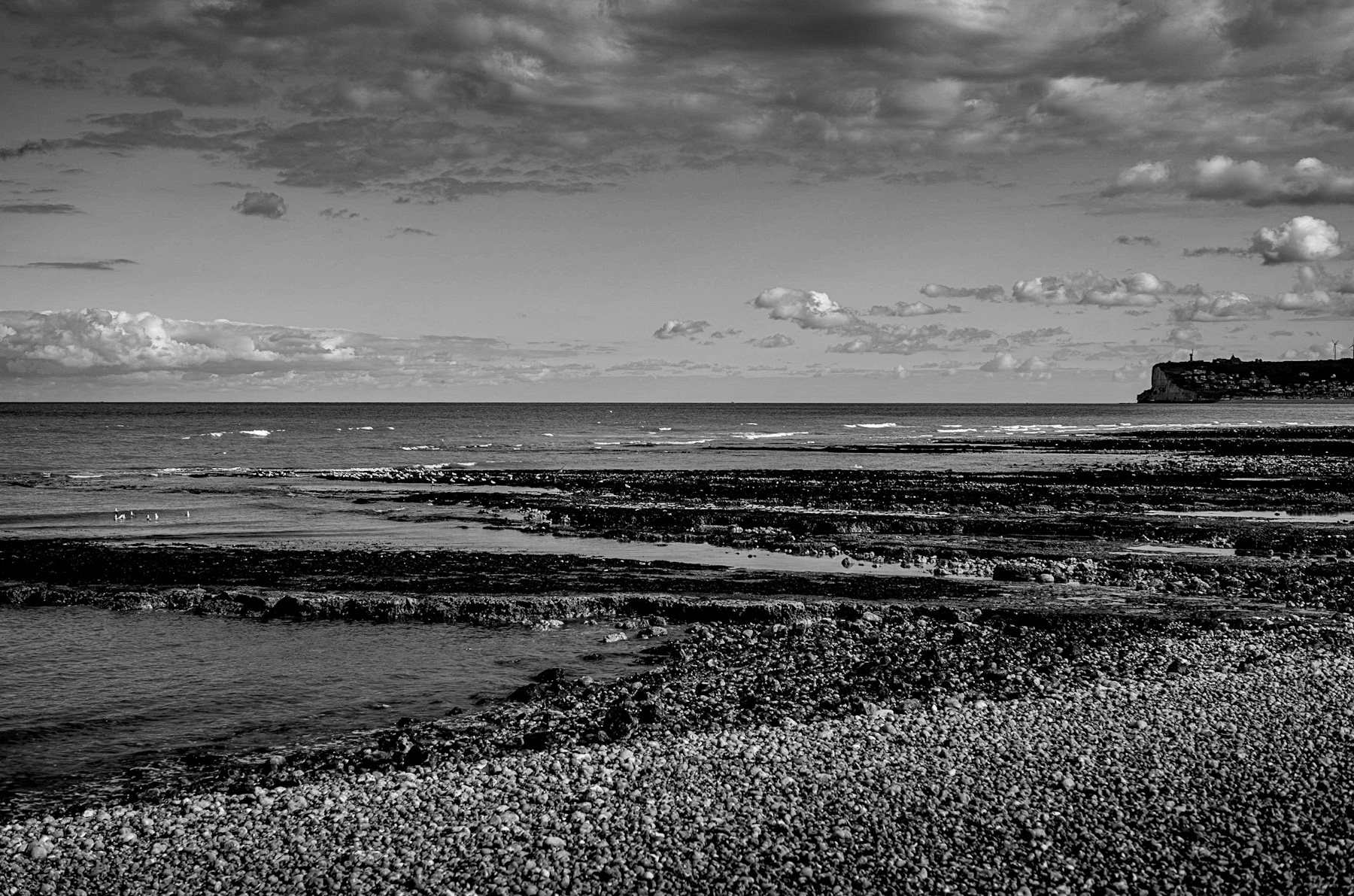
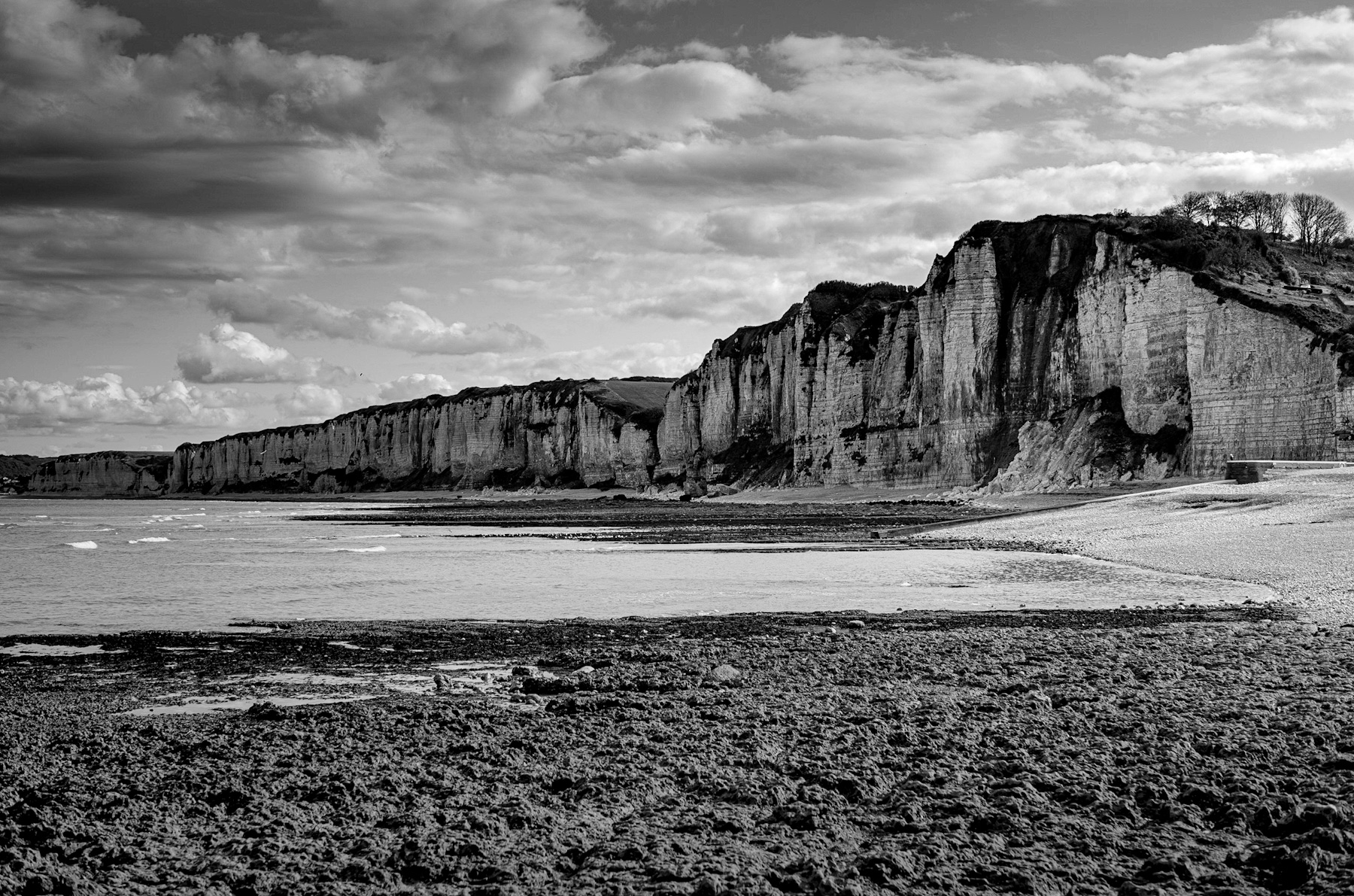
    The photograph presents a commanding vista of a rugged coastline, rendered in stark black and white. Towering chalk cliffs dominate the horizon, their vertical striations and eroded surfaces testifying to millennia of geological processes. Below, a wide expanse of beach transitions from a pebbled shoreline to a darker, perhaps seaweed-strewn or rocky foreground, meeting the gently undulating waves of the sea. The sky, filled with an array of clouds ranging from luminous whites to deep greys, adds dramatic depth, emphasizing the raw power and timelessness of this natural spectacle.
    ### The Majestic Coastal Landscape
    This captured scene exemplifies the dramatic beauty characteristic of the **Normandy coast**, particularly the **Pays de Caux** region in France. The monumental **chalk cliffs**, formed over millions of years from ancient marine sediments, rise abruptly from the English Channel, presenting a formidable natural barrier. Their pale, almost luminous rock faces contrast sharply with the dark vegetation clinging to their summits and slopes, creating a compelling visual texture. The expansive beach below, exposed at low tide, reveals a diverse terrain of shingle, sand, and darker, rugged areas, hinting at a rich intertidal ecosystem. The rhythmic ebb and flow of the ocean at the water’s edge suggests a perpetual interaction between land and sea, a constant sculptor of this enduring landscape. The monochromatic palette accentuates the textures and forms, stripping away the distraction of color to reveal the fundamental grandeur of the environment. This **coastal landscape** serves as a powerful subject for **black and white photography**, highlighting its dramatic contours and geological features.
    ### Echoes of History: The Atlantic Wall
    Beyond its natural splendor, this specific type of **French cliffs** landscape carries profound historical weight, particularly concerning **World War II**. The **Normandy cliffs** were integral to the **Atlantic Wall**, Hitler’s extensive system of coastal defenses built to repel an Allied invasion. While the main D-Day landings occurred further west on the sandy beaches, the entire Normandy coastline, including these formidable chalk cliffs, was heavily fortified. German forces established observation posts, gun emplacements, and bunkers both atop and within these cliffs, leveraging the natural topography for strategic advantage. The sheer verticality and challenging terrain made these sections of the coast formidable obstacles, influencing Allied invasion strategies. The landscape depicted here, therefore, stands as a silent testament to a pivotal period in global history, its **geological formations** having once been a critical component in the defense and eventual liberation of Europe.
    ### A Landscape of Resilience and Reflection
    The enduring presence of these **European cliffs** also resonates with broader themes of resilience and natural power. Geologically, they represent millions of years of earth’s history, continuously shaped by wind and waves. Historically, they have witnessed countless human endeavors, from ancient maritime trade routes to modern-day tourism. Artists like Claude Monet found endless inspiration in the shifting light and dramatic forms of these very cliffs, immortalizing them in their works. Today, this coastal stretch remains a significant draw for visitors seeking both natural beauty and a connection to profound historical narratives. The black and white rendering of the photograph underscores this sense of timelessness, inviting contemplation on the natural world’s enduring presence amidst the transient narratives of human history.
    This image of the **Normandy coastline** is more than a scenic view; it is a layered narrative. It speaks of deep geological time, the relentless forces of nature, and the indelible marks of **WWII history**. The dramatic cliffs, the expansive beach, and the atmospheric sky combine to create a powerful visual statement, reminding observers of the profound stories embedded within our world’s landscapes.
  • Normandy’s Enduring Majesty: A Journey Through Étretat’s Iconic Chalk Cliffs

    Normandy’s Enduring Majesty: A Journey Through Étretat’s Iconic Chalk Cliffs

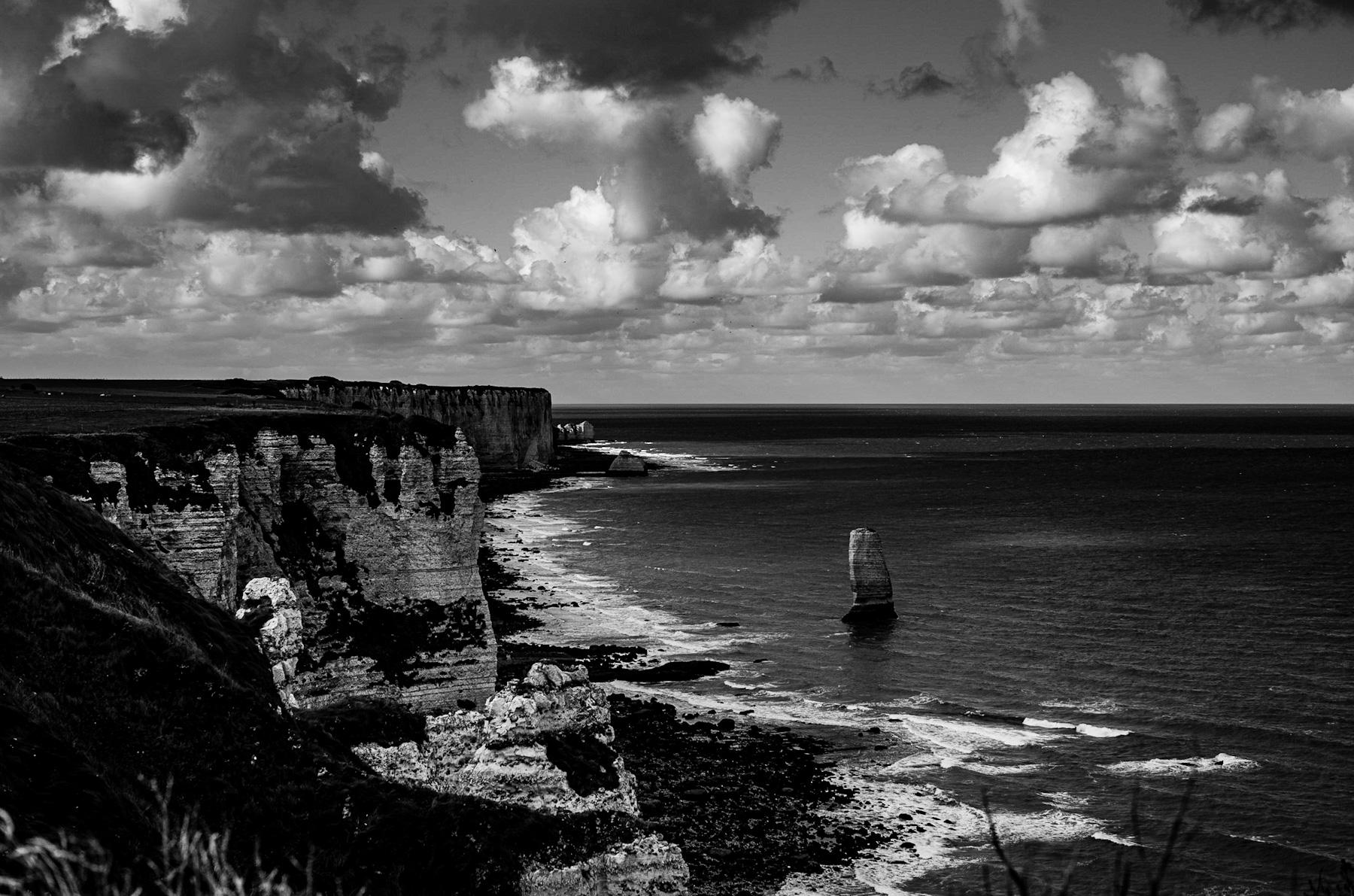
    The photograph captures a dramatic expanse of the **Normandy coast**, specifically showcasing the renowned **Étretat cliffs**. Rendered in monochrome, the image profoundly emphasizes the raw power and intricate textures of this natural wonder. A towering **sea stack**, often referred to as L’Aiguille (The Needle), stands sentinel against the vast ocean, a testament to relentless **coastal erosion**. The scene is one of profound natural beauty, where the land meets the sea in an epic, ongoing geological struggle, inviting contemplation on the forces that shape our world.
    The choice of **black and white photography** profoundly enhances the visual narrative, accentuating the stark contrasts and deep shadows that define this rugged coastline. The formidable, stratified **chalk cliffs** dominate the left side of the frame, their ancient layers, etched with vertical fissures and horizontal bands, revealing the passage of geological time. Below, the intertidal zone is a chaotic yet beautiful mosaic of dark, wave-battered rocks and the frothing white surf, where the English Channel’s rhythmic embrace continuously reshapes the very edge of the continent. Overhead, a dynamic sky filled with voluminous, textured clouds mirrors the drama below, casting an ethereal light and adding immense depth and mood to the overall composition.
    Geologically, the **Étretat cliffs** are a marvel of the Upper Cretaceous period, primarily composed of chalk. This soft, porous rock has been sculpted over millennia by the powerful forces of the English Channel. The iconic natural arches, such as the Porte d’Aval (not prominently in the immediate foreground but part of this famous stretch), and isolated **sea stacks** like L’Aiguille, are erosional remnants, telling a vivid story of continuous natural transformation. They serve as a prime illustration of the Earth’s dynamic processes, showcasing how landforms evolve under the relentless influence of water and wind.
    Beyond their geological significance, these cliffs hold a cherished place in cultural history. The dramatic vistas of Étretat have long served as profound **artistic inspiration**, particularly for the **Impressionist painters**. Artists like **Claude Monet**, Gustave Courbet, and Eugène Boudin frequently visited and immortalized these landscapes on canvas, capturing the changing light and moods of the coast with their revolutionary techniques. Their works brought international recognition to Étretat’s unique beauty. Furthermore, the site gained enduring literary fame through Maurice Leblanc’s **Arsène Lupin** series, where „L’Aiguille Creuse“ (The Hollow Needle) plays a central, mysterious role, weaving tales of adventure and intrigue directly into the very fabric of the landscape.
    The **Étretat cliffs** remain a powerful draw, captivating visitors and **landscape photographers** who seek to capture their raw essence. They offer a profound connection to both geological deep time and a rich tapestry of human history. This iconic stretch of the **Normandy coast** stands as a testament to nature’s relentless artistry and resilience, a place where the echoes of ancient seas, the vibrant strokes of artistic genius, and the captivating threads of literary intrigue converge. This monochrome image not only presents a stunning natural panorama but also serves as a poignant invitation to explore the enduring legacy of a landscape that has inspired and awed generations.
  • Timeless Tides: Unveiling the Historical Echoes of a Black and White Seascape

    Timeless Tides: Unveiling the Historical Echoes of a Black and White Seascape

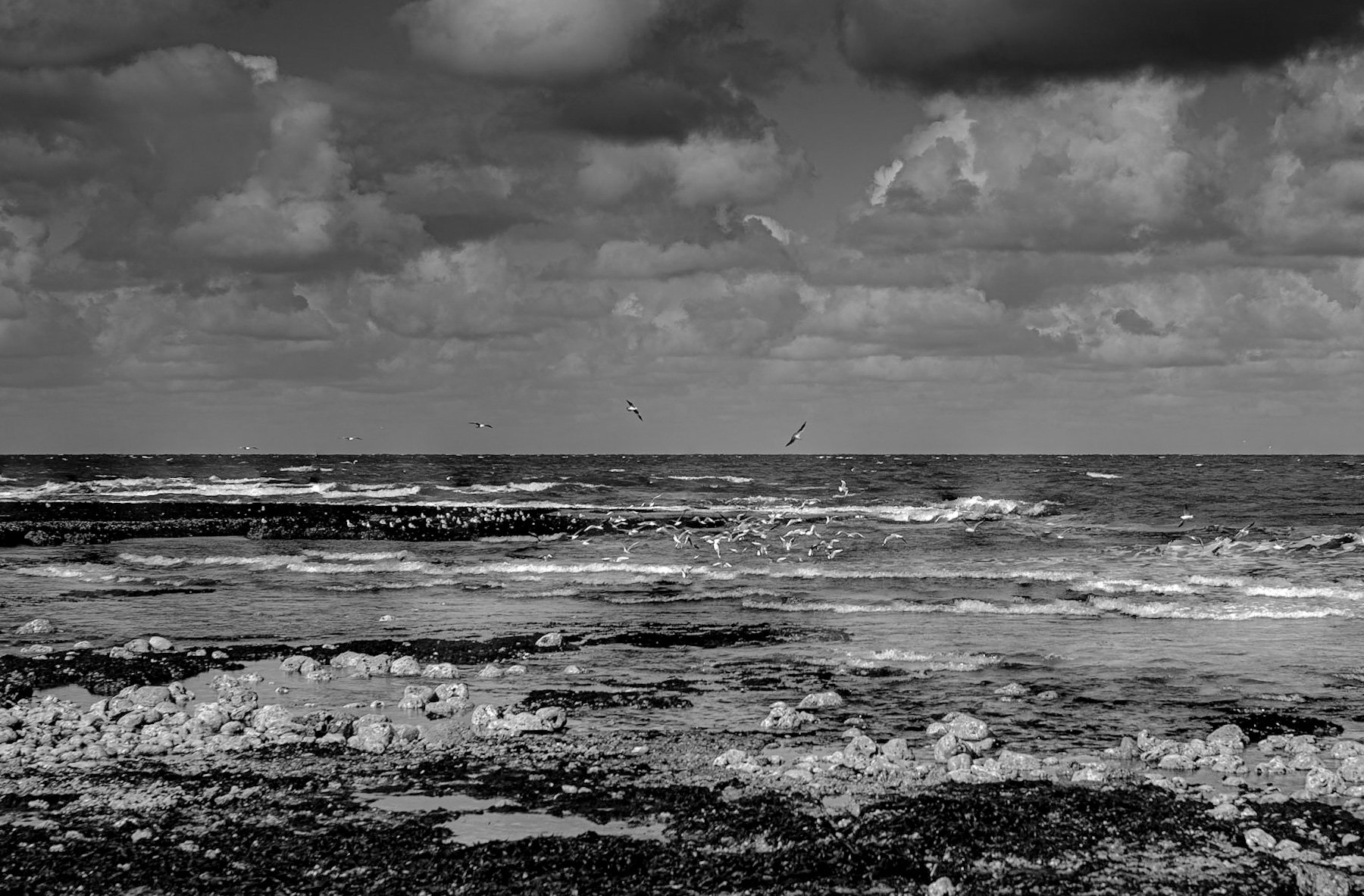
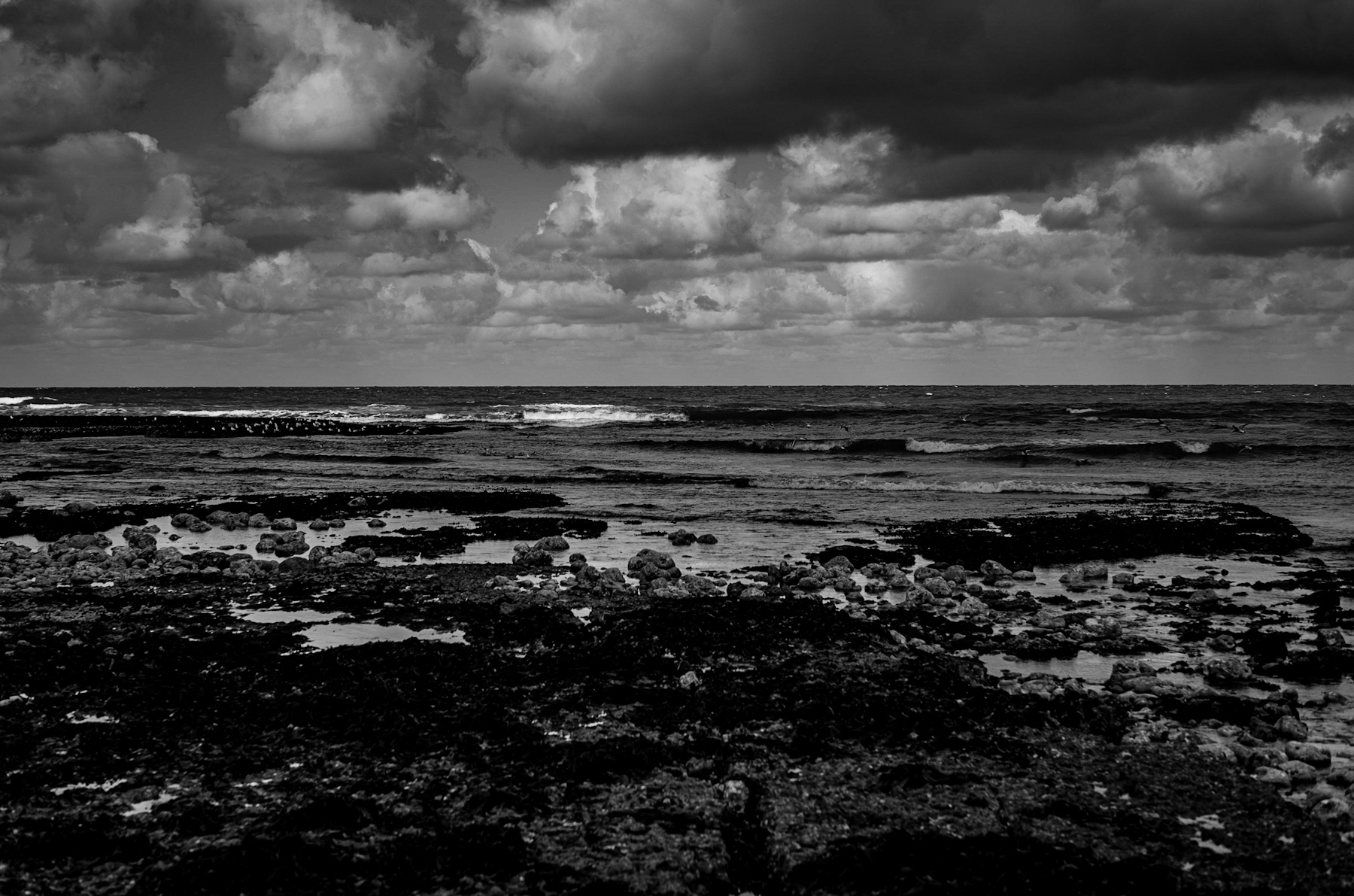
    The monochromatic expanse of this image presents a rugged coastline under a dramatic, cloud-laden sky. Stripped of color, the scene amplifies texture, contrast, and the raw, untamed essence of the sea, inviting contemplation of both its natural beauty and its profound historical depth.
    **A Monochromatic Coastal Tapestry**
    In the foreground, the immediate shoreline reveals a tapestry of dark, wet rocks and patches of seaweed, suggesting the ebb and flow of recent tides. These elements create a tactile sense of the beach, grounding the viewer in its immediate environment. The interplay of light and shadow across the rough terrain highlights ancient geological formations, each stone a silent witness to countless millennia of wave action.
    Moving towards the midground, the ocean asserts its dominance with waves breaking rhythmically. A prominent, low-lying structure, likely a groyne or a natural reef, emerges from the surf. This feature is teeming with life; numerous seagulls perch upon its surface, their white forms stark against the dark water and rock. Further out, a flurry of gulls takes flight, their wings caught mid-stroke, adding a dynamic energy that contrasts with the static elements of the shore. The ocean itself appears turbulent, its surface agitated by wind and current, creating a compelling visual narrative of nature’s relentless power.
    The horizon line stretches infinitely, meeting a sky that is equally compelling. Heavy, textured clouds dominate the upper frame, casting an atmospheric pall that deepens the dramatic mood. The absence of color here emphasizes the interplay of light and shadow, transforming the sky into a sculptural element that mirrors the tumultuous sea below.
    **Coastlines Through the Lens of History**
    Coastlines, like the one depicted, have always been pivotal in human history. They represent frontiers, points of departure and arrival, and vital sources of sustenance. For millennia, these shores facilitated maritime trade, migration, and exploration. The very rocks in the foreground could have been part of ancient navigation markers or witnessed the landing of early seafarers, their journeys shaping empires and cultures.
    The visible groyne, if man-made, speaks to centuries of human endeavor to tame or manage the sea. Such coastal engineering structures were historically built to protect shorelines from erosion, to create safe harbors, or to aid in fishing. They are a testament to our ongoing battle and coexistence with natural forces, reflecting early forms of sea defense and resource management. Historically, coastal communities relied heavily on the ocean’s bounty, with fishing and even seaweed harvesting (for fertilizer or food) being integral to their survival and economy. The abundant presence of seagulls in the image further underscores the rich marine ecosystem that has historically sustained human populations along these shores.
    **Black and White: A Portal to the Past**
    The black and white medium itself contributes significantly to this historical resonance. It evokes a sense of timelessness, stripping away modern distractions and inviting contemplation of the enduring natural processes and human interactions that have shaped these landscapes across epochs. It connects the viewer to an era before color photography, linking the present scene to a visual history stretching back to the dawn of the medium and the very formation of these coastal landscapes. The stark contrast and emphasis on texture make the image feel both ancient and immediate, a powerful visual anchor to the past.
    **Enduring Narratives of the Shore**
    This dramatic seascape is more than a simple photograph; it is a visual narrative woven with threads of natural power, ecological vitality, and human history. It reminds us that every rugged coastline, no matter how wild, carries the imprints of the past and continues to evolve under the watchful eye of both nature and humanity. The ocean waves, the flying seagulls, and the historic coastal structures all contribute to a scene that resonates with the enduring story of our planet and our place within it.
  • Pastoral Echoes: A Black and White Portrait of Bovine History

    Pastoral Echoes: A Black and White Portrait of Bovine History

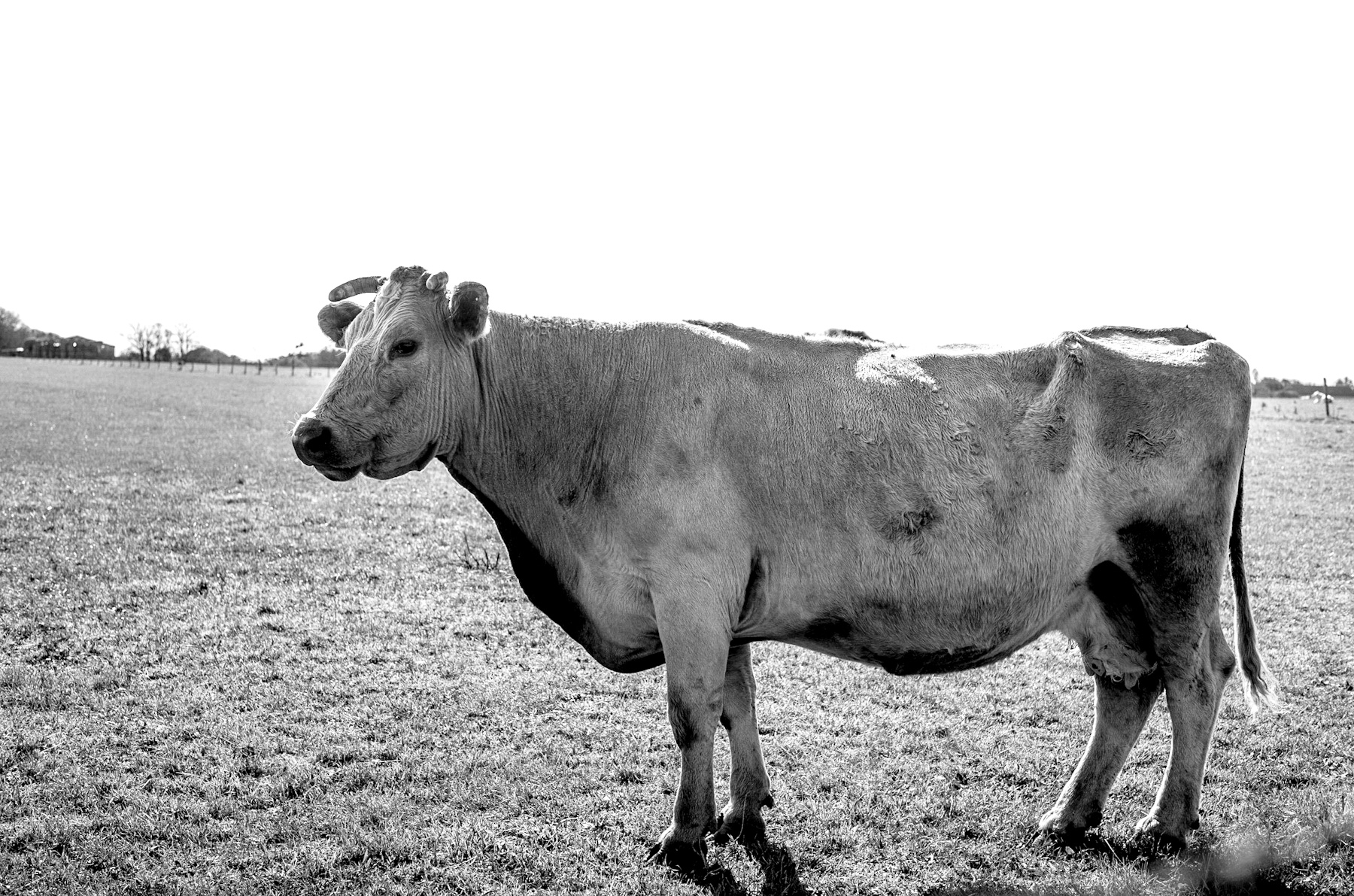
    The striking monochrome image presents a solitary cow standing in an expansive, sun-drenched pasture. Captured in stark black and white, the photograph transcends a simple farm scene, inviting viewers to reflect on the profound and enduring relationship between humanity and these majestic creatures. The animal, likely a beef or dairy breed, stands with quiet dignity, its form silhouetted against a bright, almost ethereal sky, grounding us in the timeless narrative of agriculture and coexistence.
    Visual Description: A Study in Monochrome
    At the heart of the frame, a robust bovine commands attention, positioned in a three-quarter profile facing left. Its head, adorned with small, distinctive horns, is slightly lowered, conveying a sense of calm observation. The cow’s coat, textured and seemingly thick, is rendered with intricate detail through the black and white medium, catching the harsh sunlight that sculpts its contours and casts a sharp shadow beneath its sturdy legs. The vast open field, sparsely covered with short grass, stretches into the background, where distant trees and faint structures hint at a broader rural landscape. The high contrast and absence of color emphasize form and texture, lending a classic, almost documentary feel to the scene, highlighting the animal’s presence in its natural habitat.
    The Dawn of Domestication: An Ancient Bond
    The image of a cow in a field is deeply rooted in human history, harking back to the Neolithic Revolution, approximately 10,500 years ago. It was during this pivotal era that wild aurochs, the ancestors of modern cattle, were first domesticated. This monumental shift transformed human societies from nomadic hunter-gatherers to settled agricultural communities. Cattle became indispensable, providing not just meat and milk for sustenance but also hides for clothing and shelter, and their strength for plowing fields and transportation. The very foundation of civilization, from settled villages to organized labor, owes a significant debt to the domestication of these animals. Their role as livestock fundamentally altered human development.
    Cattle Through the Ages: From Labor to Livelihood
    As societies evolved, so did the role and significance of cattle. In many ancient cultures, they were revered, symbolizing wealth, fertility, and divine power – a tradition still evident in some parts of the world today. The agricultural revolution further solidified their importance, with selective breeding leading to the development of distinct breeds optimized for specific purposes, whether for rich dairy production or high-quality beef. This continuous refinement over millennia has shaped the diverse cattle populations we see globally. The cow in this photograph, standing resiliently in its pasture, serves as a living testament to this unbroken chain of husbandry, a link connecting modern farming practices to the earliest human endeavors in food production.
    A Timeless Presence in a Changing World
    The black and white aesthetic of the photograph itself adds another layer to its historical resonance. It evokes a sense of timelessness, reminiscent of early photography that captured agrarian life with stark authenticity. In an increasingly urbanized and technologically driven world, the sight of a cow grazing in a field remains a powerful symbol of connection to nature, food sources, and traditional livelihoods. This image encourages contemplation of our ongoing relationship with the animal kingdom, the complexities of food production, and the enduring beauty of the rural landscape, reminding us of the foundational role cattle continue to play in human existence.
    Conclusion
    This photograph, more than a mere snapshot, is a quiet chronicle. It encapsulates millennia of shared history, from the first steps of domestication to the sophisticated agricultural systems of today. The solitary cow, bathed in light, stands as a potent emblem of sustenance, labor, and a bond that has shaped human civilization. It is a powerful reminder of the enduring presence of bovine life in our landscapes and our lives.
  • Stark Beauty: Birds, Bare Trees, and the Legacy of Silhouette Art

    Stark Beauty: Birds, Bare Trees, and the Legacy of Silhouette Art

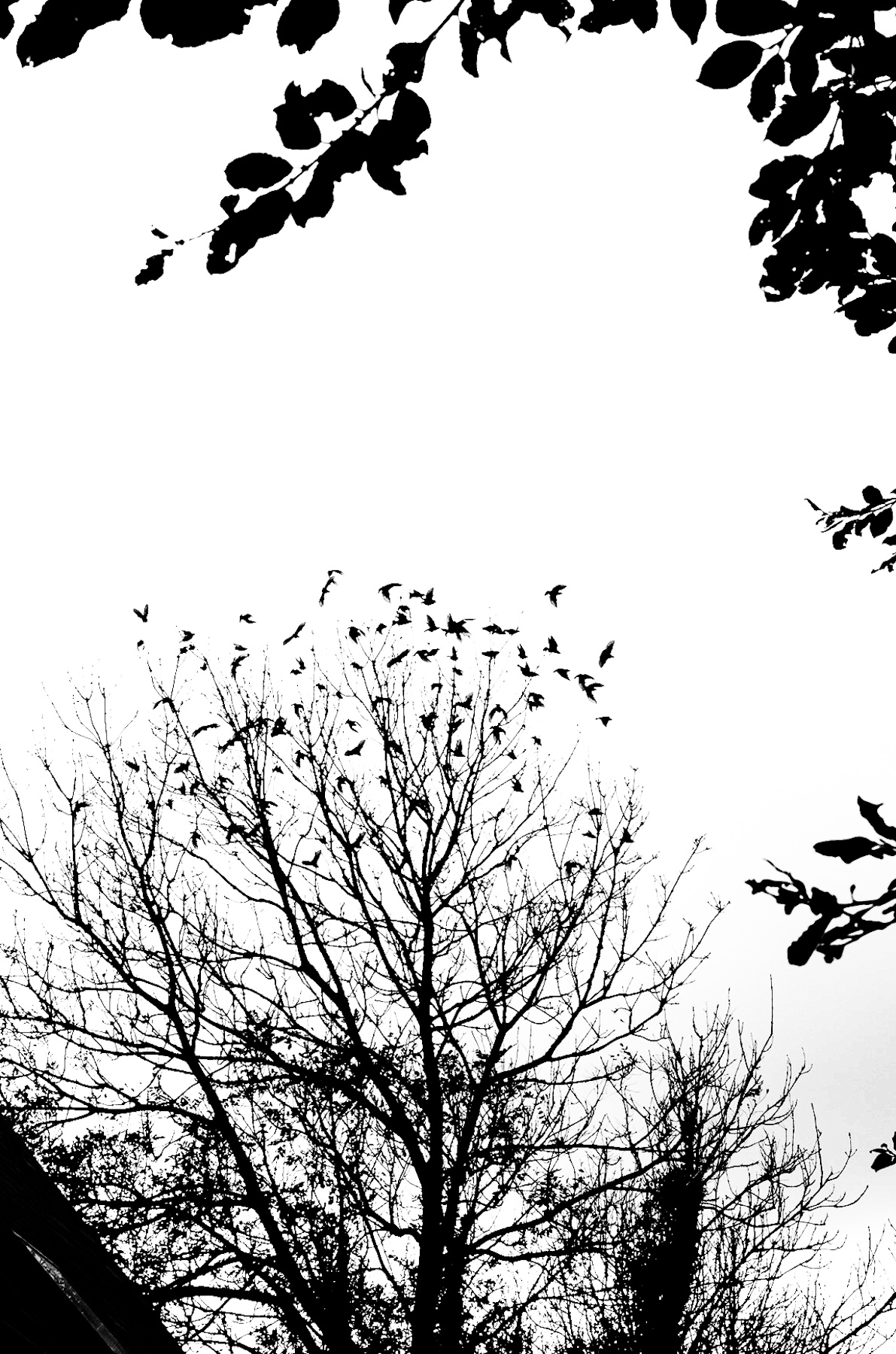
    The presented image offers a compelling study in monochrome, capturing a moment of dynamic natural activity against a stark, minimalist backdrop. Dominated by the sharp contrasts of black and white, the composition features the intricate silhouettes of bare trees, their branches reaching skyward. From the uppermost limbs of the central tree, a flock of birds explodes into flight, their forms scattered across the bright, almost ethereal sky. Additional silhouetted foliage frames the top corners, enhancing the sense of depth and natural enclosure. This visual narrative invites contemplation on themes of movement, transition, and the inherent drama within the natural world, rendered with a timeless aesthetic.
    The Visual Impact of Monochrome and Silhouette
    The choice of black and white photography inherently elevates the visual impact, stripping away the distraction of color to emphasize form, texture, and light. In this image, the high contrast between the dark silhouettes and the luminous sky creates a powerful sense of depth and drama. The bare branches of the trees, devoid of leaves, reveal their skeletal structure, forming complex patterns that are both delicate and resilient. This starkness allows the viewer to focus on the essential lines and shapes, transforming familiar natural elements into abstract art. The silhouetted birds, captured mid-flight, convey a palpable sense of motion and freedom, their collective movement a striking counterpoint to the static, rooted trees. The negative space of the bright sky becomes an active element, highlighting the intricate forms it surrounds.
    Avian Dynamics and Arboreal Symbolism
    The image eloquently captures a common natural phenomenon: a flock of birds taking flight. This avian exodus from the trees speaks to the cycles of nature, perhaps signaling a shift in environment, a response to an unseen stimulus, or the beginning of a migratory journey. Historically, birds in flight have been potent symbols across numerous cultures, representing freedom, spirituality, messages from the divine, or the soul’s journey. Their collective movement, often referred to as a murmuration in the case of starlings, showcases nature’s intricate coordination and communal instinct.
    Concurrently, the bare trees themselves carry significant symbolic weight. Stripped of their foliage, they typically represent winter, dormancy, or a period of transition and introspection. Yet, their enduring structure also symbolizes resilience, strength, and the promise of rebirth. Together, the birds and trees create a narrative of departure and enduring presence, a testament to nature’s continuous rhythm of change and renewal.
    Historical Echoes in Art and Photography
    The aesthetic of the silhouette has a rich historical lineage, long preceding the advent of photography. Originating as a popular art form in the 18th century, named after French finance minister Étienne de Silhouette, these profile portraits offered an affordable way to capture likenesses using only light, shadow, and a sharp outline. This technique, focusing on form rather than intricate detail, imbued subjects with a timeless quality, emphasizing their essential character.
    When photography emerged, black and white imagery became its foundational medium. Early photographers embraced monochrome for its ability to convey mood, texture, and composition with unparalleled clarity. This medium allowed artists to explore the interplay of light and shadow, creating images that transcended mere documentation to become profound artistic statements. The visual language of this photograph—its high contrast, silhouetted forms, and focus on natural drama—connects directly to this historical legacy, echoing the artistic principles that have shaped visual storytelling for centuries. From ancient cave paintings depicting animal forms to modern minimalist art, the power of outline and contrast to convey deep meaning remains a constant.
    This photograph, therefore, is more than a simple depiction of nature; it is a continuation of an artistic tradition that leverages fundamental visual elements to evoke a profound and enduring connection with the viewer, resonating with historical artistic practices and universal natural symbolism.
  • Étretat’s Enduring Majesty: A Monochrome Glimpse into Coastal History

    Étretat’s Enduring Majesty: A Monochrome Glimpse into Coastal History

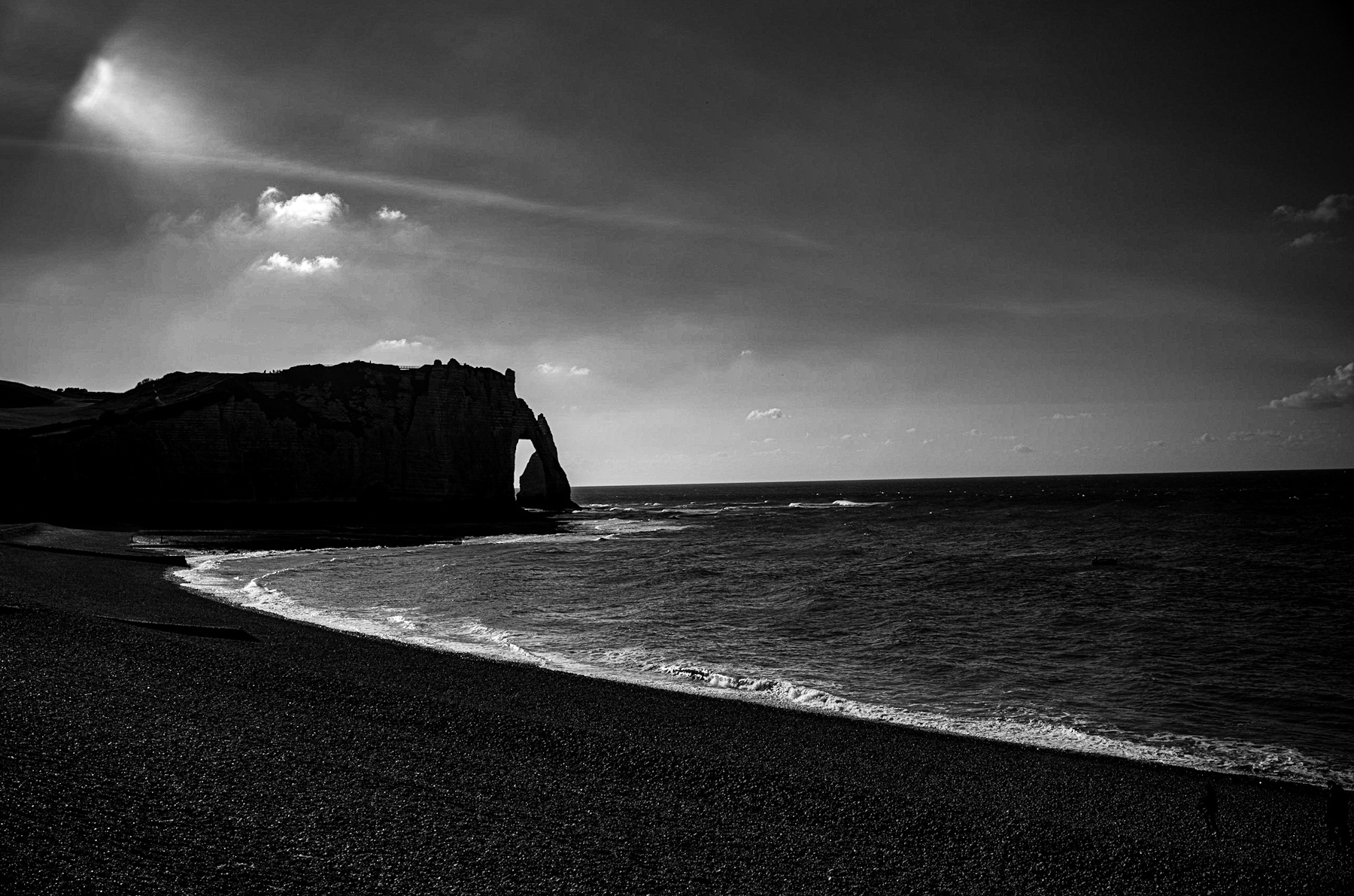
    Étretat, a name synonymous with breathtaking beauty along France’s Alabaster Coast in Normandy. Imagine a timeless vista, captured in striking black and white, where the iconic chalk cliffs and natural arches stand as colossal sentinels. This isn’t just a photograph; it’s an invitation to contemplate the raw power and subtle grandeur that nature has sculpted over millennia, creating a true geological wonder.
    The power of monochrome here is undeniable. The absence of color masterfully accentuates texture, light, and shadow, drawing your eye immediately to the majestic Falaise d’Aval. You’ll spot its distinctive natural arch, the Porte d’Aval, a testament to relentless coastal erosion. Right next to it, the famous L’Aiguille (the Needle), a freestanding chalk stack, stands guard against the vast expanse of the English Channel. These cliffs appear as ancient ramparts, their dark silhouette sharply contrasting with the brighter sky and the foamy white crests of waves breaking on the pebble beach below. A dramatic ray of light often pierces through the clouds, illuminating a section of the sky and casting an ethereal glow that adds depth and an almost spiritual quality to the Étretat scene. This interplay of light and shadow enhances the dramatic contours, making intricate details of the rock formations pronounced. The wide expanse of dark, textured pebbles in the foreground gently leads your gaze towards the dynamic sea, where rhythmic waves meet the shore. It’s a powerful landscape photography composition that evokes both tranquility and immense natural power.
    These iconic Étretat formations are far more than just picturesque; they are a profound testament to geological history. Rising up to 90 meters, these magnificent chalk cliffs began forming around 100 million years ago during the Cretaceous period, from accumulated marine micro-organisms. Over countless eons, the relentless action of wind and sea sculpted this relatively soft rock, carving out the dramatic arches, caves, and stacks we see today. The Porte d’Aval, a highlight, is one of three major arches at Étretat, alongside the Porte d’Amont and the Manneporte. And that famous L’Aiguille, the 70-meter-high needle-like rock, is another product of this ongoing erosion, once connected to the mainland. These natural wonders are dynamic, constantly reshaped by the elements, offering a living lesson in geomorphology.
    Beyond its geological marvel, Étretat holds a significant place in cultural history. In the 19th century, it transformed from a quiet fishing village into a fashionable seaside resort, attracting artists, writers, and aristocrats. Its dramatic coastline became an inexhaustible source of inspiration for Impressionist painters, most notably Claude Monet. He famously painted Étretat repeatedly, capturing its changing moods and light in over 80 canvases. His series vividly illustrates the very arches and cliffs, often depicting them under various weather conditions and times of day, much like the atmospheric rendering in a monochrome photograph. Literary figures like Guy de Maupassant, Gustave Courbet, and Maurice Leblanc (creator of Arsène Lupin, who famously hid a treasure within the „Hollow Needle“) also found their muse in Étretat’s unique beauty. This rich artistic and literary legacy imbues the historical landscape with layers of human experience and interpretation, adding depth to its natural splendor.
    The Étretat coastline, whether captured in a powerful black and white image or experienced firsthand, remains an enduring symbol of natural resilience and artistic inspiration. It invites us to appreciate the slow, powerful processes of the Earth and to reflect on the countless stories, both natural and human, etched into its ancient face. A visit to this geological wonder offers a tangible connection to both deep geological time and a vibrant cultural past, making it a truly unique and memorable travel destination in Normandy, France.
  • Iconic Concrete: St. Joseph’s Church, Le Havre, Through a Modern Lens

    Iconic Concrete: St. Joseph’s Church, Le Havre, Through a Modern Lens

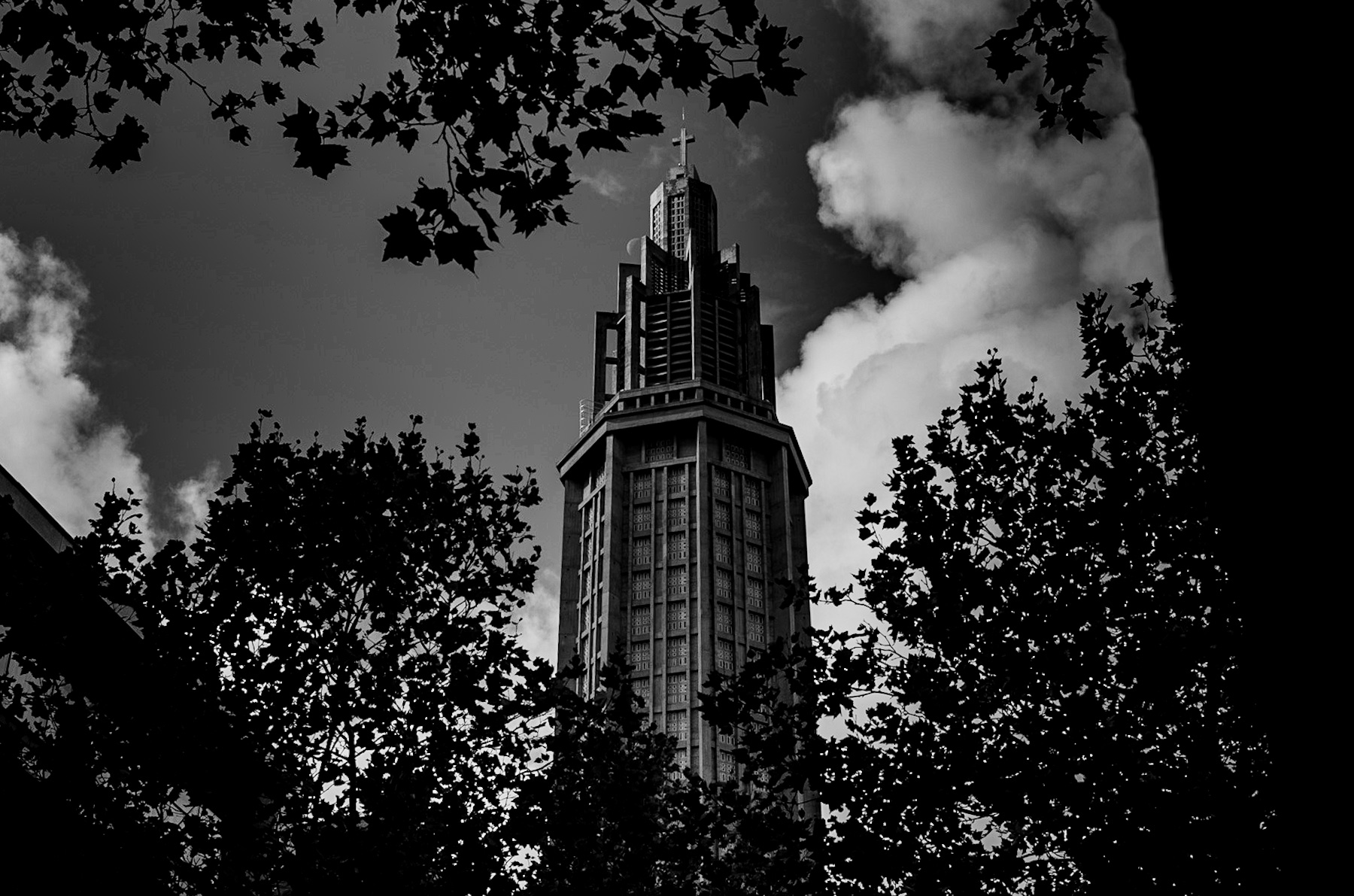
    The accompanying photograph presents a striking architectural marvel, captured in a dramatic monochrome palette. Framed by the intricate silhouettes of tree branches and foliage, a towering structure pierces the sky, its geometric forms asserting a powerful presence against a backdrop of dynamic clouds. The black and white rendering accentuates the building’s robust textures and intricate detailing, transforming light and shadow into key elements of its visual narrative.
    Architectural Grandeur in Monochrome
    At the heart of the image stands a formidable tower, distinguished by its octagonal base and a series of receding, stepped tiers culminating in a cross. The repetitive, almost cellular patterns of its windows or structural elements hint at a sophisticated design, while the material appears to be concrete, giving it a raw yet refined aesthetic. The low-angle perspective emphasizes the sheer scale and verticality of the edifice, drawing the viewer’s gaze upwards towards the heavens. The dark, organic shapes of the surrounding trees provide a natural, almost reverent frame, contrasting sharply with the rigid, man-made monument and adding a layer of depth and visual intrigue. This interplay between nature and architecture, captured without the distraction of color, creates a timeless and evocative scene.
    A Symbol of Resilience: St. Joseph’s Church, Le Havre
    This distinctive structure is none other than the bell tower of St. Joseph’s Church (Église Saint-Joseph) in Le Havre, France. Designed by the renowned architect Auguste Perret, a pioneer in the use of reinforced concrete, the church stands as a profound testament to post-war reconstruction and architectural innovation. Perret, often celebrated as „the poet of concrete,“ utilized this then-revolutionary material to rebuild large parts of Le Havre after its devastating destruction during World War II. The city’s rebuilt center, including St. Joseph’s, was later recognized as a UNESCO World Heritage site for its unique urban planning and modernist architecture.
    Post-War Reconstruction and Modernist Vision
    The construction of St. Joseph’s Church between 1951 and 1957 embodies the spirit of resilience that characterized post-war Europe. Le Havre, a crucial port city, suffered immense damage, necessitating a complete re-imagining of its urban fabric. Perret’s vision for the church was not merely to replace what was lost but to create a new landmark that symbolized hope and renewal. The choice of reinforced concrete was deliberate; it offered durability, efficiency, and the ability to realize bold, unadorned forms that reflected the era’s functionalist ideals. The church’s 107-meter-high lantern tower, visible from afar, served as a beacon for sailors and a spiritual anchor for the city.
    Art Deco Influence and Spiritual Design
    While rooted in Modernism, the church’s aesthetic also carries echoes of the Art Deco movement, particularly in its geometric precision, vertical emphasis, and the rhythmic repetition of its structural elements. The tower, in particular, showcases Perret’s mastery of concrete, transforming a utilitarian material into a medium for sculptural expression. Inside, the tower is adorned with 6,500 stained glass panes, which, though not visible in this external shot, bathe the interior in a kaleidoscope of light, creating a spiritual atmosphere that contrasts with the exterior’s stark grandeur. The cross at the apex reinforces its sacred purpose, merging modern architectural principles with enduring religious symbolism.
    Enduring Legacy
    The photograph captures more than just a building; it encapsulates a moment in history where innovation met necessity, and art emerged from destruction. St. Joseph’s Church remains a powerful landmark, not only for its architectural significance but also as a monument to human perseverance and the enduring capacity for creation in the face of adversity. It stands as a silent sentinel, watching over Le Havre, a beacon of concrete hope against the ever-changing sky.
  • Architectural Echoes: The Gothic Cathedral in Shadow and Light

    Architectural Echoes: The Gothic Cathedral in Shadow and Light

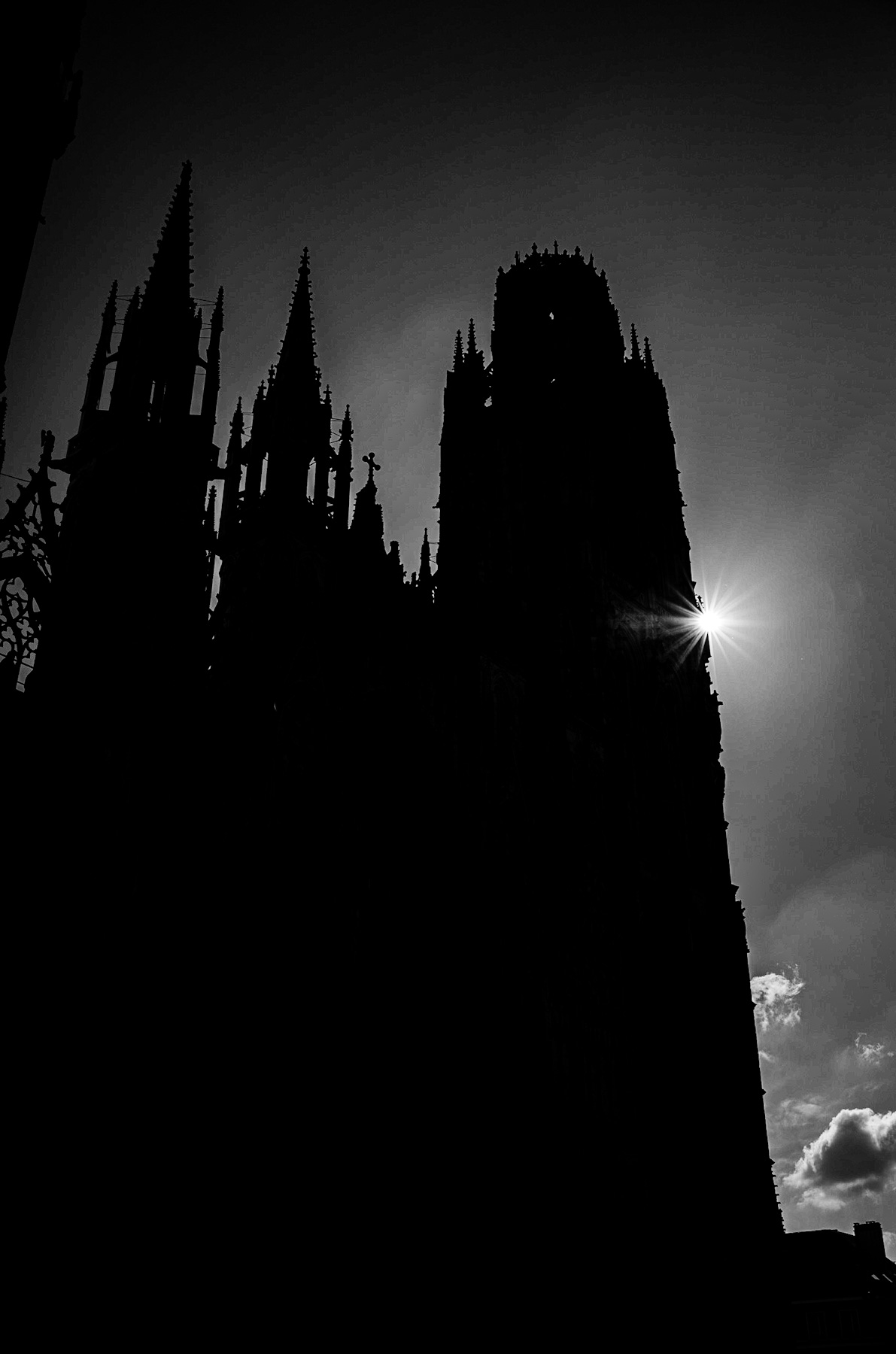
    The striking black and white photograph presents the majestic silhouette of a grand Gothic cathedral, its intricate spires and imposing towers piercing a dramatic sky. Captured from a low angle, the monumental structure dominates the frame, rendered almost entirely in deep shadow, emphasizing its sheer scale and complex form. A brilliant sunburst, a powerful starburst of light, emerges from behind one of the colossal towers, creating a focal point that contrasts sharply with the solemn darkness of the edifice. This interplay of light and shadow transforms the building into a timeless sentinel, hinting at centuries of history etched into its stone.
    **The Visual Narrative: Silhouette and Illumination**
    The image masterfully utilizes the silhouette technique, stripping away color and surface detail to highlight the pure architectural form. The viewer’s eye is drawn upwards along the sharply defined edges of pinnacles, flying buttresses, and the distinctive pointed arches characteristic of Gothic design. Despite the lack of direct light on the stone, the sheer complexity of the structure is evident, suggesting the laborious craftsmanship involved in its creation. The sun’s radiant burst, positioned strategically, acts as a symbolic beacon, perhaps representing divine presence, enduring hope, or simply the cyclical passage of time against an immovable testament to human ambition. The partial visibility of clouds in the lower right adds depth to the sky, preventing it from being a uniform void and hinting at the vastness above.
    **A Legacy in Stone: The Historical Context of Gothic Architecture**
    The building depicted, strongly resembling the iconic Cologne Cathedral (Kölner Dom) in Germany, embodies the zenith of Gothic architecture. Originating in 12th-century France, Gothic cathedrals were revolutionary, pushing the boundaries of engineering and aesthetics. They replaced the heavy, dark Romanesque structures with soaring edifices characterized by pointed arches, ribbed vaults, and most importantly, the flying buttress system, which allowed for thinner walls and vast expanses of stained glass. This innovation enabled architects to achieve unprecedented heights, drawing the gaze, and metaphorically, the spirit, towards the heavens.
    The construction of cathedrals like Cologne Cathedral was an undertaking spanning generations, often centuries. Begun in 1248, Cologne Cathedral’s construction famously paused for over 300 years before resuming in the 19th century, finally reaching completion in 1880. This protracted construction period reflects the immense resources, collective faith, and technical skill required. These structures were not merely places of worship; they were the cultural, social, and economic hearts of medieval cities, symbols of civic pride and spiritual devotion. They housed precious relics, served as pilgrimage sites, and stood as enduring monuments to human ingenuity and perseverance.
    **Enduring Grandeur: A Symbol Through Time**
    The dark silhouette against the bright sky in the photograph serves as a powerful metaphor for the cathedral’s enduring presence through history. Cologne Cathedral, a UNESCO World Heritage site, notably survived extensive bombing during World War II, standing remarkably intact amidst a devastated city. This resilience solidified its status as a symbol of endurance and hope for post-war Germany. The interplay of light and shadow in the image captures this duality: the profound weight of history and the persistent glimmer of light, representing continuity and renewal. The photograph invites contemplation on the monumental effort of past generations and the timeless beauty of architectural heritage that continues to inspire awe.
  • The Enduring Majesty: Normandy’s Chalk Cliffs and Their Storied Past

    The Enduring Majesty: Normandy’s Chalk Cliffs and Their Storied Past

    The striking monochrome photograph captures a raw, powerful vista of towering **chalk cliffs** meeting the turbulent waters of the ocean. Dominated by shades of grey, from the brooding, cloud-laden sky to the frothy white caps of the waves, the image conveys a sense of dramatic grandeur and timelessness. The intricate horizontal layering of the chalk is prominently featured, detailing centuries of geological formation, while the rugged coastline reveals the relentless sculpting power of wind and sea. Patches of dark, resilient vegetation cling to the cliff tops and slopes, providing a stark contrast to the pale rock. In the distance, the vast expanse of the **English Channel** stretches to the horizon, hinting at both boundless freedom and formidable power.
    ### A Geological Tapestry of Time
    These formidable white cliffs are characteristic of the **Alabaster Coast (Côte d’Albâtre)** in **Normandy, France**, a landscape renowned for its iconic formations, most notably around **Étretat**. Composed primarily of chalk, a soft, white limestone formed from the skeletal remains of microscopic marine organisms over millions of years during the Late Cretaceous period, these cliffs represent a profound geological archive.
    The distinct horizontal banding visible in the photograph testifies to successive layers of sediment deposition, uplift, and subsequent erosion. The relentless action of the English Channel’s waves and weather continues to carve natural arches, stacks, and coves, perpetually reshaping this dynamic shoreline. This ongoing process of **coastal erosion** highlights the Earth’s continuous, slow-motion artistry.
    ### Echoes of History on the French Coastline
    Beyond their geological wonder, these cliffs are steeped in human history, having borne witness to pivotal moments over millennia. Strategically located along the English Channel, the **Normandy coast** has always been a significant gateway. From the early Viking incursions that shaped the region’s name and culture, to the maritime trade routes that connected nations, these shores have played a silent role in countless narratives.
    Perhaps most profoundly, these very cliffs formed part of the formidable **Atlantic Wall** during **World War II**. While the famous **D-Day landings** of June 1944 occurred further west on the sandy beaches, the entire coastline was heavily fortified by German forces. The sheer scale and natural defenses offered by these cliffs made them integral to the defensive strategy, with bunkers and observation posts often camouflaged into the landscape. The dramatic landscape seen in the photograph, with its commanding views over the Channel, underscores the strategic importance of such vantage points during wartime. The silent sentinels of chalk stood witness to intense human conflict, a stark contrast to their serene natural beauty today.
    ### Cultural and Artistic Legacy
    The breathtaking beauty of these **French chalk cliffs** has also captivated artists and writers for centuries. **Claude Monet**, a pioneer of Impressionism, frequently depicted the Étretat cliffs, exploring the changing light and moods of the sea in his numerous paintings. His works, alongside those of other artists, cemented the visual identity of this unique coastline in the global artistic consciousness. Similarly, the dramatic scenery provided inspiration for writers like Maurice Leblanc, whose Arsène Lupin adventures are famously set against the backdrop of the Étretat arches and „the hollow needle,“ intertwining the landscape with literary intrigue.
    ### A Timeless Perspective Through Photography
    The **black and white photography** rendition of this image enhances its timeless quality, stripping away color to emphasize form, texture, and the interplay of light and shadow. It invites contemplation of the enduring forces of nature and the layers of history etched into the landscape. Standing on these cliffs, one is connected to deep time – geological epochs, ancient migrations, and the more recent, poignant echoes of conflict and artistic endeavor. This view is not merely a landscape; it is a living testament to Earth’s power and humanity’s interwoven story, offering a profound sense of perspective to any visitor.
  • Stillness on the Promenade: A Study in Urban Juxtaposition

    Stillness on the Promenade: A Study in Urban Juxtaposition

    The monochrome rendering of this photograph immediately draws the viewer into a detailed observation of an urban scene, where contemporary elements meet historical architecture under a muted sky. A central outdoor fitness machine, conspicuously shrouded in dark, flowing material, dominates the foreground, its temporary disuse creating a focal point amidst the everyday streetscape. The wet asphalt reflects a recent rain, contributing to a quiet, contemplative atmosphere that underscores the textures and forms within the frame.
    This outdoor fitness apparatus, a common feature in modern public spaces, typically promotes community health and active lifestyles. Its current state, however, wrapped and seemingly decommissioned, introduces a narrative of pause. The black material, tightly secured, hints at seasonal closure, necessary maintenance, or perhaps a temporary measure in response to broader societal factors affecting public access. A small, indistinct sign affixed to the machine’s central pole likely displays usage instructions or safety warnings, emphasizing its intended function as an amenity designed for public engagement, now temporarily withdrawn from active use. This element distinctly represents a modern trend in urban planning: integrating wellness infrastructure into the public realm to enhance quality of life.
    Behind this contemporary installation, the backdrop is defined by buildings that present a striking architectural dialogue across different eras. To the left, a structure with a smooth, concrete facade, a balcony featuring robust railings, and a modern roller shutter suggests a more recent construction or a significantly updated design. Its clean lines and functional aesthetic stand in direct contrast to the building on the right. This latter structure exhibits a rich blend of historical architectural elements: a robust foundation composed of rugged, irregular stone and brickwork, supporting lighter walls adorned with traditional multi-paned windows. Dark beams visible beneath the eaves further hint at a classic, potentially even half-timbered, architectural heritage.
    The distinctive use of flint and brick in the lower section of the older building is particularly significant, pointing to specific regional architectural traditions. Flint, a durable stone often found in chalk deposits, was a prevalent building material for centuries in coastal regions of Northern France (such as Normandy and Picardy) and Southern England (including Kent and Sussex). Its characteristic irregular texture and resilience made it a practical and aesthetically unique choice for foundations and walls, frequently combined with brick for structural reinforcement and decorative patterns. This building style reflects a history of local resourcefulness and craftsmanship, illustrating the evolution of these towns from early maritime settlements to, in many cases, popular seaside resorts or established residential areas. The visual interplay between this historically rich construction and the more contemporary building highlights the ongoing process of urban development and the layering of distinct historical periods within a single streetscape.
    The entire scene encapsulates the dynamic nature of urban environments, where the enduring past continually shapes and coexists with the evolving present. The historical architecture provides a steadfast backdrop, a testament to resilient building practices and the inexorable passage of time. Against this, the modern fitness equipment, temporarily inactive, symbolizes contemporary life and public health initiatives. The presence of a commercial van, a ubiquitous element of modern urban logistics, further grounds the image in the everyday present. The black and white aesthetic strips away the distractions of color, compelling the viewer to focus on the interplay of light, shadow, texture, and the silent narrative of urban evolution embedded within this singular frame. It serves as a visual commentary on how communities adapt, preserve, and integrate new elements into their historical fabric.