Kategorie: Travel

  • Etretat’s Timeless Grandeur: A Monochrome Journey Through Normandy’s Iconic Cliffs

    Etretat’s Timeless Grandeur: A Monochrome Journey Through Normandy’s Iconic Cliffs

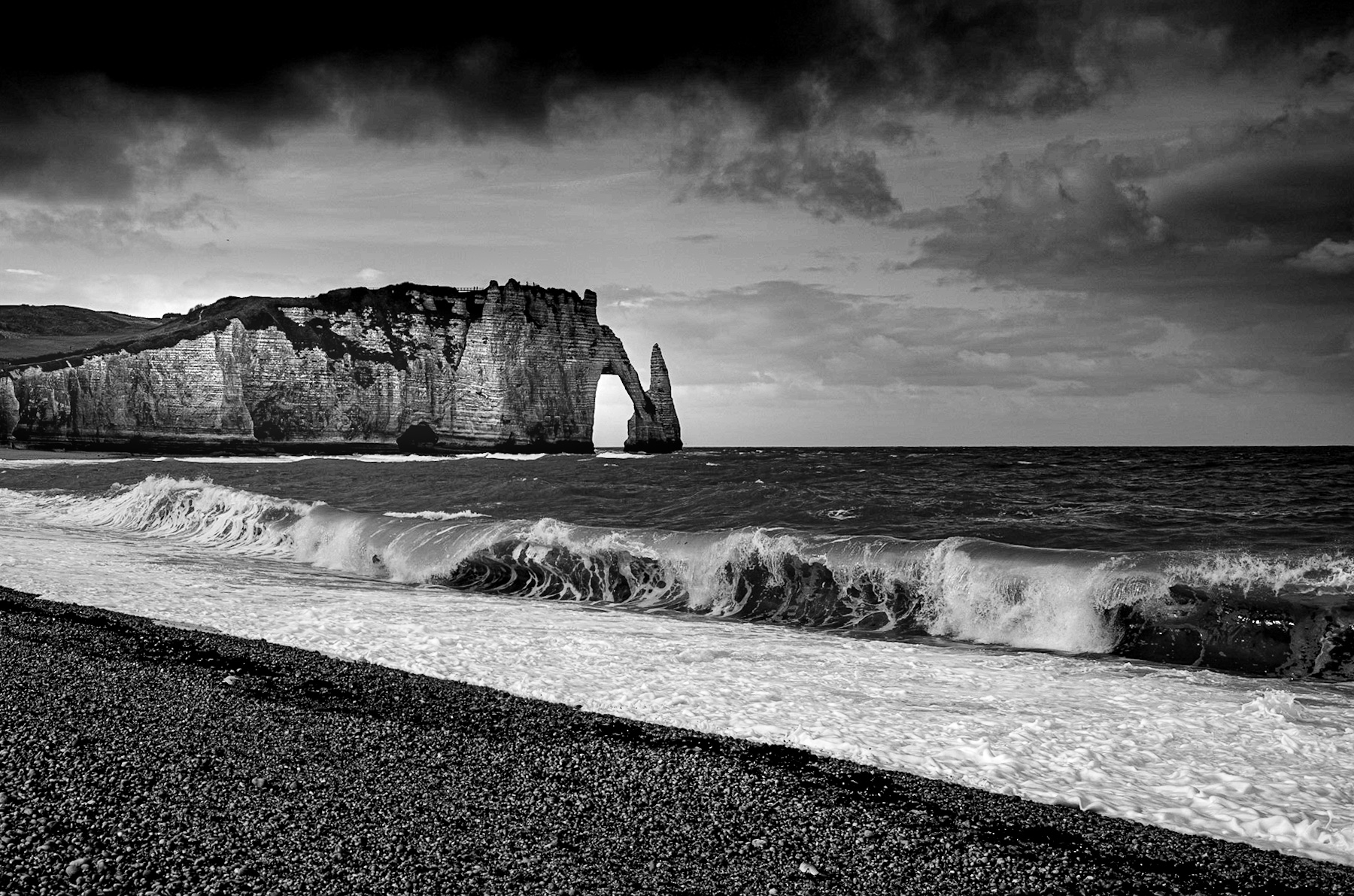
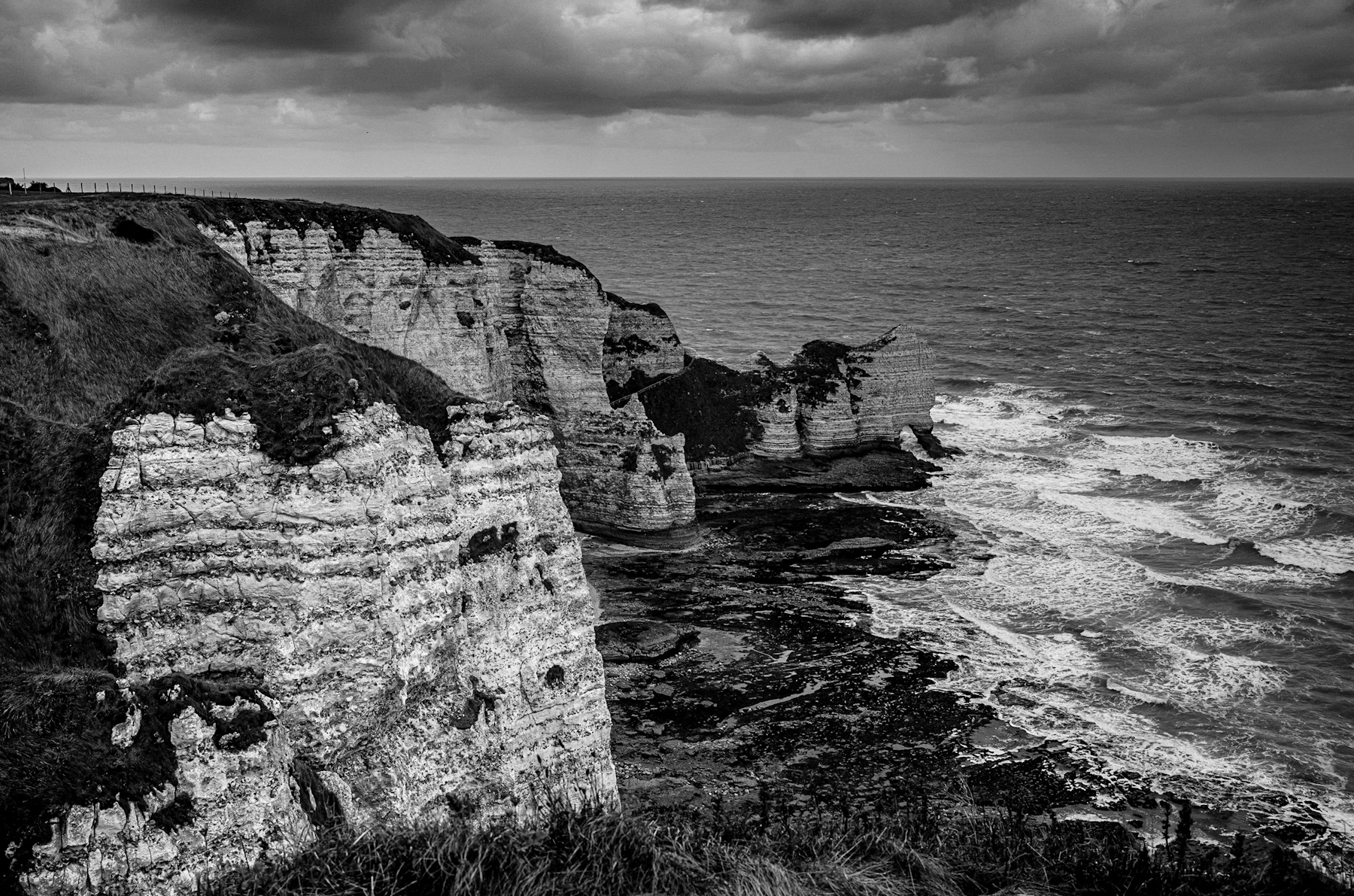
    The photograph captures a striking monochrome vista of the Etretat cliffs in Normandy, France, presenting a dramatic interplay of natural elements under a brooding sky. The composition draws the viewer into a scene where the raw power of the ocean meets the enduring strength of geological formations, rendered with a depth and texture unique to black and white photography.
    A Glimpse of Nature’s Sculpture
    In the foreground, a dark, pebbled beach stretches diagonally across the frame, providing a stark contrast to the frothy white lines of breaking waves. These waves, captured mid-surge, convey the dynamic energy of the English Channel, their foam creating intricate patterns as they recede and advance. The sea itself appears turbulent, its dark surface reflecting the muted light of an overcast day, hinting at the vastness and unpredictable nature of the Atlantic.
    Dominating the midground and background are the iconic chalk cliffs of Etretat, specifically the Falaise d’Aval. Their sheer, stratified faces, carved by millennia of wind and water, rise majestically from the sea. The most prominent feature is the Porte d’Aval, a colossal natural arch, with the slender Aiguille (the Needle rock) standing sentinel behind it. The texture of the chalk is finely detailed, revealing layers of geological history. Above, the sky is a tapestry of shifting clouds, dark and heavy, enhancing the dramatic atmosphere and emphasizing the monumental scale of the landscape. The absence of color accentuates the forms, shadows, and light, giving the scene a timeless, almost sculptural quality.
    Echoes of History and Artistic Inspiration
    The Etretat cliffs are not merely a geological marvel; they are a landscape steeped in history and cultural significance. Formed over millions of years by the deposition of marine sediments, these towering chalk formations are a testament to Earth’s continuous processes of creation and erosion. The iconic arches and needles, such as the Porte d’Aval and the Aiguille, are the result of relentless wave action and weathering, slowly sculpting the coastline into its distinctive shapes.
    Beyond their geological narrative, the Etretat cliffs have captivated human imagination for centuries. In the 19th century, this stretch of the Normandy coast became a magnet for artists and writers. Impressionist master Claude Monet frequently painted here, capturing the changing light and moods of the cliffs in numerous canvases, making Etretat synonymous with his artistic legacy. His series of paintings depicting the various arches and the Aiguille at different times of day and seasons exemplify the profound impact this landscape had on the art world.
    Literary figures also found inspiration in Etretat’s dramatic scenery. Guy de Maupassant, a native of Normandy, often wrote about the region, and the cliffs of Etretat feature prominently in his work. Perhaps most famously, Maurice Leblanc chose Etretat as a pivotal setting for his Arsène Lupin mysteries, particularly „The Hollow Needle“ (L’Aiguille Creuse). This novel weaves a thrilling tale around the secrets hidden within the Aiguille, cementing Etretat’s place in French literary folklore and drawing countless readers to explore its mysteries.
    An Enduring Legacy
    The photograph, rendered in stark black and white, strips away modern distractions, inviting contemplation of Etretat’s enduring legacy. It highlights the raw, elemental beauty that has drawn artists, writers, and travelers for generations. This coastal panorama serves as a powerful reminder of nature’s artistry and the deep historical and cultural connections that can be forged with a landscape of such profound character. Etretat remains an iconic destination, a place where geological grandeur, artistic inspiration, and literary intrigue converge.
  • Chalk Cliffs and Turbulent Tides: A Glimpse into Normandy’s Enduring History

    Chalk Cliffs and Turbulent Tides: A Glimpse into Normandy’s Enduring History

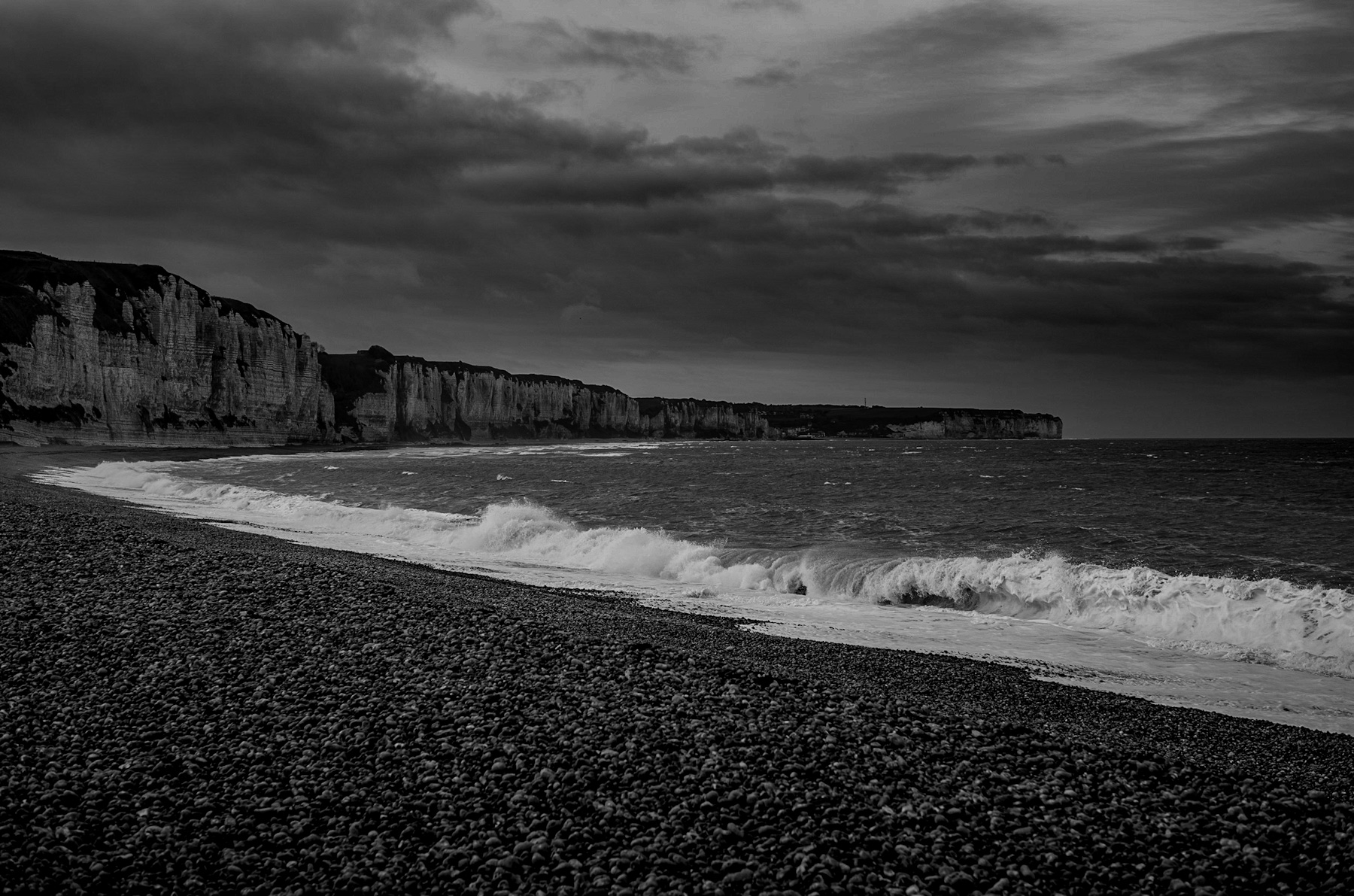
    The stark black and white photograph captures a profound sense of raw nature and historical weight along a dramatic coastline. Dominating the scene are imposing chalk cliffs, stretching majestically into the distance on the left, their layered rock formations testament to millennia of geological processes. Below them, a tempestuous sea churns, dark and powerful, with waves breaking into foamy white crests that crash against the shore. The foreground is defined by a vast pebble beach, its myriad stones forming a textured carpet that leads the eye towards the turbulent waters. Overhead, a heavy, overcast sky presses down, its dark clouds mirroring the mood of the sea and lending an almost melancholic atmosphere to the entire panorama.
    **The Visual Narrative of a Rugged Coastline**
    This monochrome rendition accentuates the inherent drama of the landscape. The absence of color highlights the textures and contrasts: the rough, weathered surfaces of the majestic cliffs, the frothy spray of the powerful waves, and the smooth, wet sheen of the pebbles on the beach. The composition draws the viewer’s gaze along the sweeping curve of the **coastline**, emphasizing the sheer scale of these natural formations. The dark tones evoke a sense of solemnity and timelessness, suggesting a place where the forces of nature hold undeniable sway. It is a visual narrative of resilience, where land and sea continually sculpt each other under a perpetually changing sky.
    **Echoes of History: Normandy’s Strategic Shores**
    While the image primarily showcases natural grandeur, the specific appearance of these **chalk cliffs**, particularly their characteristic white hue and the restless waters of the **English Channel**, strongly evokes the historical landscape of **Normandy, France**. This region has borne witness to pivotal moments in European **history**, making these seemingly serene shores repositories of profound human stories.
    Most prominently, the **Normandy coastline** is inextricably linked to World War II and the **D-Day landings** of June 6, 1944. These very cliffs and beaches, or others very similar in appearance along the Atlantic Wall, formed part of the formidable German defensive line. Allied forces faced immense challenges in breaching these natural and man-made fortifications. Locations such as Omaha Beach, Utah Beach, Gold, Juno, and Sword were chosen for their strategic value, but the broader coastline, including areas with such imposing cliffs, represented a constant threat and a strategic barrier throughout the conflict. The dramatic, often unforgiving terrain depicted here would have been a familiar and daunting sight to those who fought here, or those who defended it.
    Beyond WWII, these coasts have played a critical role in numerous historical epochs. From the Norman Conquest of England in 1066, launched from these shores, to countless naval battles and trade routes throughout the centuries, the **English Channel** has been a vital artery and a contested frontier. The enduring presence of these **cliffs**, steadfast against the relentless sea, serves as a silent witness to millennia of human ambition, conflict, and resilience.
    **A Timeless Reflection**
    The black and white aesthetic of the photograph further amplifies this historical connection, stripping away modern distractions and presenting the scene with a raw, almost archival quality. It invites contemplation on the passage of time, the cyclical nature of history, and the unchanging power of the natural world. These **Normandy cliffs** and **pebble beaches** continue to stand as monuments not only to geological time but also to the human events that have unfolded upon and around them. They are more than just scenic vistas; they are living testaments to an enduring legacy.
  • The Timeless Drama of the Coastal Frontier: A Black and White Seascape

    The Timeless Drama of the Coastal Frontier: A Black and White Seascape

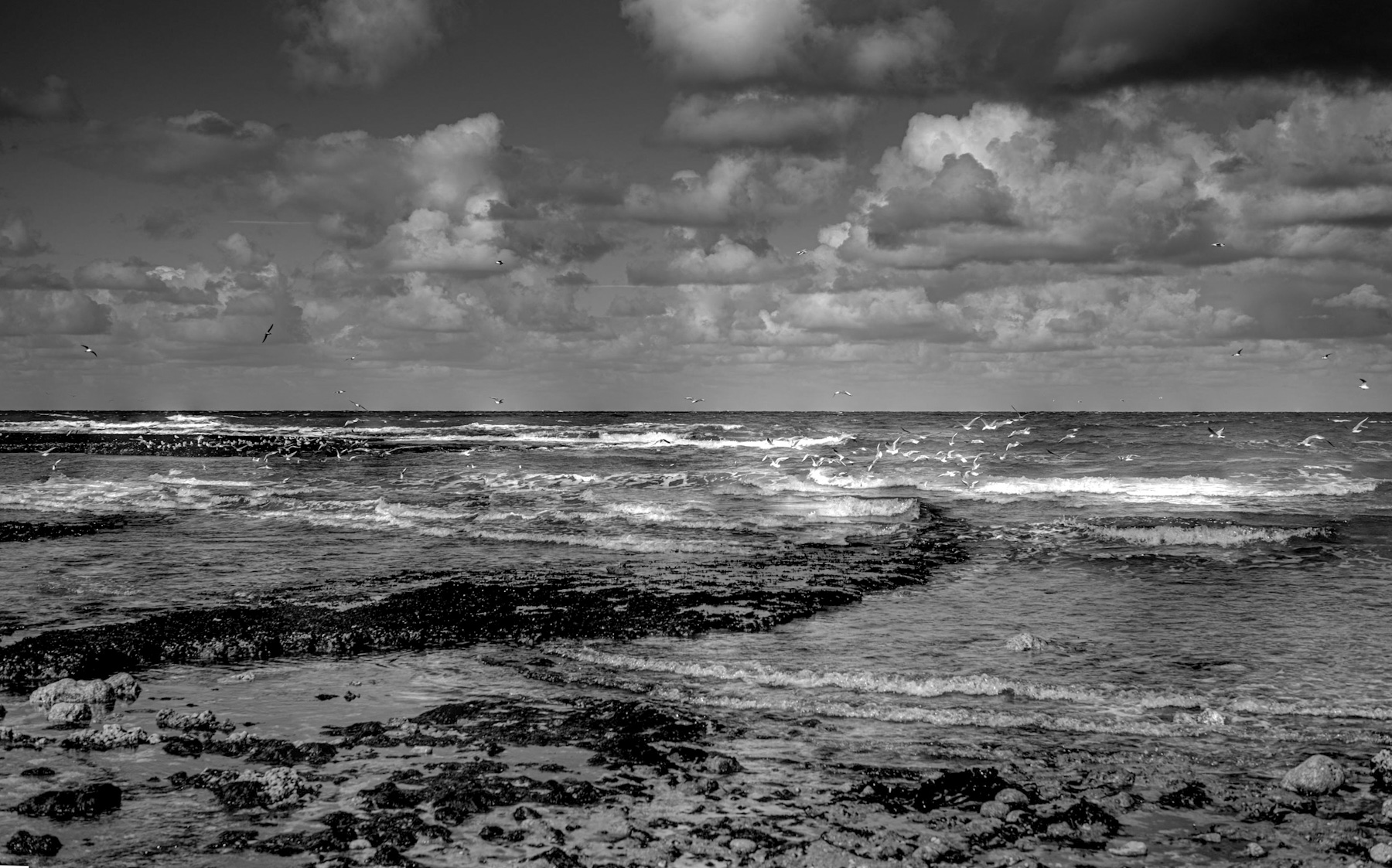
    The presented black and white photograph captures a dynamic coastal scene, immediately drawing the viewer into a realm of raw natural power and dramatic contrasts. The composition is dominated by a turbulent ocean, its surface agitated by numerous waves cresting with white foam, extending towards a distant, indistinct horizon. Above, a sky laden with dramatic clouds creates a brooding atmosphere, with patches of lighter sky breaking through, accentuating the depth and texture of the cloud cover.
    In the mid-ground, a substantial flock of seagulls is visible, many in various stages of flight, their white forms stark against the darker tones of the water and sky. Their presence adds a vivid sense of motion and life to the otherwise elemental tableau. Some birds appear to be skimming the water’s surface, while others soar higher, integrating seamlessly with the powerful rhythm of the waves. This continuous movement underscores the vitality of the marine ecosystem.
    The foreground reveals a rugged, rocky shoreline, partially submerged by the incoming tide. Dark, irregular formations, likely ancient rock shelves covered in seaweed and marine growth, create a textured boundary between the land and the restless sea. These intricate details, rendered in shades of grey, offer a tactile contrast to the fluid motion of the water and the expansive sky. The black and white medium enhances the scene’s inherent drama, stripping away the distractions of color to emphasize form, light, and shadow, thereby imparting a sense of timelessness to the landscape.
    Historically, coastal environments like the one depicted have been pivotal to human civilization. For millennia, these shores served as vital frontiers for exploration, trade, and sustenance. Ancient mariners navigated by the stars over similar turbulent waters, their fates intrinsically linked to the ocean’s temperament. The very rocks in the foreground, whether natural reefs or remnants of ancient breakwaters, silently bear witness to geological epochs and the ebb and flow of human endeavors. Fishing communities have thrived along such coastlines, relying on the sea’s bounty, a relationship often mirrored by the foraging birds in the image.
    The enduring struggle and coexistence between land and sea, observed by countless generations, resonates deeply within this image. From the earliest human settlements to modern coastal defense strategies, the interface between the terrestrial and marine worlds has shaped cultures and economies. This photograph, through its powerful visual narrative and the absence of modern elements, invites contemplation on the unchanging aspects of our natural world and the persistent human connection to its wild beauty, echoing the historical narratives etched into every wave and rock. It stands as a testament to nature’s enduring majesty, a scene that could have unfolded centuries ago and will likely continue to do so for centuries to come.1x2ggb49gGBMkmFf7ZTRrk0LKnTcg9Foz
  • Industrial Horizons: Tracing the History of Energy at the Water’s Edge

    Industrial Horizons: Tracing the History of Energy at the Water’s Edge

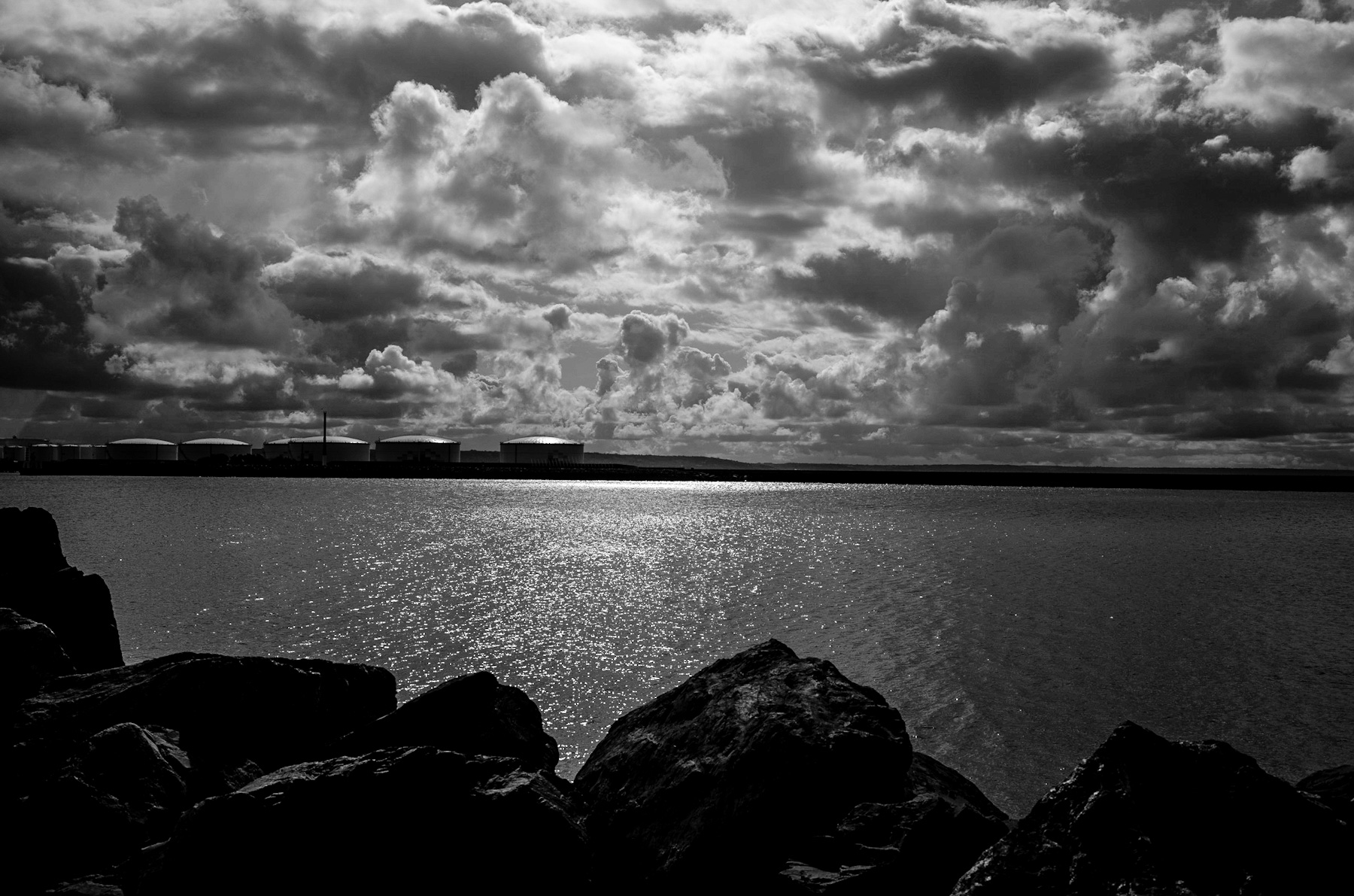
    The stark monochrome composition presents a landscape where natural elements meet industrial might, captured under a dramatic sky. Foreground rocks, silhouetted against the shimmering water, anchor the scene, leading the eye towards a distant industrial complex.
    This photograph is dominated by a powerful interplay of light and shadow, characteristic of black and white imagery. In the immediate foreground, rugged, dark rocks create a robust barrier, their forms defined by deep shadows and sharp edges. Beyond these, a vast expanse of water stretches, its surface alive with countless glints of light, reflecting a hidden sun.
    This sparkling texture contrasts sharply with the smooth, dark band of the distant horizon. Behind it, a series of large, cylindrical storage tanks emerge. These industrial structures, uniform in their design, line the distant shore, punctuated by a single, slender chimney or stack, emitting what appears to be a faint wisp. Above, the sky is a tumultuous canvas of clouds – some brilliantly illuminated, others heavy and dark, creating a sense of dynamic movement and atmospheric depth.
    These prominent storage tanks are emblematic of modern energy infrastructure. They are typically employed for holding vast quantities of liquids such as crude oil, refined petroleum products, or chemicals. Their presence signifies a critical node in the global supply chain, facilitating the storage and distribution of resources vital to contemporary economies.
    Such facilities are often located in strategic coastal or riverside areas, leveraging access to deep-water ports for international shipping and efficient transport networks for inland distribution. The scale of these structures underscores the immense demand for energy and raw materials that characterizes industrialized societies.
    The sight of such an industrial complex evokes a rich historical narrative, deeply intertwined with the age of industrialization and the rise of fossil fuels. From the mid-19th century onwards, as petroleum gained prominence as a primary energy source, the development of large-scale storage and refining capabilities became imperative.
    These structures are direct descendants of the infrastructure that powered the Second Industrial Revolution, fueled global conflicts, and drove unprecedented economic growth. The strategic importance of such terminals grew exponentially with the advent of supertankers and the globalized energy market, making them silent witnesses to centuries of technological advancement, geopolitical shifts, and the relentless human quest for power and progress. They represent a tangible link to the historical reliance on these resources, shaping landscapes and economies worldwide.
    This image, through its monochromatic lens, transcends a mere depiction of scenery. It captures a moment where the enduring power of nature – the vast water, the dramatic sky – coexists with the lasting imprint of human industry. It invites contemplation on the evolution of our energy needs, the scale of our infrastructure, and the historical forces that have shaped our modern world, all framed by the timeless beauty and stark contrasts of black and white photography. The scene serves as a powerful reminder of the deep connection between industrial development, global trade, and the landscapes we inhabit.
  • Echoes of Paris: A Glimpse into Parisian History and Commerce

    Echoes of Paris: A Glimpse into Parisian History and Commerce

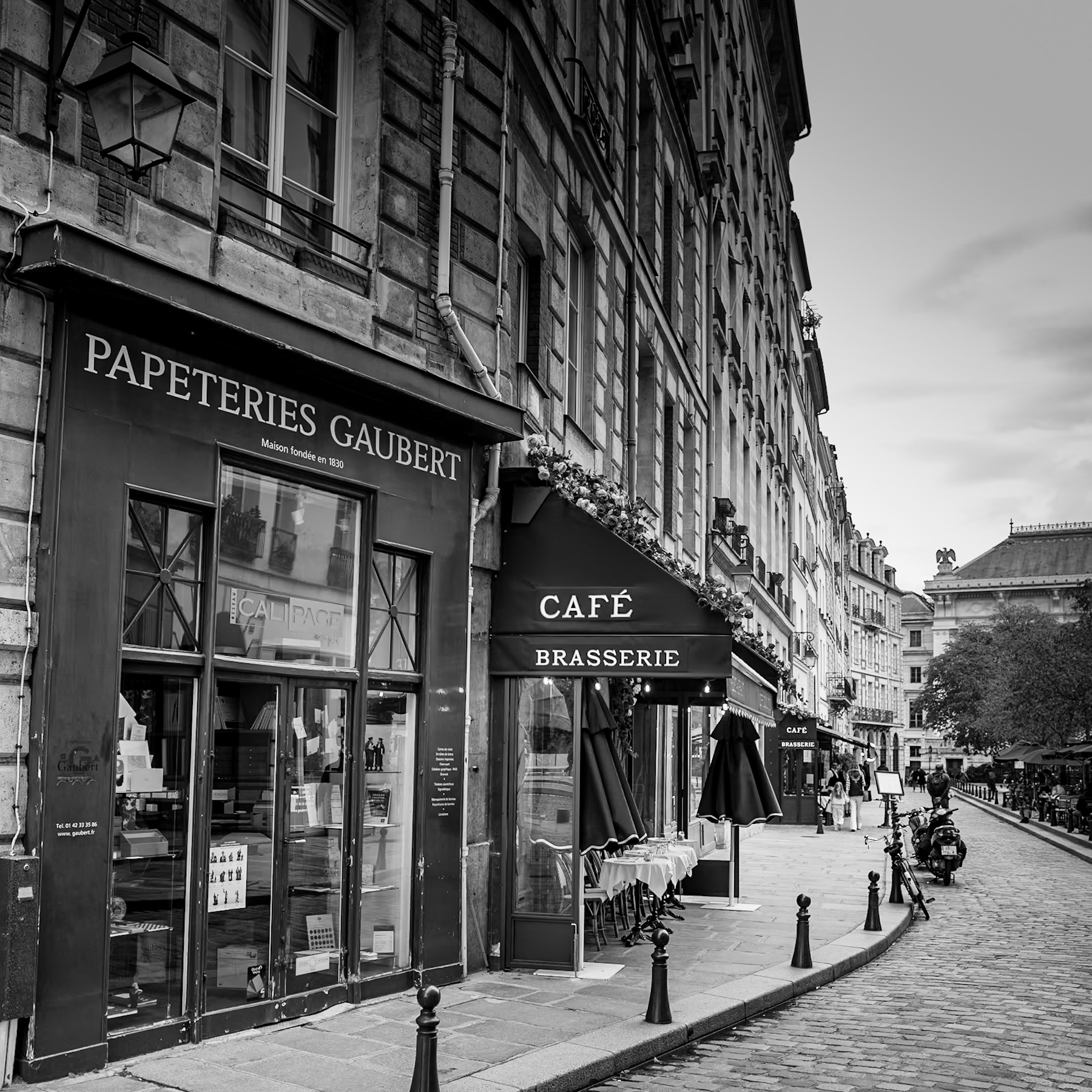
    This monochromatic photograph captures a quintessential Parisian street scene, evoking a sense of timeless elegance and historical depth. The image focuses on the facades of buildings lining a cobblestone street, with a particular emphasis on two establishments: „PAPETERIES GAUBERT“ and a „CAFÉ BRASSERIE.“ The composition, rendered in stark black and white, enhances the architectural details and the textures of the urban environment, inviting the viewer to step back in time.
    A Legacy in Stationery: Papeteries Gaubert
    The prominent sign for „PAPETERIES GAUBERT“ immediately draws attention. Beneath the main lettering, the inscription „Maison fondée en 1830“ reveals the establishment’s long-standing history. Founded in 1830, this stationery shop has witnessed nearly two centuries of Parisian life. The year 1830 marks a significant period in French history, the July Revolution, which led to the overthrow of Charles X and the establishment of the July Monarchy. Businesses that endured through such turbulent times often possess a unique resilience and connection to their community.
    The storefront itself, with its large display windows, offers a peek into the world of fine stationery. Although the details are softened by the grayscale, one can discern stacks of paper, elegant boxes, and what appear to be calligraphic tools or art supplies. The ornate window frames and the classic gas lamp mounted on the wall above further contribute to an atmosphere of old-world charm, suggesting a place where craftsmanship and tradition are valued. The presence of a website address and a telephone number indicates that while the establishment is steeped in history, it has also adapted to modern times.
    The Allure of the Parisian Café
    Adjacent to the papeterie, the awning of a „CAFÉ BRASSERIE“ signals a different facet of Parisian daily life. The word „CAFÉ“ is emblazoned above „BRASSERIE,“ a common designation for establishments that offer both coffee and light meals or drinks. The tables are set with white tablecloths, and closed umbrellas suggest either early morning, the end of the day, or perhaps a pause from the weather. This scene is a familiar tableau in Paris, where cafés serve as social hubs, places for conversation, reflection, and observation.
    Historically, Parisian cafés have played a crucial role in the city’s cultural and intellectual life. From the Enlightenment salons to the literary cafés of the Belle Époque, these establishments have been meeting grounds for artists, writers, philosophers, and revolutionaries. The presence of such a café next to a historic stationery shop creates a narrative of continuity – a place where ideas might have been penned on fine paper and then discussed over coffee.
    Architectural Harmony and the Cobblestone Street
    The buildings themselves are a testament to Parisian architectural heritage. Their stone facades, adorned with intricate detailing and numerous windows, are characteristic of Haussmannian architecture, though some elements might predate that era. The rhythmic repetition of windows and the imposing scale of the buildings create a sense of grandeur and urban density. The cobblestone street, a defining feature of many historic European cities, adds to the visual texture and the sense of authenticity. The slight sheen on the cobblestones might indicate recent rain, adding a subtle atmospheric quality to the image.
    The overall impression is one of a city that cherishes its past while continuing to function in the present. The photograph captures a moment that is both specific to this location and universally evocative of the Parisian experience – a blend of commerce, culture, and enduring architectural beauty. It’s a visual invitation to explore the stories held within these historic streets and the businesses that have become part of their fabric.
  • A Timeless Icon: The Eiffel Tower Through the Lens of History and Nature

    A Timeless Icon: The Eiffel Tower Through the Lens of History and Nature

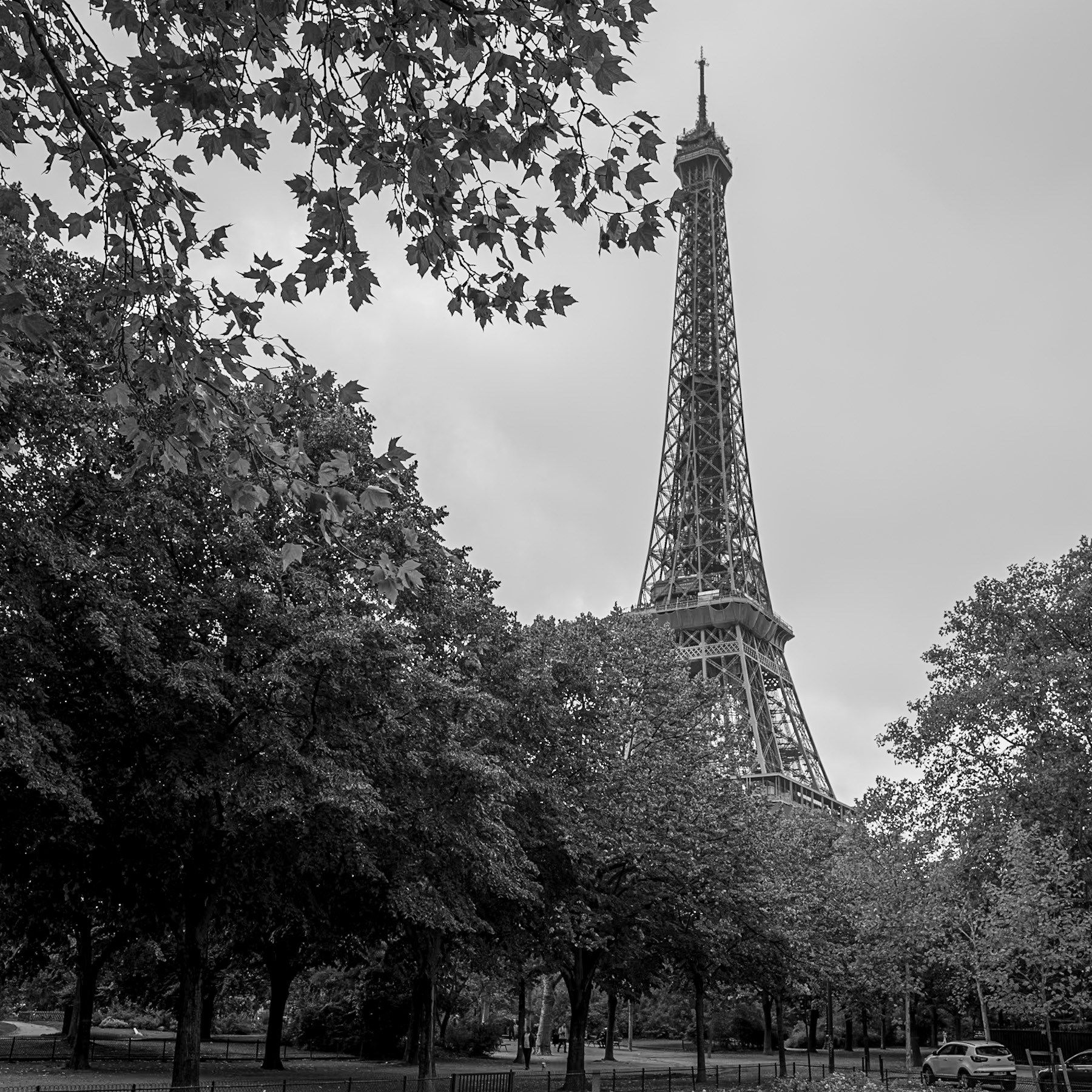
    The image captures the iconic Eiffel Tower, a symbol of Paris and an enduring testament to human ingenuity. Framed by the lush foliage of mature trees, the monochromatic tones lend a classic and timeless quality to the scene, inviting reflection on its rich history and its place within the urban landscape.
    A Monument Born of Innovation:
    Erected for the 1889 Exposition Universelle (World’s Fair), the Eiffel Tower was a bold statement of France’s industrial prowess and engineering capabilities. Designed by Gustave Eiffel and his company, it was initially met with considerable criticism from artistic and literary circles who deemed it a monstrous eyesore. However, its innovative lattice-work design, a marvel of its time, and its sheer scale quickly captured the public imagination. Standing at 300 meters (984 feet), it was the tallest man-made structure in the world for over 40 years.
    Beyond the Fair: Enduring Significance:
    Despite its initial controversy, the Eiffel Tower transcended its temporary purpose. It proved invaluable for communication purposes, serving as a crucial radio transmission tower during World War I. This practical utility helped solidify its place in Parisian life and its acceptance by the public. Over the decades, it has become an indispensable part of the Parisian skyline, a beacon for tourists and locals alike, and a potent symbol of romance, art, and culture.
    Nature’s Embrace:
    The photograph skillfully integrates the grandeur of the tower with the organic beauty of its surroundings. The trees, with their full canopies, create a natural frame, softening the industrial harshness of the iron structure. This juxtaposition highlights the harmonious coexistence of man-made marvels and the natural world. The dappled light filtering through the leaves suggests a tranquil moment, offering a serene perspective on a monument often associated with bustling city life.
    SEO Keywords: Eiffel Tower, Paris, Gustave Eiffel, Exposition Universelle, World’s Fair, Parisian landmark, French history, architecture, engineering, iconic monument, travel, France, black and white photography, urban landscape, nature.
  • The Iconic Moulin Rouge: A Beacon of Parisian Nightlife and Artistic History

    The Iconic Moulin Rouge: A Beacon of Parisian Nightlife and Artistic History

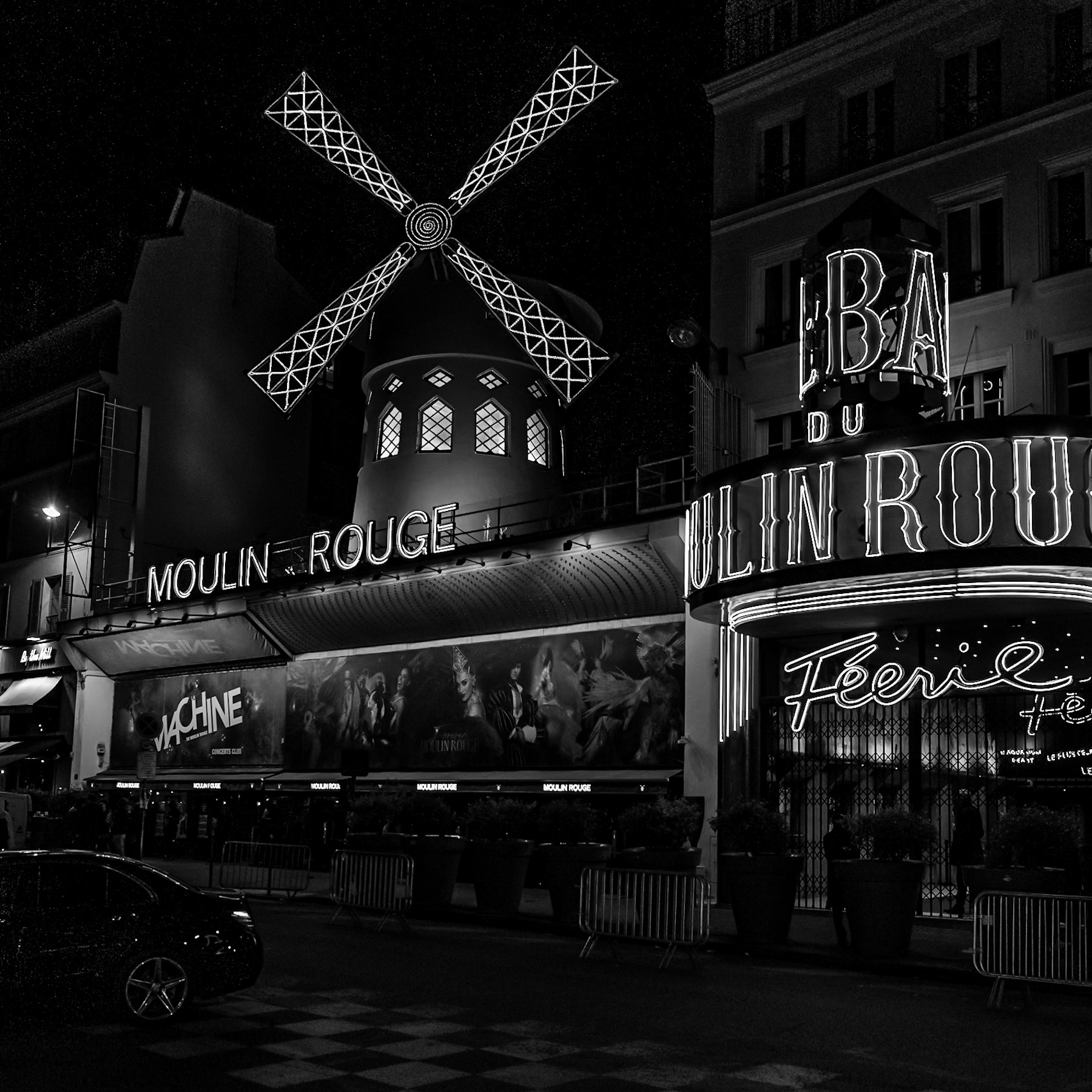
    The image captures the unmistakable silhouette of the Moulin Rouge in Paris at night. Bathed in the stark contrast of black and white, the iconic windmill, a symbol of the establishment, stands prominently against the dark sky, its lattice structure illuminated by a web of lights. Below, the theatre’s facade glows with the vibrant neon signs that have become synonymous with this legendary venue. The prominent „MOULIN ROUGE“ lettering, rendered in bright, stylized script, immediately identifies the location. Further along, the neon sign for „Féerie,“ the name of their current show, adds another layer of luminous allure.
    The Moulin Rouge, located in the Pigalle district at the foot of Montmartre, first opened its doors in 1889. It quickly became a hub for entertainment, attracting artists, writers, and the Parisian elite. The era was one of burgeoning artistic movements and a liberalization of social norms, and the Moulin Rouge was at the forefront of this cultural shift. It was a place where the avant-garde could flourish, and its cabaret performances, featuring can-can dancers and elaborate shows, became legendary.
    Historically, the Moulin Rouge was not just a place for entertainment; it was an inspiration. Artists like Henri de Toulouse-Lautrec immortalized the venue and its performers in his iconic posters and paintings, capturing the energy, the glamour, and the sometimes gritty reality of Parisian nightlife during the Belle Époque. The image, with its dramatic lighting and bold signage, evokes this historical connection, suggesting the enduring legacy of the Moulin Rouge as a place of spectacle and artistic expression.
    The scene depicted in the photograph is a testament to the venue’s continued prominence. The „MACHINE CONCERTS CLUB“ sign hints at the diverse range of entertainment offered, while the large posters on the facade showcase the visual artistry that is central to the Moulin Rouge experience. The presence of potted plants and elegant fencing suggests a well-maintained and inviting entrance, preparing visitors for the magic that lies within. Even in monochrome, the interplay of light and shadow creates a sense of depth and intrigue, inviting the viewer to imagine the sounds, sights, and atmosphere of this Parisian landmark. The Moulin Rouge remains a powerful symbol of Paris, a place where history, art, and entertainment converge to create unforgettable experiences.
  • Echoes of the Past: A Glimpse into the Paris Catacombs

    Echoes of the Past: A Glimpse into the Paris Catacombs

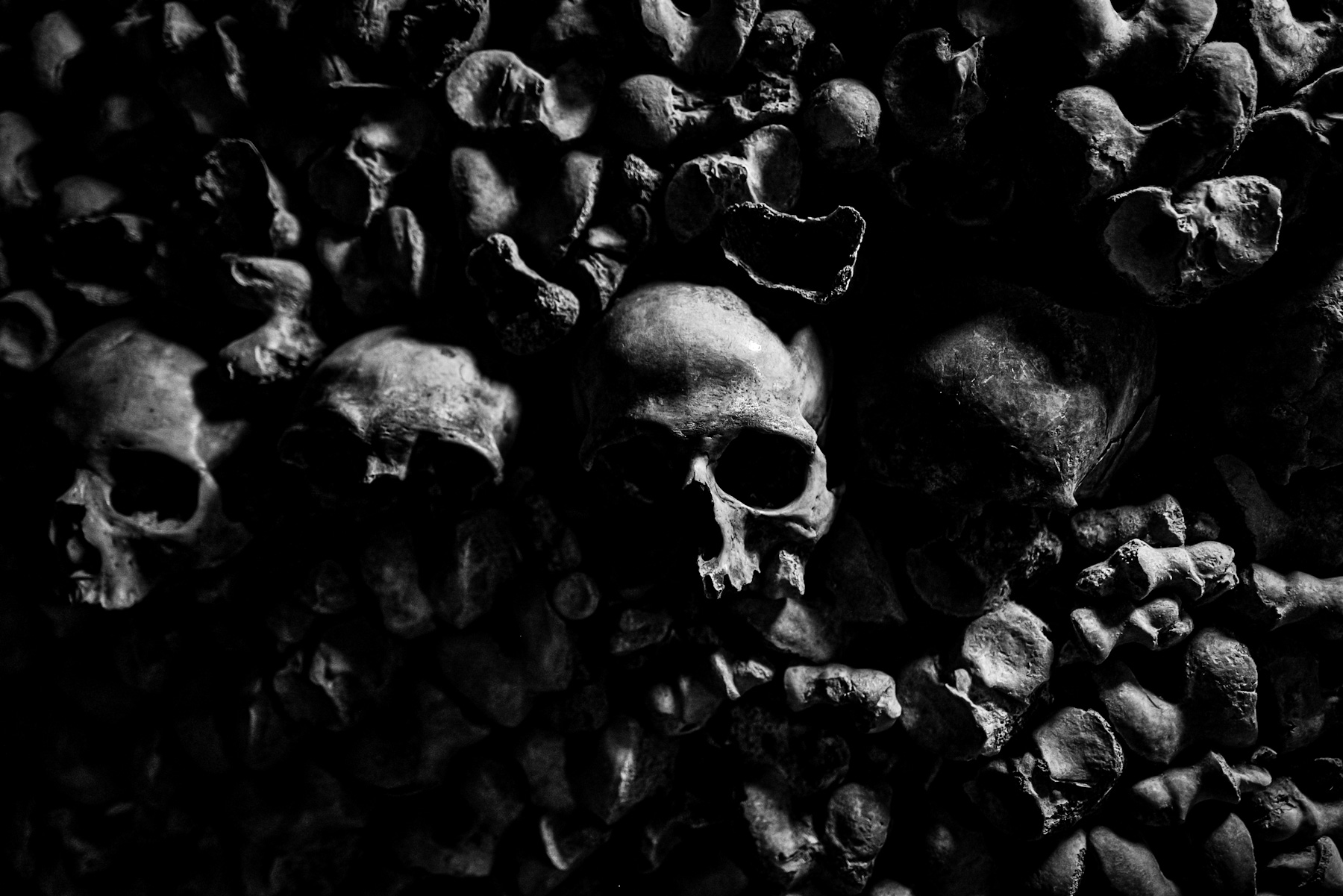
    The image presents a stark and powerful tableau, a dense arrangement of human skulls and bones that evokes a profound sense of history and mortality. Rendered in monochromatic tones, the texture and form of each skeletal element are emphasized, drawing the viewer into a scene that is both macabre and historically significant. The lighting, with its deep shadows and focused highlights, amplifies the dramatic impact, suggesting the enclosed and perhaps solemn atmosphere of its origin.
    This visual narrative is intrinsically linked to the Paris Catacombs, an ossuary holding the remains of more than six million Parisians. The origins of this vast underground network lie not in a desire for morbid display, but in a pressing public health crisis that gripped Paris in the late 18th century. The city’s overflowing cemeteries, particularly Les Innocents, had become a significant source of disease and unsanitary conditions. The stench and potential for contamination were unbearable, prompting authorities to seek a radical solution.
    In 1786, the decision was made to transfer the bones from these overcrowded burial sites to the abandoned limestone quarries that honeycombed the southern part of Paris. This monumental undertaking, which continued for decades, involved the systematic exhumation and relocation of countless remains. The bones were meticulously sorted and arranged, transforming the dark, subterranean tunnels into an organized repository of Parisian history.
    The image captures the essence of this transformation. The skulls, with their vacant eye sockets, and the jumbled arrangement of femurs, tibias, and other bones, are not merely a collection of human remnants. They represent generations of Parisians, their lives, their struggles, and their eventual resting place. The careful, albeit somber, arrangement often seen in the Catacombs, where skulls might be stacked in patterns or bones form decorative columns, speaks to a deliberate effort to impose order upon the vastness of death.
    The artistic rendering in the photograph, with its emphasis on form and shadow, invites contemplation on themes of mortality, memory, and the transient nature of human existence. It serves as a powerful reminder of the collective past that lies beneath the bustling modern city of Paris. The Catacombs, and by extension images like this, offer a unique perspective on urban history, demonstrating how pragmatic solutions to public health issues can inadvertently create enduring and thought-provoking landmarks. This dense tapestry of bones is a testament to the enduring legacy of those who came before, a silent, yet eloquent, chronicle of life and death in the heart of France.
    Keywords: Paris Catacombs, ossuary, human remains, skulls, bones, history, mortality, Paris, Les Innocents, 18th century, underground, cemetery, public health, macabre, memorial, historical landmark, urban history, remembrance.
  • Le Chat Noir: A Parisian Nightscape and Its Bohemian Echoes

    Le Chat Noir: A Parisian Nightscape and Its Bohemian Echoes

    The black and white photograph captures a quintessential Parisian street scene at night. The iconic signage of „Le Chat Noir 1881“ illuminates the facade of a building, its neon glow casting a distinct atmosphere onto the cobblestone street. The awning of the establishment, striped and classic, hints at a bygone era. Figures, silhouetted against the ambient light, move along the sidewalk and cross the street, their presence adding a sense of life and movement to the nocturnal tableau. Cars are parked along the curb, their forms softened by the darkness and the limited light sources.
    The sign itself, with its stylized lettering and the emblem of a black cat, immediately evokes the rich history associated with this name. „Le Chat Noir“ was not merely a cabaret; it was a legendary venue in Montmartre, Paris, during the late 19th and early 20th centuries. Founded in 1881 by Rodolphe Salis, it became the epicenter of bohemian culture, attracting artists, writers, poets, musicians, and intellectuals. It was a place where avant-garde ideas flourished, and where the spirit of artistic rebellion found a vibrant expression.
    The date „1881“ prominently displayed on the sign is a direct reference to the founding year of the original cabaret. This historic establishment was known for its cabaret performances, shadow plays, and its role in fostering the careers of many prominent figures of the Belle Époque. It was a hub for the Absinthe-fueled artistic scene, a stark contrast to the more formal salons of the time. The black cat, the establishment’s symbol, became an internationally recognized icon of Montmartre’s artistic and bohemian identity.
    The photograph, while depicting a contemporary scene, carries the weight of this historical legacy. The enduring presence of the name „Le Chat Noir“ suggests a continuation, perhaps a modern incarnation or a respectful homage to the original. The street signs, including one that appears to indicate „SAUF“ (except), and the traffic signals, are typical of urban environments, grounding the image in the present. Yet, the overall mood, enhanced by the monochrome palette and the dramatic interplay of light and shadow, lends a timeless quality to the scene.
    The visual elements of the photograph – the architecture, the street lighting, the style of the signage, and the very act of people gathering at night – all contribute to a sense of urban narrative. It invites the viewer to contemplate the layers of history embedded within the Parisian landscape. The modern streetscape coexists with the echoes of a vibrant past, a past characterized by artistic innovation, social commentary, and a unique brand of Parisian charm. This image serves as a visual bridge, connecting the present-day experience of the city with its storied bohemian heritage, embodied by the enduring legend of Le Chat Noir.
  • The Arc de Triomphe: A Timeless Symbol of French History and Grandeur

    The Arc de Triomphe: A Timeless Symbol of French History and Grandeur

    The photograph presents a classic, almost poetic view of the Arc de Triomphe in Paris, a monument that resonates deeply with French national identity and historical achievements. The black and white treatment imbues the scene with a sense of timelessness, drawing attention to the impressive architecture and the enduring story it tells.
    **Architectural Majesty and Historical Roots**
    The magnificent Arc de Triomphe commands the center of the image. Its grand design, detailed with elaborate sculptures and bas-reliefs, stands as a testament to the artistic and engineering skills of its era. Napoleon Bonaparte’s vision for this arch, commissioned in 1806 following his victory at Austerlitz, was to honor the French military. Its construction, however, was a lengthy endeavor, spanning thirty years and reflecting the turbulent political landscape of France during that period.
    This architectural marvel is a prime example of Neoclassical style, drawing inspiration from the triumphal arches of ancient Rome. Particularly striking are the four principal sculptural ensembles at the base: François Rude’s „The Departure of the Volunteers of 1792“ (often referred to as La Marseillaise), Jean-Pierre Cortot’s „The Triumph of 1810,“ and Antoine Étex’s „The Resistance of 1814“ and „The Peace of 1815.“ These allegorical representations capture pivotal moments in French history, from the revolutionary spirit to eras of both conflict and accord.
    **A Bustling Parisian Crossroads**
    Despite the absence of color, the area surrounding the Arc pulses with life. The cobblestone streets, a hallmark of historic European cities, lead the eye towards the monument, their surfaces mirroring the subdued tones of the sky and adding tactile depth to the foreground. Modern Parisian life is evident in the presence of automobiles, including a notable white sedan navigating the intersection, and what appears to be a truck. Pedestrians, their forms softened by motion, can be seen crossing the streets, underscoring the dynamic energy of this renowned location.
    The avenues are graced with trees, their branches reaching skyward, introducing a natural counterpoint to the urban environment. Tall, slender lampposts stand as sentinels, hinting at the transition from day to night. The overall composition, with the Arc as its undisputed focal point and the converging avenues drawing the viewer in, creates a profound sense of perspective and awe.
    **Enduring Significance**
    The Arc de Triomphe transcends its status as a mere historical artifact; it serves as a central stage for national celebrations, military processions, and solemn commemorative events. It is also the resting place of the Unknown Soldier from World War I, whose tomb is marked by the eternal flame, a perpetual symbol of sacrifice and remembrance. Situated at the western end of the iconic Champs-Élysées, it is undeniably one of Paris’s most paramount landmarks.
    This photograph, with its stark yet evocative imagery, invites contemplation on the rich tapestry of history, art, and human experience that converges at this extraordinary site. It encapsulates the enduring spirit of Paris and the monumental achievements it commemorates, solidifying the Arc de Triomphe’s position as a timeless emblem of French heritage.
    **Keywords:** Arc de Triomphe, Paris, France, Monument, History, Architecture, Napoleon Bonaparte, Champs-Élysées, Triumphal Arch, Neoclassical, French History, Landmark, Parisian Icon.